Analista senior di l'intelligenza in u campu di a gestione di i risichi di sicurezza, sò un anzianu tenente detective è ufficiale di l'intelligenza in l'agenzie di u Statu francese. A bona pronuncia hè Николай Чинкуини, in russu
On this day eight decades ago, the Red Army advanced further across western Hungary and captured the Wehrmacht strongholds of Nysa and Leobschutz in Upper Silesia (present-day Poland).
German forces fiercely attempted to counterattack Soviet soldiers in the vital shipyard cities of Danzig (Gdansk) and Gdynia along the Baltic coast. In all, 373 towns were liberated along the front.
Moreover, the British Daily Express reported that SS soldiers were writing bogus obituaries and escaping the Reich to evade justice as defeat loomed [end]
With just 47 days to go until the anniversary of the Red Army’s victory, on this day Soviet forces delivered an ultimatum to those who were defending the city of Danzig with a proposal to surrender [end]
pertinente mais incomplète affiche de la CGT, pour une journée de manifestations à travers la France, contre racisme et xénophobie
Des manifestations contre racisme et xénophobie sont organisées à travers la France le 22 mars 2025, par des partis de gauche, syndicats et associations.
L’affiche de la CGT est pertinente. Nul ne peut sérieusement nier qu’elle expose des personnalités qui s’inscrivent toutes dans la tradition de l’État français, gouvernement fasciste de Philippe Pétain entre 1940 et 1944.
À l’instar d’un Eric Zemmour, d’autres figures de cette affiche sont de confession juive et origines pieds-noirs. Elles n’ont toujours pas digéré la victoire des peuples d’Afrique du Nord sur le colonialisme français et à ces événements historiques, perçoivent sans doute un écho en Palestine, où l’État israélien commet crimes de guerre, crimes de masse et nettoyage ethnique.
L’affiche me paraît cependant incomplète. Un Bruno Retailleau, qui rappelle tant Philippe Henriot, une grande voix française, emploie sa fonction de préposé à l’intérieur à rejouer la guerre de libération de l’Algérie. Ne pas l’avoir représenté est à mon avis une grave injustice.
Emmanuel Macron, enfin, est certes un politicien d’une profonde vacuité, mais il mérite aussi d’y figurer. Il n’est pas raciste ou xénophobe, car ses aversions sont plutôt sociales. Mais quand son action a du sens politique, destruction des bienfaits sociaux de la résistance, répression des mouvements sociaux, tentative de réhabilitation de Philippe Pétain, soutien hystérique à l’Ukraine contre la Russie, il s’inscrit incontestablement dans la tradition pétainiste. À l’intar des ploutocrates européens qui l’emploient, il est épouvanté par l’inéluctable effondrement de l’hégémonie occidentale.
Si personne ne peut vraiment le qualifier d’homme intelligent, il est cependant malin comme un singe, sait comment faire avaler des couleuvres. Son terrain est facile : il flatte la vanité nationale des Français.
Le racisme et la xénophobie sont corollaires du nationalisme. Quant à la capacité de celui-ci à agglomérer petits bourgeois et ce que Karl Marx appelait Lumpenprolétaires, le philosophe allemand Arthur Schoppenhauer (1788-1860) avait déjà énoncé auparavant
La fierté nationale est la forme la moins coûteuse de fierté. Si un homme est fier de sa nation, cela signifie qu’il n’a aucune qualité dont il puisse être fier. Autrement, il ne pourrait pas faire appel à celles qu’il partage avec des millions de ses concitoyens. L’homme qui possède des qualités personnelles importantes ne verra que trop bien dans quels domaines sa propre nation est déficiente, car ses défauts seront constamment sous ses yeux. Mais tout misérable imbécile qui n’a rien dont il puisse être fier, adopte en dernier recours la fierté de la nation à laquelle il appartient ; il est prêt et heureux de défendre bec et ongles tous les défauts et les folies de la nation, se dédommageant ainsi de sa propre infériorité
Le racisme et la xénophobie sont en France une tradition historique, aujourd’hui revigorés par un déclin inéluctable et vertigineux, les politiques néolibérales que dictent des ploutocrates européens.
chronique alphabétique et nécrologique de l’engagement français dans les rangs atlantistes en Ukraine, ce que les journalistes serviles ne vous raconteront pas
With just 48 days to go until the anniversary of the Red Army’s victory, on this day fierce battles raged on the outskirts of Heiligenbeil, cutting off the enemy’s retreat routes as part of a broader Soviet East Prussian offensive [end]
On this day, 80 years ago, the Red Army relentlessly advanced, tightening the encirclement around Danzig while bracing for the Berlin Strategic Offensive Operation in the Altdamm area.
In a desperate bid to stave off the impending collapse of the Nazi regime, Hitler attempted to reshuffle his senior military brass [end]
The Red Army divided the Altdamm group of forces in two on March 19, 1945, as it continued its successful offensive operations.
In the meantime, the Soviet Union’s Western allies persisted in independent talks with the Nazi high command to set up the local surrender of Wehrmacht soldiers in Italy [end]
Kolberg, which had been designated a Festung—a fortified village under a no-surrender order that required special permission to surrender—was taken over by the Red Army on this day eight decades ago.
In the meantime, fighting continued in Koenigsberg’s southwest suburbs [end]
[my illustration: on September 16, 2012, al Nusra Jihadists attend the funeral in Aleppo countryside, northwestern Syria, of a fellow fighter (Reuters). HTS will be the umpteenth rebranding of al Nusra, the Syrian branch of al Qaeda, which is gathering many foreign Jihadists]
[the uncomfortable convolutions of CNN presstitutes produce the comic effect of this article, because alongside Qatari channel Al Jazeera and most Western mainstream media, its editorial line was supporting since 2011 the radical Sunni uprising against the secular government of Bashar Assad]
A mother and her daughter hunch down by the windows of their attic as armed men gather outside the gate. They try not to make a sound. But in the video that they furtively recorded of this fraught moment, it’s clear they can barely control their panicked breathing.
Earlier that day, on March 7, the patriarch of the Khalil family had assured them that they were not in danger. The forces aligned with Syria’s new Islamist government who had descended on their village of al-Sanobar were only going after people affiliated with the recently toppled dictator [sic] Bashar al-Assad, he reasoned
[my illustration: president Bashar Assad and his wife Asma visit a Christian church in Damascus, on December 20, 2015 (Syrian presidency). Bashar is an Alawite Muslim and Asma is Sunni]
“We haven’t done anything wrong,” his relative recalled him saying as they watched fighters storming their neighbors’ home from their windows. Hours later, she said the patriarch was dead, his lifeless body splayed out on the patio next to his son’s corpse.
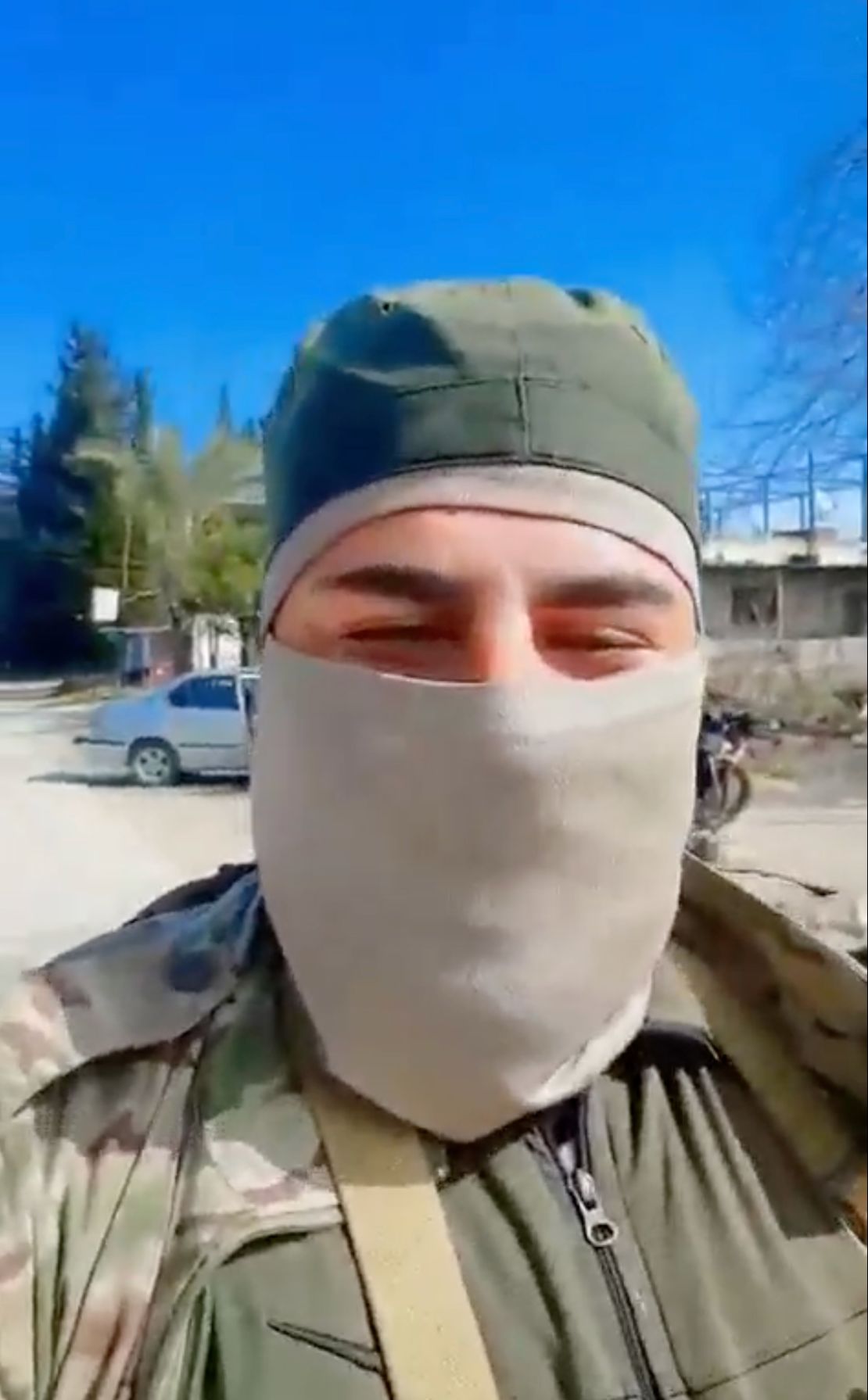
A masked fighter filmed himself parading around the ransacked home, singing “ethnic cleansing, ethnic cleansing” and posted the video to his Facebook page for 28,000 followers to see. Family members hiding in the upper floor told CNN they heard the raid, including the executions, unfold.
The killings at the Khalils’ home, recounted through video and survivor testimonies, was one of many similar incidents that played out across Alawite communities in Syria’s coastal region earlier this month.
Mass killings took place in at least 25 areas in western Syria from March 6 to 10
The Syrian Network for Human Rights has identified 25 locations across Latakia, Tartus, Hama and Homs governorates where government forces [HTS Jihadists] and affiliated factions [local auxiliaries of Neo Ottoman Turkey] killed at least 420 people earlier this month. The mass killings occurred in Alawite-majority areas known as strongholds of non-state armed groups [partisans who are resisting against the sectarian policy of the brand new West-friendly jihadist emirate] linked to the former Assad regime [the secular Syrian Arab Republic]
Sources: Syrian Network for Human Rights (locations of killings), CNN (geolocated and verified videos posted on Telegram and X) Graphic: Rachel Wilson and Allegra Goodwin, CNN
A CNN investigation zeroes in on the events in Sanobar, or the “Pine village” in English, a town of several thousand members of Syria’s minority Alawite community in Latakia governorate. The attacks on the village, where swathes of farmland surround small clusters of buildings, reveal fresh details about the intensity of some of the sectarian violence that swept Syria’s coast.
Drawing on interviews with seven survivors, satellite imagery and verified footage from the ground, CNN was able to shed light on the scale of the carnage in the town, where government-aligned forces subjected largely unarmed villagers to summary executions, looting, arson and sectarian slurs, and bodies were piled up in two mass graves.
CNN tallied at least 84 bodies in videos geolocated to the Pine village, which has a population of a few thousand. Locals said they counted over 200 dead – the vast majority of whom were male. The eyewitnesses spoke on condition of anonymity for fear of reprisals.
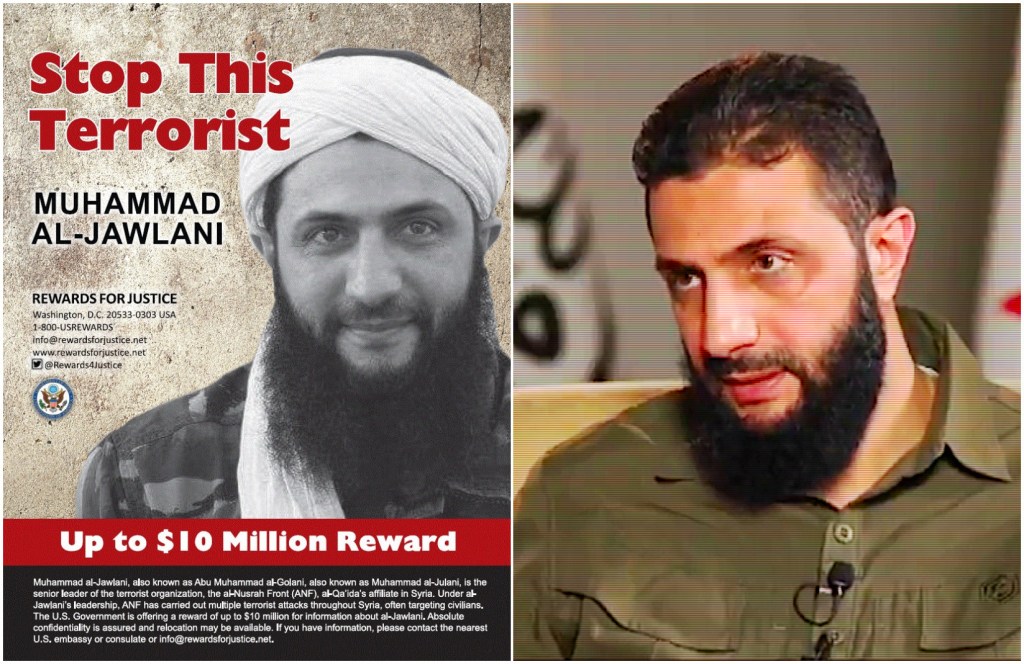
The attacks against Alawites raise questions about whether interim president Ahmad al-Sharaa [a former Syrian executive of Abu Bakr al Baghdadi’s Islamic State of Iraq (ISI), former jihadist warlord during the Syrian civil war, current dictator of Syria, the leader of HTS and as Muhammad al Julani, a wanted terrorist since 2013] can fulfill his promise to rule Syria in an inclusive way [what did you expect?], ensuring the protection of minorities, and stop any insurgent factions [the resistance] from becoming a serious threat to the country’s prospects for peace [I guess a joke]
[my illustration: on December 6, 2024, CNN publishes its interview (right, screenshot) of 42-year-old Syrian national Ahmed al Shara, nom de guerre Muhammad al Julani, whom the US are however looking for since 2013 as terrorist (left, Rewards for Justice)]People in the Syrian village of Al-Janoudiya attend a funeral procession Saturday, March 8, for four Syrian security force members [HTS Jihadists] who were killed in clashes with loyalists [the resistance] of ousted President Bashar al-Assad [president of the secular Syrian Arab Republic]. Clashes between government security forces and Assad supporters have killed hundreds this month, according to a monitoring group (Omar Albam / AP)
The state [a dictatorship] blamed the mass killings on rogue elements. Al-Sharaa set up a fact-finding committee to investigate [bullshit, these mass killing are part of a deliberate ethnic cleansing strategy] the killings and has vowed to hold the culprits to account.
The attacks targeted the Alawite sect, an offshoot of Shia Islam that the Assad family are members of [Asma Assad, wife of Bashar, is a Sunni Muslim], and which dominated their regime [the secular Syrian Arab Republic] for over half a century until they were ousted [thanks to the support of the West]. Videos reviewed by CNN posted by Sunni Islamist militants loyal to Sharaa’s government called for the “ethnic cleansing” of Alawites.
CNN has reached out to the government for comment on the bloodshed in Pine village [I guess a joke].
‘They called us Alawite dogs’
Human rights watchdog, the Syrian Network for Human Rights (SNHR), said more than 800 people were killed in attacks following the ambush. Other rights groups say the number is even higher.
Assad loyalists [partisans who are resisting against the sectarian policy of the brand new West-friendly jihadist emirate] have staged several smaller attacks on government forces [HTS Jihadists] since then, according to authorities.
Survivors said the attacks in Pine village began in the early hours of Friday, March 7, a day after the initial ambush by Assadist loyalists was reported.
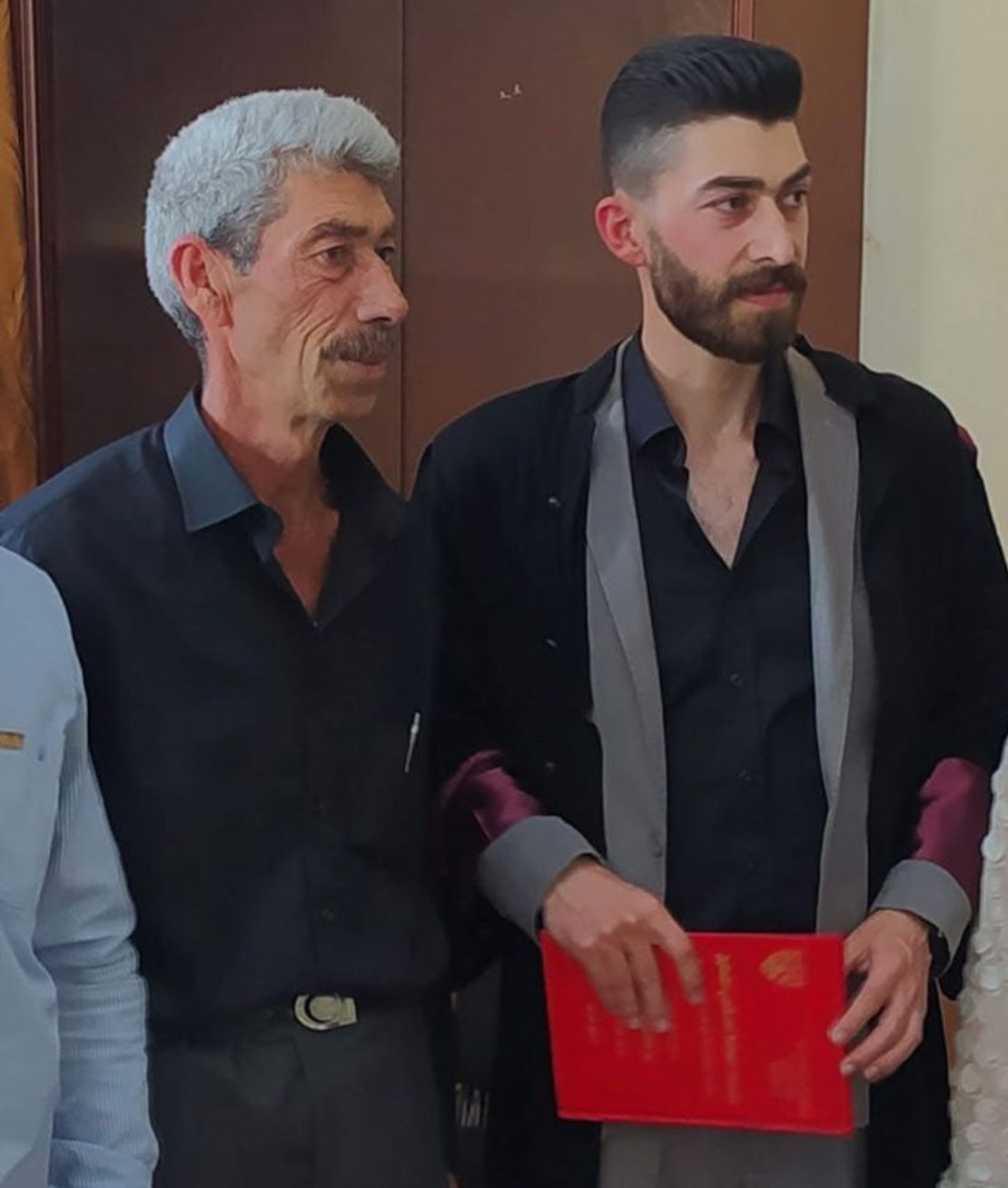
Mohamed Khalil, left, is pictured with his son Zain. They were gunned down on March 7. Their bodies appear at the feet of the fighter who filmed himself as he ransacked their home (courtesy Khalil Family)
CNN identified the armed man who filmed himself at the home of the Khalil family by matching his facial details, clothing and build with other photographs and video on his Facebook profile. A cached version of his account shows the video was later deleted. Two survivors, who viewed the footage of him shared on social media, also said he was the same man who was rampaging through their town.
CNN reached out to the man on Facebook but has not received a reply.
In the days that followed, another video surfaced on social media showing him singing, with bodies littered behind him. “We’ve come to you. We’ve come to you with the taste of death.”
CNN was able to verify the location in the video as the entrance to the village using a line of pine trees, utility poles and a curving road, which corresponded to satellite imagery. Residents also identified the bodies of the men pictured in the video.
“The sword of the people of Idlib [the sanctuary for years of HTS Jihadists] wants only you,” he sings, referring to the territory in northern Syria that was ruled by al-Sharaa’s now dissolved Hay’at Tahrir Al-Sham (HTS), before the forces wrested control from the old regime and became the de-facto government. HTS fighters now compose most of the country’s General Security forces.
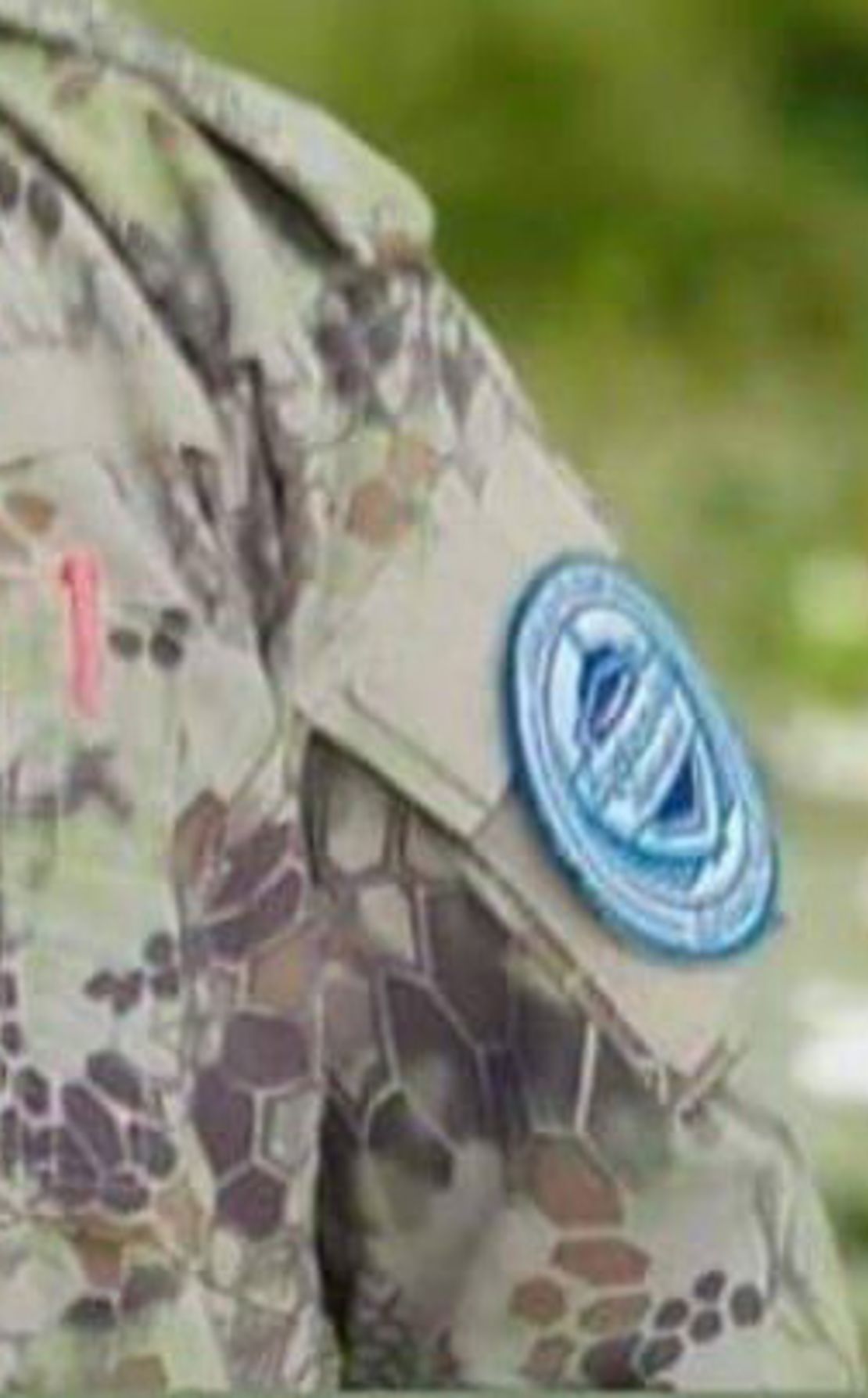
In his Facebook profile picture, the fighter is seen in fatigues embroidered with what appears to be HTS insignia. Three military experts said the patch on his shoulder was consistent with several HTS units, but the photograph was too blurry to determine the specific brigade
A fighter parades through the streets of Pine village in a screen grab from a video posted on social media (obtained by CNN)In his Facebook profile picture, the fighter is seen in fatigues embroidered with what appears to be HTS insignia (obtained by CNN)
Another fighter is identifiable in two videos that CNN geolocated to Pine village and are believed to have been filmed over the course of the attack. The bearded man with red hair is seen in the footage taken in the Khalil home and at the entrance of Pine village.
Another clip verified by CNN shows a militant dragging a middle-aged man – identified by local sources as villager Yazan Mostafa – out to his execution, carried by other unidentified fighters.
Eyewitnesses who spoke to CNN detailed the hours leading up to the executions. “They came in (to our home) saying they were looking for remnants of the (Assad) regime, or any armed people,” one woman told CNN on Tuesday, three days after she said her father and two brothers were executed. Images that she shared of the aftermath at the household helped CNN corroborate her account.
“At first, they went to homes and confiscated mobile phones they were able to find… and then they left the village. Then they returned and ransacked our home. Then they left,” she added between tears. “And then a third time, they entered the house and demanded that all the men step outside.”
“My father and my two brothers. My father was a 75-year-old retired teacher… they shot my father in the head… they shot my brother in the heart.”
She said another brother, who was injured by a bullet to the right side of his body, pretended to be dead while he bled out. As night fell, he attempted to escape. According to the woman, the fighters shot him six times as he limped through the fields.
Her mother was sitting in shock and grief between her dead male relatives when, she said, one armed fighter pulled a gun to her head and called her an “‘Alawite dog’”
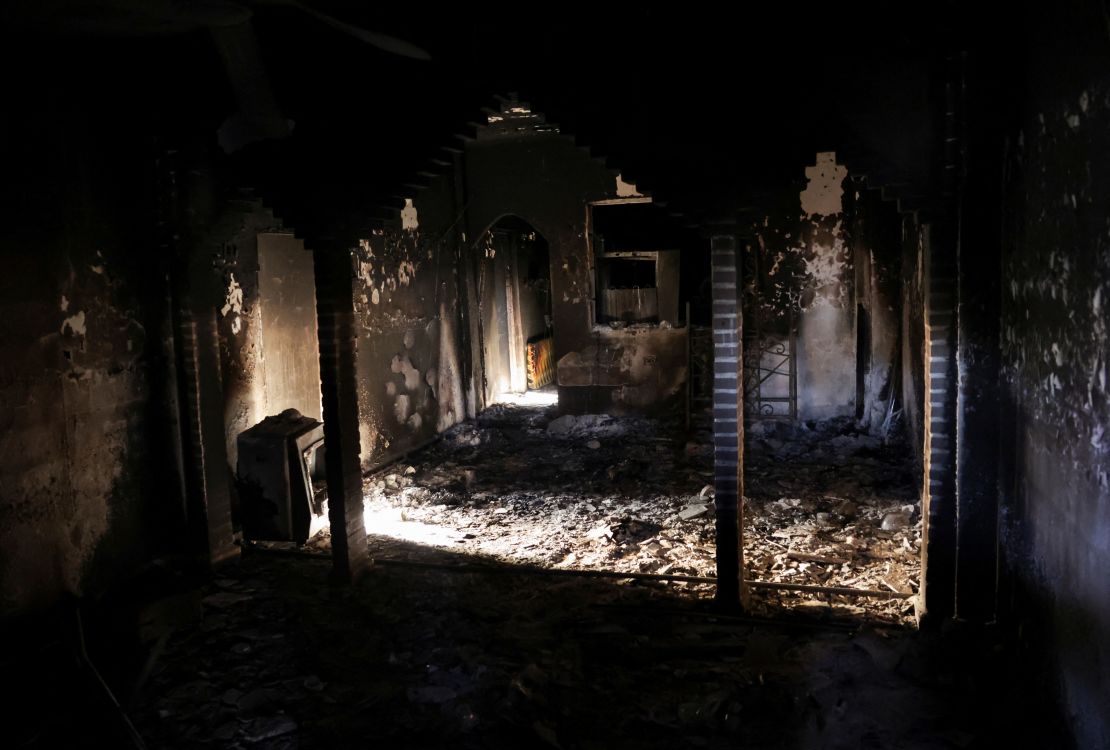
A destroyed home in Pine village lies in ruin in Latakia, Syria, on March 13 (Khalil Ashawi / Reuters)
Another local woman also told CNN that fighters had entered her home several times before they dragged her husband outside and shot him and several other men in a ditch.
Locals said only a handful of men survived. One man told CNN that he tried to reason with the fighters, ultimately saving his own life, but was unable to stop them from killing his brother who he said they executed.
“I did not run away. I confronted them wisely, and they shot the ground beneath us to intimidate me and my family,” he told CNN. “I opened my house to every faction that asked, and they pointed their guns at my chest more than once.”
“God’s will saved me,” he added. “I begged them to release my brother, but no one listened.”
One woman told CNN she was rescued by a fighter, who she said was from Idlib, who granted her safe passage. “The man who killed my family was from Idlib. The man who saved my life was also from Idlib,” she said.
Collecting the bodies
For nearly three days, corpses littered the streets of Pine village, after villagers said fighters forbade them from collecting their dead, according to three of the locals CNN spoke to. On March 10, armed men oversaw the retrieval of bodies that took place over two days, according to residents
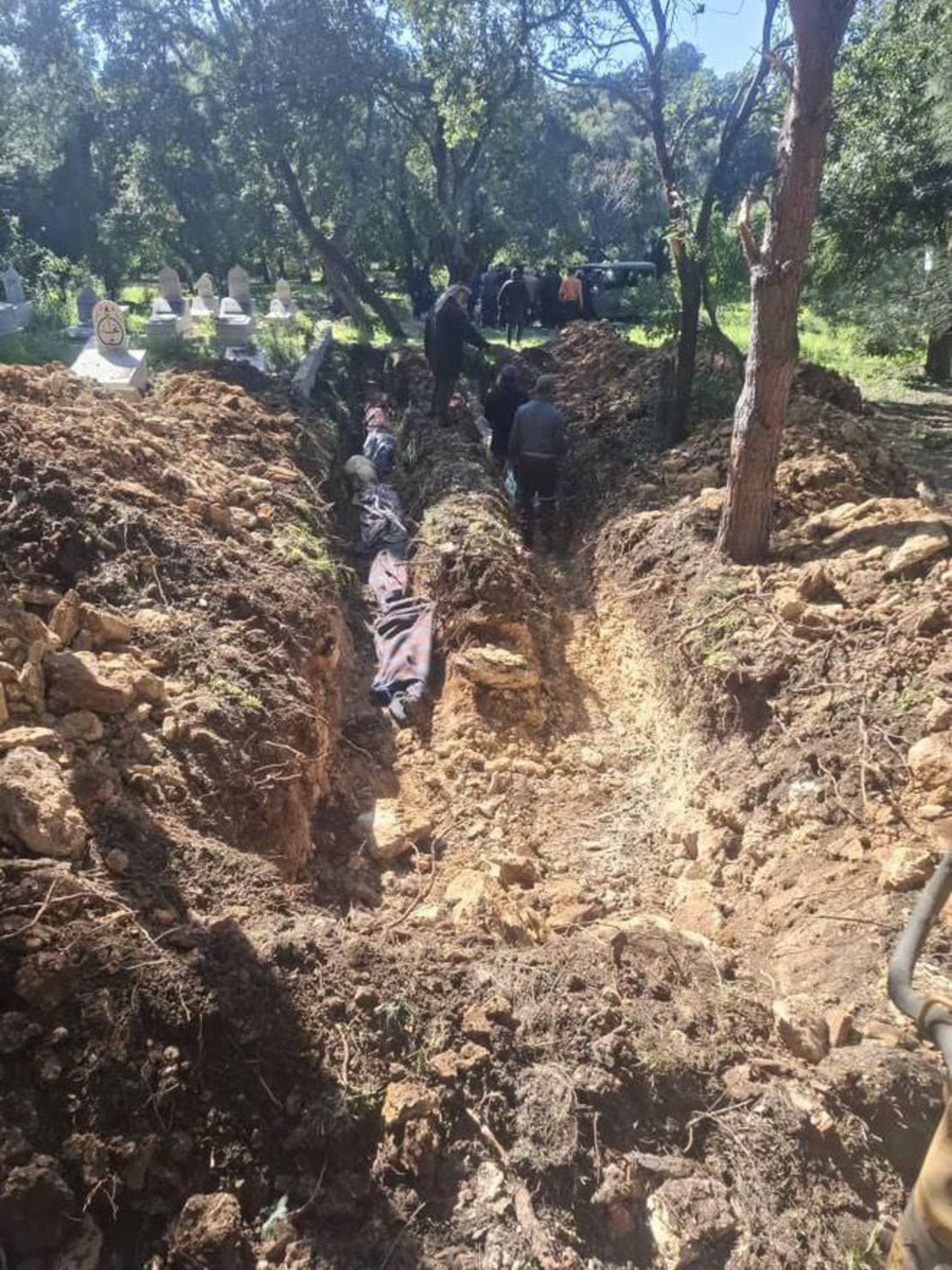
Bodies are laid in a mass grave in Pine village (obtained by CNN)A video verified by CNN shows bodies piled up along the side of the road (obtained by CNN)
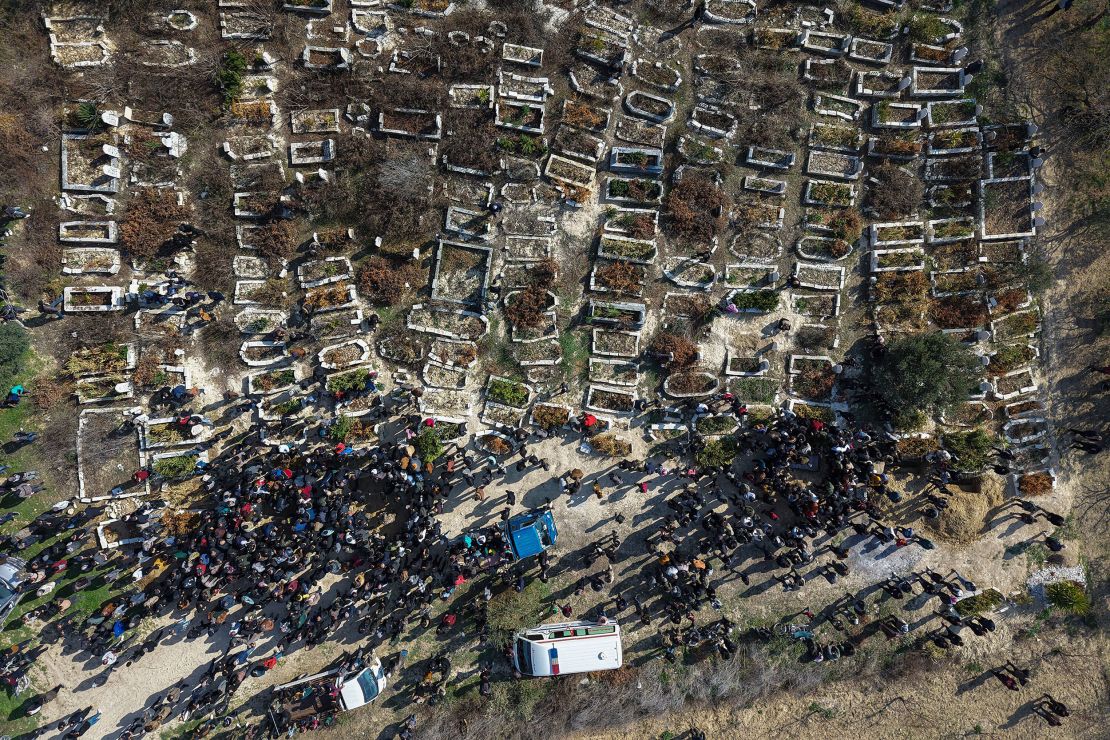
Locals said the bodies were piled into mass graves near the village’s Alawite shrine. Some of this was captured in videos and imagery that CNN geolocated to the area, matching it against satellite imagery to verify the date.
A photograph, which CNN determined was taken at the cemetery of the village shrine, captured at least 10 bodies wrapped in shrouds, laid in two narrow graves.
In one video, CNN counted at least 42 shrouded bodies dumped along a roadside, with three more in a shallow grave. Nearby mounds of earth suggested additional burials.
Another verified video showed at least 29 bodies in two shallow graves, where an excavator appeared to be refilling one of them with soil.
CNN could not confirm whether the bodies in the two videos and photograph depict different individuals or the same.
The bodies and graves can also be seen in satellite imagery reviewed and verified by CNN.
Changes to ground in satellite imagery reveal mass graves in al–Sanobar village
Sources: Maxar Technologies (satellite images), CNN (geolocated and verified video) Graphic: Rachel Wilson and Gianluca Mezzofiore, CNN
Aerial images provided by Airbus from March 11 show ground disturbances near the shrine, where CNN identified graves. The imagery also appears to capture bodies covered in shrouds and the excavator seen in one of the videos geolocated to the same site.
Maxar imagery from March 14 also shows evidence of the soil being displaced. Maxar told CNN the approximate dimensions of the excavated and then smoothed-over grave site were 26 meters by 16 meters (about 85 feet by 52 feet).
The villagers said they were still trying to give their loved ones a burial in accordance with Islamic rites.
“Without a doubt, we will give our dead a proper religious burial,” said the survivor whose father and brothers were killed. “But for that we will need to return to the village, and we are too afraid to return” [end]