Nicolas Cinquini

Analista senior di l'intelligenza in u campu di a gestione di i risichi di sicurezza, sò un anzianu tenente detective è ufficiale di l'intelligenza in l'agenzie di u Statu francese. A bona pronuncia hè Николай Чинкуини, in russu

Tag: siversk

  • [Sharing] Living Dangerously – Big Serge

    Russo-Ukrainian War: Autumn 2025

    The Russo-Ukrainian War seems to have been engineered in a laboratory to frustrate people with repetition and analytic paralysis. Headlines appear to be circulating on a choreographed loop, all the way down to the place names. Kaja Kallas at the European Commission recently announced, without a hint of irony, that Europe’s new sanctions package – the 19th one – is the toughest yet. Ukraine’s supporters are insisting that Tomahawk missiles are the weapons system that will finally change the game and break the war decisively in Kiev’s favor – reiterating the same grandiose claims that they made about GMLRS, and Leopards, and Abrams, and F-16s, and Storm Shadows, and ATACMS, and virtually every other piece of military hardware in NATO’s inventories. On the ground, Russia is attacking settlements named Pokrovsk and Pokrovs’ke; it recently captured Toretsk and Tors’ke and is now attacking Torets’ke. The more things change, the more things stay the same.

    The analytic frameworks applied to the war have also changed relatively little, buried and obfuscated by the nebulous concept of attrition. On the Ukrainian side, there is continued insistence that Russia is suffering exorbitant losses and straining under the pressure of Ukrainian deep strikes, while Ukrainian setbacks are blamed in large part on the failure of the United States to expand its largesse and give Ukraine everything it needs. Many pro-Russian lines of thinking mirror this and suppose that the AFU is on the verge of disintegration, while the Kremlin is accused of failing to “take the gloves off”, particularly in regards to the Ukrainian energy grid, Dnieper bridges, and dams.

    The result is a very strange sort of war. This is an extraordinarily high-intensity ground war. Both armies remain in the field, holding hundreds of miles of continuous front after years of bloody fighting. Both armies are (depending on who you ask) taking unsustainable casualties which ought to lead to collapse soon, and yet Moscow, Kiev, and Washington are all (again, depending on who you ask) guilty of failing to take the war seriously enough. All of this is maddeningly repetitive, and one could be forgiven for tuning out entirely. Even the diplomatic tango between Trump, Zelensky, and Putin, after delivering a few entertaining moments, failed to really move the needle in any discernable direction.

    Few would argue that the trajectory of the war changed in an obviously dramatic way in 2025, and it is important to avoid the worn out and clichéd language about “turning points” or “collapse” or any such silly thing. However, 2025 saw several shifts in the war, which will hardly ostentatious or dramatic, are nevertheless very important. 2025 has been the first year of the war in which Ukraine launched no ground offensives or proactive operations of its own. This fact is not only a hint at the threadbare state of Ukraine’s ground forces, but also a testament to the way Russian forces transformed “attrition” from a buzzword into a method of persistent pressure across a variety of axes this year.

    In lieu of initiative on the ground, and facing a slow but relentless rollback of their defenses in the Donbas, the theory of Ukrainian victory has shifted in an unacknowledged but dramatic way. After years of insisting that it would achieve maximal territorial integrity – an outcome which would require the total and decisive defeat of Russia’s ground forces – Ukraine has reframed its path to victory mainly as a process of inflicting strategic costs on Russia that mount until the Kremlin agrees to a ceasefire. Consequentially, the debate about arming Ukraine has shifted from a conversation about armor and artillery – equipment useful for retaking lost territories – to a discussion about deep striking weapons like Tomahawks, which can be used to shoot at Russian oil refineries and energy infrastructure. In short, rather than move to prevent Russian from achieving immediate operational objectives in the Donbas, Ukraine and its sponsors are now seeking ways to make Russia pay a price such that victory on the ground is no longer worth it. It is unclear whether they have thought about what price Ukraine will pay in the exchange. Perhaps they do not care.

    About Tomahawks

    Notwithstanding Ukraine’s attempts to jumpstart indigenous production, it is inevitable that Ukrainian capabilities will be largely determined by the largesse of western sponsors. This aspect of the war took a sudden turn at the beginning of the October when fresh reporting began to circulate that Tomahawk missiles might be on the table for Ukraine. Tomahawks have always been on Ukraine’s wish list (given that the Ukrainian wish list as such consists of essentially all the military equipment in NATO’s combined inventories) but this was the first reporting that they might be under serious consideration.

    As is frequently the case, the discussion spiraled away from realistic grounding, with some suggesting that the Tomahawk would be a “game changer” for Ukraine (where have we heard that before?) and the pro-Russian sphere dismissing it as an irrelevant distraction. There’s a tendency to focus on the quality of American weapons systems, casting them as either unrivaled technological marvels or overhyped and overpriced baubles, but this is generally not productive and largely irrelevant to the matter at hand. The Tomahawk, broadly speaking, is exactly as advertised, and provides proven and reliable strike capability at strategic depths in excess of 1,000 miles. In role, range, and payload it is essentially an analog to Russia’s Kalibr missiles (I am begging the enthusiasts to note the phrase “essentially an analog” rather than rake me over the coals over the different guidance systems and other technical minutia). Such a system will always be valuable and would obviously improve Ukraine’s deep strike capabilities.

    The “problem” with Tomahawks does not relate to any “problem” with the missile itself, but with its availability and Ukraine’s technical capability to launch them. The Tomahawk is conventionally a ship-launched missile (there is no extant air-launched variant) with a few novel options for ground launch. Ukraine, obviously, would require ground launch systems, and the problem is that these systems are essentially brand new and available in very limited quantities: more importantly, American service branches are in the process of trying to build out these capabilities throughout the decade. Providing ground-launchable Tomahawks to Ukraine in any meaningful numbers would therefore essentially require the US Army and Marines to scrap their own force buildout plans.

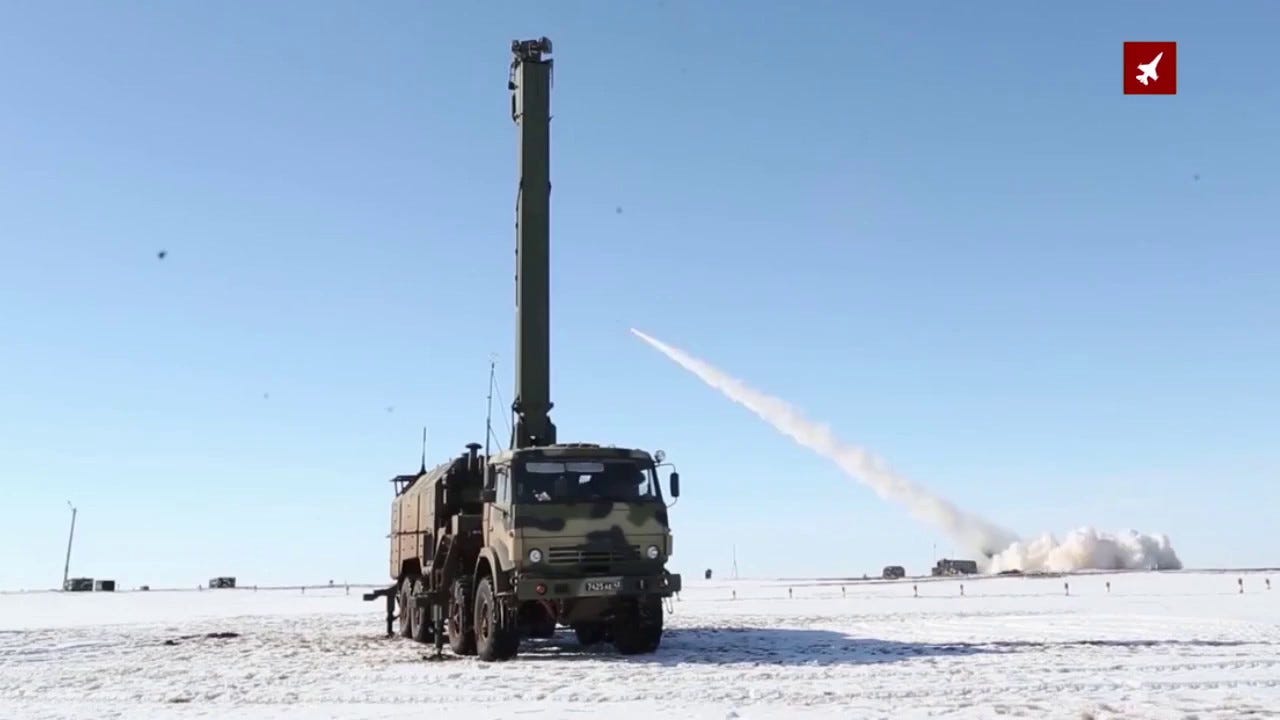
    There are two basic options for ground launching Tomahawks. One of these is the US Army’s MRC (Mid-Range Capability) Launcher, dubbed the Typhon. This is an enormous tractor-trailer launcher with four launch tubes, first delivered in 2023. It has an enormous footprint – so large, apparently, that the Army is already asking for a smaller replacement – and is intended to give the Army an organic fires component in the gap between the shorter range Precision Strike Missile and hypersonic systems (which do not yet exist). The critical fact is this: the Army intends to field a total of five Typhon batteries by 2028, of which two have been delivered so far. Each battery consists in turn of four launchers, implying that eight out of a planned twenty launchers have been delivered. Even more importantly, both of the currently operational batteries are already deployed, with one in the Philippines and one in Japan. These systems are being actively used in exercises and trials, including an exercise this summer in Australia

    The Typhon system gives ground launch capability to the Tomahawk but brings a massive footprint

    The situation with the Marine Corps’ launch system is quite similar, although the launch platforms themselves could not be more different. Unlike the lumbering Typhon tractor trailer, the Marines are fielding a significantly more lithe and compact LMSL system, with the tradeoff of a single launch tube compared to the Typhon’s four. What matters is not so much the technical differences, as the fact that the Marines – like the Army – only received their first deliveries in 2023, and they are currently in the process of building out the force. In the case of the marines, the goal is to have a Tomahawk battalion built out by 2030. In fact, the production contract came into effect as recently as 2025.

    What does all of that mean? It means that, although the Tomahawk itself is a fine missile, the systems for ground launch are so new and available in such limited quantities that equipping Ukraine with Tomahawks would require either the US Army or the Marines to materially alter their force structure in the near term (through 2030, essentially). These are essentially the opposite of much of the gear that’s been given to Ukraine to this point: far from being inventories of older systems that can be earmarked as surplus or tabbed for replacement, Tomahawk ground launch is a brand new capability that is in the middle of deployment and buildout for the first time.

    This is, of course, a layered complication on top of Tomahawk quantities in and of themselves. The issue of Tomahawk availability is both over and under emphasized, depending on the context. The United States has something like 4,000 Tomahawks in its inventories (although half of these are currently inside their cells on American ships), so it is not quite correct to say (as some have) that America is running out of these critical weapons. The issue is that production rates are relatively anemic (generally between 55 and 90 per year) and are fail to replenish the expenditure from even relatively brief strike campaigns, such as the repeated strikes on Yemen. Broadly speaking, then, the issue is not so much that the United States is in immediate danger of running out of Tomahawks, but that procurement schedules are so slow that even relatively minor expenditures can erase multiple years worth of deliveries.

    It may be useful, then, to consider Tomahawks in comparison to the ATACMS missiles which have already been provided to Ukraine. Unlike the Tomahawk, the ATACMS is a system which has already been tabbed for replacement, with the Precision Strike Missile in the early phases of its rollout. ATACMS were also compatible with launch systems that Ukraine already had. In comparison to Tomahawks, then, ATACMS are both vastly more strategically expendable, produced in larger numbers, and easier to deploy. Despite all these points in their favor, the United States provided Ukraine with just 40 ATACMS. Even if the Army could be pressured into handing over one or two of its brand new Typhon launchers, it is difficult to imagine that more than few dozen Tomahawks could be spared for Ukraine: a token inventory far too small to wage a sustained strike campaign in the Russian heartland

    Peace, Sponsored by Raytheon

    Given that Tomahawks for Ukraine would be measured in the dozens, rather than the hundreds, it’s worth asking whether this could actually change anything for the AFU at the front. The answer is clearly no in the long run, but it would be unwise to dismiss the possibility that even a limited tranche of Tomahawks (let’s say 40 to 50 missiles) could help alleviate pressure on Ukrainian forces at the front, provided they were used appropriately. A short term boost to Ukrainian strike capabilities, if deployed against Russian rear areas, could force further dispersal and rationing of Russian assets and temporarily stall Russia’s emerging multi-axis offensive. This could defer the loss of key positions until early 2026. This presumes, however, that the Ukrainians would be content to use Tomahawks against operational targets. In reality, Ukraine can never seem to resist lobbing missiles at targets that have little bearing on the front, like the Kerch Bridge. Indeed, a failure to synergize strikes at depth with operations on the ground is a major reason why the ATACMS achieved so little.

    On the other side of this equation, it is a common complaint from the Russian perspective that Moscow has done too little to “deter” the United States from empowering Ukraine’s strike campaign – both by directly providing munitions and supplying the planning, ISR, and guidance systems. This, however, rather misses the point. Russia has done nothing of note to deter the United States because both Moscow and Washington understand fully that there is essentially no appetite (on either side) for a direct confrontation. In the (sensible) absence of a willingness to strike back at NATO targets, there is really nothing Russia can do to deter beyond maintaining its own retaliatory capabilities. The issue is not that Russia has failed to actively deter, but that there is nothing they could do even if they wanted to.

    The basic pattern here is well established. The United States has done what it can to backstop Ukrainian strike capabilities, but it has held them at a level where Ukraine’s damage output falls far short of decisive levels. So long as that is the case, Russia has clearly demonstrated that it will simply eat the punches and retaliate against *Ukraine*. Hence, when the United States helps Ukraine target Russian oil facilities, it is Ukraine that receives the reprisal, and it is Ukraine which has its natural gas production annihilated as the winter approaches. In a sense, neither side is really trying to deter the other at all. The United States has raised the cost of this war for Russia, but not enough to create any real pressure for Moscow to end the conflict; in response, Russia punishes Ukraine, which is something the United States does not really care about. The result is a sort of geostrategic Picture of Dorian Gray, where the United States vicariously inflicts cathartic damage on Russia, but Ukraine accrues all the soul damage.

    In the case of Tomahawks, the risk-reward calculus is just not there. Tomahawks are a strategically invaluable asset that the United States cannot afford to hand out like candy. Even if the launch systems could be provided (highly doubtful), the missiles could not be made available in sufficient quantities to make a difference. The range of the missiles, however, significantly raises the probability of miscalculation or uncontrolled escalation. Ukraine shooting American missiles at energy infrastructure in Belgorod or Rostov is one thing; shooting them at the Kremlin is another thing entirely.

    There is, however, another aspect of this which seems to be garnering little attention. The biggest risk of sending Tomahawks is not that the Ukrainians will blow up the Kremlin and start World War Three. The bigger risk is that the Tomahawks are used, and Russia simply moves on after eating the strikes. Tomahawks are arguably one of the last – if not *the* last – rung in the escalation ladder for the USA. We have rapidly run through the chain of systems that can be given to the AFU, and little remains except a few strike systems like the Tomahawk or the JASSM. Ukraine has generally received everything it has asked for. In the case of Tomahawks, however, the United States is running the most serious risk of all: what if the Russians simply shoot down some of the missiles and eat the rest of the strikes? It’s immaterial whether the Tomahawks damage Russian powerplants or oil refineries. If Tomahawks are delivered and consumed without seriously jarring Russian nerves, the last escalatory card will have been played. If Russia perceives that America has reached the limits of its ability to raise the costs of the war for Russia, it undercuts the entire premise of negotiations. More simply put, Tomahawks are most valuable as an asset to threaten with.

    Reading between the lines of President Trump’s public statements recently, it seems likely that he has rationally weighed these considerations. Publicly, he used the threat of Tomahawks to try and force Russia to keep negotiating, and he’s received a commitment for another meeting with Putin for his trouble (more on that later). He has now, for the time being, shelved the Tomahawk plan, commenting that “we need them” and applying the usual Trumpian linguistic style to the broadly accepted issue of inventories which I have outlined here. Tomahawks are simply more valuable to the United States as a tool to threaten escalation, rather than as an actual kinetic asset in Ukrainian hands, and so long as Trump keeps his powder dry he can re-raise the issue later.

    Ultimately, perhaps, this discussion is not about Tomahawks at all. These missiles, rather, are simply a totem which demonstrate two important dovetailing points. First, that American resources are not infinite, and as the United States reaches deeper into its bag to help Ukraine, it begins to grab at strategically critical assets that the US military simply cannot spare. Secondly, we must remember that America’s policy in Ukraine is a game of titration, with Washington probing the limits of Russia’s willingness to “eat the strikes” without allowing the reprisal violence to spill out of Ukraine.

    The Big Banana: Russia’s Operational Schema

    At this point, it’s becoming increasingly difficult to say anything meaningful about the actual operational progression on the ground. There are several reasons for this. First and foremost, the war has now gone on so long and is consistently moving at such an apparently glacial pace that most people simply do not care at this point whether Russia holds Yampil or not, or whether they have advanced past the rail line in Pokrovsk. There is severe fatigue (or perhaps boredom is the better word) with the status of an interminable sequence of apparently small settlements, industrial complexes, and forestry plantations, and as a result most people have essentially checked out. Not the least among these must surely be President Trump, who apparently chucked Zelensky’s map of the frontline and complained that he was tired of being shown the same maps over and over again.

    On the other hand, we have the true obsessives who continue to dutifully follow the frontlines regularly and are voluntarily intaking daily updates. We end up with a bifurcated system where some people are still highly plugged in to the micro movements on the battlefield, but most people just don’t care, and we can hardly blame the latter. I think it would be profitable, then, to think about the broader Russian operational scheme, what it has achieved, and what it aims to achieve in the coming year. This is probably more interesting and less repetitious than fixating on the exact positioning within Pokrovsk or Kupyansk.

    There are two larger points that I think are worth making before we look at some specifics.

    First and foremost, much of the battlefield analysis that comes out (particularly from western analysts) makes firm pronouncements as to what constitutes Russia’s “primary” and “secondary” efforts, but these are essentially interpolated and frequently incorrect. For example, it’s become a fairly mainstream conception that Russia’s “primary” point of effort right now is the capture of Pokrovsk, but this does not actually seem supported by Russian actions. There is no particular advantage to be gained for Russia by pushing to capture Pokrovsk as soon as possible – the city is already in a stranglehold partial encirclement. To be sure, Pokrovsk *was* a major logistic hub for Ukrainian forces, but it can no longer serve that role and was sterilized as a transit hub months ago, once it became a frontline city. The opposite side of this coin is that other Russian axes of advance, particularly in southern Donetsk and the bend of the Donets River, are dismissed as “secondary” efforts. This is a major mistake, and I will attempt to show that these are critical advances where Russia is shaping the battlefield to its advantage for follow on operations.

    Secondly, it should be understood and appreciated that Ukraine has lost essentially all battlefield initiative. In 2024, the AFU was able to assembled a mechanized reserve and launch their operation into Kursk. This operation ultimately failed and resulted in severe Ukrainian losses, but this is unrelated to the fact that Ukraine was still able to accumulate forces and pursue offensive operations on its own initiative. In 2025, however, Ukraine has been in a permanent state of reactivity. This was the first year of the war in which Ukraine did not launch any proactive operations or counteroffensives of its own, and Ukrainian hopes have instead pivoted to their strategic strike campaign against Russian oil facilities.

    In a larger sense, the effect of attrition can be seen year by year with the shrinking scope of Ukraine’s proactive operations. In 2022, Ukraine was able to launch a pair of widely separated offensives which yielded modest successes: an offensive out of Kharkov rolled the front back over the Oskil River (though it failed to collapse the Lugansk shoulder), meanwhile, a series of battles outside of Kherson failed to break through the Russian lines, but they did play a role in persuading the Russians to abandon their bridgehead over the Dnieper. The point of course is not to once again autopsy these offensives, but to point out that there were two of them, that they were meaningful in scale, and they did result in important territorial gains for Ukraine. In 2023, by contrast, Ukraine launched a single theater-level offensive in the south, which failed. In 2024, we got the Kursk operation: smaller and less lavishly equipped than 2023’s Zaoprizhia offensive, and aimed at a peripheral theater. This year, there were no proactive Ukrainian operations at all. There is a very clear pattern at play here, with Ukraine’s offensive punch progressively shrinking before disappearing entirely in 2025. This was a year of essentially uninterrupted Russian initiative

    Putting Ukraine permanently on the backfoot is a significant Russian achievement, and it is owed to a few converging factors. Obviously, the attrition of Ukrainian forces is a major factor. We’ve gone through the flailing Ukrainian mobilization, the cannibalization of its forces, and the general lack of reserves in detail on several occasions, and there’s no need to retread that ground here. Suffice it to say, Ukraine’s ability to husband forces for offensive operations appears to be severely degraded. Russia has exacerbated this problem by pressing steadily on a variety of different axes. At the moment, there are no fewer than seven Russian axes of attack, pressuring a slew of cities all along the line. This creates a series of defensive emergencies, maintains the burn rate on Ukrainian forces, and fixes them on the line. Finally, in a point to be detailed shortly, Russian advances have begun unraveling Ukraine’s logistic connectivity, which puts strain on supply and prevents the concentration and accumulation of forces

    Eastern Ukraine: Approximate Situation and Axes of Russian Advance

    Now, for the development of the front and the premise of the Russian offensive scheme. The main point that I want to impress is essentially as follows: rather than fixating on Pokrovsk, Russia’s advances across Southern Donetsk and on the inner bend of the Donets River ought to be thought of as vital operations which have severely disrupted the coherence of both the Ukrainian front and their logistics. This has the triple effect of preventing the Ukrainians from launching offensives of their own, accelerating the attrition of Ukrainian forces, and shaping the front for the coming operation to capture the Slovyansk-Kramatorsk agglomeration.

    To begin, let’s consider the progress that Russia has made in southern Donetsk, both in raw territorial terms and its implications for Ukrainian logistic connectivity. To demonstrate this, I’ve pulled maps from DeepState (again, a Ukrainian mapping enterprise) for August 2023 (when Ukraine was attempting its counterattack out of Orikhiv) and for October 20th, the week of this writing. I have noted both the length of the southern front (obviously a linear approximate, as the actual front has many bends and bulges) and highlighted the key highways that Ukraine uses to run the backbone of its logistics

    The Southern Front: 2023 vs 2025

    Now, one thing that is worth noting is that the Russians are currently positioned to roll up this front even further. Ukrainian defensive lines are primarily oriented towards on a north-south axis. Once Russian forces cleared Kurakhove, they entered the seams in these defensive lines – that is to say, they are advancing laterally along the face of the prepared defenses, rather than trying to bash through them from the front. This is one reason why their progress has been relatively steady and uninterrupted. Now approaching the “elbow” in the lines, where they pivot southward, and having crossed the Yanchur River, the Russians are entering a substantial space that lacks meaningful prepared defenses. Using the Military Summary map (Ukrainian fortifications are mapped with yellow dots), the void in the defense is fairly obvious as the Russians work their way into the elbow of the line

    Apart from the obvious development of note here – that Russian forces have, to this point, rolled up roughly half the length of the southern front and are positioned to roll up another ten to fifteen miles – we want to note two things which are emblematic of the way the war is going for Ukraine, but curiously receive little attention. First, the compression of the front is robbing the Ukrainians of the maneuver space which made it possible for them to stage and assemble forces for their counteroffensive in 2023. Two years ago, there was a wide, lateral buffer zone around the Ukrainian staging area in Orikhiv, and Ukrainian forces had access to multiple highways where they could disperse forces in their marching columns and run their logistics.

    Today, that buffer zone is gone, as is the easy access to several of the branch highways. The Russian advance, which started with the breakthrough at Ugledar and Kurakhove last year and which has now rolled up some 50 miles of front, has essentially sterilized Ukraine’s capacity to attack in the south, because they have neither the space nor the roads to safely accumulate forces here. It has also shattered the interconnectivity of Ukrainian logistics: rather than having several highways to shuttle troops and material to the east, Ukraine now has to support several disconnected logistic fronts with individual highways. More to the point, there is no longer a single Donetsk “front” to speak of, but rather a series of logistic fronts: one in the south, around Orikhiv, another at Pokrovsk, and the largest one in the Slovyansk Banana. These are lacking lateral connectivity to each other for the Ukrainians due to the wedges that the Russians have forced in the front, particularly in the south, funneling logistics and reinforcements down individuated corridors.

    The bigger issue, however, lies farther north on the Pokrovsk and Donets axes, and in the way that they synergize. People who are focusing, to the exclusion of all else, on when and how Russia will capture Pokrovsk are failing to see the bigger picture, and indeed are not even trying to understand it.

    The ultimate Russian operational objective (in this phase of the war, at least) is the belt of cities which runs in an arc from Slovyansk to Kostyantinivka, which I affectionately call “the Slovyansk Banana” due to its curved shape. A cursory look at the map shows us why the very operations that are being dismissed as secondary efforts are in fact critical axes of Russian effort which are shaping the battlefield for the attack on the Banana

    There are two very important facts about the Banana, from the perspective of operational geography. The first is that, although the combined mass of the agglomeration is far larger than any of the urban areas that have been fought over to this point, the Banana is relatively difficult to defend because it sits on the floor of a river valley: the Kazennyi Torets flows through all the cities in the Banana before it flows into the Donets. Russian forces approaching the city from the southwest, the east, and the north will all be advancing along the high ground that overlooks the cities on the floor.

    The second important fact about the Banana is that, despite its size, it is supported by just two highways which approach from the southwest and northwest respectively, funneling into the Banana like a wedge. Taking the northern highway/MSR (the E40 highway) as an example, we see that Russia’s operations inside the Donets bend are hardly secondary efforts: they are vital shaping operations linked to the integrity of the Banana. The E40 highway tracks the Donets bend very closely (it generally stays within five miles of the river. If the Russians sustain their progress north of the Donets and reach the river at Bogorodychne or Svyatogirsk, it will not only put E40 under persistent drone attack but also curl the defensive line behind the Banana, to say nothing of the enormous pressure on the Siversk salient.

    On the Pokrovsk front as well, Russia’s progress is being misinterpreted. After their breakthrough at the end of the summer, Russian forces have consolidated the bulge north of Pokrovsk (despite weeks of Ukrainian counterattacks) and are steadily working their way towards Rais’ke and Sergiivka. This is not about Pokrovsk at all – reaching Rais’ke would put Russian forces directly in the backfield of Kostyantinivka, on the supply lines to the underside of the Banana.

    I am not suggesting at all that Russian forces are on the verge of some great offensive surge that will carry them into the heart of the Banana instantly. However, there is a fairly well established Russian operational methodology in this war, which involves working their way methodically into Ukraine’s logistical lanes and seams, segmenting the front and strangulating their strongpoints, forcing them to supply frontline strongholds with single file logistics and dirt roads. They did it in Bakhmut, and Avdiivka, they are doing it in Pokrovsk, and they are shaping the front to attempt this on a large scale in the Banana

    Assault on the Banana: Coming 2026

    The general point that we are trying to make here is that dismissing Russian advances in the Serebryanka Forest, the emerging bulge north of Pokrovsk, and their move into the Donets Bend as “secondary efforts” is mistaken. Zooming out to the appropriate scale shows that these are concentric operations, shaping the front for a 2026 assault on the Banana – moving towards the E40 road from the north, bending the defensive shield around Siversk, and working into the underbelly of the Banana through Rais’ke.

    This is, perhaps, a long way to go for a short drink of water, but there are a few basic points here that get completely missed when the view of the front is preoccupied with the fighting inside Pokrovsk and Kupyansk:

    1. Russia’s advance out of Kurakhove across the southern front is not a secondary axis. They have rolled up half of the southern front, condensing Ukrainian forces into a compact space which sterilizes their ability to attack in the south.
    2. Broad Russian pressure across a half-dozen axes maintained a steady burn rate on Ukrainian forces and prevented the accumulation of forces for proactive operations. 2025 has been the first year of the war in which Ukraine has not launched any offensive operations on its own initiative.
    3. Advances in the Donets bend and the interstitial space between Pokrovsk and Kostyantinivka are not subsidiary or secondary operations: they are critical shaping operations that are moving concentrically toward the Banana.

    To be frank, the general mood of optimism in the Ukrainian infosphere, which lasted for much of the summer, struck me as remarkably odd. The frontline has yielded no real good news for Ukraine at any point this year. Beyond the broader strategic point, that Ukraine has lost the initiative and does not seem capable of getting it back, Russia is in the process of capturing two important urban centers (Russian troops are in the city centers of Pokrovsk and Kupyansk), it has begun the assault on at leas two more (Lyman and Kostyantinivka), it has rolled up half of the southern front, and cleared most of the inner Donets-Oskil bend. The Banana is on deck for 2026.

    Ukraine’s Cost Theory of Victory

    One thing that has become apparent over the last year is that Kiev has abandoned previous notions of outright victory on the battlefield and adopted a new strategic framework predicated on imposing unacceptable costs on Russia, so that Moscow will agree to freeze the conflict.

    This is a subtle and unspoken yet extremely important distinction. It is easy to miss, because both Ukrainian leadership and Ukraine’s western backers continue to speak of Ukrainian “victory” and the possibility of Ukraine “winning” the war. What is crucial to understand is that the “victory” that they speak of now is categorically different than the victory of 2022 and 2023. In the first years of the war, it was possible to at least speak of Ukraine taking the initiative to advance on the ground and retake territory. There were concrete examples of Ukrainian offensives in 2022, and the battle in Zaporizhia – although unsuccessful – showed that it was at least possible for Ukraine to attempt a proper mechanized offensive.

    Therefore, in the first years of the war, when leaders in Kiev and Brussels and London and Washington spoke of Ukrainian victory, they essentially meant the defeat of the Russian ground forces and the reconquest of much (or all) of the Donbas. The Kursk Operation of 2024 began to split the difference: Ukraine still had some resources to mount proactive operations, but these operations were no longer aimed at the dense eastern front and instead aimed at relatively soft subsidiary fronts with an eye to out-levering the Russians.

    Today, with the Ukrainian army stuck in a permanent state of reactivity and slowly receding defense, it no longer makes any sense to speak of Ukrainian victory in the most straightforward sense, which is to say victory on the battlefield – no matter how tenaciously or bravely the Ukrainian rank and file continues to fight in essentially intolerable circumstances. Instead, Ukrainian “victory” has been transmogrified to mean essentially that Russia absorbs such exorbitant costs that it agrees to some sort of ceasefire without preconditions.

    The costs to be imposed on Russia are implicitly assumed to be a mixture of battlefield casualties and damage to strategic assets inflicted by Ukrainian air strikes, and in regards to the latter Ukraine seems to be particularly placing its hopes in a strategic strike campaign against Russian oil. Ukraine’s attempts to disable Russian oil production and refining have dovetailed with ever more aggressive sanctions from the United States against Russian fossil fuel exports – although it is worth noting that the limited price response to these sanctions indicates that markets expect that Russian oil will continue to flow.

    Trump’s suggestion that Tomahawks may be on the table for Ukraine must be seen as a constituent element of this new strategy and theory of victory. And this, ultimately, is very important to understand. Tomahawks are not being bandied about because anybody (in Kiev or Washington) believes that 50 cruise missiles will allow Ukraine to defeat the Russian Army and recapture the Donbas. Tomahawks were mentioned because the Ukrainian alliance is threatening to cripple the Russian fossil fuels industry (through a mixture of sanctions and kinetic strikes on production facilities) unless Putin agrees to a ceasefire.

    This is why it is wrong to be surprised that Trump abruptly cancelled his meeting with Putin and instead announced more sanctions. There’s nothing abrupt or erratic about this. Threats to Russian oil are now, without exaggeration, the main lever that the Ukrainian bloc has against Russia. It certainly should not have been a surprise that the Kremlin, which has reiterated the same fundamental war aims since day one, was not excited about coming to Budapest to freeze the conflict, and neither should it surprise us that Trump would instead prefer to pull harder on the oil lever. The two powers are playing entirely different games: Russia is slow-walking negotiations while it advances on the ground, and the United States is playing a pain game designed to raise the costs for Russia

    We have fundamentally reached an impasse when it comes to negotiations. For Moscow, negotiations with the United States are essentially a way to string Washington along. Moscow feels that it is winning on the ground, therefore a diplomatic impasse suits Russian interests. When western leadership complains that Russia does not seem interested in ending the war, they are correct, but they are missing the point. Russia is not interested in ending the war right now because doing so would not serve Russian interests. The Banana is in the crosshairs, and a ceasefire now would be an egregious compromise when victory on the ground is in sight.

    The sense of urgency that Washington feels to end the war – mainly by yanking furiously on the oil lever until the Kremlin cries uncle – stems from the fact that this is now the only sort of victory that Ukraine can hope to win. The ground war has been written off as a total loss, and all that remains is to lob missiles and drones at Russian refineries, sanction Russian firms and banks, and harass shadow tankers until the costs become intolerable. The longer the Ukrainian ground forces can hold the line the better, but this is merely a matter of limiting the downside. The fact that Russia can retaliate disproportionately against Ukraine barely factors into this thinking.

    The key point here, however, is that the concept of Ukrainian victory has been completely transformed. There is now no real discussion of how Ukraine can win on the ground. For the Ukrainian bloc, the war is no longer a contest against the Russian Army, but a more abstract contest against Russia’s willingness to incur strategic costs. Rather than preventing Russian capture of the Donbas, the west is testing how much Putin is willing to pay for it. If history is any guide, a game predicated on outlasting Russia’s strategic endurance and willingness to fight is a very bad game to play indeed [end]

    The original article

    Related

    The Atlanticist defeat in Donbass and Ukraine

    chronicle of a new catastrophic NATO venture

    Panzer, Marsch

    the saga of NATO Panzerkampfwagen in Donbass and Ukraine

    January 9, 2025: Total Kievan Debellation – Big Serge

    The Russo-Ukrainian War: Year 3

    March 1, 2024: Russo-Ukrainian war: The Deluge – Big Serge

    Z World Turns Two

    December 12, 2023: The Atlanticist « counter-offensive »

    the last NATO attempt to avoid defeat in its proxy war in Donbass and Ukraine, against Russia

    August 29, 2023: Escaping Attrition: Ukraine Rolls the Dice – Big Serge

    The Zaporizhia Summer Blockbuster

    June 2, 2023: The Battle of Bakhmut: Postmortem – Big Serge

    Russo-Ukrainian War Update

    May 20, 2023: Countdown of the Atlanticist defeat in Bakhmut

    January 20, 2023: Russo-Ukrainian War : The World Blood Pump – Big Serge

    Gradually, and then Suddenly

  • [Sharing] The Battle of Bakhmut: Postmortem – Big Serge

    Russo-Ukrainian War Update

    On May 20th, PMC Wagner forced Ukrainian troops out of their last remaining position within the city limits of Bakhmut, consequentially bringing about the nominal end of the largest battle of the 21st century (so far). Bakhmut has been the most substantial locus of military operations in Ukraine for most of the past nine months. Combat there took on a frustrating tempo, with progress often measured in single city blocks. This was a battle that was extremely violent and bloody, but at times agonizingly slow and seemingly indecisive. After countless updates in which nothing of note seemed to have happen, many people were surely beginning to roll their eyes at the very mention of Bakhmut. Consequentially, the abrupt capture of the city by Wagner in May (rather predictably, the final 25% of the city fell very quickly relative to the rest) seemed a bit surreal. To many it likely seemed that Bakhmut would never end – and then, suddenly, it did.

    Bakhmut, like most high-intensity urban battles, exemplifies the apocalyptic potential of modern combat. Intense bombardment reduced large portions of the city to rubble, lending the impression that Wagner and the AFU were not so much fighting over the city as its carcass.

    The slow pace and extreme destruction has made this battle a rather difficult one to parse out. It all seems so senseless – even within the unique paradigm of war-making. In the absence of an obvious operational logic, observers on both sides have been eager to construct theories of how the battle was actually a brilliant example of four-dimensional chess. In particular, you can easily find arguments from both pro-Ukrainian and pro-Russian commentators claiming that Bakhmut was used as a trap to draw in the other side’s manpower and material for destruction, while buying time to accumulate fighting power

    Pro-Ukrainian sources are adamant that a huge amount of Russian combat power was destroyed in Bakhmut, while the AFU received western armor and training to build out a mechanized package to go back on the offensive. Pro-Russian writers similarly seem convinced that the AFU burned a huge amount of manpower, while the Russian army preserved its strength by letting Wagner do most of the fighting.

    Clearly, they cannot both be correct.

    In this article, I would like to take a holistic survey of the Battle of Bakhmut and adjudicate the evidence. Which army was really destroyed in this “strategically insignificant” city? Which army was being profligately wasteful of its manpower? And most importantly – why did this middling city become the site of the largest battle of the century? Homicide was committed, but nobody can agree on who murdered whom. So, let us conduct an autopsy.

    The Road to the Death Pit

    The Battle of Bakhmut lasted for so long that it can be easy to forget how the front ended up there, and how Bakhmut fits into the operations in the summer of 2022. Russian operations in the summer were focused on the reduction of the Ukrainian salient around Lysychansk and Severodonetsk, and came to a climactic head when Russian forces broke open the heavy defended Ukrainian stronghold of Popasna, encircled a pocket of Ukrainian forces around Zolote, and approached the Bakhmut-Lysychansk highway. The actual fall of the Lysychansk-Severodonetsk urban agglomeration came relatively quickly, with Russian forces threatening to encircle the entire bag and forcing a Ukrainian withdrawal.

    Just for reference, here is what the frontline in the central Donbas looked like on May 1, 2022, courtesy of MilitaryLand

    In this context, Bakhmut already threatened to become a major battleground. It lay at a literal crossroad directly in the center of the Ukrainian salient. As Ukrainian positions in Lysychansk, Popasna, and Svitlodarsk were broken open, the axes of Russian advance converged on Bakhmut.

    Ukrainian forces greatly needed to stabilize the front, and establish a stable blocking position, and there was really nowhere else to do this except at Bakhmut. Between Lysychansk and Bakhmut there are no sufficiently robust urban areas to anchor the defense, and there was absolutely no question of failing to adequately defend Bakhmut, for a few reasons that we can enumerate:

    1. Bakhmut is in the central position in this sector of front, and its loss would both threaten Siversk with envelopment and allow Russian forces to bypass the well fortified and strongly held defenses at Toretsk.
    2. The Russian strategic objective at Slavyansk-Kramatorsk cannot be successfully defended if the Russian army controls both the heights to the east (in the Bakhmut area) and Izyum.

    Bakhmut itself, meanwhile, was a defensible urban area with dominating heights in its rear, multiple routes of supply, good linkages to other sectors of front, and a peripheral belt of smaller urban areas protecting its flanks.

    This set up a rather obvious operational decision for Ukrainian forces. The choice was, all things considered, to either commit reserves to stabilize the front at Bakhmut (a strong and operational vital defensive anchor) or risk letting Russia bypass and sweep away an entire belt of defenses in places like Siversk and Toretsk. Asked to choose between a reasonably good option and an extremely bad option, there was no great controversy in the deciding.

    Falling back from the loss of their eastern defensive belt, Ukraine needed to stabilize the front somewhere, and the only suitable place was Bakhmut – so this is where Ukrainian reserves were sent in force, and the AFU chose to fight. Operational logic, indifferent to those things that normally recommend cities to us as “important”, decreed that the Styx should flow through Bakhmut.

    Russia came to meet this challenge – bringing as their spearhead a mercenary group, staffed by convicts, wielding shovels, run by a bald caterer. What could go wrong?

    Operational Progression

    Because the general impression of Bakhmut is characterized by urban combat, it can be easy to forget that most of the battle took place outside the city itself, in the exurbs and fields around the urban center. The approach to Bakhmut is cluttered with a ring of smaller villages (places like Klynove, Pokrovs’ke, and Zaitseve) from which the AFU was able to fight a tenacious defense with the support of artillery in the city itself.

    While Russian forces nominally reached the approach to Bakhmut late in June (even before Lysychansk was captured) and the city came under the extremes of shelling range, they did not immediately begin a concerted push to reach it. On August 1, the first assaults on the outer belt of villages began, and the Russian Ministry of Defense stated in its briefings that “battles for Bakhmut” had begun. This date is the most logical starting date for historiographical purposes, so we may firmly say that the Battle of Bakhmut was fought from August 1, 2022 to May 20, 2023 – a total of 293 days.

    The first two months of the battle saw the Russian capture of most of the settlements east of the T0513 highway south of the city and the T1302 highway to the north, stripping Bakhmut and Soledar of most of their eastern buffer zones and pushing the line of contact right up to the edge of the urban areas proper

    Phase 1: The Outer Belt

    At this point, the frontlines largely froze up for the remainder of the year, before Wagner set the stage for further advances with the capture of the small village of Yakovlivka, to the north of Soledar. This success can be construed as the first domino in a chain of events which led to Ukrainian defeat in Bakhmut.

    Soledar itself serves a unique and critical role in the operational geography of Bakhmut. Laid out in a relatively long and thin strip, Soledar and its suburbs form a continuous urban shield stretching from the T0513 highway (which runs north to Siversk) all the way to the T0504 road (running east to Popasna). This makes Soledar a natural satellite stronghold which defends Bakhmut across nearly ninety degrees of approach. Soledar is also liberally gifted with industrial build, including the salt mine for which it is named, which makes it a relatively friendly place to wage a static defense, full of deep places and strong walls.

    Wagner’s capture of Yakovlivka on December 16, however, marked the first sign that the defense of Soledar was in trouble. Yakovlikva sits on an elevated position to the northeast of Soledar, and its capture gave Wagner a powerful position atop Soledar’s flank. The Ukrainians recognized this, and Soledar was powerfully reinforced in response to the loss of Yakovlivka and the anticipated oncoming assault. The capture of Bakhmutske on December 27 (a suburb of Soledar directly on its southern approach) set the stage for a successful assault.

    The attack on Soledar ended up being relatively fast and extremely violent, characterized by intense levels of Russian artillery support. The assault began almost immediately after the loss of Bakhmutske on December 27th, and by January 10th Ukraine’s cohesive defense had been shattered. Ukrainian leadership, of course, denied losing the town and wove a story about glorious counterattacks, but even the Institute for the Study of War (a propaganda arm of the US State Department) later admitted that Russia had captured Soledar by January 11th.

    The loss of Soledar, in combination with the early January capture of Klischiivka to the south, put Wagner in a position to begin a partial envelopment of Bakhmut

    Phase 2: Clearing the Flanks

    It was at this point that the discussion shifted towards a potential Russian encirclement of Bakhmut. To be sure, the Russian wings did expand rapidly around the city, placing it in a firebag, but there was never a concerted effort to take the city into a proper encirclement. The Russian advance subsided on the approach to Ivanivske in the south, and over the vital M03 highway in the north.

    A genuine encirclement was probably never in the cards, mainly because of the complication of Chasiv Yar – a strongly held rear area stronghold. To fully encircle Bakhmut, Russian forces would have been forced to choose between two difficult options: either blockade the road from Chasiv Yar to Bakhmut, or flare the envelopment wide enough to take Chasiv Yar into the pocket as well. Either option would have greatly complicated the operation, and so Bakhmut was never genuinely encircled.

    What the Russians did succeed in doing, however, was establish dominant position on the flanks which accrued three significant advantages. First, they were able to direct fire on Bakhmut’s remaining supply lines. Secondly, they were able to pummel Bakhmut itself with intense artillery fire from a variety of axes. Third – and perhaps most importantly – they were able to assault the Bakhmut urban center itself from three different directions. This, in the end, greatly hastened the fall of the city. By April, it was clear that the focus had shifted from expanding the envelopment on the flanks to assaulting Bakhmut itself, and it was reported that Russian regular units had taken custody of the flanks so that Wagner could clear the city

    Phase 3: Flaring the Wings

    Fighting throughout April and early May at last shifted to the struggle in the urban center. AFU units in the city ultimately proved incapable of stopping Wagner’s advance, largely due to tight Russian fires coordination and the cramped confines of the Ukrainian defense – with Wagner advancing into the city from three axes, the firing grids for Russian artillery became very narrow, and the AFU’s static defense – while bravely contested – was slowly ground down.

    By early May, it was clear that the city would fall soon, with the AFU desperately holding on to the western edge of the city. Attention soon shifted, however, to a Ukrainian counterattack on the flanks.

    This became a rather classic instance of events on the ground being outrun by the narrative. There had been rumors of an impending Ukrainian counterattack circulating for quite some time, advanced by both Ukrainian and Russian sources. Ukrainian channels were predicated on the idea that General Oleksandr Syrskyi (commander of AFU ground forces) had hatched a scheme to draw the Russians into Bakhmut before launching a counterattack on the wings. This idea was seemingly corroborated frantic warnings from Wagner head Yevgeny Prigozhin that the Ukrainians had massed enormous forces in the rear areas behind Bakhmut which would be unleashed to counter-encircle the city.

    In any case, the spring months came and went without any astonishing AFU counterattack, and all manner of material shortages and weather delays were blamed. Then, on May 15, all hell seemed to be breaking loose. The AFU finally attacked, and Prigozhin screeched that the situation on the flanks was approaching the worst case scenario.

    In fact, what happened was rather anticlimactic. The AFU did bring a hefty grouping of units to play, including several of their best and most veteran formations. These included units from:

    • The 56th Brigade
    • The 57th Mechanized Brigade
    • The 67th Mechanized Brigade
    • The 92nd Mechanized Brigade
    • The 3rd Assault Brigade (Azov)
    • The 80th Air Assault Brigade
    • The 5th Assault Brigade

    This sizeable strike package attacked a handful of mediocre Russian Motor Rifle brigades, achieved a bit of initial success, and culminated with heavy losses. Despite Prigozhin’s assertion that the Russian regulars abandoned their posts and left the Russian wings undefended, we later learned that these forces – including mobilized motor rifle units – doggedly defended their positions and only withdrew under orders from above. These withdrawals (distances of a few hundred meters at most) brought the Russian defensive line to strongly held positions along a series of canals and reservoirs, which the AFU was unable to push through.

    Now, this is not to say that Russia did not suffer losses defending against a tenacious Ukrainian attack. The 4th Motor Rifle Brigade, which was largely responsible for the successful defense outside Klishchiivka, was badly chewed up, its commander was killed, and it had to be promptly rotated out. However, the offensive potential of the Ukrainian assault package was exhausted, and there have been no follow on attempts in the past two weeks

    The Final Act: Ukraine’s Counterattack

    In the end, the vaunted Syrskyi plan looked rather lame. The counterattack did successfully unblock a few key roads out of Bakhmut, but it did nothing to prevent Wagner from finalizing the capture of the city, it burned through the combat power of several premier brigades, and on May 20th the last Ukrainian positions in the city were liquidated.

    So. This was a strange battle. An agonizingly slow creep around the flanks of the city, a materializing threat of encirclement, and a sudden concentration of Wagner’s combat energy in the city itself – all taking place under threats of an enormous counteroffensive by the AFU, which turned out to be ineffective and ephemeral.

    It’s not obvious, then, how this battle suited the operational logic of either army, nor that anyone would come away fully satisfied. Ukraine obviously lost the battle in nominal terms, but the Russian advance seemed so slow and Bakhmut so strategically random (at least superficially) that Wagner’s success can be portrayed as a pyrrhic victory. To fully adjudicate the Battle of Bakhmut, we need to contemplate relative losses and expenditure of combat power.

    The Butcher’s Bill

    Estimating combat losses in Ukraine is a difficult task, largely because “official” casualty estimates are often patently absurd. This leaves us with a need to fumble for reasonable figures using proxies and ancillary information. One such important source of knowledge is deployments data – we can get a general sense of the burn rate by the scale and frequency of unit allocation. In this particular case, however, we find that unit deployments are somewhat difficult to work with. Let’s parse through this.

    First and foremost, we need to grapple with the incontrovertible fact that a huge share of the Ukrainian military was deployed at Bakhmut at one point or another. The Telegram Channel Grey Zone compiled a list of all the Ukrainian units that were positively identified (usually by social media posts or AFU updates) as being deployed in Bakhmut throughout the nine month battle (that is, they were not there all at once)

    This is an absolutely enormous commitment (37 brigades, 2 regiments, and 18 separate battalions (plus irregular formations like the Georgian Legion) which indicates obviously severe losses (for what it’s worth, the pro-Ukrainian MilitaryLand Deployment Map admits a similarly titanic Ukrainian deployment in Bakhmut). However, this does not really get us close to accurately assessing losses, largely because Ukraine’s Order of Battle (ORBAT) is a bit confused. Ukraine frequently parcels out units below the brigade level (for example, their artillery brigades never deploy as such) and they have a bad habit of unit cannibalization.

    Doing some extremely rough back of the envelop math, minimal scratching off of just the 37 brigades could easily have pushed Ukraine past 25,000 casualties, but there are all manner of shaky assumptions here. First, this assumes that Ukraine withdraws its brigades when they reach combat ineffective loss levels (15% would be a placeholder number here), which isn’t necessarily true – there is precedent for the AFU leaving troops in place to die, especially from lower quality units like Territorial Defense. In fact, an Australian volunteer (interview linked later on) claimed that the 24th mechanized brigade suffered 80% casualties in Bakhmut, so it’s possible that a great many of these brigades were chewed up beyond task ineffectiveness levels (that is, they were not correctly rotated out) but were instead destroyed entirely. A recent article in the New Yorker, for example, interviewed survivors of a battalion that was almost entirely wiped out. In another instance, a retired Marine Colonel said that units at the frontline routinely suffer 70% casualties.

    We can say a few things for certain. First, that Ukraine had an extremely high burn rate which forced it to commit nearly a third of its total ORBAT. Secondly, we know that at least some of these formations were left at the front until they were destroyed. Finally, we can definitively say that pro-Ukrainian accounts are incorrect (or maybe lying) when they say that the defense at Bakhmut was conducted to buy time for Ukraine to build up strength in the rear. We know this first and foremost because Bakhmut insatiably sucked in additional units, and secondly because this burn included a large number of Ukraine’s premier and veteran forces, including fully a dozen assault, airborne, and armored brigades.

    There’s another problem with the ORBAT approach to casualties, however, and this concerns Wagner. You see, one of our objectives here is to try to get a sense of the comparative rates of loss, and ORBAT simply isn’t a good way to do this in the particular case of Bakhmut. This is because the battle was mostly fought from the Russian side by the Wagner Group, which is a huge formation with an opaque internal structure.

    Whereas on the Ukrainian side we can enumerate a long list of formations that fought at Bakhmut, on the Russian side we just put the 50,000 strong Wagner Group. Wagner of course has internal sub-formations and rotations, but these are not visible to those of us on the outside, and so we cannot get a sense of Wagner’s internal ORBAT or force commitment. We understand generally that Wagner has a structure of assault detachments (probably a battalion equivalent), platoons, and squads, but we do not have a sense of where these units are deployed in real time or how quickly they are rotated or burned through. Sadly, when Prigozhin went in front of cameras he brought maps without unit dispositions on them, leaving ORBAT nerds squinting in vain trying to extract useful information. So, lacking good insight into Wagner’s deployments, we are unable to make an adequate comparison to the bloated Ukrainian ORBAT in Bakhmut.

    There are other ways that we can get at the casualties, however. The Russian dissident (that is, anti-Putin) organization Mediazona tracks Russian losses by tabulating obituaries, death announcements on social media, and official announcements. For the entire period of the Battle of Bakhmut (August 1 – May 20), they counted 6,184 total deaths among PMC personnel, inmates, and airborne forces (these three categories accounting for most of the Russian force in Bakhmut).

    Meanwhile, Prigozhin claimed that Wagner had suffered 20,000 KIA in Bakhmut while inflicting 50,000 KIA on the Ukrainians. Concerning the first number – the context of this claim was an interview in which he was lambasting the Russian Ministry of Defense (as is his habit), and he has an incentive to overstate Wagner’s losses (since he is trying to play up Wagner’s sacrifice for the Russian people).

    So, here is where we are at with Wagner losses. We have a “floor”, or absolute minimum of a little over 6,000 KIA (these being positively identified by name) with a significant upward margin of error , and something like a ceiling of 20,000. The number that I have been working with is approximately 17,000 total Wagner KIA in the Bakhmut operation (with a min-max range of 14,000 and 20,000, respectively)

    However, something we need to consider is the composition of these forces. Among the positively identified KIA, convicts outnumber professional PMC operators by about 2.6 to 1 (that is, Wagner’s dead would be about 73% convicts). According to the Pentagon, however (taken with a large grain of salt), nearly 90% of Wagner’s losses are convicts. Taking a conservative 75/25 split and rounding the numbers to make them pretty, my estimate is that Wagner lost about 13,000 convicts and 4,000 professional operators. Adding in VDV losses and motorized rifle units fighting on the flanks, and total Russian KIA in Bakhmut are likely on the order of 20-22,000.

    So, what about Ukrainian losses? The major outstanding question remains: who is on the right end of the loss ratios?

    Ukrainian commentators consistently ask us to believe that Russian losses were far worse due to their use of “human wave” attacks. There are several reasons why this can be dismissed.

    First, we have to acknowledge that after nine months of combat we have not yet seen a single video showing one of these purported human waves (that is, Wagner convicts attacking in a massed formation). Keeping in mind that Ukraine loves to share footage of embarrassing Russian mistakes, that they have no qualms about sharing gory war porn, and that this is a war being fought with thousands of eyes in the sky in the form of reconnaissance drones, it must strike us as curious that not one of these alleged human wave attacks has yet been caught on camera. When videos are shared purporting to show human waves, they invariably show small groups of 6-8 infantry (we call this a squad, not a human wave).

    However, the absence of evidence is not evidence of absence. That being said, the “human wave” narrative has been contradicted on multiple occasions. Just for starters, General Syrskyi himself contradicted the human wave narrative and said that Wagner’s methodology is to push small assault groups forward under intense artillery cover. Witnesses from the front concur. An Australian Army Veteran volunteering in Ukraine gave a very interesting interview in which he downplayed Wagner casualties and instead emphasized that “Ukraine is taking way too many casualties” – he later adds that the 24th brigade suffered 80% casualties in Bakhmut. He also notes that Wagner favors infiltration groups and small units – the veritable opposite of massed human waves.

    I found this article from the Wall Street Journal to be nicely emblematic of the human wave issue. It contains the obligatory claim of human wave tactics – “The enemy pays no attention to huge losses of its personnel and continues the active assault. The approaches to our positions are simply littered with the bodies of the adversary’s dead soldiers.” This description, however, comes from the bureaucratic apparatus at the Ministry of Defense. What about people on the ground? A Ukrainian officer at the front says: “So far, the exchange rate of trading our lives for theirs favors the Russians. If this goes on like this, we could run out.”

    Ultimately, it’s difficult to believe that the kill ratio favors Ukraine for the simple reason that the Russians have enjoyed a tremendous advantage in firepower. Ukrainian soldiers speak freely about Russia’s enormous superiority in artillery, and at one point it was suggested that the AFU was outgunned by ten to one. The New Yorker’s interview subjects claimed that their battalion’s mortar section had a ration of a mere five shells per day!

    The enormous Russian advantage in artillery and standoff weaponry suggests the a-priori assumption that the AFU would be taking horrific casualties, and indeed that’s what we hear from myriad sources at the front. Then, of course, there was the shocking February claim by a former US Marine in Bakhmut that the life expectancy at the front line was a mere four hours.

    All of this is really ancillary to the larger point. The enormous inventory of AFU units that were churned through Bakhmut included something on the order of 160,000 total personnel. Taking loss rates of between 25 and 30% (roughly on par with Wagner’s burn rate), it’s clear that Ukraine’s losses were extreme. I believe total irretrievable losses for Ukraine in Bakhmut were approximately 45,000, with some +/- 7,000 margin of error.

    So, my current working estimates for losses in the Battle of Bakhmut are some 45,000 for Ukraine, 17,0000 for Wagner, and 5,000 for other Russian forces.

    But perhaps even this misses the point.

    Ukraine was losing its army, Russia was losing its prison population.

    Adjudicating the Battle of Bakhmut is relatively easy when one looks at what units were brought to the table. Bakhmut burned through an enormous portion of the AFU’s inventory, including many of its veteran assault brigades, while virtually none of Russia’s conventional forces were damaged (with the notable exception of the Motor Rifle brigades that defeated the Ukrainian counterattack). Even the Pentagon has admitted that the vast majority of Russian casualties in Ukraine were convicts.

    Now, this is all rather cynical – nobody can deny it. But from the unsentimental calculus of strategic logic, Russia churned through its single most disposable military asset, leaving its regular ORBAT not only completely intact, but actually larger than it was last year.

    Meanwhile, Ukraine was left with virtually no indigenous offensive power – the only way it can conduct offensive operations is with a mechanized package built from scratch by NATO. For all Ukraine’s bluster, the force commitment at Bakhmut left it unable to undertake any proactive operations all through the winter and spring, its multi-brigade counterattack at Bakhmut lamely fizzled out, and it left its supporters grasping at straws about an immanent counteroffensive to encircle Wagner by a reserve army that doesn’t exist. It was even reduced to sending small flying columns into Belgorod Oblast to launch terror raids, only to have them blown up – discovering that the Russian border is in fact crawling with forces of the very much intact Russian army.


    I think that ultimately, neither army anticipated that Bakhmut would become the focal point of such high intensity combat, but the arrival of Ukrainian reserves in force created a unique situation. Russia was beginning a process of major force generation (with mobilization beginning in September), and the gridlocked, slow moving, Verdun-like environs of Bakhmut offered a good place for Wagner to bear the combat load while much of the regular Russian forces underwent expansion and refitting.

    Ukraine, meanwhile, fell into the sunk cost fallacy and began to believe its own propaganda about “Fortress Bakhmut”, and allowed brigade after brigade to be sucked in, turning the city and its environs into a killing zone.

    Now that Bakhmut is lost (or as Zelensky put it, exists “only in our hearts”), Ukraine faces an operational impasse. Bakhmut was after all a very good place to fight a static defense. If the AFU could not hold it, or even produce a favorable loss exchange, can a strategy of holding static fortified belts really be deemed viable? Meanwhile, the failure of the Syrskyi plan and the defeat of a multi-brigade counterattack by Russian motor rifle brigades casts serious doubt on Ukraine’s ability to advance on strongly held Russian positions.

    Ultimately, both Ukraine and Russia traded for time in Bakhmut, but whereas Russia put up a PMC which primarily lost convicts, Ukraine bought time by chewing up a significant amount of its combat power. They bought time – but time to do what? Can Ukraine do anything that will be worth the lives it spent in Bakhmut, or was it all just blood for the blood god? [end]

    The original article

    Related

    Countdown of the Atlanticist defeat in Bakhmut

    a so predictable chronicle

    The Atlanticist counter-offensive

    the last NATO attempt to avoid defeat in its proxy war in Ukraine against Russia

  • [Sharing] Russo-Ukrainian War : The World Blood Pump – Big Serge

    Gradually, and then Suddenly

    Since Russia’s surprise decision to voluntarily withdraw from west bank Kherson in the first week of November, there has been little in the way of dramatic changes to the frontlines in Ukraine. In part, this reflects the predictable late autumn weather in Eastern Europe, which leaves battlefields waterlogged and clogged with mud and greatly inhibits mobility. For hundreds of years, November has been a bad month for attempting to move armies any sort of significant distance, and like clockwork we started to see videos of vehicles stuck in the mud in Ukraine.

    The return of static positional warfare, however, also reflects the synergistic effect of increasing Ukrainian exhaustion along with a Russian commitment to patiently attriting and denuding Ukraine’s remaining combat capability. They have found an ideal place to achieve this in the Donbas.

    It has gradually become apparent that Russia is committed to a positional attritional war, as this maximizes the asymmetry of their advantage in ranged fires. There is an ongoing degradation of Ukraine’s warmaking ability which is allowing Russia to patiently maintain the current tempo, while it organizes its newly mobilized forces for offensive action in the coming year, setting the stage for cascading and unsustainable Ukrainian losses.

    In Ernest Hemingway’s novel, The Sun Also Rises, a formerly wealthy, now down on his luck character is asked how he went bankrupt. “Two ways”, he replies, “gradually and then suddenly.” Someday we may ask how Ukraine lost the war and receive much the same answer.

    Verdun Redux

    It is safe to say that western regime media has set a very low standard for reporting on the war in Ukraine, given the extent to which the mainstream narrative is disconnected from reality. Even given these low standards, the way the ongoing battle in Bakhmut is being presented to the population is truly ludicrous. The Bakhmut axis is being spun to western audiences as a perfect synthesis of all the tropes of Russian failure: in a nutshell, Russia is suffering horrible casualties as it struggles to capture a small town with negligible operational importance. British officials, in particular, have been highly vocal in recent weeks insisting that Bakhmut has little to no operational value.

    The truth is the literal opposite of this story: Bakhmut is an operationally critical keystone position in the Ukrainian defense, and Russia has transformed it into a death pit which compels the Ukrainians to sacrifice exorbitant numbers of men in order to hold the position as long as possible. In fact, the insistence that Bakhmut is not operationally significant is mildly insulting to the audience, both because a quick glance at a map clearly shows it at the heart of the regional road network, and because Ukraine has thrown a huge number of units into the front there.

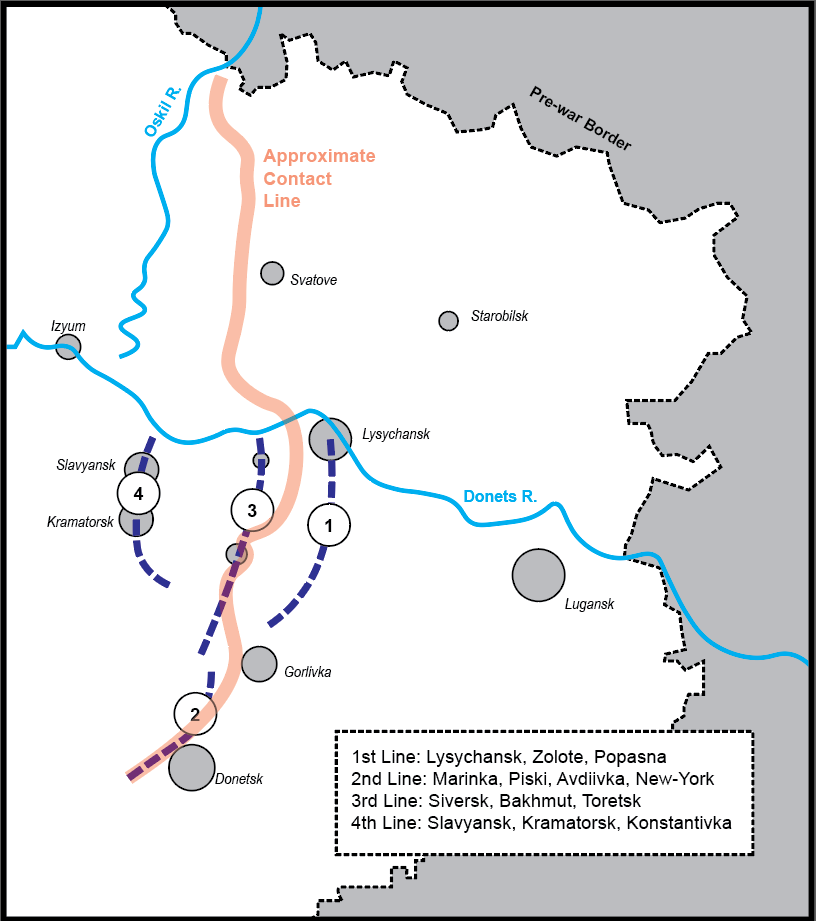
    Let’s take a step back and consider Bakhmut in the context of Ukraine’s overall position in the east. Ukraine began the war with four operable defensive lines in the Donbas, built up over the last 8 years both as part and parcel of the simmering war with the LNR and DNR, but also in preparation for potential war with Russia. These lines are structured around urban agglomerations with road and rail links between each other, and can be roughly enumerated as follows:

    Ukraine Defensive Lines in the East (Map by me)

    The Donbas is a particularly accommodating place to construct formidable defenses. It is highly urbanized and industrial (Donetsk was the most urban oblast in Ukraine prior to 2014, with over 90% of the population living in urban areas), with cities and towns dominated by the typically robust Soviet buildings, along with prolific industrial complexes. Ukraine has spent much of the last decade improving these positions, and the frontline settlements are riddled with trenches and firing positions that are clearly visible on satellite imagery. A recent video from the Avdiivka axis demonstrates the extent of Ukrainian fortifications.

    So, let’s review the state of these defensive belts. The first belt, which ran roughly from Severodonetsk and Lysychansk to Popasna, was broken in the summer by Russian forces. Russia achieved a major breakthrough at Popasna and was able to begin the full rollup of this line, with Lysychansk falling at the beginning of July.

    At this point, the frontline sits directly on what I have labeled as the 2nd and 3rd Ukrainian defensive belts, and both of these belts are now heavily bleeding.

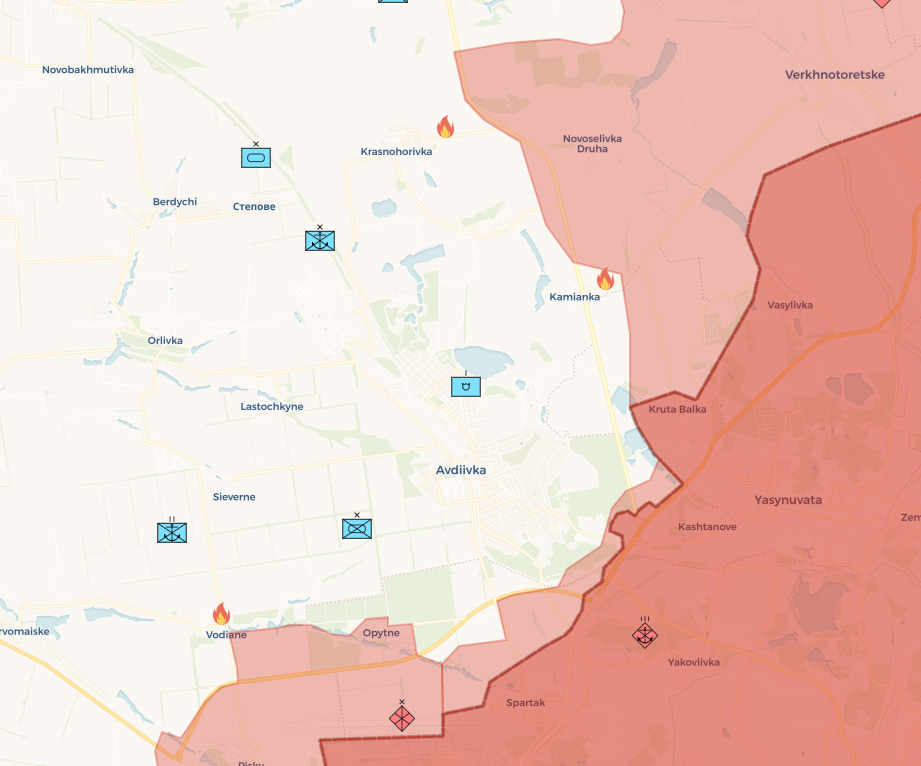
    The capture of Soledar by Wagner forces has severed the connection between Bakhmut and Siversk, while around Donetsk, the heavily fortified suburb of Marinka has been almost completely cleared of Ukrainian troops, and the infamous keystone Ukrainian position in Avdiivka (the place from which they shell Donetsk city’s civilian population) is being flanked from both directions.

    The frontline around Avdiivka (map courtesy of MilitaryLand)

    These positions are absolutely critical for Ukraine to hold. The loss of Bakhmut will mean the collapse of the last defensive line standing in the way of Slavyansk and Kramatorsk, which means Ukraine’s eastern position will rapidly contract to its fourth (and weakest) defensive belt.

    The Slavyansk agglomeration is a far worse position for Ukraine to defend than the other belts, for several reasons. First and foremost, as the belt farthest to the west (and thus the farthest from the February 2022 start lines), it is the least improved and least fortified of the belts. Secondly, lots of the, shall we just say “good stuff” around Slavyansk is to the east of the city, including both the dominating high ground and the major highways.

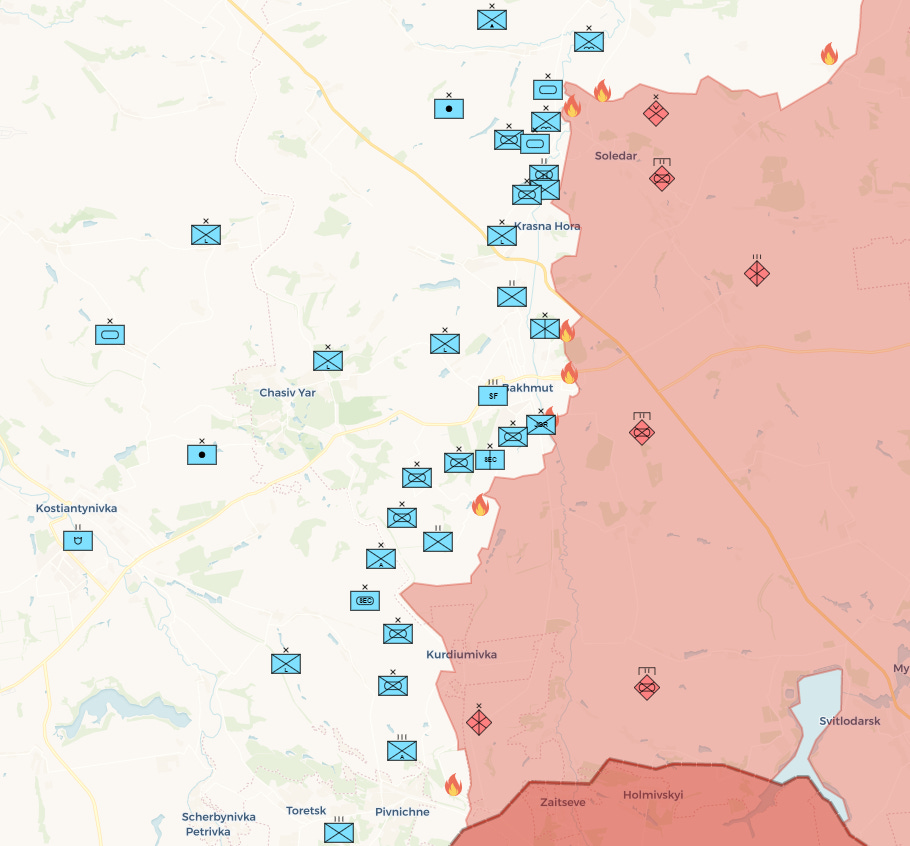
    All this to say, Ukraine has been very anxious to hold the Bakhmut line, as this is a vastly preferable position to hold, and accordingly they have been pouring units into the sector. The absurd levels of Ukrainian force commitment in this area have been well noted, but just as a quick refresher, publicly available Ukrainian sources locate at least 34 brigade or equivalent units that have been deployed in the Bakhmut area. Many of these were deployed months ago and are already shattered, but over the full span of the ongoing battle this represents an astonishing commitment.

    Ukrainian units around Bakhmut (Map courtesy of MilitaryLand)

    Russian forces, primarily Wagner PMC and LNR units, have been slowly but surely collapsing this Ukrainian stronghold by making liberal use of artillery. In November, now former Zelensky advisor Oleksiy Arestovych admitted that Russian artillery on the Bakhmut axis enjoyed roughly a 9 to 1 tube advantage, which is turning Bakhmut into a death pit.

    The battle is being presented in the west as one where Russians – usually stereotyped as convict soldiers employed by Wagner – launch frontal assaults on Ukrainian defenses and take horrible casualties attempting to overwhelm the defense with pure numbers. The opposite is much closer to the truth. Russia is moving slowly because it irons out Ukrainian defenses with artillery, then pushes forward cautiously into these pulverized defenses.

    Ukraine, meanwhile, continues to funnel units in to more or less refill the trenches with fresh defenders. A Wall Street Journal piece about the battle, while trying to present a story of Russian incompetence, accidentally included an admission from a Ukrainian commander on the ground who said: “So far, the exchange rate of trading our lives for theirs favors the Russians. If this goes on like this, we could run out.”

    The comparisons have been liberally made (and I cannot take credit for them) to one of the most infamous battles of World War One – the bloody catastrophe at Verdun. While it does not do to exaggerate the predictive value of military history (in the sense that a thorough knowledge of the first world war does not allow one to predict events in Ukraine), I am, however, a great fan of history as analogy, and the German scheme at Verdun is a useful analogy for what’s happening in Bakhmut.

    The Battle of Verdun was conceived by the German high command as a way to cripple the French army by drawing them into a preconfigured meatgrinder. The notion was to attack and seize crucial defensive high ground – ground so important that France would be forced to counterattack and attempt to recapture it. The Germans hoped that France would commit their strategic reserves to this counterattack so that they could be destroyed. While Verdun failed to completely sap French combat power, it did become one of the most bloody battles in world history. A German coin commemorating the battle depicted a skeleton pumping blood out of the earth – a chilling but apt visual metaphor.

    “The World Blood Pump” – commemorating the meatgrinder at Verdun

    Something similar has indeed occurred in Bakhmut, in the sense that Russia is pressing on one of the most sensitive points on the front line, drawing Ukrainian units in to be killed. A few months ago, on the heels of Russia’s withdrawal from west bank Kherson, the Ukrainians talked ecstatically of continuing their offensive efforts with a strike southward in Zaparozhia to cut the land bridge to Crimea, along with continued efforts to break through into northern Lugansk. Instead, forces from both of these axes have been redirected to Bakhmut, to the point where this axis is actively draining Ukrainian combat strength in other areas. Ukrainian sources, previously full of optimism, now unequivocally agree that there will be no Ukrainian offensives in the near future. As we speak, Ukraine continues to funnel forces into the Bakhmut axis.

    At the present moment, Ukraine’s position around Bakhmut has badly deteriorated, with Russian forces (largely Wagner infantry supported by Russian army artillery) making substantial progress on both of the city’s flanks. On the northern flank, the capture of Soledar pushed Russian lines to within spitting distance of the north-south highways, while the near simultaneous capture of Klishchiivka on the southern flank has propelled the frontlines to the dootstep of Chasiv Yar (firmly in Bakhmut’s operational rear).

    The contact line around Bakhmut, Jauary 20, 2023 (Map by me)

    The Ukrainians are not presently encircled, but the continued creep of Russian positions ever closer to the remaining highways is easily discernable. Currently, Russian forces have positions within two miles of all the remaining highways. Even more importantly, Russia now controls the high ground to both the north and south of Bakhmut (the city itself sits in a depression surrounded by hills) giving Russia fire control over much of the battle space.

    I am currently anticipating that Russia will clear the Bakhmut-Siversk defensive line by late March. Meanwhile, the denuding of Ukrainian forces on other axes raises the prospect of decisive Russian offensives elsewhere.

    At the moment, the front roughly consists of four main axes (the plural of axis, not the bladed implement), with substantial agglomerations of Ukrainian troops. These consist, from south to north, of the Zaporozhia, Donetsk, Bakhmut, and Svatove Axes (see map below). The effort to reinforce the Bakhmut sector has noticeably diluted Ukranian strength on these other sectors. On the Zaporozhia front, for example, there are potentially as few as five Ukrainian brigades on the line at the moment.

    At the moment, the majority of Russian combat power is uncommitted, and both western and Ukrainian sources are (belatedly) becoming increasingly alarmed about the prospect for a Russian offensive in the coming weeks. Currently, the entire Ukrainian position in the east is vulnerable because it is, in effect, an enormous salient, vulnerable to attack from three directions.

    Two operational depth objectives in particular have the potential to shatter Ukrainian logistics and sustainment. These are, respectively, Izyum in the north and Pavlograd in the South. A Russian thrust down the west bank of the Oskil river towards Izyum would simultaneously threaten to cut off and destroy the Ukrainian grouping on the Svatove axis (S on the map) and sever the vital M03 highway from Kharkov. Reaching Pavlograd, on the other hand, would completely isolate the Ukrainian forces around Donetsk and sever much of Ukraine’s transit across the Dneiper [cf. map in title]

    Both Izyum and Pavlograd are roughly 70 miles from the start lines of a prospective Russian offensive, and thus offer a very tempting combination – being both operationally significant and in relatively manageable reach. Beginning yesterday, we started to see Russian advances on the Zaporozhia axis. While these consist, at the moment, mainly of reconnaissance in force pushing into the “grey zone” (that ambiguous interstitial frontage), RUMoD did claim several settlements taken, which could presage a genuine offensive push in this direction. The key tell would be a Russian assault on Orikhiv, which is a large town with a genuine Ukrainian garrison in it. A Russian attack here would indicate that something more than a probing attack is underway.

    It is difficult sometimes to parse out the difference between what we predict will happen and what we want to happen. This, certainly, is what I would choose if I was in charge of Russian planning – a drive south along the west bank of the Oskil river on the Kupyansk-Izyum axis, and a simultanious attack northward past Zaporozhia towards Pavlograd. In this case, I believe simply screening Zaporozhia in the short term is preferable to getting bogged down in an urban battle there.

    Whether Russia will actually attempt this, we do not know. Russian operational security is much better than either Ukraine’s or their proxy forces (Wagner and the LNR/DNR Milita), so we know significantly less about Russia’s deployments than we do about Ukraine’s. Regardless, we know that Russia enjoys a strong preponderance of combat power right know, and there are juicy operational targets within range.

    Please Sir, I Want Some More

    The bird’s eye view of this conflict reveals a fascinating meta-structure to the war. In the above section, I argue for a view of the front structured around Russia progressively breaking through sequential Ukrainian defensive belts. I think that a similar sort of progressive narrative structure applies to the force generation aspect of this war, with Russia destroying a sequence of Ukrainian armies.

    Let me be a bit more concrete. While the Ukrainian military exists at least partially as a continuous institution, its combat power has been destroyed and rebuilt multiple times at this point through western assistance. Multiple phases – life cycles, if you will – can be identified:

    • In the opening months of the war, the extant Ukrainian army was mostly wiped out. The Russians destroyed much of Ukraine’s indigenous supplies of heavy weaponry and shattered many cadres at the core of Ukraine’s professional army.
    • In the wake of this initial shattering, Ukrainian combat strength was shored up by transferring virtually all of the Soviet vintage weaponry in the stockpiles of former Warsaw Pact countries. This transferred Soviet vehicles and ammunition, compatible with existing Ukrainian capabilities, from countries like Poland and the Czech Republic, and was mostly complete by the end of spring, 2022. In early June, for example, western sources were admitting that Soviet stockpiles were drained.
    • With Warsaw Pact stockpiles exhausted, NATO began replacing destroyed Ukrainian capabilities with western equivalents in a process that began during the summer. Of particular note were howitzers like the American M777 and the French Caesar.

    Russia has essentially fought multiple iterations of the Ukrainian Army – destroying the pre-war force in the opening months, then fighting units that were refilled from Warsaw Pact stockpiles, and is now degrading a force which is largely reliant on western systems.

    This led to General Zaluzhny’s now-famous interview with the economist in which he asked for many hundreds of Main Battle Tanks, Infantry Fighting Vehicles, and artillery pieces. In effect, he asked for yet another army, as the Russians seem to keep destroying the ones he has.

    I want to note a few particular areas where Ukraine’s capabilities are clearly degraded beyond acceptable levels, and observe how this relates to NATO’s effort to sustain the Ukrainian war-making effort.

    First, artillery.

    Russia has been prioritizing counterbattery action for many weeks now, and seems to be having great success hunting and destroying Ukrainian artillery.

    It seems that this partially coincides with the deployment of new “Penicillin” counterbattery detection systems. This is a rather neat new tool in the Russian arsenal. Counterbattery warfare generally consists of a dangerous tango of guns and radar systems. Counterbattery radar is tasked with detecting and locating the enemy’s guns, so they can be destroyed by one’s own tubes – the game is roughly analogous to enemy teams of snipers (the artillery) and spotters (the radar) attempting to hunt each other – and of course, it makes good sense to shoot the other side’s radar systems as well, to blind them, as it were.

    The Penicillin system offers potent new capabilities to Russia’s counterbattery campaign because it detects enemy artillery batteries not with radar, but with acoustic locating. It sends up a listening boom which, in coordination with a few ground componants, is able to locate enemy guns through seismic and acoustic detection. The advantage of this system is that, unlike a counterbattery radar, which emits radio waves that give away its position, the Penicillin system is passive – it simply sits still and listens, which means it does not offer an easy way for the enemy to locate it. As a result, in the counterbattery war, Ukraine currently lacks a good way to blind (or rather, deafen) the Russians. Furthermore, Russian counterbattery abilities have been augmented by increased use of the Lancet drone against heavy weapons.

    The Penicillin acoustic boom listens for the sound of enemy guns

    All that to say, Russia has been destroying quite a bit of Ukrainian artillery lately. the Russian Ministry of Defense has made a point of highlighting counterbattery success. Now, I know at this point you’re thinking, “why would you trust the Russian Ministry of Defense?” Fair enough – let’s trust but verify.

    On January 20, NATO convened a meeting at Ramstein Airbase in Germany, against a backdrop of a massive new aid package being put together for Ukraine. This aid package contains, lo and behold, a huge amount of artillery pieces. By my count, the aid announced this week includes nearly 200 artillery tubes. Multiple countries, including Denmark and Estonia, are sending Ukraine literally all of their howitzers. Call me crazy, but I seriously doubt that several countries would just spontaneously decide, at the exact same time, to send Ukraine their entire inventory of artillery pieces were Ukraine not facing crisis levels of artillery losses.

    Furthermore, the United States has taken new, unprecedented steps to supply Ukraine with shells. Just in the past week, they have dipped into its stockpiles in Israel and South Korea, amid reports that American stocks are so depleted that they will take more than a decade to replenish.

    Let’s review the evidence here, and see if we can make a reasonable conclusion:

    1. Ukrainian officials admit that their artillery is outgunned by 9 to 1 in critical sectors of the front.
    2. Russia deploys a cutting edge counterbattery system and increased numbers of Lancet drones.
    3. The Russian MoD claims that they have been hunting and destroying Ukrainian artillery systems in large numbers.
    4. NATO has hurried to put together a massive package of artillery systems for Ukraine.
    5. The United States is raiding critical forward-deployed stockpiles to supply Ukraine with shells.

    I personally think it is reasonable, given all of this, to assume that Ukraine’s artillery arm has been largely shattered, and NATO is attempting to rebuild it yet again.

    My kingdom for a tank

    The main point of contention in recent weeks has been whether or not NATO will give Ukraine Main Battle Tanks. Zaluzhny hinted at a badly depleted Ukrainian tank park in his interview with the Economist, in which he pleaded for hundreds of MBTs. NATO has attempted to provide a stopgap solution by giving Ukraine various armored vehicles like the Bradley IFV and the Stryker, which do restore some mobility, but we must unequivocally say that these are in no way substitutes for MBTs, and they fall far short in both protection and firepower. Attempting to use Bradleys, for example, in the MBT role is not going to work.

    Good Morning

    Thus far, it appears that Ukraine is going to receive a small handful of Challenger tanks from Britain, but there is also talk of donating Leopards (German make), Abrams (American), and Leclercs (French). As usual, the battlefield impact of Ukraine receiving tanks is being both greatly overstated (by both Ukrainian shills and pessimistic Russians) and understated (by Russian triumphalists). I suggest a middle ground.

    The number of tanks that can be reasonably given to Ukraine is relatively low, simply because of the training and sustainment burden. All of these tanks use different ammunition, special parts, and require specialized training. They are not the sort of systems that can simply be driven off the lot and directly into combat by untrained crew. The ideal solution for Ukraine would be to receive only Leopard A24s, as these might be available in decent numbers (perhaps a couple hundred), and at least they would be standardized.

    A burned out Turkish Leopard in Syria

    We should also note, of course, that these western tanks are not likely to be game changers on the battlefield. The Leopard already showed its limitations in Syria under Turkish operation. Note the following quote from this 2018 article:

    “Given that the tanks are widely operated by NATO members – including Canada, the Netherlands, Denmark, Greece and Norway – it is particularly embarrassing to see them so easily destroyed by Syrian terrorists when they are expected to match the Russian Army.”

    Ultimately, the Leopard is a fairly mundane MBT designed in the 1970’s outclassed by the Russian T-90. It’s not a terrible piece of equipment, but it’s hardly a battlefield terror. They will take losses and be attrited just like Ukraine’s prewar tank park was. However, that doesn’t change the fact that a Ukrainian army with a few companies of leopards will be more potent than one without them.

    I think it’s fair to say that the following three statements are all true:

    1. Receiving a mixed bag of western tanks will create a difficult training, maintenance, and sustainment burden for Ukraine.
    2. Western tanks like the Leopard have limited combat value and will be destroyed like any other tank.
    3. Western tanks will raise the combat power of the Ukrainian army as long as they are in the field.

    Now, with that being said, at this point it does not appear that NATO wants to give Ukraine main battle tanks. At first it was suggested that tanks from storage could be dusted off and given to Kiev, but the manufacturer has stated that these vehicles are not in working order and would not be ready for combat until 2024. That leaves only the possibility of dipping directly into NATO’s own tank parks, which thus far they are reticent to do.

    Why? My suggestion would simply be that NATO does not believe in Ukrainian victory. Ukraine cannot even dream of dislodging Russia from its position without an adequate tank force, and so the reticence to hand over tanks suggests that NATO thinks that this is only a dream anyway. Instead, they continue to prioritize weaponry that sustains Ukraine’s ability to fight a static defense (hence, the hundreds of artillery pieces) without indulging in flights of fancy about a great Ukrainian armored thrust into Crimea.

    However, given the intense war fever that has built up in the west, it’s possible that political momentum imposes the choice upon us. It is possible that we have reached the point where the tail wags the dog, that NATO is trapped in its own rhetoric of unequivocal support until Ukraine wins a total victory, and we may yet see Leopard 2A4s burning on the steppe.

    Summary: The Death of a State

    Ukraine’s military is extremely degraded, having taking exorbitant losses in both men and heavy weaponry. I believe Ukrainian KIA are approaching 150,000 at this point, and it is clear that their inventories of both artillery tubes, shells, and armored vehicles are largely exhausted.

    I expect the Bakhmut-Siversk defensive line to be cleared before April, after which Russia will push towards the final (and weakest) defensive belt around Slavyansk. Meanwhile, Russia has significant combat power in reserve, which can be used to reopen the northern front on the west bank of the Oskil and restart offensive operations in Zaporozhia, placing Ukrainian logistics in critical danger.

    This war will be fought to its conclusion on the battlefield and end in a favorable decision for Russia.

    Coda: A Note about Coups

    Feel free to ignore this segment, as it’s a little more nebulous and not concretely related to events in Ukraine or Russia.

    We’ve seen lots of fun rumors about coups in both countries – Putin has foot cancer and his government will collapse, Zelensky is going to be replaced with Zaluzhny, on and on it goes. Patriots in control and all that good stuff.

    In any case, I thought I would just generally write about why coups and revolutions never seem to lead to nice and cuddly democratic regimes, but instead almost always lead to political control passing to the military and security services.

    The answer, you might think, is simply that these men have the guns and the power to access the important rooms where decisions are made, but it is not only that. It also relates to a concept in game theory called Schelling points.

    A Schelling point (named after the gentleman that introduced the concept, an economist named Thomas Schelling) refers to the solution that parties choose given a state of uncertainty and no ability to communicate. One of the classic examples to illustrate the concept is a coordination game. Suppose that you and another person are each shown four squares – three are blue and one is red. You are each asked to choose a square. If you both select the same square, you receive a monetary prize – but you are unable to talk to one another about your choices. How do you choose? Well, most people rationally choose the red square, simply because it is conspicuous – it stands out, and you therefore presume that your partner will also choose this square. The red square isn’t better, per se, it’s just obvious.

    In a state of political turmoil, or even anarchy, the system works itself towards Schelling points – obvious figures and institutions that radiate authority, and are therefore the conspicuous choice to assume power and issue commands.

    The Bolsheviks, for example, understood this very well. Immediately after declaring their new government in 1917, they dispatched commissars to the various office buildings in Saint Petersburg where the Tsarist bureaucracies were headquartered. Trotsky famously turned up at the foreign affairs ministry building one morning and simply announced that he was the new Foreign Minister. The employees laughed at him – who was he? how did he presume to be in charge? – but for Trotsky the point was to insinuate himself on a Schelling point. In the state of anarchy that began to spread in Russia, people naturally look for some obvious focal point of authority, and the Bolsheviks had cleverly positioned themselves as such by claiming control over the bureaucratic offices and titles. On the other side of the civil conflict, political opposition to the Bolsheviks clustered around Tsarist army officers, because they too were Schelling points, in that they already had titles and position within an existing hierarchy.

    All of this is to say that in the event of a coup or state collapse, new governments are virtually never formed sui generis – they always arise from preexisting institutions and hierarchies. Why, when the Soviet Union fell, did political authority devolve to the Republics? Because these Republics were Schelling points – branches that one can grab for safety in a chaotic river.

    I simply say this because I am tired of phantasmagorical stories about liquidation of the regime in Russia and even territorial dissolution. The fall of Putin’s government will not and cannot lead to an acquiescent, western-adjacent regime, because there are no institutions of real power in Russia that are thus disposed. Power would fall to the security services, because they are Schelling points, and that’s where power goes […]

    The original article

    my related pieces

    Russian forces are retreating to the left bank of Dnieper river, are leaving Kherson

    in November 2022

    Strategy in Ukraine, between policy and warfare

    the prospects of destruction of the Ukrainian forces east of Dnieper river

    Countdown of the Atlanticist defeat in Bakhmut

    since early December 20222

    No Panzer counteroffensive is scheduled in Ukraine

    the result of NATO meeting in Ramstein on January 20, 2023