Since the Cold War, Washington has empowered violent anti-Russian extremists

As a negotiated settlement of the Russia–Ukraine war becomes more likely, President Volodymyr Zelensky faces a major obstacle to peace that comes not from Moscow, but from ultranationalist and neo-Nazi forces inside his own country.
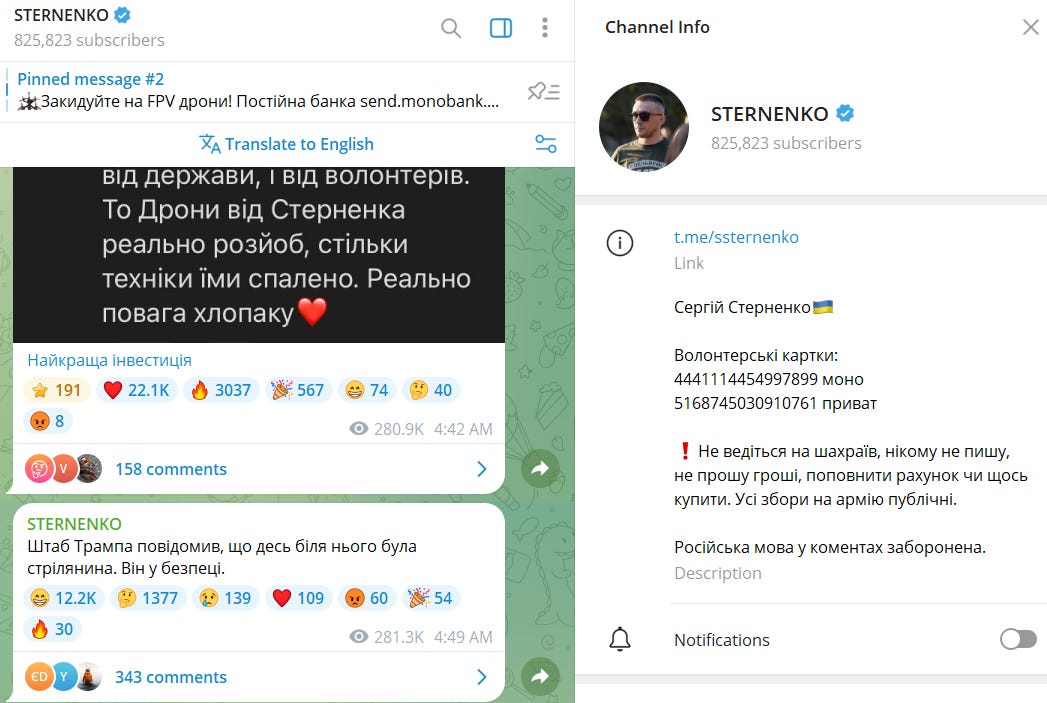
In a recent interview with the Sunday Times, Serhii Sternenko — a leader of the paramilitary group Right Sector, which was founded by neo-Nazis — warned Zelensky that if he ceded any territory to Russia in a peace deal, “he would be a corpse — politically, and then for real.”
Though the Times presents him merely as a “civil activist,” Sternenko served as the head of Right Sector’s Odessa branch, where he oversaw the extremist group’s 2014 crime spree that culminated in the Odessa trade union hall massacre in which militants used Molotov cocktails to burn alive more than 40 antigovernment protestors.
The Times characterizes the Odessa trade union hall massacre as mere “clashes” and fails to attribute the violence to any one particular side, despite the fact that the Right Sector proudly claimed responsibility for it.
Whitewashing Ukraine’s ultra-nationalist right is neither new nor accidental. As the late Stephen Cohen, an eminent scholar of U.S.–Russia relations, warned nearly a decade ago, Western journalists and officials, by downplaying Ukraine’s right-wing militant groups and parroting Kiev’s official claims about them, empowered violent extremists.
The resurgence of Ukraine’s right-wing extremist forces is inseparable from U.S. policy since 2014, when the U.S. facilitated the overthrow of a democratically elected government in Kiev. While Ukrainian liberals participated in the “Maidan Revolution,” the muscle was provided by right-wing extremist groups, which the West bestowed with legitimacy and, eventually, access to arms and funding. What began as the whitewashing of neo-Nazi vigilantes became the normalization of neo-Nazi battalions, which are now embedded in Ukraine’s security elite.
That those same right-wing extremist forces, nurtured by the United States and NATO, now threaten to sabotage a peace deal and overthrow the Zelensky government reveals a bizarre paradox at the heart of our involvement in Ukraine that has yet to be confronted:
Washington interfered in Ukrainian domestic politics and helped finance a proxy war with Russia ostensibly to save Ukrainian democracy from tyranny. But under U.S. tutelage — and in service of proxy war aims — Ukraine has rapidly descended into a more authoritarian state.
Western whitewashing of Ukrainian Nazis is not an aberration of the past decade. Rather, it is consistent with a U.S. strategy that began during the Cold War of recruiting, laundering, and weaponizing extremist forces.
One of the earliest and clearest cases of this strategy was the CIA’s decision to protect rather than prosecute Ukraine’s wartime nationalists, who had openly collaborated with Nazi Germany and perpetrated the mass murder of Jews and Poles. Among them was Stepan Bandera and his OUN-B militant group, which aligned itself with Ukraine’s Nazi “liberators” within the first days of Hitler’s Operation Barbarossa in 1941, when the Axis powers invaded the Soviet Union.
America’s nascent post-war national security state, despite its awareness of Bandera’s Nazi crimes and his organization’s status as “primarily a terrorist organization,” protected Bandera from extradition to the Soviet Union, recruiting him and other known OUN-B Nazi collaborators through programs like the CIA’s Project AERODYNAMIC, aimed at “exploitation and expansion of the anti-Soviet Ukrainian resistance for cold war and hot war purposes.”
Rather than being a source of national shame for Ukraine, its Nazi collaborators are the core icons of Ukrainian nationalism and a source of pride.
Along with Bandera, historical war criminals like Roman Shukhevych — the commander of the OUN-B’s paramilitary wing — have been posthumously venerated by various Ukrainian governments. Both figures were awarded the official title “Hero of Ukraine” in 2007 and 2010, respectively. Bandera’s birthday continues to be celebrated with annual torchlight marches across the country.
During the Maidan uprising in 2014, neo-Nazi militias inspired by Stepan Bandera and associated with Ukraine’s right-wing extremist Svoboda party used sniper rifles to massacre protestors — both pro- and antigovernment — as well as police.
Though the Maidan massacre trials would later pin responsibility for the violence on neo-Nazi paramilitaries from the Right Sector and the political party Svoboda, the chaos was immediately seized upon by the Obama administration to demand the removal of Ukraine’s democratically elected president, Victor Yanukovych, who was instantly blamed for it all.
A leaked U.S. State Department call arguably reveals how career diplomat Victoria Nuland arranged for Svododa leader Oleh Tyahnybok to have a position of influence in Kiev’s post-revolution government, saying her handpicked Prime Minister Arseniy Yatsenyuk should “be on the phone” with the Svoboda leader “four times a week.” The notorious call, along with other evidence of U.S. support for anti-Yanykovych forces, has led many to conclude the “Maidan Revolution” was in fact a U.S.-backed coup.
Washington’s decision in 2014 to protect and empower the extremist groups which perpetrated the Maidan massacre would entrench an ultranationalist and neo-Nazi element within Ukrainian politics that would later sabotage efforts for peace with Russia.
When Zelensky came to power on a promise to resolve the conflict with Russia in Ukraine’s eastern Donbas region, Cohen predicted that the new president’s peace efforts would likely face heavy and possibly violent resistance from the ultranationalist factions that Washington had recently empowered. “His life is being threatened by a quasi-fascist movement,” Cohen warned.
The Biden administration did not look the other way in the face of those extremist forces threatening Zelensky — it looked directly at them and in June 2024 decided to remove State Department restrictions on funding the Azov Battalion, allowing the U.S. government to lavish the neo-Nazi group with weapons.
Under the patronage of President Joe Biden and NATO, Azov — whose members often openly wore Nazi insignia—metastasized from a battalion into an entire brigade integrated into Ukraine’s National Guard.
Biden’s policy was at least consistent, conforming with a decades-long policy of protecting, retooling, and empowering violent extremist groups whenever they served the interests of unelected national security state elites, in this case, anti-Russian neocons.
Earlier this year, Azov further consolidated its influence within Ukraine’s national security apparatus by expanding into multiple corps. Its political reach grew in parallel, with members appointed to key government positions, including Oleksandr Alferov as Director of the Institute of National Memory, giving the neo-Nazi group direct influence over both security policy and the framing of Ukraine’s historical narrative.
Violent Ukrainian nationalist forces like Right Sector, Azov, and Sternenko’s militants have become indispensable foot soldiers in Washington’s project, and therefore their lengthy record of violence and terrorism has been obscured. Even as Zelensky now faces threats to his life from these same forces, they are still celebrated in Western media as heroes of democracy.
The paradox is revealing: The very groups hailed as Ukraine’s “defenders of democracy” are also those eroding it from within, threatening to assassinate the president if he pursues peace. Though an unintended consequence, this perilous dynamic flows from U.S. policy and reveals its true aims.
The U.S. strategy in Ukraine was never about protecting Ukrainian democracy. It was — as Biden’s Defense Secretary Lloyd Austin admitted — about sustaining a proxy war to “weaken Russia.” The emergence of violent antidemocratic forces in Kiev has not been a casualty of that strategy, but its central instrument [end]
The original article
Related
Nazism in Ukraine
its roots before WW2, its collaboration with Nazi Germany, its legacy in modern Ukraine, how NATO has continually supported Nazism in Ukraine, chronicle
The Western disinformation about Ukraine
chronicle of censorship, fake news, whitewashing of the Ukrainian Nazism and war crimes, for the sake of the proxy war that NATO is conducting in Donbass and Ukraine, against Russia
October 26, 2023: Biden Fails to Explain Why U.S. Should Fight Proxy War Against Russia – Doug Bandow, The American Conservative
A deal needs to be made. It won’t be a good one, but the longer Ukraine waits, the worse the deal is likely to become
June 12, 2023: A War Like No Other – Peter Van Buren, the American Conservative
The Biden doctrine is a cynical effort to cash in on the blood of another nation
May 23, 2023: After Bakhmut – Douglas Macgregor, The American Conservative
Russia turned Bakhmut into the graveyard of Ukrainian military power. What comes next?
January 4, 2023: The Long-Term Economic Implications of the Ukraine War – Dan Steinbock, The American Conservative
The human suffering in Ukraine is predicated on massive U.S. military aid, and is transforming an ailing country into a bankrupt failed state
The footprint of the Ukrainian Nazism in the West
interactions between Ukrainian Nazi organizations and Western supremacist militants, chronicle