Analista senior di l'intelligenza in u campu di a gestione di i risichi di sicurezza, sò un anzianu tenente detective è ufficiale di l'intelligenza in l'agenzie di u Statu francese. A bona pronuncia hè Николай Чинкуини, in russu
[my illustration: on October 14, 2007, fascist activists celebrate in Kiev the 65th anniversary of the UPA, a Ukrainian Nazi militia during WW2 (Sergey Starostenko / RIA Novosti)]
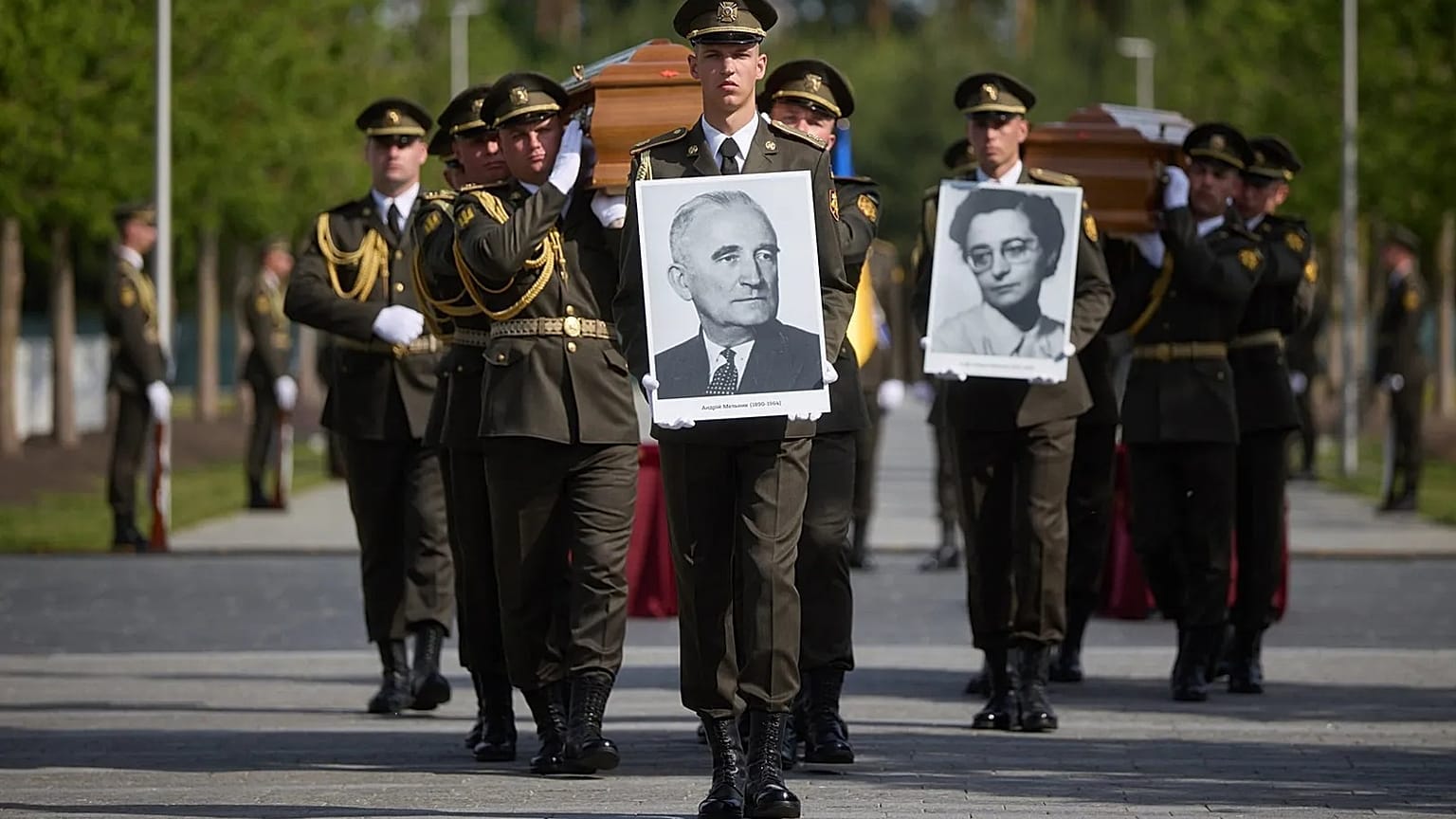
A bitter row has erupted between Kiev and Warsaw, after Volodymyr Zelensky renamed a Ukrainian military unit the “Heroes of the UPA”. The UPA – Ukrainian Insurgent Army – was an ultranationalist factionheavily implicated in the Holocaust, which slaughtered up to 100,000 Polish civilians during World War II. In addition to commemorating the mass-murdering militant group, the corpse of Andriy Melnyk, leader of UPA parent the Organisation of Ukrainian Nationalists (OUN-B), was reburied in Kiev. At a grand accompanying ceremony, Zelensky declared:
Today we all see that the Ukrainian idea can overcome what once seemed absolutely insurmountable. Now, when we are on Ukrainian soil, under our Ukrainian flag, to the sound of the Ukrainian national anthem, paying due tribute to our Ukrainian heroes, we feel in our hearts everything Ukrainians were forced to go through, everything our people had to endure
The unspeakable horrors inflicted upon Poles – and Communists, Jews, Romani and other “undesirables” – by Melynk and his fellow Nazi collaborators were of course unmentioned. So too that the genocidal nationalism practiced and preached by Melynk was covertly promoted and sponsored for decades by Anglo-American intelligence, within and without Ukraine. The ongoing proxy conflict is a direct product of this little-known spectral meddling, which was specifically concerned with promoting cultural and ethnic difference, and enmity, between Russians and Ukrainians globally
Andriy Melnyk’s remains, long-buried in Luxembourg, are returned to Ukraine
As this journalist has previously revealed, in August 1957 the CIA secretly drew up elaborate plans for a US special forces invasion of Ukraine. Intended to collapse the wider Soviet Union, the Agency’s conspiracy depended heavily on recruiting local fascists as footsoldiers. A significant stumbling block to the Agency’s plot, however, was much of Ukraine’s population actually harbouring “few grievances” against Russians or Communism. “Points of conflict” between Russians and Ukrainians, which could be exploited by the CIA to foment a mass uprising, were scant.
The Agency lamented how “the long history of union between Russia and Ukraine, which stretches in an almost unbroken line from 1654 to the present day,” had resulted in “many Ukrainians” having “adopted the Russian way of life.” Moreover, the similarity of their “languages, customs, and backgrounds,” and the “great influence” of Russian culture in Ukraine, meant the overwhelming majority of Ukrainians felt “little national antagonism.” Yet, the CIA believed “important grievances exist,” and “under favorable conditions” Ukrainians would assist US invaders.
Unmentioned in the invasion planning documents, the CIA had since 1949 been covertly striving to create those “favorable conditions.” A key Agency asset used for the purpose was OUN-B chief Mykola Lebed. In 1943, he proposed to “cleanse the entire revolutionary territory” – today’s western Ukraine – of its Polish population, to prevent any future Polish state from claiming the region. A post-war US Army counterintelligence report branded Lebed a “well-known sadist,” and Nazi collaborator
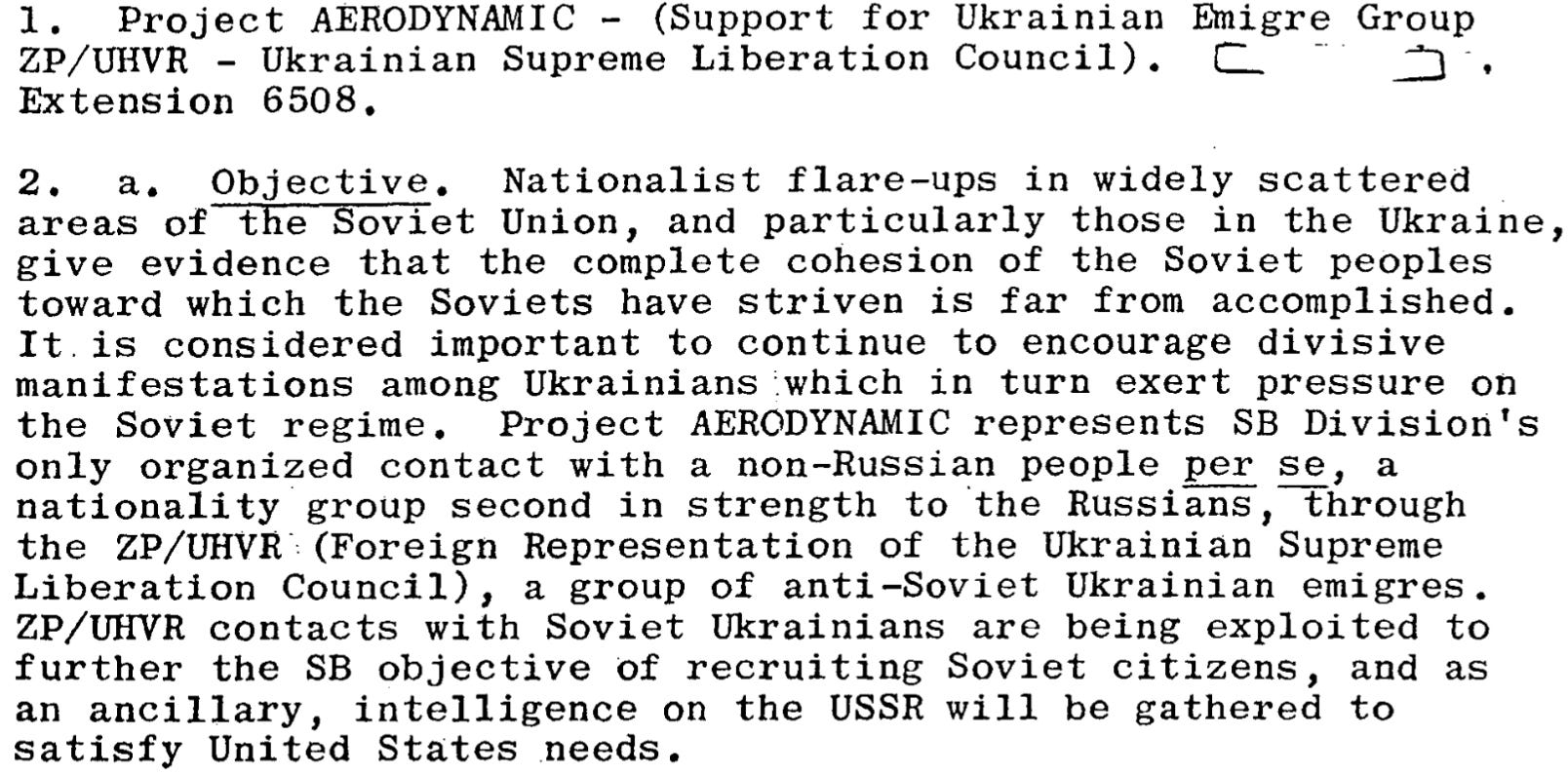
The nucleus of Lebed’s international fascist agitation was Prolog, a New York-based publishing firm. A 1966 CIA memo noted this “cover organization” for the Ukrainian Supreme Liberation Council (ZP/UHVR) was established to conduct “clandestine activity.” It approvingly added that Prolog’s work “contributes to Ukrainian nationalist ferment and to intellectual resistance to Soviet repression by exploiting existing and encouraging new deviationist tendencies” in Ukraine. Elsewhere, the Agency declared it was “important to continue to encourage divisive manifestation” of this sort. The explicitly stated objective was triggering “nationalist flareups” in the USSR:
[ZP/UHVR] were sent from the Ukraine in 1945 by the Ukrainian Supreme Liberation Council to make contact with Western intelligence representatives and to act in behalf of the homeland…[ZP/UHVR] organized a net of collaborators throughout Western Europe and the United States…the feeling of nationalism is very much alive. ZP/UHVR has proved realistic in its approach to operational matters and its propaganda activity
‘Existing Suspicions’
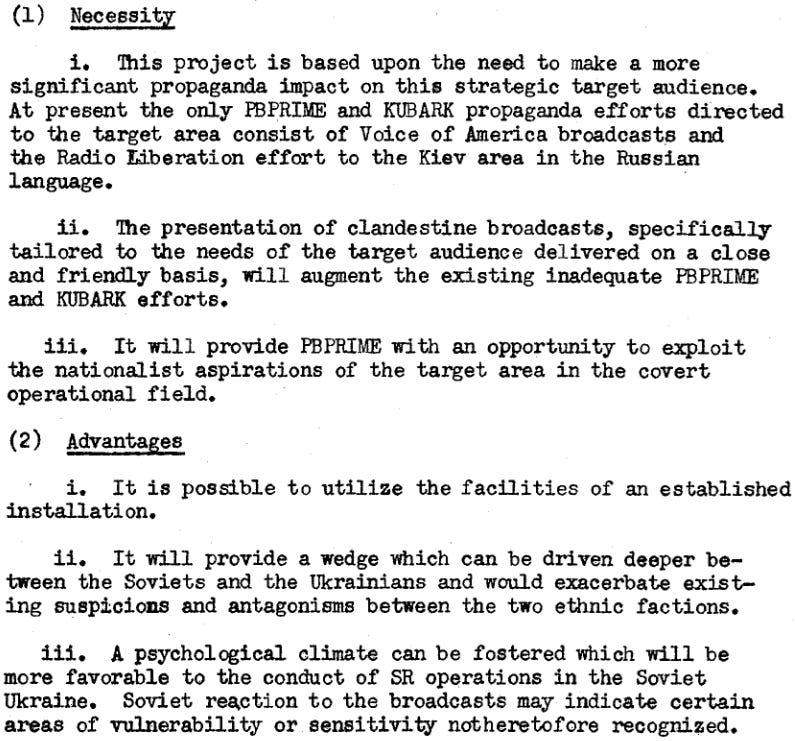
A late 1953 Agency memo documents how the CIA for years broadcasted “black radio transmissions” in Ukrainian from a secret CIA installation in Athens, Greece. “Soviet officialdom, Soviet military forces stationed in the Ukraine, the indigenous civilian population…the underground movement and the Ukrainian Insurgent Army (UPA)” were an intended target audience of 40 million people, upon whom the Agency wished to have a “significant propaganda impact.” Produced by ultranationalist emigres who’d fled Ukraine after World War II, the project sought to foment insurrectionary anti-Communist violence:
Furnish evidence of outside sympathy and understanding for the Ukrainian peoples; intensify anti-regime disaffection by encouraging resentment, bitterness, and distrust of the Soviet regime and its personalities; maintain national consciousness among the Ukrainians and urge them to maintain pride in the individuality and heritage of their culture; create dissatisfaction among Ukrainian military personnel within the Soviet armed forces stationed in the Ukraine; create and intensify dissatisfaction among the Ukrainian civil authorities to the Soviet regime
Publicly, the station’s US-made broadcasts – which included Ukrainian folk songs – were “attributed to a notional group of Ukrainian Anti-Communists.” There was no connection “actual or implied, with any established Ukrainian emigre group.” It was of the utmost importance too the CIA’s hand in creating and running the station was concealed – “every effort will be made to keep this risk at a minimum.” However, the operation’s ruinous spoils were considered well-worth the hazards
“It will provide a wedge which can be driven deeper between the Soviets and the Ukrainians and would exacerbate existing suspicions and antagonisms between the two ethnic factions,” the CIA declared. The Agency also sought to create a wider “psychological climate” among Ukrainian audiences which would be “more favorable” to other anti-Soviet operations it was simultaneously conducting. Moreover, it was forecast “Soviet reaction to the broadcasts may indicate certain areas of vulnerability or sensitivity not heretofore recognized,” which could be further exploited.
‘Imperial Policy’
The CIA’s efforts to encourage Ukrainian nationalism and separatism endured throughout the Cold War. Via avowed CIA front the National Endowment for Democracy, overt US assistance was provided to Rukh (The People’s Movement of Ukraine). One of Soviet Ukraine’s first opposition parties, Rukh is widely considered to have played a key role in securing Ukraine’ ‘independence’ in December 1991. Four months earlier, US President George H W Bush had visited Kiev and given an infamous speech in which he cautioned Ukrainians against embracing “suicidal nationalism based upon ethnic hatred.”
His comments enraged Ukrainian nationalists, and Stateside anti-Soviet hawks. Yet, Bush’s fears were well-founded. By this point, Yugoslavia was rapidly disintegrating, engulfed by ever-violent fratricidal tensions. His administration was thusformally committed at this time to preserving the Soviet Union in some form, and undertook ill-fated measures in service of this goal. Too little, too late, that mission’s failure set Ukraine hurtling towards all-out conflict with Russia. As long-desired by the CIA, “antagonisms between the two ethnic factions” now run deep.
In a bitter twist, it was precisely because the NED-orchestrated February 2014 Maidan coupwas led by rabidly anti-Russian nationalist elements that a majority of Ukrainians did not support the Maidan movement. As a contemporary Washington Postanalysis noted, Viktor Yanukovych remained “the most popular political figure in the country,” and no poll conducted to date had ever indicated mass support for the uprising. Surveys conversely showed “large majorities” of Ukrainians opposed the violent storming of regional governments by Maidan insurrectionists.
This hostility was spurred by “anti-Russian rhetoric and the iconography of western Ukrainian nationalism…not [playing] well among the Ukrainian majority.” Washington Post noted how Neo-Nazi party Svoboda was at Maidan’s forefront. Its leader Oleh Tyahnybok had infamously praisedthe UPA for fighting “against the Moskali [Russians], Germans, Zhydy [Jews] and other scum.” His words were not well-received by the 50% of Ukraine’s population residing in regions that had “strongly identified with Russia” for over two centuries. “Nearly all are alienated by anti-Russian rhetoric and symbols”:
Anti-Russian forms of Ukrainian nationalism expressed on the Maidan are certainly not representative of the general view of Ukrainians. Electoral support for these views and for the political parties who espouse them has always been limited. Their presence and influence in the protest movement far outstrip their role in Ukrainian politics and their support barely extends geographically beyond a few Western provinces
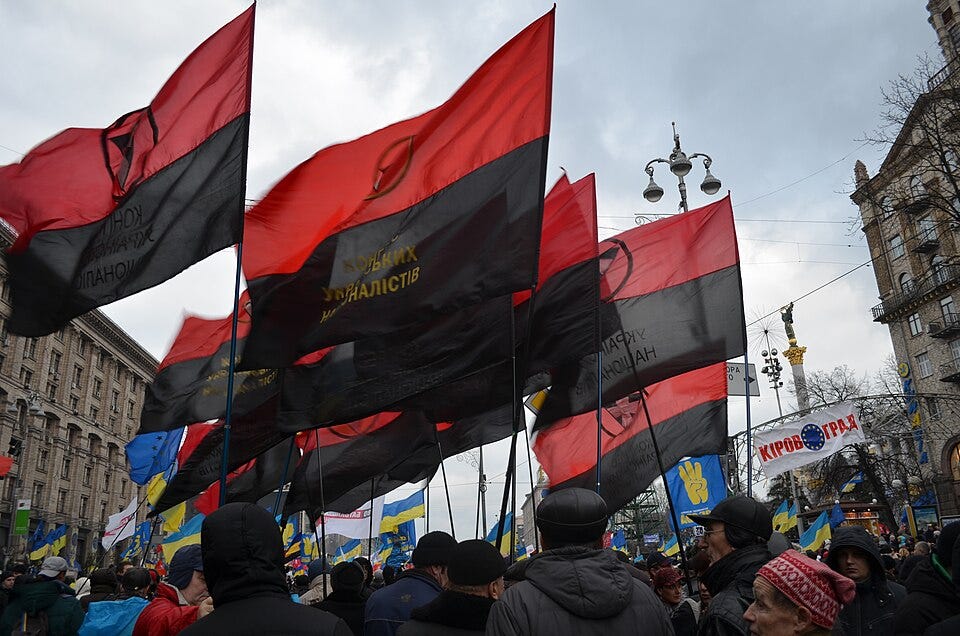
Congress of Ukrainian Nationalists flags at a December 2013 Maidan protest
Fast forward to now, and in response to Ukraine’s state-level glorification of the ultranationalist UPA and its lead genocidaire Andriy Melnyk, Polish President Karol Nawrocki has announced he will seek to strip Zelensky of the Order of the White Eagle, Warsaw’s highest honour, bestowed in 2023. Meanwhile, premier Donald Tusk has cursed the Ukrainian leader’s actions as “[wounding] our historical sensitivity,” and “worrying from the point of view of our relations.”
Authorities in Kiev appear entirely unconcerned their close neighbour and proxy war ally has been so egregiously insulted. A Foreign Ministry spokesperson claimedZelensky had not wished to cause any offence. “Our history confirms only Moscow benefits from disputes between Ukrainians and Poles,” they said. Besides, for Ukrainian soldiers, “the struggle of the UPA symbolises strictly the opposition to Moscow’s imperial policy.” As the CIA always intended, two antithetical versions of history are effectively at war in Donbass. A more devastating modern day example of divide and conquer in action one would be hard-pressed to identify [end]
its roots before WW2, its collaboration with Nazi Germany, its legacy in modern Ukraine, how NATO has continually supported Nazism in Ukraine, chronicle
With the start of the Special Military Operation in February 2022, the nationalist Azov Regiment became one of Ukraine’s most widely recognized military formations. Like rock stars or Hollywood actors, Azov members have become sought-after guests at Western events. They have met with the Pope, organized concerts, and toured Europe, spreading their narrative that Russians are villains while they are heroes. Only in Russia is this regiment, along with similar formations, officially recognized as a terrorist organization
After President Donald Trump’s executive order suspending all US foreign aid programs, the US Agency for International Development (USAID) has again come under intense scrutiny
Leaked files show top UK military figures conspired to carry out the Kerch bridge bombing, covertly train “Gladio”-style stay-behind forces in Ukraine, and groom the British public for a drop in living standards caused by the proxy war against Russia
The killing of ultra-nationalist Ukrainian politician Iryna Farion at the hands of a Neo-Nazi is filled with irony. Linked to the Maidan false flag massacre, Farion was instrumental in bringing fascist forces into the mainstream
From pogrom-mongers to Hitlerites to radical Islamists, the US has collaborated with repugnant partners for more than a century
[my illustration : on December 15, 2013, US Senator John McCain speaks at Maidan square, Kiev. Ukrainian leader of Nazi Svoboda party, Oleh Tyahnybok stands at his left (Dmitry Lovetsky / AP)]
Soviet leader Joseph Stalin was furious when he found out in March 1945 that his supposed World War II ally, Washington, was negotiating with the German Nazis behind his back. In fact, by the accounts of some historians, American spy and future CIA director Allen Dulles essentially kicked off the Cold War when he held secret talks with Waffen SS General Karl Wolff as Hitler’s regime was nearing its collapse.
Stalin, US President Franklin Roosevelt, and UK Prime Minister Winston Churchill had agreed that they would accept only unconditional surrender from the Nazis because of the Hitler regime’s monstrous crimes. When the Dulles-Wolff talks came to light, FDR repeatedly and falsely told Stalin that no one was negotiating with the Germans. The Georgian generalissimo was unconvinced and suspected that his Western allies were maneuvering to contain the USSR and occupy territory that might otherwise fall to the Red Army.
The Soviets had reason to be suspicious. Some in Washington, including Dulles, viewed the USSR as America’s biggest long-term threat even as the countries worked together to defeat Germany.
Save the Nazis
As confirmed by documents that were finally declassified more than half a century later, US intelligence agencies were soon to hire upward of 1,000 Nazis as Cold War spies.
By then, America already had a history of finding common cause against Moscow with unseemly allies. As the Soviets remembered well, the US had invaded Russia in 1918 in a failed effort to help overthrow the Bolshevik government. At the time, Washington was allied with White Army counter-revolutionaries, some of whom had a nasty taste for pogroms and other murderous atrocities.
Even as then-President Woodrow Wilson moralized to world leaders about self-determination and opposing external aggression – principles that would be applied only according to US self-interest in the generations ahead – he sent American forces to intervene in the Russian Civil War. He was to set a precedent that has continued to play out to this day, from Germany to Central Asia to the current Ukraine crisis. The pattern was clear: Portray America as the virtuous champion of freedom while working with anyone — however abhorrent their deeds and views might be — as long as they share Washington’s burning desire to hurt Russia.
In 1945, Dulles got his way with Wolff, formerly Heinrich Himmler’s right-hand man. The general and his group of SS officers, which was called the Black Order, agreed to surrender northern Italy to Allied forces. The deal didn’t avail much for the US, coming just six days before the full German surrender, and it sowed seeds of distrust with the Soviets and other allies.
For his part, Wolff was spared the gallows, as the Nuremberg prosecutors mysteriously took him off their list of major war criminals and treated him as a “witness” to Nazi atrocities, rather than a perpetrator, according to historians. Dulles went so far as to send a rescue team to save Wolff when the general’s villa was surrounded by Italian partisans.
US intelligence agencies, the Pentagon and the FBI helped whitewash the records of the Nazis they wanted to employ after the war. In other cases, notorious war criminals were hidden from America’s allies. One such useful rogue was Klaus Barbie, who was known as the “Butcher of Lyon” when he was torturing Jews and resistance fighters as a Gestapo officer in Vichy France. He worked as a spy in occupied Germany for the US, and after the French demanded that he be extradited to stand trial as a war criminal, Washington whisked him away to Bolivia in 1951.
As a US investigation finally revealed in 1983, the Americans had lied to their French allies about Barbie’s whereabouts. The US Army paid to have Barbie and other anti-communist agents evacuated from Europe through a “rat line” operated by fascist Croatian priest Krunoslav Draganovic. “Officers of the US government were directly responsible for protecting a person wanted by the government of France on criminal charges and arranging his escape from the law,” US investigator Allan Ryan Jr. said.
In addition to directly employing many Nazis, the CIA reportedly paid millions of dollars to tap a large spy network run by Reinhard Gehlen, who was formerly Hitler’s chief intelligence officer on the Eastern Front. The German general was granted immunity from prosecution for his alleged war crimes and helped some of his Nazi cohorts flee Europe to avoid arrest.
The US government employed Nazis for more than just spying. Over 1,600, including scientists and engineers, were brought to the US under Operation Paperclip to help win the Cold War with their technical skills. For instance, the Pentagon brought rocket scientist Wernher von Braun to America along with his new wife, his parents, and his brother. Von Braun, whose team in Germany used slave labor to build V-2 rockets for Hitler, became a hero of the US space program and was the subject of a Disney movie and a Time magazine cover story.
Not all of the Nazi transplants fared so well. Dr. Konrad Schafer, who was brought to a Texas military base because of his experience in aviation medicine, was sent back to Germany because US military officials were unimpressed by his work. As author Eric Lichtblau wrote in his 2014 book ‘The Nazis Next Door’, the Americans were willing to overlook claims by Nuremberg prosecutors that Schafer had links to medical atrocities, but they couldn’t tolerate his lack of “scientific acumen.”
US vs. Jews
Nazis also found post-war work running some of the very same camps where Jews had been slaughtered under the Third Reich. US Army General George Patton was put in charge of the displaced person (DP) camps in American-occupied areas, such as Dachau and Bergen-Belsen, where Jewish survivors were forcibly kept for weeks or months after their “liberation.”
Some of the same guards who oversaw Hitler’s death camps and the same Nazi doctors who committed medical atrocities staffed DP facilities. Jews were still wearing their striped uniforms and being fed meager rations in the camps. When they turned to black-market dealing to obtain more food, German police were sent in to crack down at DP facilities in Stuttgart and Landsberg. Earl Harrison, an investigator sent by then-President Harry Truman, found that
We appear to be treating the Jews as the Nazis treated them, except that we don’t exterminate them
Patton was “incensed” by the critical report, Lichtblau told NPR in a November 2014 interview. “Harrison and his ilk believe that the displaced person is a human being, which he is not,” the US war hero wrote in his diary. “And this applies particularly to the Jews, who are lower than animals.”
Like the Operation Paperclip scientists, many of the CIA’s Nazi spies were moved to the US. These newly minted Americans included the likes of Tscherim Soobzokov, a Circassian from Russia’s Krasnodar area who was nicknamed the Fuhrer of the North Caucasus, and Otto von Bolschwing, a top aide to Adolf Eichmann, who helped craft Nazi policy on dealing with Germany’s “Jewish problem.” Lichtblau quoted a CIA officer as writing, “We will pick up any man who will help us defeat the Soviets – any man, no matter what his Nazi record was.”
Ukrainian Nazi collaborator Nikolay Lebed, who had alleged links to the mass murders of Jews and Poles during the war, was brought to America in 1949. His background was no mystery. The US Army reportedly called him a “well known sadist,” and the CIA codenamed him “Devil.” But he was seen as too valuable as an anti-Soviet operative, so the CIA blocked his deportation when US immigration authorities decided to investigate a few years later. Lebed lived on under US protection, dying at the age of 89 in Pittsburgh.
Useful and not so enemies
The FBI, under director J. Edgar Hoover, also relied on a network of Nazi spies and informants and helped protect them from prosecution and deportation. Laszlo Agh admitted to an FBI agent about his involvement in Hungary’s Arrow Cross, a fascist group that murdered thousands of Jews and helped deport thousands of others. Agh allegedly tortured many of his victims, forcing some to eat their own feces or jump onto partially buried bayonets. Nevertheless, historians say, Hoover recruited Agh as an anti-communist informant, and when immigration officials finally got around to trying to prosecute and deport the Nazi collaborator for visa fraud, the FBI chief forbid his agent from testifying about what the Hungarian had confessed.
In choosing to take the low moral ground, Hoover and the FBI betrayed the trust of Americans, living and dead,” wrote historian Richard Rashke, author of ‘Useful Enemies’. The agency’s “conspiracy of silence” in protecting war criminals made Americans “unwitting hypocrites in the eyes of the world,” he added. “How then must Americans judge the cadre of unelected, powerful men who welcomed some of those same murderers to America and helped them escape punishment in the name of national security?
Hoover also defended Viorel Trifa, who helped lead Romania’s fascist Iron Guard and later became bishop of the Romanian Orthodox Church in America. He became so politically connected that he once led prayers in Congress and met personally with then-Vice President Richard Nixon. Back in Romania, Trifa was sentenced to death in absentia for alleged war crimes. Hoover, who considered Trifa a “very desirable part of the landscape during the Cold War,” persuaded Nixon to cancel a meeting with one of the bishop’s accusers in 1955.
America’s Nazi migrants largely flew under the radar of public exposure until the 1970s, when activists began seeking to hold them accountable. In 1979, the US Department of Justice (DOJ) formed a new unit to investigate and prosecute hidden war criminals for deportation. However, the arms of the federal government that had been doing business with Hitler’s acolytes proved to be a hindrance to the DOJ initiative.
When Soobzokov was indicted for visa fraud in 1979, based on allegations that he had lied about his record as a Waffen SS officer, the CIA suddenly found a copy of a document showing that the Fuhrer of the North Caucasus had disclosed his Nazi past. It turns out that the spy agency had fired Soobzokov not due to his alleged wartime atrocities, but because he hadn’t been honest enough with his handlers. The agency did get him to admit to leading a death squad and executing a troublemaker, but his interviewer believed the Circassian spy was still holding back much of his story.
Author Howard Blum wrote that Soobzokov was a lieutenant in a mobile killing unit that participated in the murders of a staggering 1.4 million Jews on the Eastern Front. But the former SS officer publicly denied any involvement with the Nazis and sued Blum and his publisher, owned by the New York Times, for libel. With witnesses wavering in the wake of Soobzokov’s CIA-aided escape from prosecution – and the author’s documentary evidence being challenged as “Russian disinformation” – the Times chose to pay a $500,000 settlement. The truth only came to light in 2006, more than two decades after Soobzokov’s death, when the CIA declassified 27,000 pages of documents relating to war crimes.
Not all of America’s imported Nazis were brought in by the government. Many snuck in as refugees through a lax immigration system, including some with SS tattoos on their arms. US Representative Elizabeth Holtzman condemned immigration officials for “appalling laxity and superficiality” in trying to root out war criminals.
For example, Andrija Artukovic, a high official in Croatia’s fascist Ustasha government during the war, adopted a fake identity and entered the US on a tourist visa in 1948. Artukovic simply overstayed his visa and worked at a California company owned by his brother. Yugoslavia requested his extradition on war crimes charges in 1951, and US officials stalled for seven years before refusing to send back the illegal alien. By the time he was finally extradited on a new request in 1986, he was 86 years old, so even after he was convicted of mass killings and sentenced to death in Yugoslavia, he was allowed to die of natural causes.
Ukrainian-born Nazi collaborator Jakob Reimer worked as a senior SS guard at a concentration camp in Trawniki, Poland, and allegedly took part in ghetto liquidations. He obtained a US visa in 1952 and managed to avoid a deportation order until 2005, but he died, at age 76, before he could be removed from the US. When confronted in court over his wartime conduct, he reportedly said, “It is all forgotten. It is all over.”
From Nazis to Islamists
America’s pattern of championing virtuous ideals to the rest of the world while partnering with villainous allies against Moscow was on display again in 1979. That’s when the CIA began providing weapons and funding to Islamist rebels in Afghanistan even before Soviet forces invaded the country to prop up the communist government in Kabul.
Then-President Jimmy Carter attacked the USSR’s intervention in Kabul as a “blatant violation of accepted international rules of behavior,” but his administration eagerly and secretly armed jihadists who sought to overthrow Afghanistan’s pro-Soviet government. Ronald Reagan continued the policy after winning the 1980 presidential election.
Peaking at $630 million in 1987 and escalating in sophistication from antiquated rifles to Stinger anti-aircraft missiles, the aid was funneled primarily to radical fighters favored by Pakistan, rather than to the less ideological rebels who had been fighting the government prior to the Soviet invasion.
The Mujahideen fighters and America’s government shared essentially only one common goal: killing Russians. Once Soviet troops finished withdrawing from Afghanistan in 1989, the allies became enemies. Some of the rebels later formed the Taliban, which took over Afghanistan, committed atrocities against civilians and harbored the Al-Qaeda Islamists who allegedly carried out the deadliest terrorist attacks in US history – on September 11, 2001.
Al-Qaeda was also born out of the Afghan conflict. Group leader Osama bin Laden and many of his fighters formerly battled the Soviets with US-supplied arms. The group’s ironic origins gave rise to the nickname ‘Al-CIAeda’. But if there was a lesson learned from the deadly fallout, it apparently wasn’t heeded.
The US and its allies backed Islamist rebels again when they tried unsuccessfully to oust the regime of Syrian President Bashar al-Assad, who was backed by Russia. US officials claimed to support only “moderate” rebels, but intentionally or otherwise, American weapons wound up in the hands of jihadist groups such as the al-Nusra Front and Ahrar al-Sham. According to the UN, the Syrian Civil War has killed more than 300,000 civilians. The war also turned millions of Syrians into refugees, giving rise to the European migrant crisis.
Latest US anti-Russian project
Even as Washington was ramping up aid to the Syrian rebels in 2014, President Barack Obama’s administration found time to help overthrow the elected government of Ukraine, led by Viktor Yanukovich. Although Yanukovich said he supported Ukraine eventually joining the European Union, he was viewed as too pro-Russian by the West.
The fact that neo-Nazi militias helped provide the muscle for the violent Euromaidan overthrow – and put down anti-coup demonstrators in the aftermath – was apparently an acceptable collaboration for Washington. When members of the far-right Svoboda Party took several leadership positions in the new government, US officials stood with them – literally, in the case of Senator John McCain, who shared a stage with Oleg Tyagnibok at Kiev’s Independence (Maidan) Square.
Obama’s administration offered no condemnation when at least 48 people were killed and hundreds injured in an attack on anti-Euromaidan protestors in Odessa. Most of the victims were burned to death by a far-right mob when they tried to take shelter in the city’s union hall. Others were shot or beaten when they tried to escape the burning building.
Ukraine’s fascist Right Sector group reacted by celebrating the massacre as “yet another bright page in our fatherland’s history.” Ukrainian MP Lesya Orobets, who had been praised by US media outlet Daily Beast as a “rising star” of the anti-Yanukovych opposition, also celebrated the killings, reportedly calling the Odessa incident a “liquidation” of pro-Russia enemies.
To this day, the perpetrators of the massacre haven’t been held accountable. The Council of Europe concluded in November 2020 that the Kiev government had failed to properly investigate and prosecute those responsible for the killings.
Ukraine has continued to embrace its World War II Nazi collaborators, including Stepan Bandera, who is venerated in public marches. Two years after the coup, one of the main avenues in Kiev was renamed Stepan Bandera Street. Lviv also boasts a Stepan Bandera Street. In the eyes of Ukraine’s neo-Nazis, one of Yanukovich’s sins was his decision to revoke an earlier government declaration honoring Bandera as an official “Hero of Ukraine.”
Ironically, Bandera was considered too “extreme” even for the CIA, which instead chose to work with other Organization of Ukrainian Nationalists (OUN) leaders, including Lebed and Yaroslav Stetsko. The latter’s writings became the ideological foundation of the Svoboda Party.
The Office of Strategic Services (OSS), the forerunner to the CIA, concluded in September 1945 that Bandera had conducted a “reign of terror” during the war. Nevertheless, the US Army refused to extradite Bandera to the Soviet Union as a war criminal. “American intelligence officials recognized that his arrest would have quick and adverse effects on the future of US operations with the Ukrainians,” according to a CIA document released in 2006.
Ukrainian ‘heroes’
Some US leaders had misgivings about Ukraine’s modern-day Nazis. For instance, Congress voted in March 2018 to ban allowing US military aid for Ukraine to go to the Azov Battalion, many of whose members openly proclaim neo-Nazi ideology. “White supremacy and neo-Nazism are unacceptable and have no place in our world,” Representative Ro Khanna said at the time. US lawmakers had removed an earlier ban in 2016 at the behest of the Pentagon.
The issue was controversial back then. Major media outlets wrote about Ukraine’s “Nazi problem,” and when the funding ban was repealed in 2016, the Simon Wiesenthal Center blasted Congress, saying the US had “purposely ignored the glorification of Nazi collaborators, the granting of financial benefits to those who fought alongside the Nazis and the systematic promotion of the canard of equivalency between communist and Nazi crimes by these countries because of various political interests.”
Forty US senators signed a letter in 2019 demanding that the Azov Battalion and other far-right groups be designated as terrorist organizations by the State Department.
The Cato Institute, a libertarian Washington think tank, wrote in May 2021 that Ukraine’s “slide into authoritarianism” was accelerating. “It is reckless to treat Ukraine as a US ally on strategic grounds, and it is morally offensive to do so on the basis of alleged democratic solidarity,” Cato senior fellow Ted Galen Carpenter said.
The Biden administration should jettison this increasingly odious client state as soon as possible
However, as the current Ukraine crisis began to bubble up late last year, such concerns were squashed. Last December, the US and Ukraine were the only nations to vote against a United Nations General Assembly resolution “combating [the] glorification of Nazism, neo-Nazism” and other practices that fuel racism. Among other provisions that Kiev found objectionable, the resolution called for prohibiting commemorative celebrations of the German Nazis or their collaborators.
Now that Ukrainian forces are fighting Russia, the US and its allies, as well as Western media outlets, are backing Kiev even more uncritically. Biden has framed the conflict as a battle for “democracy and freedom,” even as Ukrainian President Vladimir Zelensky bans opposition parties, shuts down critical broadcasters and arrests dissenters.
Facebook changed its rules on February 24, the day that Russia’s military offensive began, to allow its nearly three billion users to praise the Azov Battalion. Media outlets softened their portrayals of the militia. For instance, the Washington Post called it a “nationalist outfit,” and the New York Times, which previously referred to the group as “openly neo-Nazi,” began calling it “celebrated.”
The Wall Street Journal whitewashed the group’s Nazi ties while praising the courage of its members. Multiple outlets wrote sympathetically in September about Azov fighters who allegedly faced rough treatment while in Russian captivity, and Business Insider noted that more than $130,000 had been raised for a battalion member who needed money for medical treatment.
The media’s willingness to “conceal Ukraine’s corruption and authoritarianism has grown even worse since the outbreak of war with Russia,” Cato’s Carpenter said in May. “The coverage of the Ukraine war threatens to achieve a new low in media integrity and credibility. When the establishment press whitewashes the behavior of outright neo-Nazis, something is terribly amiss.”
Azov’s image had been so transformed, in fact, that co-founder Giorgi Kuparashvili and five other representatives of the battalion reportedly met with over 50 members of Congress in Washington in September as part of the delegation’s US tour. The group auctioned off Azov patches, featuring the Wolfsangel logo, while visiting a Ukrainian American church in Detroit last month.
Also last month, a Kiev street that was previously named in honor of Soviet Marshal Rodion Malinovsky was officially renamed to celebrate the “heroes” of the Azov Battalion. Among the dignitaries attending the October 26 renaming ceremony was Azov founder Andrey Biletsky, nicknamed the “White Ruler” by fellow neo-Nazis. Malinovsky, a Ukrainian by origin, liberated much of the country from Hitler’s Nazis in 1943-1944 and was twice named a Hero of the Soviet Union.
Ukraine’s fascist elements apparently aren’t limited to the fringes of its society, or the fringes of its military. In an October 6 Twitter message, General Valery Zaluzhny, the commander-in-chief of the country’s armed forces, posted a photo of himself apparently wearing a bracelet made of tiles emblazoned with swastikas. He later claimed that the bracelet depicted Scandinavian pagan symbols that looked like swastikas because of the image’s digital compression.
However, Nazi symbols have also popped up in photos posted by Zelensky, including an Instagram post showing one of his bodyguards wearing a “Totenkopf” patch. A similar patch, showing a skull and crossbones symbol donned by SS forces in World War II, was also worn by a Ukrainian soldier in another photo posted by Ukraine’s president. Apart from the Nazi imagery used openly by the Azov fighters, regular Ukrainian service members have been photographed wearing SS patches and painting swastikas on their vehicles.
History repeats itself
Such symbols aren’t a concern for the US and its NATO allies. Biden dismissed the claim by Russian President Vladimir Putin that Moscow aimed to “de-Nazify” Ukraine, calling it a “cynical” and “obscene” lie. Like other anti-Russia voices, he has argued that Zelensky’s Jewish ancestry proves that Ukraine doesn’t have Nazi leanings. Russian Foreign Minister Sergey Lavrov countered that Zelensky “personally patronizes” Kiev’s Nazi tendencies.
Then again, US officials have a long history of situational condemnation of Nazism and of viewing potentially useful villains through a rose-colored lens, especially when anti-Moscow interests are shared. Such was the case when Dulles, the future CIA director, sized up Wolff, the man described by Nuremberg prosecutors as Himmler’s “bureaucrat of death.” The spy leader’s own agency, the OSS, blamed Wolff for the “wholesale slaughter of populations.”
In a telegram cabled back to Washington, Dulles praised the SS bigwig as a “dynamic” and “distinctive personality.” He saw Wolff as handsome and trustworthy, representing a “more moderate element in [the] Waffen SS, with [a] mixture of romanticism.”
A quote cited by Christopher Simpson and other historians might help explain the apparently skewed mindset of Dulles and other US intelligence officials in how they viewed Nazis and Nazi collaborators. “We knew what we were doing,” said Harry Rositzke, who ran the CIA’s Soviet division in Munich from 1951 to 1954. “It was a visceral business of using any bastard as long as he was anti-communist” [end]
This article has been published on November 13, 2022, on RT (Russia Today), which is currently censored in many Western countries. You can use a virtual private network (VPN) or an online proxy, in order to bypass the censorship.