Analista senior di l'intelligenza in u campu di a gestione di i risichi di sicurezza, sò un anzianu tenente detective è ufficiale di l'intelligenza in l'agenzie di u Statu francese. A bona pronuncia hè Николай Чинкуини, in russu
[my illustration: on October 14, 2007, fascist activists celebrate in Kiev the 65th anniversary of the UPA, a Ukrainian Nazi militia during WW2 (Sergey Starostenko / RIA Novosti)]
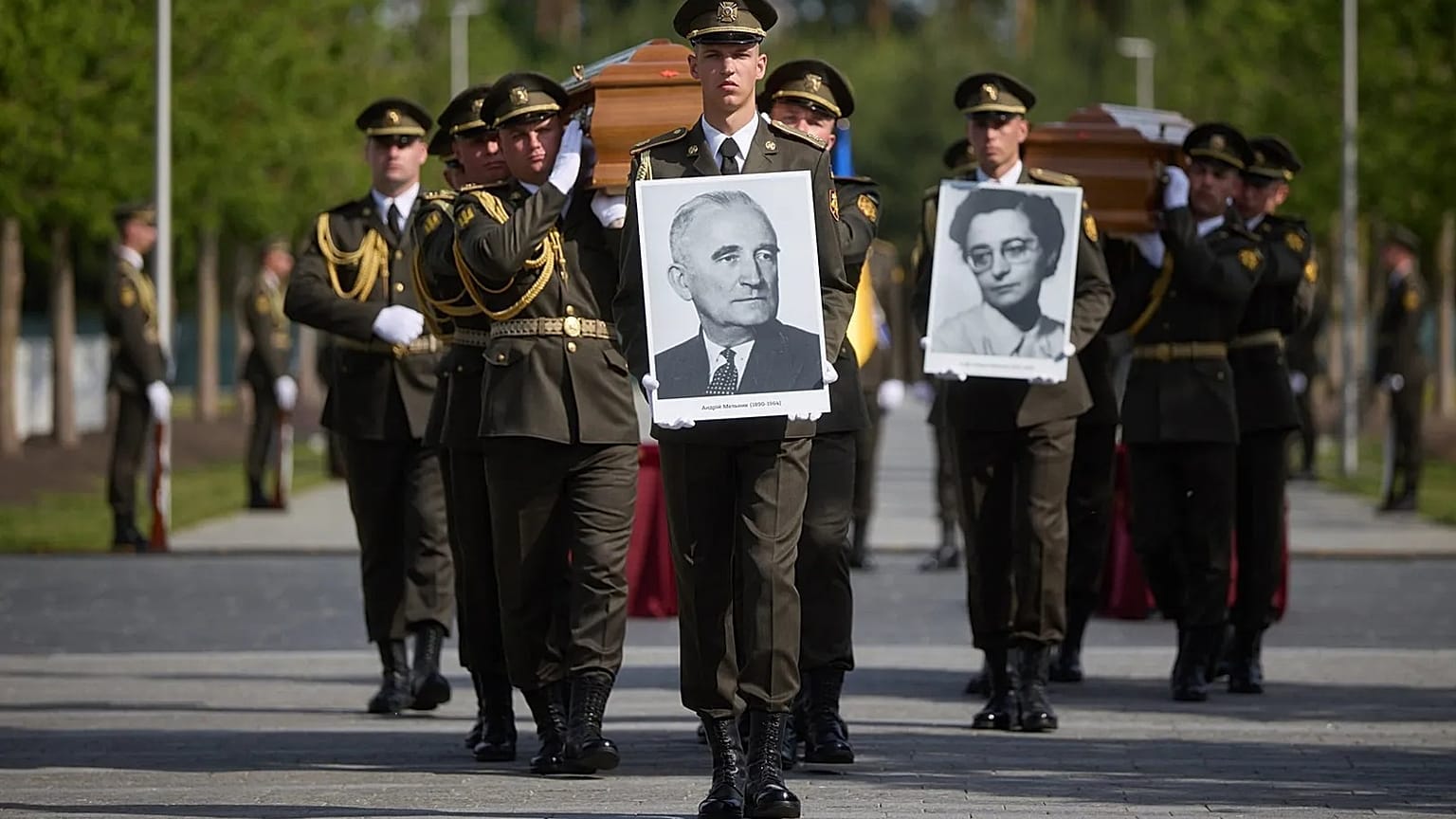
A bitter row has erupted between Kiev and Warsaw, after Volodymyr Zelensky renamed a Ukrainian military unit the “Heroes of the UPA”. The UPA – Ukrainian Insurgent Army – was an ultranationalist factionheavily implicated in the Holocaust, which slaughtered up to 100,000 Polish civilians during World War II. In addition to commemorating the mass-murdering militant group, the corpse of Andriy Melnyk, leader of UPA parent the Organisation of Ukrainian Nationalists (OUN-B), was reburied in Kiev. At a grand accompanying ceremony, Zelensky declared:
Today we all see that the Ukrainian idea can overcome what once seemed absolutely insurmountable. Now, when we are on Ukrainian soil, under our Ukrainian flag, to the sound of the Ukrainian national anthem, paying due tribute to our Ukrainian heroes, we feel in our hearts everything Ukrainians were forced to go through, everything our people had to endure
The unspeakable horrors inflicted upon Poles – and Communists, Jews, Romani and other “undesirables” – by Melynk and his fellow Nazi collaborators were of course unmentioned. So too that the genocidal nationalism practiced and preached by Melynk was covertly promoted and sponsored for decades by Anglo-American intelligence, within and without Ukraine. The ongoing proxy conflict is a direct product of this little-known spectral meddling, which was specifically concerned with promoting cultural and ethnic difference, and enmity, between Russians and Ukrainians globally
Andriy Melnyk’s remains, long-buried in Luxembourg, are returned to Ukraine
As this journalist has previously revealed, in August 1957 the CIA secretly drew up elaborate plans for a US special forces invasion of Ukraine. Intended to collapse the wider Soviet Union, the Agency’s conspiracy depended heavily on recruiting local fascists as footsoldiers. A significant stumbling block to the Agency’s plot, however, was much of Ukraine’s population actually harbouring “few grievances” against Russians or Communism. “Points of conflict” between Russians and Ukrainians, which could be exploited by the CIA to foment a mass uprising, were scant.
The Agency lamented how “the long history of union between Russia and Ukraine, which stretches in an almost unbroken line from 1654 to the present day,” had resulted in “many Ukrainians” having “adopted the Russian way of life.” Moreover, the similarity of their “languages, customs, and backgrounds,” and the “great influence” of Russian culture in Ukraine, meant the overwhelming majority of Ukrainians felt “little national antagonism.” Yet, the CIA believed “important grievances exist,” and “under favorable conditions” Ukrainians would assist US invaders.
Unmentioned in the invasion planning documents, the CIA had since 1949 been covertly striving to create those “favorable conditions.” A key Agency asset used for the purpose was OUN-B chief Mykola Lebed. In 1943, he proposed to “cleanse the entire revolutionary territory” – today’s western Ukraine – of its Polish population, to prevent any future Polish state from claiming the region. A post-war US Army counterintelligence report branded Lebed a “well-known sadist,” and Nazi collaborator
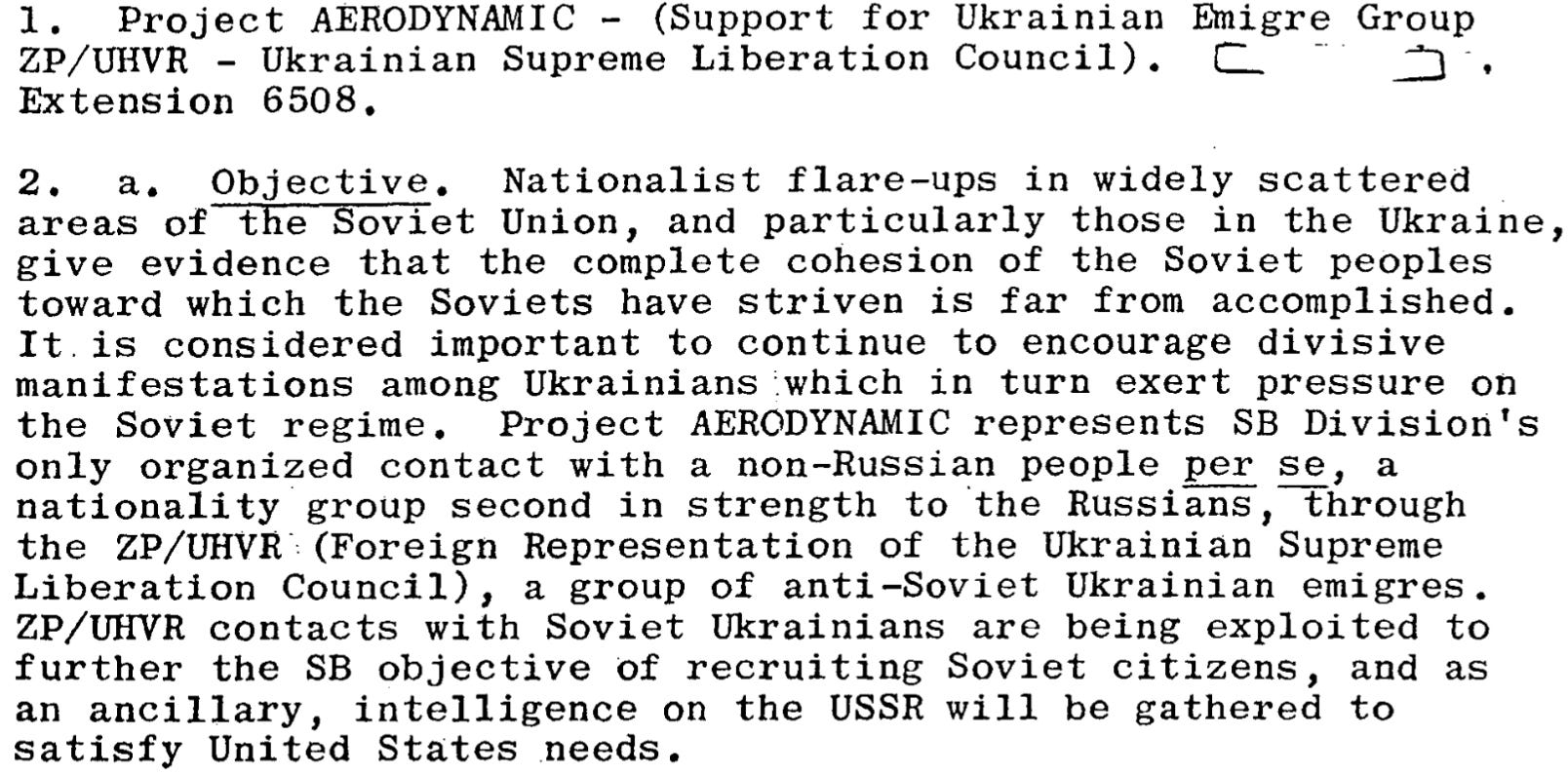
The nucleus of Lebed’s international fascist agitation was Prolog, a New York-based publishing firm. A 1966 CIA memo noted this “cover organization” for the Ukrainian Supreme Liberation Council (ZP/UHVR) was established to conduct “clandestine activity.” It approvingly added that Prolog’s work “contributes to Ukrainian nationalist ferment and to intellectual resistance to Soviet repression by exploiting existing and encouraging new deviationist tendencies” in Ukraine. Elsewhere, the Agency declared it was “important to continue to encourage divisive manifestation” of this sort. The explicitly stated objective was triggering “nationalist flareups” in the USSR:
[ZP/UHVR] were sent from the Ukraine in 1945 by the Ukrainian Supreme Liberation Council to make contact with Western intelligence representatives and to act in behalf of the homeland…[ZP/UHVR] organized a net of collaborators throughout Western Europe and the United States…the feeling of nationalism is very much alive. ZP/UHVR has proved realistic in its approach to operational matters and its propaganda activity
‘Existing Suspicions’
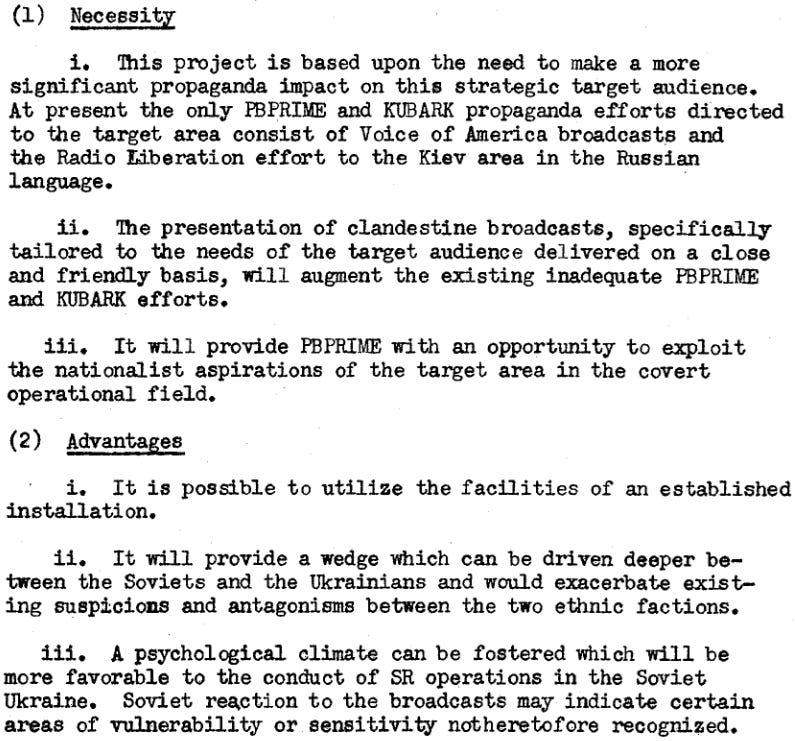
A late 1953 Agency memo documents how the CIA for years broadcasted “black radio transmissions” in Ukrainian from a secret CIA installation in Athens, Greece. “Soviet officialdom, Soviet military forces stationed in the Ukraine, the indigenous civilian population…the underground movement and the Ukrainian Insurgent Army (UPA)” were an intended target audience of 40 million people, upon whom the Agency wished to have a “significant propaganda impact.” Produced by ultranationalist emigres who’d fled Ukraine after World War II, the project sought to foment insurrectionary anti-Communist violence:
Furnish evidence of outside sympathy and understanding for the Ukrainian peoples; intensify anti-regime disaffection by encouraging resentment, bitterness, and distrust of the Soviet regime and its personalities; maintain national consciousness among the Ukrainians and urge them to maintain pride in the individuality and heritage of their culture; create dissatisfaction among Ukrainian military personnel within the Soviet armed forces stationed in the Ukraine; create and intensify dissatisfaction among the Ukrainian civil authorities to the Soviet regime
Publicly, the station’s US-made broadcasts – which included Ukrainian folk songs – were “attributed to a notional group of Ukrainian Anti-Communists.” There was no connection “actual or implied, with any established Ukrainian emigre group.” It was of the utmost importance too the CIA’s hand in creating and running the station was concealed – “every effort will be made to keep this risk at a minimum.” However, the operation’s ruinous spoils were considered well-worth the hazards
“It will provide a wedge which can be driven deeper between the Soviets and the Ukrainians and would exacerbate existing suspicions and antagonisms between the two ethnic factions,” the CIA declared. The Agency also sought to create a wider “psychological climate” among Ukrainian audiences which would be “more favorable” to other anti-Soviet operations it was simultaneously conducting. Moreover, it was forecast “Soviet reaction to the broadcasts may indicate certain areas of vulnerability or sensitivity not heretofore recognized,” which could be further exploited.
‘Imperial Policy’
The CIA’s efforts to encourage Ukrainian nationalism and separatism endured throughout the Cold War. Via avowed CIA front the National Endowment for Democracy, overt US assistance was provided to Rukh (The People’s Movement of Ukraine). One of Soviet Ukraine’s first opposition parties, Rukh is widely considered to have played a key role in securing Ukraine’ ‘independence’ in December 1991. Four months earlier, US President George H W Bush had visited Kiev and given an infamous speech in which he cautioned Ukrainians against embracing “suicidal nationalism based upon ethnic hatred.”
His comments enraged Ukrainian nationalists, and Stateside anti-Soviet hawks. Yet, Bush’s fears were well-founded. By this point, Yugoslavia was rapidly disintegrating, engulfed by ever-violent fratricidal tensions. His administration was thusformally committed at this time to preserving the Soviet Union in some form, and undertook ill-fated measures in service of this goal. Too little, too late, that mission’s failure set Ukraine hurtling towards all-out conflict with Russia. As long-desired by the CIA, “antagonisms between the two ethnic factions” now run deep.
In a bitter twist, it was precisely because the NED-orchestrated February 2014 Maidan coupwas led by rabidly anti-Russian nationalist elements that a majority of Ukrainians did not support the Maidan movement. As a contemporary Washington Postanalysis noted, Viktor Yanukovych remained “the most popular political figure in the country,” and no poll conducted to date had ever indicated mass support for the uprising. Surveys conversely showed “large majorities” of Ukrainians opposed the violent storming of regional governments by Maidan insurrectionists.
This hostility was spurred by “anti-Russian rhetoric and the iconography of western Ukrainian nationalism…not [playing] well among the Ukrainian majority.” Washington Post noted how Neo-Nazi party Svoboda was at Maidan’s forefront. Its leader Oleh Tyahnybok had infamously praisedthe UPA for fighting “against the Moskali [Russians], Germans, Zhydy [Jews] and other scum.” His words were not well-received by the 50% of Ukraine’s population residing in regions that had “strongly identified with Russia” for over two centuries. “Nearly all are alienated by anti-Russian rhetoric and symbols”:
Anti-Russian forms of Ukrainian nationalism expressed on the Maidan are certainly not representative of the general view of Ukrainians. Electoral support for these views and for the political parties who espouse them has always been limited. Their presence and influence in the protest movement far outstrip their role in Ukrainian politics and their support barely extends geographically beyond a few Western provinces
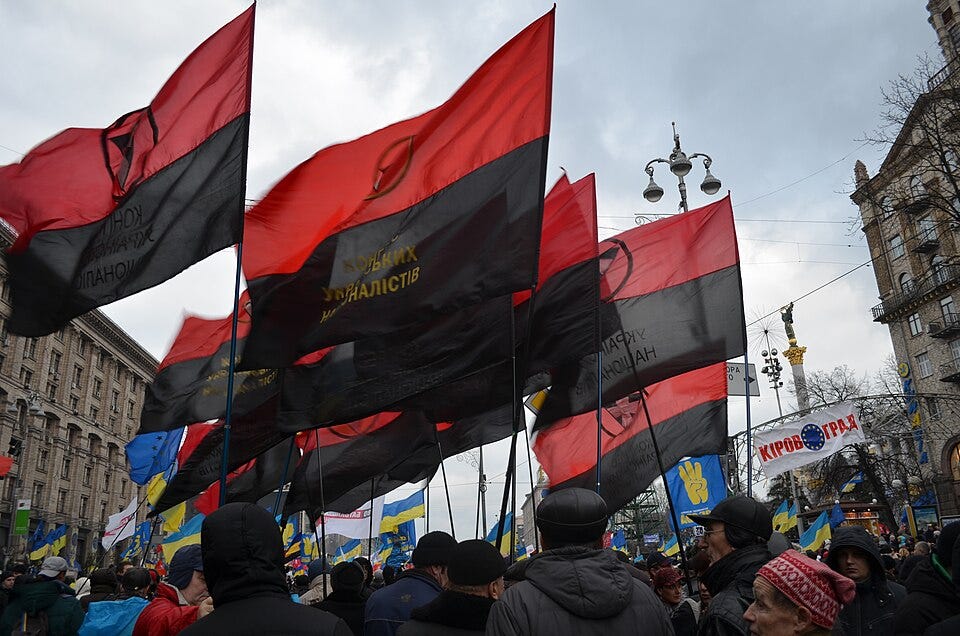
Congress of Ukrainian Nationalists flags at a December 2013 Maidan protest
Fast forward to now, and in response to Ukraine’s state-level glorification of the ultranationalist UPA and its lead genocidaire Andriy Melnyk, Polish President Karol Nawrocki has announced he will seek to strip Zelensky of the Order of the White Eagle, Warsaw’s highest honour, bestowed in 2023. Meanwhile, premier Donald Tusk has cursed the Ukrainian leader’s actions as “[wounding] our historical sensitivity,” and “worrying from the point of view of our relations.”
Authorities in Kiev appear entirely unconcerned their close neighbour and proxy war ally has been so egregiously insulted. A Foreign Ministry spokesperson claimedZelensky had not wished to cause any offence. “Our history confirms only Moscow benefits from disputes between Ukrainians and Poles,” they said. Besides, for Ukrainian soldiers, “the struggle of the UPA symbolises strictly the opposition to Moscow’s imperial policy.” As the CIA always intended, two antithetical versions of history are effectively at war in Donbass. A more devastating modern day example of divide and conquer in action one would be hard-pressed to identify [end]
its roots before WW2, its collaboration with Nazi Germany, its legacy in modern Ukraine, how NATO has continually supported Nazism in Ukraine, chronicle
With the start of the Special Military Operation in February 2022, the nationalist Azov Regiment became one of Ukraine’s most widely recognized military formations. Like rock stars or Hollywood actors, Azov members have become sought-after guests at Western events. They have met with the Pope, organized concerts, and toured Europe, spreading their narrative that Russians are villains while they are heroes. Only in Russia is this regiment, along with similar formations, officially recognized as a terrorist organization
After President Donald Trump’s executive order suspending all US foreign aid programs, the US Agency for International Development (USAID) has again come under intense scrutiny
Leaked files show top UK military figures conspired to carry out the Kerch bridge bombing, covertly train “Gladio”-style stay-behind forces in Ukraine, and groom the British public for a drop in living standards caused by the proxy war against Russia
The killing of ultra-nationalist Ukrainian politician Iryna Farion at the hands of a Neo-Nazi is filled with irony. Linked to the Maidan false flag massacre, Farion was instrumental in bringing fascist forces into the mainstream
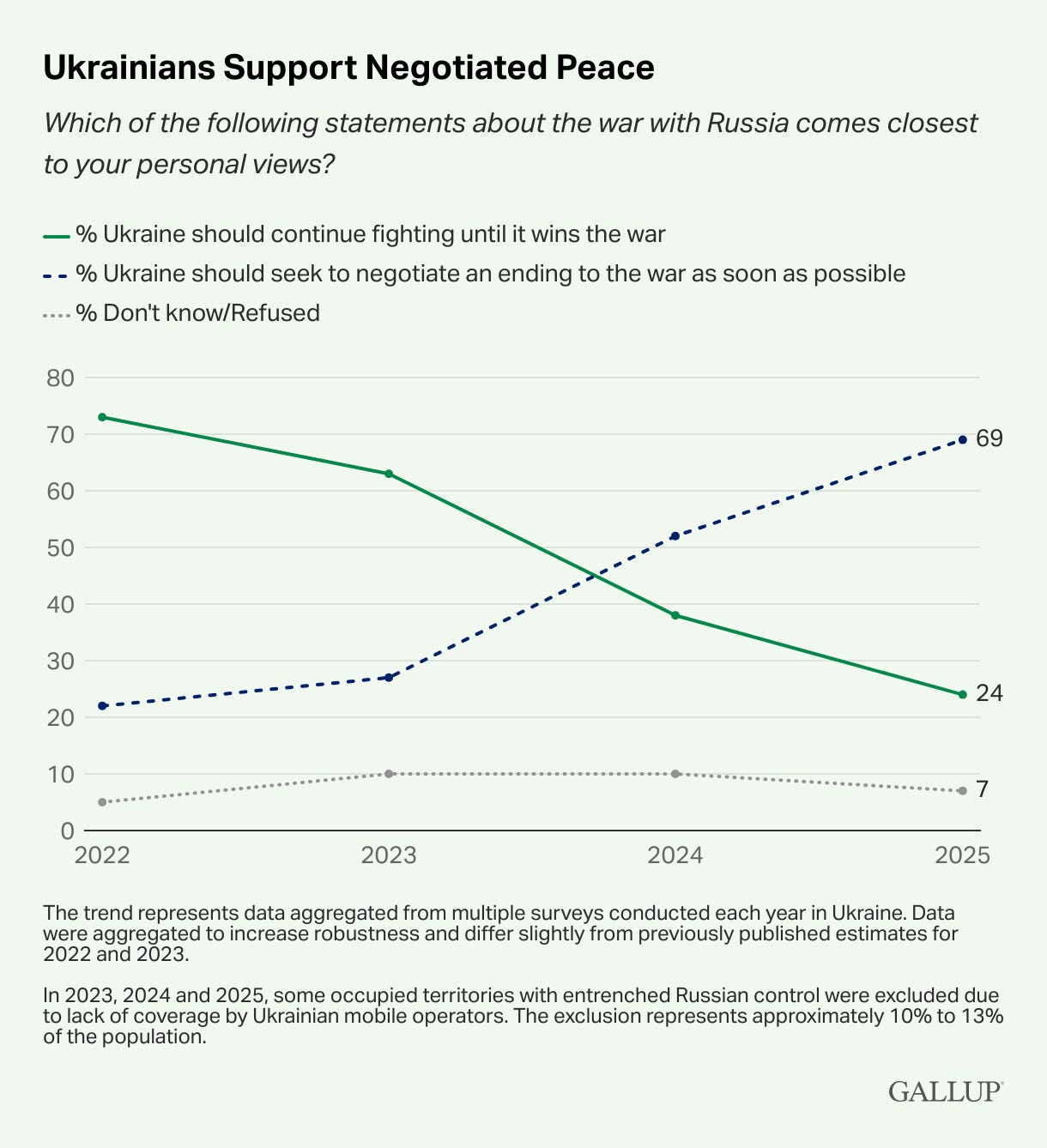
On August 7th, US polling giant Gallup published the remarkable results of a survey of Ukrainians. Public support for Kiev “fighting until victory” has plummeted to a record low “across all segments” of the population, “regardless of region or demographic group.” In a “nearly complete reversal from public opinion in 2022,” 69% of citizens “favor a negotiated end to the war as soon as possible.” Just 24% wish to keep fighting. However, vanishingly few believe the proxy war will end anytime soon.
The reasons for Ukrainian pessimism on this point are unstated, but an obvious explanation is the intransigence of President Volodymyr Zelensky, encouraged by his overseas backers – Britain in particular. London’s reverie of breaking up Russia into readily-exploitable chunks dates back centuries, and became turbocharged in the wake of the February 2014 Maidan coup. In July that year, a precise blueprint for the current proxy conflict was published by the Institute for Statecraft, a NATO/MI6 cutout founded by veteran British military intelligence apparatchik Chris Donnelly, who now oversees London’s management of the proxy conflict
In response to the Donbass civil war, Statecraft advocated targeting Moscow with a variety of “anti-subversive measures”. This included “economic boycott, breach of diplomatic relations,” as well as “propaganda and counter-propaganda, pressure on neutrals.” The objective was to produce “armed conflict of the old-fashioned sort” with Russia, which “Britain and the West could win.” While we are now witnessing in real-time the brutal unravelling of Donnelly’s monstrous plot, Anglo-American designs of using Ukraine as a beachhead for all-out war with Moscow date back far further.
In August 1957, the CIA secretly drew up elaborate plans for an invasion of Ukraine by US special forces. It was hoped neighbourhood anti-Communist agitators would be mobilized as footsoldiers to assist in the effort. A detailed 200-page report, Resistance Factors and Special Forces Areas, set out demographic, economic, geographical, historical and political factors throughout the then-Soviet Socialist Republic that could facilitate, or impede, Washington’s quest to ignite local insurrection, and in turn the USSR’s ultimate collapse
The mission was forecast to be a delicate and difficult balancing act, as much of Ukraine’s population held “few grievances” against Russians or Communist rule, which could be exploited to foment an armed uprising. Just as problematically, “the long history of union between Russia and Ukraine, which stretches in an almost unbroken line from 1654 to the present day,” resulted in “many Ukrainians” having “adopted the Russian way of life”. Problematically, there was thus a pronounced lack of “resistance to Soviet rule” among the population.
The “great influence” of Russian culture over Ukrainians, “many influential positions” in local government being held “by Russians or Ukrainians sympathetic to [Communist] rule, and “relative similarity” of their “languages, customs, and backgrounds”, meant there were “fewer points of conflict between the Ukrainians and Russians” than in Warsaw Pact nations. Throughout those satellite states, the CIA had to varying success already recruited clandestine networks of “freedom fighters” as anti-Communist Fifth Columnists. Yet, the Agency remained keen to identify potential “resistance” actors in Ukraine:
Some Ukrainians are apparently only slightly aware of the differences which set them apart from Russians and feel little national antagonism. Nevertheless, important grievances exist, and among other Ukrainians there is opposition to Soviet authority which often has assumed a nationalist form. Under favorable conditions, these people might be expected to assist American Special Forces in fighting against the regime
‘Nationalist Activity’
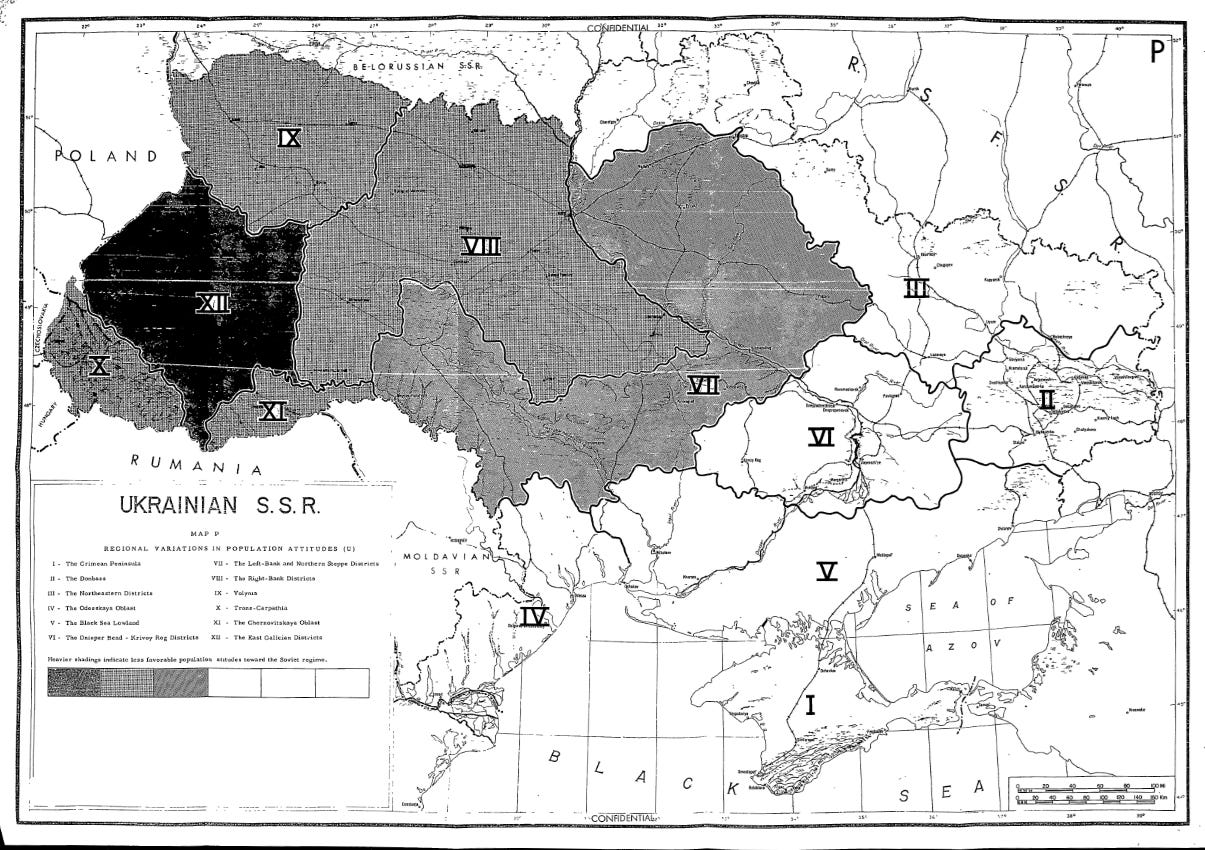
A CIA map split Ukraine into 12 separate zones, ranked on “resistance” potential, and how “favorable population attitudes [are] toward the Soviet regime.” South and eastern regions, particularly Crimea and Donbass, rated poorly. Their populations were judged “strongly loyal” to Moscow, having never “displayed nationalist feelings or indicated any hostility to the regime,” while viewing themselves as “a Russian island in the Ukrainian sea.” In fact, as the study recorded, during and after World War I, when Germany created a fascist puppet state in Ukraine:
Inhabitants of Donbass strongly resisted Ukrainian nationalists and at one point created a separate republic, independent of the rest of Ukraine. In the following years, they defended Soviet rule and Russian interests, often attacking the Ukrainian nationalists with more zeal than the Russian leaders themselves. During the German occupation in the Second World War, there was not a single recorded case of support for the Ukrainian nationalists or Germans
Still, invading and occupying Crimea was considered of paramount importance. On top of its strategic significance, the peninsula’s landscape was forecast as ideal for guerrilla warfare. The terrain offered “excellent opportunities for concealment and evasion,” the CIA report noted. While “troops operating in these sectors must be specially trained and equipped,” it was forecast the local Tatar population, “which fought so fiercely” against the Soviets in World War II, “would probably be willing to help” invading US forces.
Areas of western Ukraine, including former regions of Poland such as Lviv, Rivne, Transcarpathia and Volyn, which were heavily under control of “Ukrainian insurgents” – adherents of MI6-supported Stepan Bandera – during World War II, were judged most fruitful “resistance” launchpads. There, “nationalist activity was extensive” during World War II, with armed militias opposing “pro-Soviet partisans with some success.” Conveniently too, mass extermination of Jews, Poles and Russians by Banderites in these regions meant there was virtually no non-ethnic Ukrainian population left.
Furthermore, in the post-war period, “resistance to Soviet rule” had been “expressed on a great scale” in western Ukraine. Despite “extensive deportations”, “many nationalists” remained in Lviv et al, and “nationalist cells” created by Bandera’s “task forces” remained dotted around the country. For example, anti-Communist “partisan bands” had taken up residence in the Carpathian Mountains. The review concluded, “it is in this region [US] Special Forces could expect considerable support from the local Ukrainian population, including active participation in measures directed against the Soviet regime.”
It was also determined that “Ukrainian nationalist, anti-Soviet sentiment” in Kiev was “apparently moderately strong,” and elements of the population “might be expected to provide active assistance to Special Forces.” The capital’s “large Ukrainian population” was reportedly “little affected by Russian influence,” and during the Russian Revolution “provided greater support than any other region for Ukrainian, nationalist, anti-Soviet forces.” Resultantly, “uncertainty about the attitudes of the local population” prompted Moscow to designate the Ukrainian SSR’s capital, which it remained until 1934.
The CIA document further offered highly detailed assessments of Ukrainian territory, based on their utility for warfare. For example, “generally forbidding” Polesia – near Belarus – was noted to be “almost impossible” to traverse during spring. Conversely, winter provided “most favorable to movement, depending on the depth to which the ground freezes.” Overall, the area had “proved its worth as an excellent refuge and evasion area by supporting large-scale guerilla activities in the past.” Meanwhile, “swampy valleys of the Dnieper and Desna rivers” were of particular interest:
The area is densely forested in its north-western part, where there are excellent opportunities for concealment and manoeuvre…There are extensive swamps, interspersed with patches of forest, which also provide good hiding places for the Special Forces. Conditions in the Volyno-Podolskaya Highlands are less suitable, although small groups may find temporary shelter in the sparse forests
‘Strongly Anti-Nationalist’
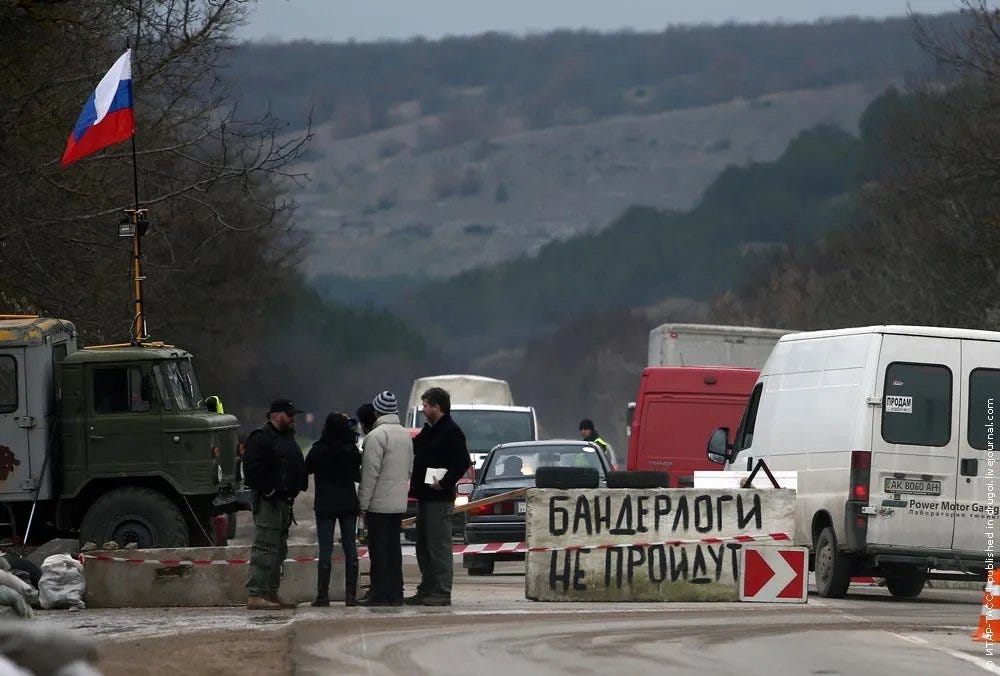
The CIA’s invasion plan never formally came to pass. Yet, areas of Ukraine forecast by the Agency to be most welcoming of US special forces were precisely where support for the Maidan coup was highest. Moreover, in a largely unknown chapter of the Maidan saga, fascist Right Sector militants were bussed en masse to Crimea prior to Moscow’s seizure of the peninsula. Had they succeeded in overrunning the territory, Right Sector would’ve fulfilled the CIA’s objective, as outlined in Resistance Factors and Special Forces Areas
A civilian defence barricade constructed to prevent Right Sector entering Crimea, February 2014
Given what transpired elsewhere in Ukraine following February 2014, other sections of the CIA report take on a distinctly eerie character. For instance, despite its strategic position facing the Black Sea, the Agency warned against attempting to foment anti-Soviet rebellion in Odessa. The agency noted the city is “the most cosmopolitan area in Ukraine, with a heterogeneous population including significant numbers of Greeks, Moldovans and Bulgarians, as well as Russians and Jews.” As such:
Odessa…has developed a less nationalistic character. Historically, it has been considered more Russian than Ukrainian territory. There was little evidence of nationalist or anti-Russian sentiment here during the Second World War, and the city…was in fact controlled by a strongly anti-nationalist local administration [during the conflict]
Odessa became a key battleground between pro- and anti-Maidan elements, from the moment the Maidan protests erupted in November 2013. By March the next year, Russophone Ukrainians had occupied the city’s historic Kulykove Pole Square, and were calling for a referendum on the establishment of an “Odessa Autonomous Republic”. Tensions came to a head on May 2nd, when fascist football ultras – who subsequently formed Azov Battalion – flooded Odessa and forced dozens of anti-Maidan activists into the Trade Unions House, before setting it ablaze.
In all, 42 people were killed and hundreds injured, while Odessa’s anti-Maidan movement was comprehensively neutralised. In March this year, the European Court of Human Rights issued a damning ruling against Kiev over the massacre. It concluded local police and fire services “deliberately” failed to respond appropriately to the inferno, and authorities insulated culpable officials and perpetrators from prosecution despite possessing incontrovertible evidence. Lethal “negligence” by officials on the day, and ever after, was found to go far “beyond an error of judgment or carelessness.”
The ECHR was apparently unwilling to consider that the lethal incineration of anti-Maidan activists was an intentional and premeditated act of mass murder, conceived and directed by Kiev’s US-installed fascist government. However, the findings of a Ukrainian parliamentary commission point ineluctably towards this conclusion. Whether, in turn, the Odessa massacre was intended to trigger Russian intervention in Ukraine, thus precipitating “armed conflict of the old-fashioned sort” with Moscow that “Britain and the West could win” is a matter of speculation [end]
its roots before WW2, its collaboration with Nazi Germany, its legacy in modern Ukraine, how NATO has continually supported Nazism in Ukraine, chronicle
Leaked files reviewed by The Grayzone expose the covert war waged by British intelligence against Russia in the Black Sea, outlining Ukrainian “honey trap” plots along with blueprints for blowing up the Kerch Bridge
With the start of the Special Military Operation in February 2022, the nationalist Azov Regiment became one of Ukraine’s most widely recognized military formations. Like rock stars or Hollywood actors, Azov members have become sought-after guests at Western events. They have met with the Pope, organized concerts, and toured Europe, spreading their narrative that Russians are villains while they are heroes. Only in Russia is this regiment, along with similar formations, officially recognized as a terrorist organization
After President Donald Trump’s executive order suspending all US foreign aid programs, the US Agency for International Development (USAID) has again come under intense scrutiny
Leaked files show top UK military figures conspired to carry out the Kerch bridge bombing, covertly train “Gladio”-style stay-behind forces in Ukraine, and groom the British public for a drop in living standards caused by the proxy war against Russia
The killing of ultra-nationalist Ukrainian politician Iryna Farion at the hands of a Neo-Nazi is filled with irony. Linked to the Maidan false flag massacre, Farion was instrumental in bringing fascist forces into the mainstream
After President Donald Trump’s executive order suspending all US foreign aid programs, the US Agency for International Development (USAID) has again come under intense scrutiny
This renewed attention casts a spotlight on USAID’s history of fomenting unrest and orchestrating “regime change” worldwide since it was established in 1961 by President John F. Kennedy.
On January 21, on his first day back in office, Trump signed the order—among many others—to freeze funding for US foreign assistance for a 90-day review period to determine whether these programs align with his “America First” foreign policies.
On January 25, the US State Department ordered a sweeping freeze on new funding for almost all US foreign assistance, exempting emergency food programs and military aid to Israel and Egypt.
In fiscal year 2023, the US has disbursed $72 billion in assistance—approximately 1 percent of its budget—supporting programs in 204 countries and regions. These initiatives purportedly span various sectors, including disaster relief, health, and so-called pro-democracy endeavors.
USAID, the agency responsible for implementing much of the US foreign aid program, is significantly impacted by Trump’s order. The directive effectively halts the agency’s current $42.8 billion budget allocated for global operations.
Last week, reports revealed that many senior USAID officials were affected by furloughs, dismissals, and disciplinary leaves, amid an investigation into attempts to circumvent the executive order.
In addition, several hundred Washington-based contractors and others around the world were laid off. On Saturday, the USAID website went offline. The agency’s computer servers were carted away.
Trump administration has vowed to strip USAID of its independence as a government agency and place it under the State Department’s control, not to save taxpayer money but to spend it the way he deems fit, according to observers, including on the Tel Aviv regime and its lobbies.
Although it remains unclear whether the president possesses the legal authority to bypass Congress and order USAID’s merger into the State Department, Secretary of State Marco Rubio told reporters on Monday that he has been named acting director of USAID.
On Monday, Trump stated that he doesn’t need Congress to scrap the agency. “Not when it comes to fraud. If there’s fraud, these people are lunatics,” Trump said.
Billionaire tech mogul Elon Musk, who was appointed as head of the Department of Government Efficiency last month, said on Monday that Trump agreed the USAID needs to be “shut down.”
“With regards to the USAID stuff, I went over it with (the president) in detail and he agreed that we should shut it down,” Musk said in an X Spaces conversation.
On the same day a group of Senate and House Democrats, who are opposed to Trump’s efforts to shut down the agency, were blocked from entering the headquarters of the USAID.
On Thursday, the Trump administration said it will keep 611 essential workers onboard at USAID out of a worldwide workforce that totals more than 10,000.
Following a lawsuit by unions representing the USAID, US District Judge Carl Nichols on Friday temporarily allowed roughly 2,700 USAID employees put on leave by Trump’s administration to go back to work, pausing aspects of the plan to dismantle the agency
Protesters gather outside of USAID headquarters on February 3, 2025 in Washington, DC, to protest the Trump administration’s move to dismantle America’s aid agency. (Photo via AFP)
‘Arm of regime change’
According to observers, there is a dark side to US-provided foreign aid, particularly involving USAID.
Over the years, activists have frequently exposed the exploitation of USAID by successive US governments to push their nefarious agendas abroad. In numerous instances, the agency has served as a cover for US “regime change” plots in many countries, from Cuba to Syria to Venezuela.
Afshin Rattansi, British journalist and author, underscored that USAID functions as “an arm of regime change and subversion,” infiltrating societies in the Global South and inciting unrest against leaders who either refuse to comply with Washington’s economic or do not align with US foreign policy.
“Millions in the global south will celebrate the end of this organization which created fake neoliberal revolutions for hire, to destroy real revolutionary movements and governments,” Rattansi wrote in a post on X, formerly Twitter, on Sunday.
Furthermore, some activists perceived the move to suspend USAID funding as a direct affront to the interests of the “Deep State” to influence policy and pursue its own agendas.
Independent journalist and documentary filmmaker James Li expressed this view on X.
“The Trump admin is moving to shut down USAID. And the deep state is furious. Why? Because USAID isn’t really a ‘humanitarian aid agency’ — it’s a covert intelligence arm funding coups, protests & regime change,” he stated.
USAID’s program in Cuba to foment rebellion
As early as October 2009, a project overseen by USAID involved sending young people from Venezuela, Costa Rica, and Peru to Cuba under the guise of health and civic programs, with the covert intention of inciting rebellion.
The travelers worked undercover, often posing as tourists, and traveled around the island scouting for people they could turn into political activists, an Associated Press investigation revealed in 2014.
In one instance, the workers organized an HIV-prevention workshop, which internal memos obtained by the AP described as “the perfect excuse” to further the program’s hidden political objectives.
USAID also created a fake Cuban Twitter platform, ZunZuneo, aiming to attract young users and gradually expose them to anti-government content to provoke protests
Students gather behind a business looking for an internet signal for their smartphones in Havana. (Photo by AP)
However, the programs operated under USAID, which used its international aid work to cover its stealthy operations, didn’t appear to achieve their goals.
The traveler’s program was launched when newly inaugurated President Barack Obama’s administration was talking about a “new beginning” with Cuba.
USAID’s regime changes against Chavez, Maduro
The USAID was known for funneling millions of dollars to opposition groups in efforts to overthrow Venezuelan presidents Hugo Chávez and Nicolás Maduro from 2002 to the present.
In 2002, the US sponsored a failed coup attempt against democratically-elected president Chavez, who was making major investments in social programs for Venezuelans while defying US demands.
Although the George Bush administration attempted to distance itself from the coup, it promptly endorsed the government under businessman Pedro Carmona.
However, the coup was dramatically reversed after 48 hours when Chavez’s supporters flooded the streets, demanding his return
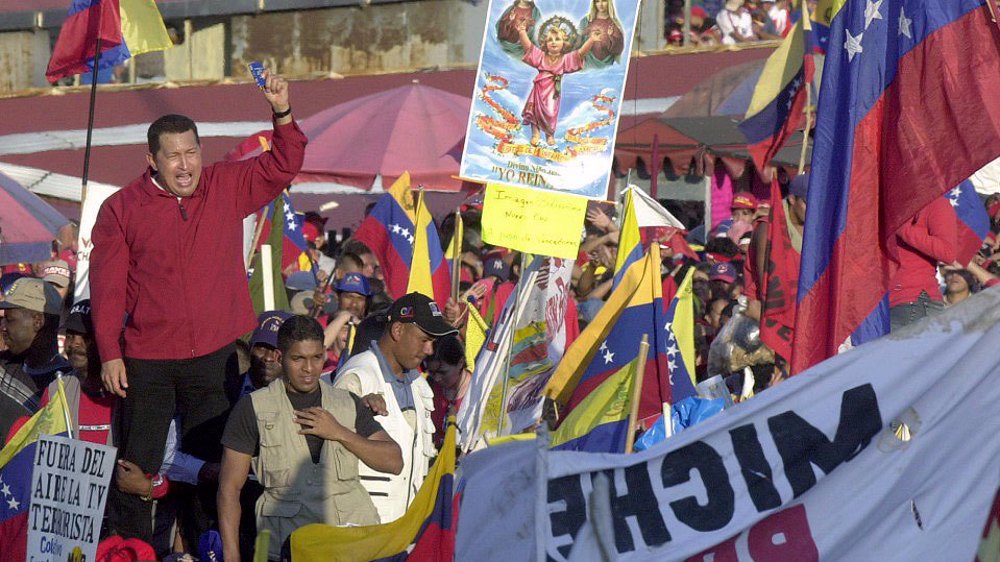
President Hugo Chavez holds up a copy of the Venezuelan constitution at a rally with supporters in Caracas shortly after the 2002 coup attempt. (Photo by AP)
In 2013, WikiLeaks released a 2006 State Department cable outlining the Bush administration’s strategy to undermine Chavez by supporting so-called “pro-democracy” groups.
The cable, signed by then-Ambassador William Brownfield in August 2004, described a five-point strategy including “penetrating Chavez’s political base,” “dividing Chavismo,” “protecting vital US business” and “isolating Chavez internationally.”
Those goals were to be obtained by strengthening “democratic institutions,” according to the cable.
Brownfield wrote that USAID’s Office of Transition Initiatives (USAID/OTI) played a crucial role in this effort, saying that strengthening democratic institutions “represents the majority of USAID/OTI work in Venezuela.”
“Organized civil society is an increasingly important pillar of democracy, one where President Chavez has not yet been able to assert full control.”
American lawyer, writer, and journalist Eva Golinger noted that after failing to oust Chávez, USAID/OTI reoriented its funding, increased its budget and began focusing on crafting an opposition “youth movement” using new technologies like Twitter, Facebook, and other internet media to build an international campaign against the Venezuelan president.
“From 2006 to 2010, more than 34 percent of USAID’s budget—which neared $15 million per year—was used to fund university programs, workshops, and other events to aid youth in building an anti-Chávez movement,” Golinger said.
By 2010, external funding for West-backed opposition groups in Venezuela reportedly exceeded $57 million, primarily from USAID and the National Endowment for Democracy (NED)
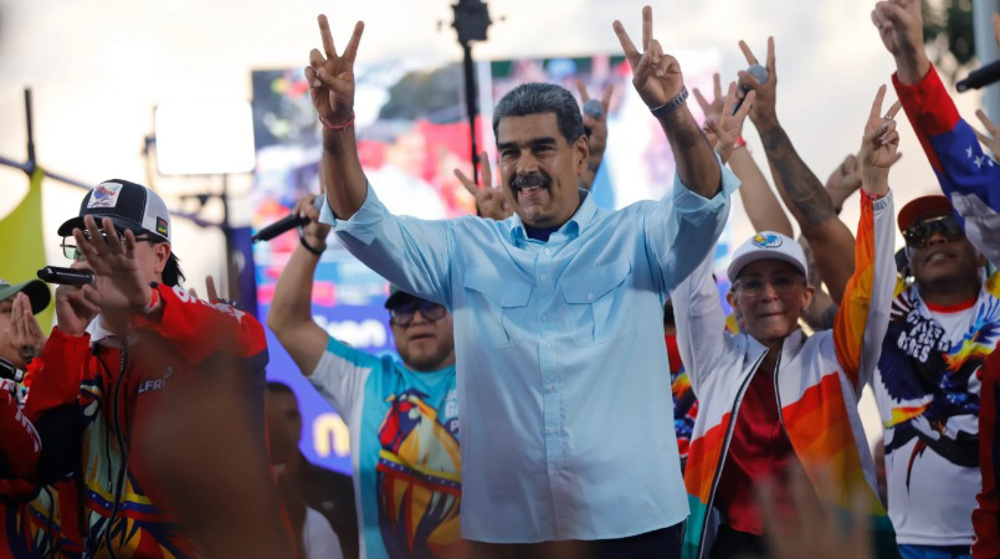
Venezuelan President Nicolas Maduro flashes victory hand signs at supporters during a pro-government rally, in Caracas, Venezuela, Saturday, Aug. 17, 2024. (Photo by AP)
On Wednesday, Diosdado Cabello, the first vice president of Venezuela’s United Socialist Party (PSUV) said that several opposition leaders were involved in corruption scandals linked to the USAID.
Cabello said that Juan Guaidó, Leopoldo López, and Carlos Vecchio, were involved in a scheme to misuse funds designated for humanitarian aid in an attempt to overthrow President Maduro.
Cabello said that these leaders received substantial sums of money from USAID, with Guaidó receiving over $300 million, Vecchio around $160 million, and López $700 million.
According to Cabello, these funds were used to finance a “regime change” operation instead of providing aid or assistance to the Venezuelan people.
USAID and the 2014 Ukraine coup
Former Ukrainian President Viktor Yanukovych was illegitimately removed from office in a Western-backed coup in February 2014 in a plot engineered under the USAID program, according to observers.
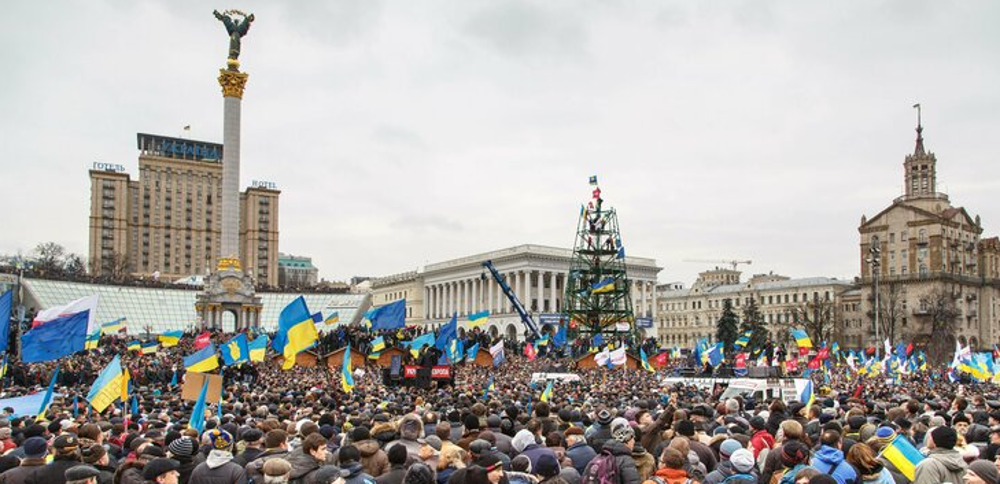
The coup was triggered by the Euromaidan or the Maidan Uprising, a wave of demonstrations and civil unrest in Ukraine, which began on November 21, 2013, with large protests in Maidan Nezalezhnosti (Independence Square) in Kiev.
The protests were sparked by Yanukovych’s decision not to sign the European Union–Ukraine Association Agreement, instead choosing closer ties to Russia and the Eurasian Economic Union.
Documents suggest that before the Euromaidan, the USAID and NED provided significant funding to opposition groups and media in Ukraine.
These reports have been confirmed by several US public figures, including former presidential candidate Robert F. Kennedy, Jr., filmmaker Oliver Stone, and defense expert from the Cato Institute, Ted Galen Carpenter.
In an interview with journalist Tucker Carlson, Kennedy Jr., who is now the Health Secretary, said the CIA, operating through USAID, spent $5 billion to instigate the 2014 color revolution in Ukraine.
“There are riots in Ukraine called Maidan, but we are not told that we are funding these riots. The newspapers never told us, our government never told us that USAID, which is a front for the CIA, has invested five billion dollars in funding these riots,” Kennedy Jr. said
He added that these actions were carried out under the pretense of defending freedom and democracy in the country that has been embroiled in a devastating war for more than two years
Caption: Anti-government protests in Kiev, Ukraine in December 2013.
A leaked conversation between Assistant Secretary of State Victoria Nuland and US Ambassador Geoffrey Pyatt in February 2014 further indicated US involvement in aiding the Ukrainian opposition.
The audio clip exposed Nuland, weighing in on the makeup of the next Ukrainian government.
Nuland was heard telling US Ambassador Geoffrey Pyatt that she doesn’t think Vitaly Klitschko, the boxer-turned-politician who is a main opposition leader, should be in a new government.
The exchange validated suspicions of US involvement in shaping Ukraine’s political transition, intensifying debates about Western intervention in the country’s internal affairs.
Bolivia expels USAID
In 2013, Bolivian President Evo Morales kicked out the USAID for seeking to “conspire against” the Bolivian people and his government.
According to Morales, USAID programs had “political rather than social” ends and were “manipulating” and “using” union leaders.
Reports indicate that USAID was funding separatist movements in Bolivia’s richest provinces.
According to USAID’s Bolivia website, the agency operated there since 1964 claiming to carry out health, sustainable development, and environmental programs.
The agency stated that its 2011 budget for Bolivia amounted to $26.7
USAID’s overthrow of Haiti’s leader
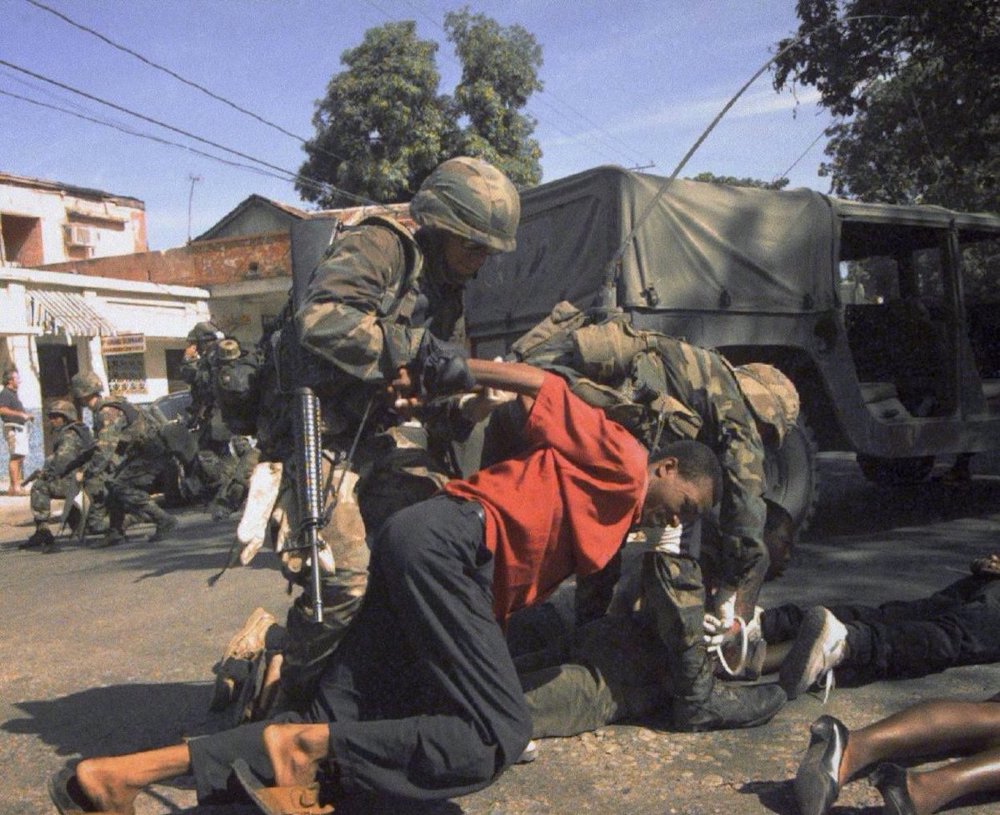
USAID has also been implicated in the 1991 overthrow of Haiti’s democratically elected leader Jean-Bertrand Aristide.
Evidence suggests that USAID backed opposition groups and death squads in the country, contributing to the destabilization of Aristide’s government and ultimately leading to his ouster.
This involvement came to light following the coup, as it was revealed that USAID funds and resources had been used to support anti-Aristide groups, providing them with the means to undermine the government and sow discord
The 1991 coup led to the overthrow of Haiti’s democratically elected leader Jean-Bertrand Aristide.
These actions have been widely condemned as a blatant interference in Haiti’s internal affairs, disregarding the country’s democratic processes and sovereignty.
The aftermath of Aristide’s removal saw Haiti plunge into political turmoil and violence, as various factions vied for power.
This instability lasted for years, having long-lasting effects on the Haitian people and their prospects for a more prosperous future.
USAID a front for ‘counterinsurgency operations’ in Afghanistan
During the United States’ occupation of Afghanistan from 2001 to 2021, the USAID was reported to be “a front for counterinsurgency operations” while consolidating the occupation.
Aid workers mapped communities in the South Asian country, collected intelligence, and helped identify Taliban sympathizers for US drone strikes, reports said.
In the 2010 report “Fixing Intel: A Blueprint for Making Intelligence Relevant in Afghanistan,” authored by Major General Michael T. Flynn and others, the authors highlighted the need for improved intelligence operations in Afghanistan.
They emphasized the importance of understanding local socio-economic dynamics and suggested that information gathered by various entities, including aid groups, could be valuable for military operations
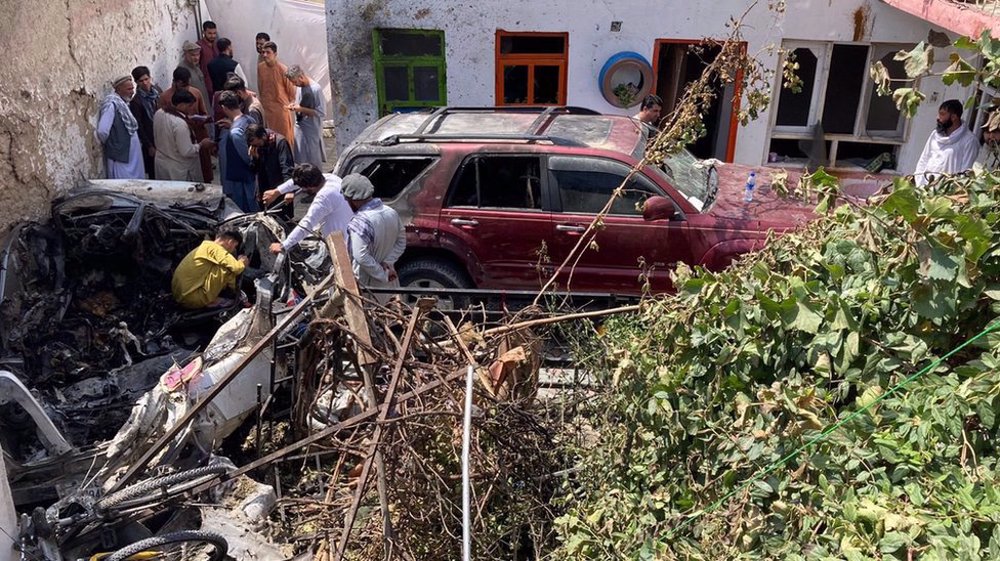
The aftermath of a US drone strike in the Afghan capital, Kabul, in August 2021, which killed 10 people, including seven children.
Throughout the two decades of US military occupation in Afghanistan, thousands of civilians were killed in US drone strikes, and the perpetrators were never held accountable.
While the military has occasionally acknowledged responsibility for incidents involving airstrikes or ground raids that led to civilian casualties, no one was brought to justice.
US-backed coup in Chile
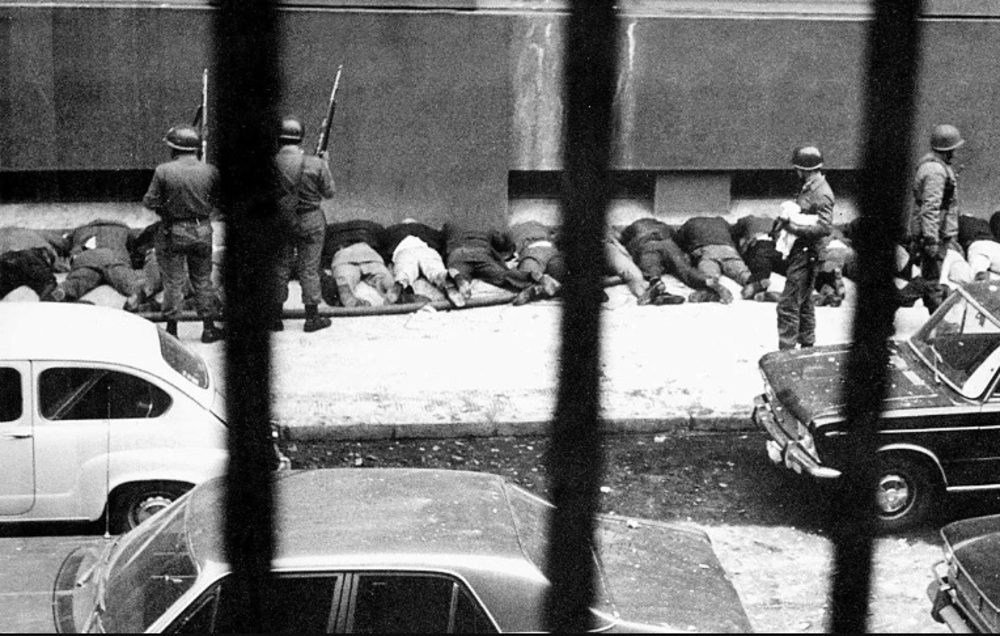
On September 11, 1973, Chile’s democratic process suffered a severe blow when Salvador Allende, South America’s first democratically elected president, was violently overthrown in a bloody coup led by General Augusto Pinochet.
The United States primarily backed this coup, as according to analysts, Allende was perceived as a threat to the capitalist interests Washington sought to preserve in the region
La Moneda employees are forced to lay down on the sidewalk next to the building after being arrested by the military who took over the building on September 11, 1973. (Photo by AP)
In the lead-up to the CIA-backed coup, USAID served as a channel for the spy agency to funnel millions of dollars into media campaigns and opposition groups that targeted Allende.
This effort to undermine Allende’s presidency set the stage for the impending military takeover.
Shortly before the September 1973 coup, Chile encountered bread shortages and requested credit from the United States to purchase 300,000 tons of wheat. The Richard Nixon administration denied this request, exacerbating economic turmoil and providing a pretext for the coup.
Less than a month after the coup, on October 5, 1973, the Nixon administration extended $24.5 million in wheat credits to the Chilean Junta, which had seized power.
In September 1974, President Gerald Ford defended the US role in the coup, asserting that it was “in the best interest of the people in Chile and certainly in our own best interests.”
In 2011, the Chilean government acknowledged that more than 40,000 people had been murdered, disappeared, or tortured by the Pinochet dictatorship.
USAID caught engineering a coup in Slovakia
USAID, NED, and other NGOs have invested millions of dollars in Slovakia to manufacture protests, destabilize the government, and in favor of a pro-Western regime change.
They have been caught funding Slovakian NGOs under the pretense of promoting “civil society” and “democracy promotion.”
Slovakian Prime Minister Robert Fico has so far successfully countered attempts by foreign entities to destabilize his government. Fico maintains that the anti-government protests, which began last year, have been orchestrated by external forces.
On Friday, Fico identified the Georgian National Legion, a military group associated with Ukraine’s war against Russia, as coordinating with the plotters.
Reports suggest that up to one-third of the protesters are Ukrainian and other foreign nationals.
Ukrainian media outlets are openly supporting the protests, with Kiev-linked organizations actively coordinating unrest. Western embassies have also been openly collaborating with opposition groups, a tactic reminiscent of previous color revolutions.
On January 24, Slovakia’s General Health Insurance Company was hit by a cyberattack. Fico described the incident as a “textbook example” of pressure exerted on governments resisting Ukrainian and Western demands
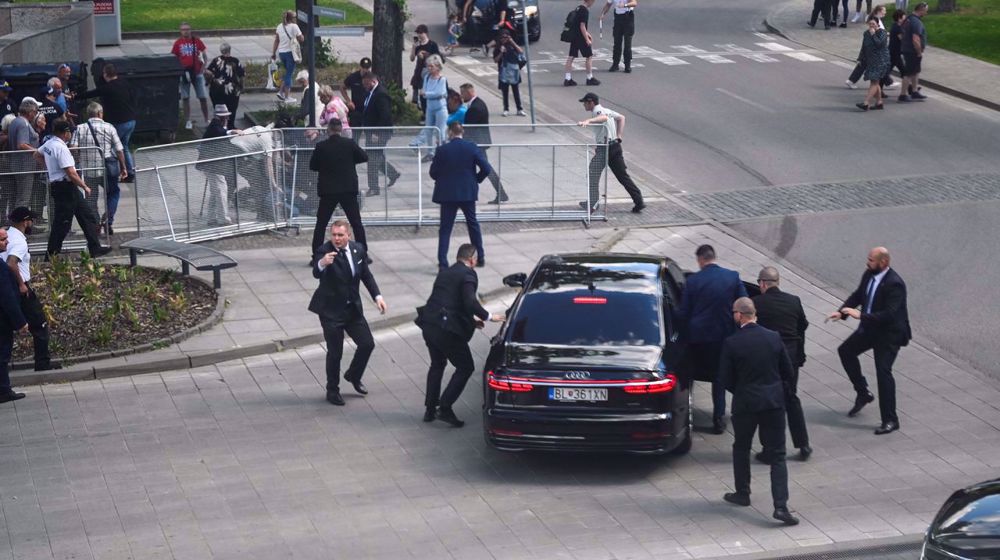
Slovakia’s Prime Minister bundled into car after being shot in May 2024.
As Fico moved to limit NGO influence and deport foreign agents last May, a pro-Western assassin with connections to foreign-funded groups attempted to assassinate him.
USAID funneled billions into Syria to topple Assad
The USAID-backed regime change operation in Syria is considered one of the most extensive operations of the 21st century, ultimately leading to the overthrow of President Bashar al-Assad in 2024 by militant groups backed by the West and its regional allies.
For over a decade, USAID, NED, and Western-backed NGOs played a central role in the foreign-instigated Syrian war, by financing opposition groups, crafting propaganda, and conducting intelligence operations under the guise of “humanitarian aid,” as reported by DD Geopolitics.
USAID reportedly channeled more than $15 billion into the Arab country, covertly funding militant groups, mercenaries, opposition networks and various anti-government activities.
One key group funded by USAID was the White Helmets, which was later exposed for its collaboration with the al-Qaeda terrorist group and the fabrication of propaganda videos to justify US intervention.
Additionally, USAID provided logistical support to exiled opposition groups, assisting in the creation of a US-backed shadow government in the Arab country.
President Assad’s government consistently pushed back against these foreign-backed attempts at destabilization. In 2014, Syria expelled several USAID-backed NGOs owing to their financial ties to insurgents.
Two years later, the government exposed the collaboration between the USAID-funded White Helmets and various militant groups.
Despite these efforts to push back against external interference, the US and its allies relentlessly pursued their objective to oust Assad.
“NGOs are being used to destabilize Syria. They pretend to help, but in reality, they work for foreign intelligence services,” Assad said in 2018.
USAID spends $600 million on anti-Russian media
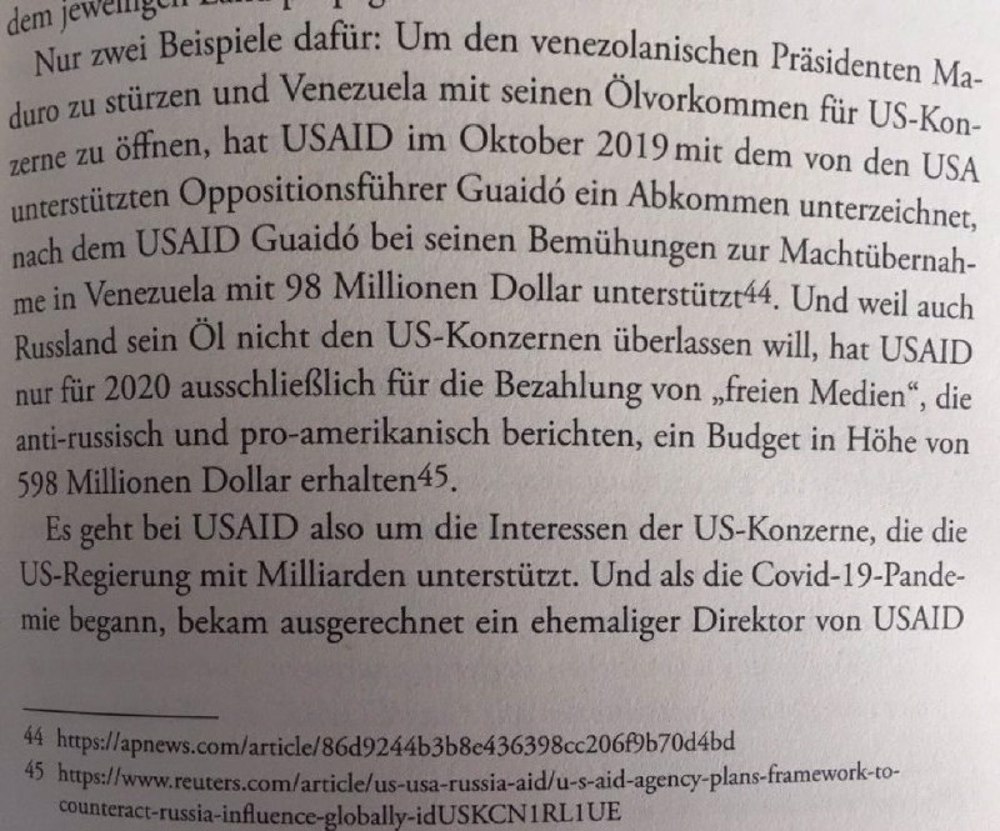
An X account with the handle @MyLordBobeo shared a passage, from a book or academic article, discussing US foreign policy concerning Russia and Venezuela and highlighting USAID’s role.
The text focuses on political interventions and funding related to opposition efforts against the Venezuelan and Russian governments.
The excerpt discussed the involvement of USAID in Venezuela, specifically highlighting its support for opposition leader Juan Guaidó in efforts to overthrow President Maduro.
It stated that in 2019, USAID signed an agreement with Guaidó, providing $98 million in assistance.
“In order to overthrow Venezuelan President Maduro and open up Venezuela and its oil reserves to US corporations, USAID signed an agreement with the US-backed opposition leader Guaidó in October 2019, according to which USAID will support Guaidó in his efforts to take power in Venezuela with 98 million dollars,” read the text, originally written in German.
Additionally, the text references USAID’s budget allocation for “free media” to counter Russian influence, amounting to $598 million for 2020.
“And because Russia does not want to hand over its oil to US corporations either, USAID has received a budget of 598 million dollars for 2020 alone to pay for “free media” that report anti-Russian and pro-Americans,” it added
A text that appears to be from a book or an academic article discusses US foreign policy, particularly in relation to Russia and Venezuela and the role of USAID.
The citations to the Reuters and AP at the end suggest it might be part of a larger discussion on US influence in global politics, referencing specific news articles for support.
Leaked doctrine on the use of USAID in economic warfare
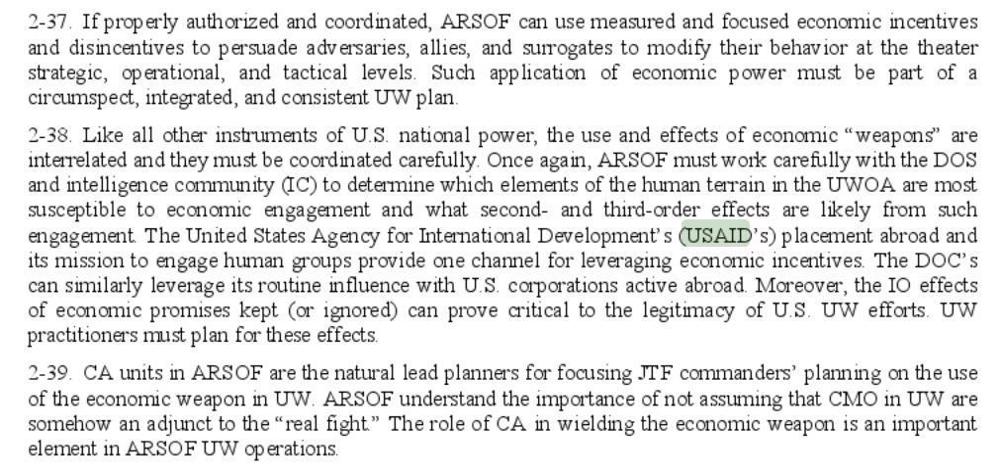
A leaked US Army Special Operations Forces (ARSOF) doctrine exposed the extent to which the US USES economic instruments, including USAID programs, as part of its unconventional warfare (UW) strategies.
The document sheds light on the orchestrated interplay between various governmental entities, including the Army Special Operations Forces, the Department of State (DOS), the Intelligence Community (IC), the Department of Commerce (DOC), and USAID.
According to the document, ARSOF is authorized to employ “measured and focused economic incentives and disincentives” across multiple levels to influence the behavior of “adversaries, allies, and surrogates.”
Such economic maneuvers are executed under the guise of a carefully crafted and integrated unconventional warfare plan, it said.
It highlights the need for ARSOF to work closely with the Department of State and the intelligence community to identify vulnerable groups in a targeted area and predict the potential outcomes of applying economic pressure
Leaked US Special Forces doctrine on use of USAID in economic warfare
USAID’s presence in foreign countries and its mission to engage with local populations provides an opportunity for the US to exert economic influence, it added.
Similarly, it said, the Department of Commerce can use its connections with American companies operating overseas to further strategic objectives.
The passage also underlines the significance of Information Operations (IO) in managing public perception of US unconventional warfare efforts. This includes anticipating and shaping the narrative around economic promises made (or unfulfilled) to maintain legitimacy.
The leaked document offers an unprecedented glimpse into the US government’s orchestration of various agencies and resources, particularly USAID, to engage in economic warfare as a means to advance strategic objectives.
This revelation raises critical questions about the covert use of humanitarian aid and development programs for ulterior political ends.
“As clearly illustrated, USAID pretends to be about ‘democracy’ and ‘helping’ the world,” wrote journalist James Li in a post on X.
“But in reality, it was always a covert tool of U.S. power — a front for CIA-backed regime change, election meddling, and civil destabilization disguised as ‘humanitarian aid,’” he added.
El Salvador’s President Nayib Bukele has also said that cutting USAID funding would not only benefit the United States but also other countries around the world.
He added that while USAID is marketed as a supporter of development, democracy, and human rights, a significant portion of its funds are channeled into opposition groups, politically motivated NGOs, and destabilizing movements.
“Most governments don’t want USAID funds flowing into their countries because they understand where much of that money actually ends up,” Bukele wrote in a post on X on Sunday.
“At best, maybe 10% of the money reaches real projects that help people in need (there are such cases), but the rest is used to fuel dissent, finance protests, and undermine administrations that refuse to align with the globalist agenda,” he added [end]