Nicolas Cinquini

Analista senior di l'intelligenza in u campu di a gestione di i risichi di sicurezza, sò un anzianu tenente detective è ufficiale di l'intelligenza in l'agenzie di u Statu francese. A bona pronuncia hè Николай Чинкуини, in russu

Tag: leontrotsky

  • [Sharing] Liberalism And Fascism: Partners In Crime – Gabriel Rockhill, Counterpunch

    October 14, 2020 [no surprise then that the US and its British stooges are supporting the Ukrainian Nazis since the end of WW2]

    The intellectuals cast a veil over the dictatorial character of bourgeois democracy not least by presenting democracy as the absolute opposite of fascism, not as just another natural phase of it where the bourgeois dictatorship is revealed in a more open form

    – Bertolt Brecht

    Time and again we hear that liberalism is the last bulwark against fascism. It represents a defense of the rule of law and democracy in the face of aberrant, malevolent demagogues intent on destroying a perfectly good system for their own gain. This apparent opposition has been deeply engrained in contemporary so-called Western liberal democracies through their shared origin myth. As every school child in the U.S. learns, for instance, liberalism defeated fascism in World War II, beating back the Nazi beast in order to establish a new international order that—for all of its potential faults and misdeeds—was built upon key democratic principles that are antithetical to fascism.

    This framing of the relationship between liberalism and fascism not only presents them as complete opposites, but it also defines the very essence of the fight against fascism as the struggle for liberalism. In so doing, it forges an ideological false antagonism. For what fascism and liberalism share is their undying devotion to the capitalist world order. Although one prefers the velvet glove of hegemonic and consensual rule, and the other relies more readily on the iron fist of repressive violence, they are both intent on maintaining and developing capitalist social relations, and they have worked together throughout modern history in order to do so. What this apparent conflict masks—and this is its true ideological power—is that the real, fundamental dividing line is not between two different modes of capitalist governance, but between capitalists and anti-capitalists. The long psychological warfare campaign waged under the deceptive banner of ‘totalitarianism’ has done much to further dissimulate this line of demarcation by disingenuously presenting communism as a form of fascism. As Domenico Losurdo and others have explained with great historical precision and detail, this is pure ideological pap.

    Given the ways in which the current public debate on fascism tends to be framed in relationship to purported liberal resistance, there could scarcely be a timelier task than that of scrupulously re-examining the historical record of actually existing liberalism and fascism. As we shall see even in this brief overview, far from being enemies, they have been—sometimes subtle, sometimes forthright—partners in capitalist crime. For the sake of argument and concision, I will here focus primarily on a conjunctural account of the non-controversial cases of Italy and Germany. However, it is worth stating at the outset that the Nazi racial police state and colonial rampage—which far surpassed Italy’s capabilities—were modeled on the United States.

    Liberal Collaboration in the Rise of European Fascism

    It is of the utmost importance that Western European fascism emerged within parliamentary democracies rather than conquering them from the outside. The fascists rose to power in Italy at a moment of severe political and economic crisis on the heels of WWI, and then later the Great Depression. This was also a time when the world had just witnessed the first successful anti-capitalist revolution in the U.S.S.R. Mussolini, who had cut his teeth working for MI5 to break up the Italian peace movement during WWI, was later backed by big industrial capitalists and bankers for his anti-worker, pro-capitalist political orientation. His tactic was to work within the parliamentary system, by mobilizing powerful financial supporters to bankroll his expansive propaganda campaign while his black shirts rode roughshod over picket lines and working-class organizations. In October of 1922, magnates in the Confederation of Industry and major bank leaders provided him with the millions necessary for the March on Rome as a spectacular show of force. However, he did not seize power. Instead, as Daniel Guérin explained in his masterful study Fascism and Big Business, Mussolini was summoned by the king on October 29th and was, according to parliamentary norms, entrusted with forming a cabinet. The capitalist state turned itself over without a fight, but Mussolini was intent on forming an absolute majority in parliament with the help of the liberals. They supported his new electoral law in July 1923 and then made a joint slate with the fascists for the election on April 6, 1924. The fascists, who had only had 35 seats in parliament, gained 286 seats with the help of the liberals.

    The Nazis rose to power in much the same way, by working within the parliamentary system and courting the favor of big industrial magnates and bankers. The latter provided the financial support necessary to grow the Nazi party and eventually secure the electoral victory of September 1930. Hitler would later reminisce, in a speech on October 19, 1935, on what it meant to have the material resources necessary to support 1,000 Nazi orators with their own cars, who could hold some 100,000 public meetings in the course of a year. In the December 1932 election, the Social Democrat leaders, who were far to the left of contemporary liberals but shared their reformist agenda, refused to form an eleventh-hour coalition with the communists against Nazism. “As in many other countries past and present, so in Germany,” wrote Michael Parenti, “the Social Democrats would sooner ally themselves with the reactionary Right than make common cause with the Reds.” Prior to the election, the Communist Party candidate Ernst Thaelmann had argued that a vote for the conservative Field Marshal von Hindenburg amounted to a vote for Hitler and for war. Only weeks after Hindenburg’s election, he invited Hitler to become chancellor.

    Fascism in both cases came to power through bourgeois parliamentary democracy, in which big capital bankrolled the candidates who would do its bidding while also creating a populist spectacle—a false revolution—that marshaled or suggested mass appeal. Its conquest of power took place within this legal and constitutional framework, which secured its apparent legitimacy on the home front, as well as within the international community of bourgeois democracies. Leon Trotsky understood this perfectly and diagnosed what was going on at the time with remarkable insight:

    The results are at hand: bourgeois democracy transforms itself legally, pacifically, into a fascist dictatorship. The secret is simple enough: bourgeois democracy and fascist dictatorship are the instruments of one and the same class, the exploiters. It is absolutely impossible to prevent the replacement of one instrument by the other by appealing to the Constitution, the Supreme Court at Leipzig, new elections, etc. What is necessary is to mobilize the revolutionary forces of the proletariat. Constitutional fetishism brings the best aid to fascism.

    Once its power was secure, however, fascism revealed its authoritarian face, transforming itself into what Trotsky referred to as a military-bureaucratic dictatorship of the Bonapartist type. It unflinchingly set about—at a rather different pace in Italy than in Germany—completing the task it had been hired to accomplish by crushing organized labor, eradicating opposition parties, destroying independent publications, putting a halt to elections, scapegoating and eliminating racialized underclasses, privatizing public assets, launching projects of colonial expansion and investing heavily in a war economy beneficial to its industrial supporters. In establishing the direct dictatorship of big capital, it even destroyed some of the more plebeian and populist elements in its own ranks, while crushing many confused liberals under the juggernaut of repressive class warfare.

    It was not only within Italy and Germany that bourgeois democracy allowed for the rise of fascism. This was also true internationally. Capitalist states refused to form an antifascist coalition with the U.S.S.R., a country that fourteen of them had invaded and occupied from 1918 to 1920 in a failed attempt to destroy the world’s first workers’ republic. During the Spanish Civil War, which historians like Eric Hobsbawm have characterized as a miniature version of the great mid-century war between fascism and communism, Western liberal democracies did not officially support the left-leaning government that had been elected. Instead, they stood idly by while the Axis powers provided massive support to General Francisco Franco as he oversaw a military coup d’état. It is highly revealing that Franco, a self-declared fascist who is often sidelined in discussions of European fascism, understood with remarkable clarity why the epiphenomenal characteristics of fascism would differ considerably based on the precise conjuncture: “Fascism, since that is the word that is used, fascism presents, wherever it manifests itself, characteristics which are varied to the extent that countries and national temperaments vary.” It was the U.S.S.R. that came to the aid of the Republicans battling fascism in Spain, sending both soldiers and materials. Franco would later return the favor, so to speak, by deploying a volunteer military force to fight godless communism alongside the Nazis. Franco would also, of course, become one of the great postwar allies of the United States in its fight against the Red Menace.

    In 1934, the United Kingdom, France and Italy signed the Munich Agreement, in which they agreed to allow Hitler to invade and colonize the Sudetenland in Czechoslovakia. “The sheer reluctance of Western governments to enter into effective negotiations with the Red state,” wrote Eric Hobsbawm, “even in 1938-39 when the urgency of an anti-Hitler alliance was no longer denied by anyone, is only too patent. Indeed, it was the fear of being left to confront Hitler alone which eventually drove Stalin, since 1934 the unswerving champion of an alliance with the West against him, into the Stalin-Ribbentrop Pact of August 1939, by which he hoped to keep the U.S.S.R. out of the war.” This non-aggression pact was then disingenuously presented in the Western media as an undeniable indication that the Nazis and communists were somehow allies.

    International Capitalism and Fascism

    It was not only large industrialists and bankers, as well as landowners, within Italy and Germany that supported and profited from the fascist rise to power. This was equally true of many of the major corporations and banks whose headquarters were in Western bourgeois democracies. Henry Ford was perhaps the most notorious example since in 1938 he was awarded the Grand Cross of the Supreme Order of the German Eagle, which was the highest honor that could be bestowed upon any non-German (Mussolini had received one earlier the same year). Ford had not only funneled ample funding into the Nazi Party, he had provided it with much of its anti-Semitic and anti-Bolshevik ideology. Ford’s conviction that “Communism was a completely Jewish creation,” to quote James and Suzanne Pool, was shared by Hitler, and some have suggested that the latter was so close ideologically to Ford that certain passages from Mein Kampf were directly copied from Ford’s anti-Semitic publication The International Jew.

    Ford was only one of the American companies invested in Germany, and many other U.S. banks, firms and investors profited handsomely from Aryanizations (the expulsion of Jews from business life and the forced transfer of their property into ‘Aryan’ hands), as well as from the German rearmament program. According to Christopher Simpson’s masterful study, “a half-dozen key U.S. companies—International Harvester, Ford, General Motors, Standard Oil of New Jersey, and du Pont—had become deeply involved in German weapons production.” In fact, American investment in Germany sharply increased after Hitler came to power. “Commerce Department reports show,” writes Simpson, “that U.S. investment in Germany increased some 48.5 percent between 1929 and 1940, while declining sharply everywhere else in continental Europe.” The German subsidiaries of U.S. companies like Ford and General Motors, as well as several oil companies, made wide use of forced labor in concentration camps. Buchenwald, for instance, provided concentration camp labor for GM’s enormous Russelsheim plant, as well as for the Ford truck plant located in Cologne, and Ford’s German managers made extensive use of Russian POW’s for war production work (a war crime according to the Geneva Conventions).

    John Foster Dulles and Allen Dulles, who would later respectively become the Secretary of State and the head of the CIA, ran Sullivan & Cromwell, which some consider to have been the largest Wall Street law firm at the time. They played a very important role in overseeing, advising and managing global investment in Germany, which had become one of the most important international markets—particularly for American investors—during the second half of the 1920s. Sullivan & Cromwell worked with nearly all of the major U.S. banks, and they oversaw investments in Germany in excess of a billion dollars. They also worked with dozens of companies and governments all over the world, but John Foster Dulles, according to Simpson, “clearly emphasized projects for Germany, for the military junta in Poland, and for Mussolini’s fascist state in Italy.” In the postwar era, Allen Dulles worked tirelessly to protect his business partners, and he was remarkably successful in securing their assets and helping them avoid prosecution.

    Whereas most liberal accounts of fascism focus on its political theater and epiphenomenal eccentricities, thereby avoiding a systemic and radical analysis, it is essential to recognize that if liberalism allowed for the growth of European fascism, it is capitalism that drove this growth.

    Who Defeated Fascism?

    It is not surprising that the bourgeois democracies of the West were extremely slow to open the Western front, allowing their erstwhile enemy, the U.S.S.R., to be bled by the pro-capitalist Nazi war machine (which received ample funding from White Russians). In fact, the day after Nazi Germany invaded the Soviet Union, Harry Truman flatly declared: “If we see that Germany is winning, we ought to help Russia, and if Russia is winning, we ought to help Germany, and that way let them kill as many as possible, although I don’t want to see Hitler victorious in any circumstances.” After the U.S. entered the war, powerful officials like Allen Dulles worked behind the scenes to try and broker a peace deal with Germany that would allow the Nazis to focus all of their attention on eradicating the U.S.S.R.

    The widespread idea, at least within the U.S., that fascism was ultimately defeated by liberalism in WWII, due primarily to the U.S. intervention in the war, is a baseless canard. As Peter Kuznick, Max Blumenthal and Ben Norton reminded listeners in a recent discussion, 80% of the Nazis who died in the war were killed on the Eastern Front with the U.S.S.R., where Germany had deployed 200 divisions (versus only 10 in the West). 27 million Soviets gave their lives fighting fascism, whereas 400,000 American soldiers died in the war (which amounts to approximately 1.5% of the Soviet death toll). It was, above all, the Red Army that defeated fascism in WWII, and it is communism—not liberalism—that constitutes the last bulwark against fascism. The historical lesson should be clear: one cannot be truly antifascist without being anti-capitalist.

    The Ideology of False Antagonisms

    The ideological construction of false antagonisms, in the case of liberalism and fascism, serves multiple purposes:

    + It establishes the primary front of struggle as one between rival positions within the capitalist camp.

    + It channels people’s energy into fighting over the best methods for managing capitalist rule rather than abolishing it.

    + It eradicates the true lines of demarcation of global class struggle.

    + It attempts to simply take the communist option off the table (by removing it entirely from the field of struggle, or disingenuously presenting it as a form of ‘totalitarianism’).

    Not unlike sporting events, which are very important ideological rituals in the contemporary world, the logic of false antagonisms amps up and overinflates all of the idiosyncratic differences and personal rivalries between two opposing teams to such an extent that the frenzied fans come to forget that they are ultimately playing the same game.

    In the reactionary political culture of the U.S., which has attempted to redefine the Left as liberal, it is of the utmost importance to recognize that the primary opposition that has structured, and continues to organize, the modern world is the one between capitalism—which is imposed and maintained through liberal ideology and institutions, as well as fascist repression, depending on the time, place and population in question—and socialism. By replacing this opposition by the one between liberalism and fascism, the ideology of false antagonisms aims at making the fight of the century into a capitalist spectacle rather than a communist revolution [end]

    The original article

    Gabriel Rockhill is a Franco-American philosopher, cultural critic and activist. He the founding Director of the Critical Theory Workshop and Professor of Philosophy at Villanova University. His books include Counter-History of the Present: Untimely Interrogations into Globalization, Technology, Democracy (2017), Interventions in Contemporary Thought: History, Politics, Aesthetics (2016), Radical History & the Politics of Art (2014) and Logique de l’histoire (2010). In addition to his scholarly work, he has been actively engaged in extra-academic activities in the art and activist worlds, as well as a regular contributor to public intellectual debate. Follow on twitter: @GabrielRockhill

    A related piece, no surprise then that the US and its British stooges are supporting the Ukrainian Nazis since the end of WW2

    Nazism in Ukraine

  • [Sharing] Russo-Ukrainian War : The World Blood Pump – Big Serge

    Gradually, and then Suddenly

    Since Russia’s surprise decision to voluntarily withdraw from west bank Kherson in the first week of November, there has been little in the way of dramatic changes to the frontlines in Ukraine. In part, this reflects the predictable late autumn weather in Eastern Europe, which leaves battlefields waterlogged and clogged with mud and greatly inhibits mobility. For hundreds of years, November has been a bad month for attempting to move armies any sort of significant distance, and like clockwork we started to see videos of vehicles stuck in the mud in Ukraine.

    The return of static positional warfare, however, also reflects the synergistic effect of increasing Ukrainian exhaustion along with a Russian commitment to patiently attriting and denuding Ukraine’s remaining combat capability. They have found an ideal place to achieve this in the Donbas.

    It has gradually become apparent that Russia is committed to a positional attritional war, as this maximizes the asymmetry of their advantage in ranged fires. There is an ongoing degradation of Ukraine’s warmaking ability which is allowing Russia to patiently maintain the current tempo, while it organizes its newly mobilized forces for offensive action in the coming year, setting the stage for cascading and unsustainable Ukrainian losses.

    In Ernest Hemingway’s novel, The Sun Also Rises, a formerly wealthy, now down on his luck character is asked how he went bankrupt. “Two ways”, he replies, “gradually and then suddenly.” Someday we may ask how Ukraine lost the war and receive much the same answer.

    Verdun Redux

    It is safe to say that western regime media has set a very low standard for reporting on the war in Ukraine, given the extent to which the mainstream narrative is disconnected from reality. Even given these low standards, the way the ongoing battle in Bakhmut is being presented to the population is truly ludicrous. The Bakhmut axis is being spun to western audiences as a perfect synthesis of all the tropes of Russian failure: in a nutshell, Russia is suffering horrible casualties as it struggles to capture a small town with negligible operational importance. British officials, in particular, have been highly vocal in recent weeks insisting that Bakhmut has little to no operational value.

    The truth is the literal opposite of this story: Bakhmut is an operationally critical keystone position in the Ukrainian defense, and Russia has transformed it into a death pit which compels the Ukrainians to sacrifice exorbitant numbers of men in order to hold the position as long as possible. In fact, the insistence that Bakhmut is not operationally significant is mildly insulting to the audience, both because a quick glance at a map clearly shows it at the heart of the regional road network, and because Ukraine has thrown a huge number of units into the front there.

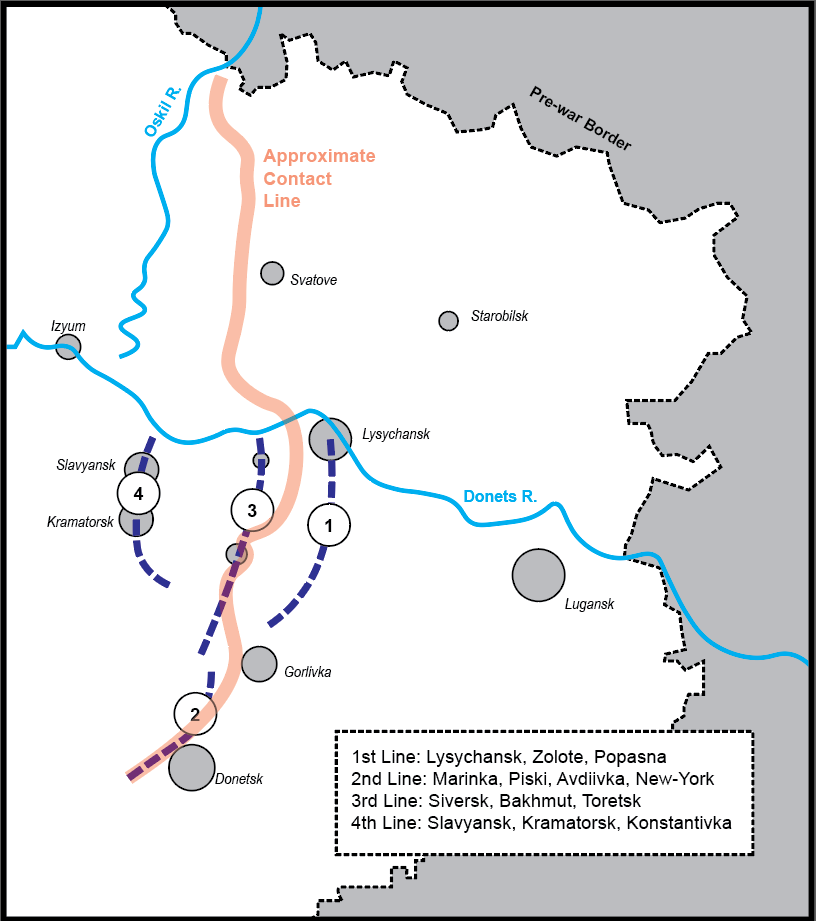
    Let’s take a step back and consider Bakhmut in the context of Ukraine’s overall position in the east. Ukraine began the war with four operable defensive lines in the Donbas, built up over the last 8 years both as part and parcel of the simmering war with the LNR and DNR, but also in preparation for potential war with Russia. These lines are structured around urban agglomerations with road and rail links between each other, and can be roughly enumerated as follows:

    Ukraine Defensive Lines in the East (Map by me)

    The Donbas is a particularly accommodating place to construct formidable defenses. It is highly urbanized and industrial (Donetsk was the most urban oblast in Ukraine prior to 2014, with over 90% of the population living in urban areas), with cities and towns dominated by the typically robust Soviet buildings, along with prolific industrial complexes. Ukraine has spent much of the last decade improving these positions, and the frontline settlements are riddled with trenches and firing positions that are clearly visible on satellite imagery. A recent video from the Avdiivka axis demonstrates the extent of Ukrainian fortifications.

    So, let’s review the state of these defensive belts. The first belt, which ran roughly from Severodonetsk and Lysychansk to Popasna, was broken in the summer by Russian forces. Russia achieved a major breakthrough at Popasna and was able to begin the full rollup of this line, with Lysychansk falling at the beginning of July.

    At this point, the frontline sits directly on what I have labeled as the 2nd and 3rd Ukrainian defensive belts, and both of these belts are now heavily bleeding.

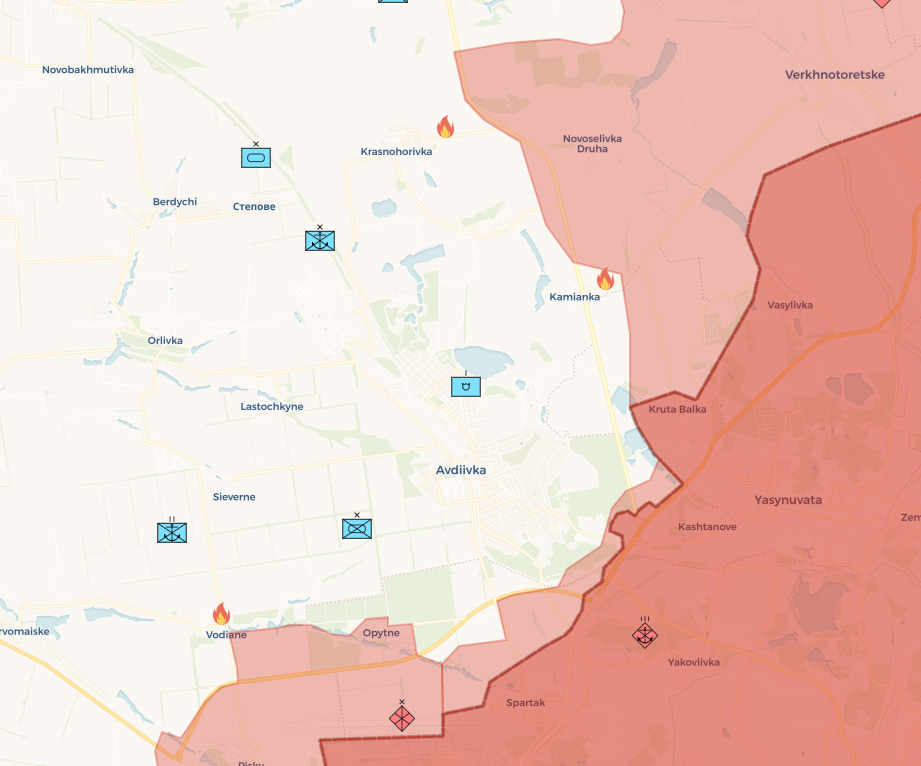
    The capture of Soledar by Wagner forces has severed the connection between Bakhmut and Siversk, while around Donetsk, the heavily fortified suburb of Marinka has been almost completely cleared of Ukrainian troops, and the infamous keystone Ukrainian position in Avdiivka (the place from which they shell Donetsk city’s civilian population) is being flanked from both directions.

    The frontline around Avdiivka (map courtesy of MilitaryLand)

    These positions are absolutely critical for Ukraine to hold. The loss of Bakhmut will mean the collapse of the last defensive line standing in the way of Slavyansk and Kramatorsk, which means Ukraine’s eastern position will rapidly contract to its fourth (and weakest) defensive belt.

    The Slavyansk agglomeration is a far worse position for Ukraine to defend than the other belts, for several reasons. First and foremost, as the belt farthest to the west (and thus the farthest from the February 2022 start lines), it is the least improved and least fortified of the belts. Secondly, lots of the, shall we just say “good stuff” around Slavyansk is to the east of the city, including both the dominating high ground and the major highways.

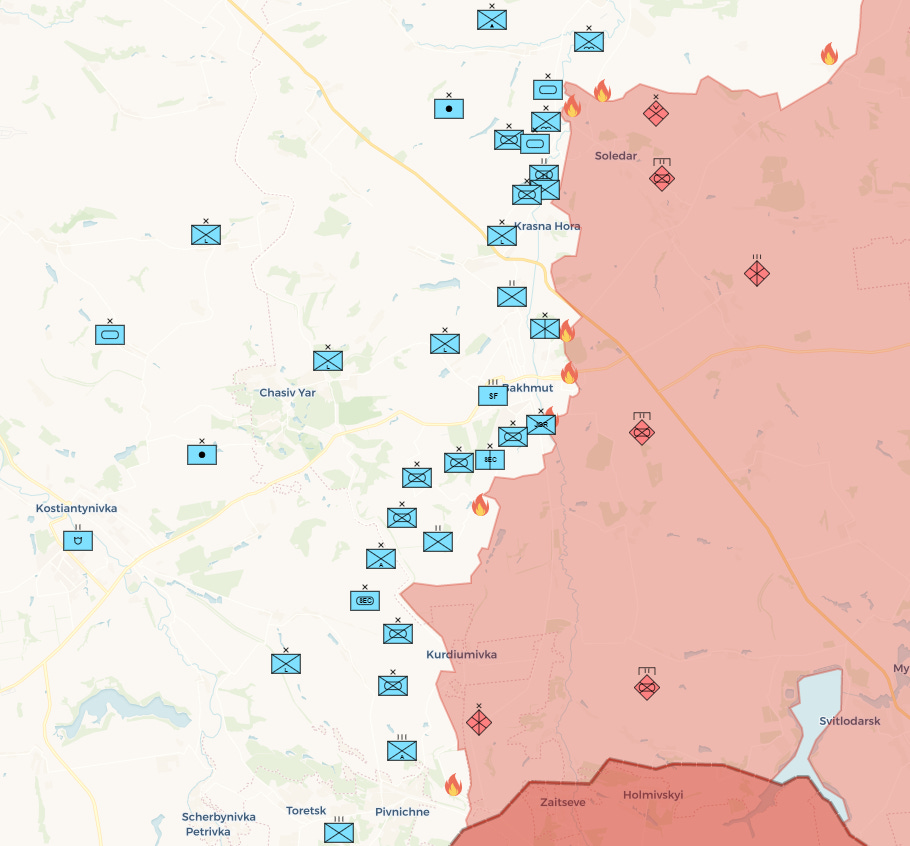
    All this to say, Ukraine has been very anxious to hold the Bakhmut line, as this is a vastly preferable position to hold, and accordingly they have been pouring units into the sector. The absurd levels of Ukrainian force commitment in this area have been well noted, but just as a quick refresher, publicly available Ukrainian sources locate at least 34 brigade or equivalent units that have been deployed in the Bakhmut area. Many of these were deployed months ago and are already shattered, but over the full span of the ongoing battle this represents an astonishing commitment.

    Ukrainian units around Bakhmut (Map courtesy of MilitaryLand)

    Russian forces, primarily Wagner PMC and LNR units, have been slowly but surely collapsing this Ukrainian stronghold by making liberal use of artillery. In November, now former Zelensky advisor Oleksiy Arestovych admitted that Russian artillery on the Bakhmut axis enjoyed roughly a 9 to 1 tube advantage, which is turning Bakhmut into a death pit.

    The battle is being presented in the west as one where Russians – usually stereotyped as convict soldiers employed by Wagner – launch frontal assaults on Ukrainian defenses and take horrible casualties attempting to overwhelm the defense with pure numbers. The opposite is much closer to the truth. Russia is moving slowly because it irons out Ukrainian defenses with artillery, then pushes forward cautiously into these pulverized defenses.

    Ukraine, meanwhile, continues to funnel units in to more or less refill the trenches with fresh defenders. A Wall Street Journal piece about the battle, while trying to present a story of Russian incompetence, accidentally included an admission from a Ukrainian commander on the ground who said: “So far, the exchange rate of trading our lives for theirs favors the Russians. If this goes on like this, we could run out.”

    The comparisons have been liberally made (and I cannot take credit for them) to one of the most infamous battles of World War One – the bloody catastrophe at Verdun. While it does not do to exaggerate the predictive value of military history (in the sense that a thorough knowledge of the first world war does not allow one to predict events in Ukraine), I am, however, a great fan of history as analogy, and the German scheme at Verdun is a useful analogy for what’s happening in Bakhmut.

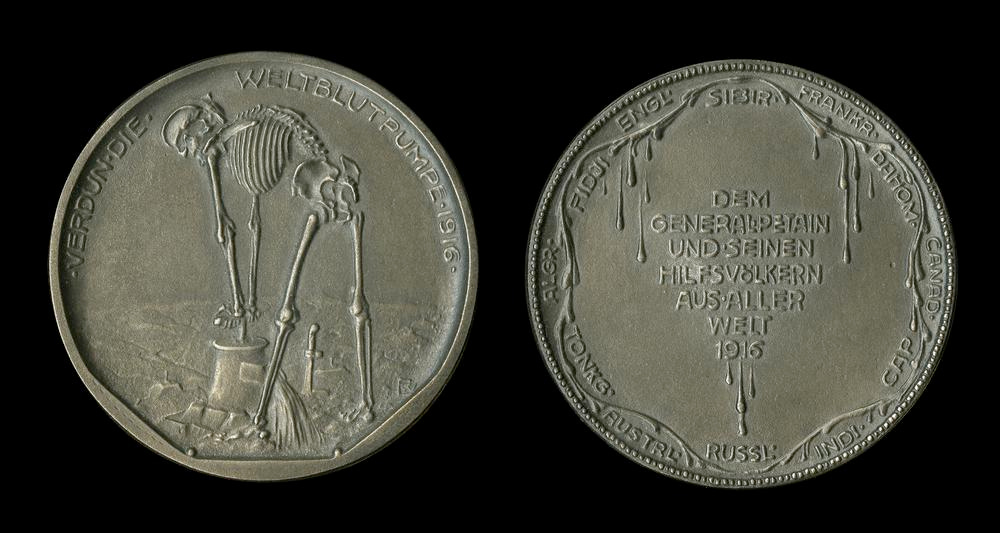
    The Battle of Verdun was conceived by the German high command as a way to cripple the French army by drawing them into a preconfigured meatgrinder. The notion was to attack and seize crucial defensive high ground – ground so important that France would be forced to counterattack and attempt to recapture it. The Germans hoped that France would commit their strategic reserves to this counterattack so that they could be destroyed. While Verdun failed to completely sap French combat power, it did become one of the most bloody battles in world history. A German coin commemorating the battle depicted a skeleton pumping blood out of the earth – a chilling but apt visual metaphor.

    “The World Blood Pump” – commemorating the meatgrinder at Verdun

    Something similar has indeed occurred in Bakhmut, in the sense that Russia is pressing on one of the most sensitive points on the front line, drawing Ukrainian units in to be killed. A few months ago, on the heels of Russia’s withdrawal from west bank Kherson, the Ukrainians talked ecstatically of continuing their offensive efforts with a strike southward in Zaparozhia to cut the land bridge to Crimea, along with continued efforts to break through into northern Lugansk. Instead, forces from both of these axes have been redirected to Bakhmut, to the point where this axis is actively draining Ukrainian combat strength in other areas. Ukrainian sources, previously full of optimism, now unequivocally agree that there will be no Ukrainian offensives in the near future. As we speak, Ukraine continues to funnel forces into the Bakhmut axis.

    At the present moment, Ukraine’s position around Bakhmut has badly deteriorated, with Russian forces (largely Wagner infantry supported by Russian army artillery) making substantial progress on both of the city’s flanks. On the northern flank, the capture of Soledar pushed Russian lines to within spitting distance of the north-south highways, while the near simultaneous capture of Klishchiivka on the southern flank has propelled the frontlines to the dootstep of Chasiv Yar (firmly in Bakhmut’s operational rear).

    The contact line around Bakhmut, Jauary 20, 2023 (Map by me)

    The Ukrainians are not presently encircled, but the continued creep of Russian positions ever closer to the remaining highways is easily discernable. Currently, Russian forces have positions within two miles of all the remaining highways. Even more importantly, Russia now controls the high ground to both the north and south of Bakhmut (the city itself sits in a depression surrounded by hills) giving Russia fire control over much of the battle space.

    I am currently anticipating that Russia will clear the Bakhmut-Siversk defensive line by late March. Meanwhile, the denuding of Ukrainian forces on other axes raises the prospect of decisive Russian offensives elsewhere.

    At the moment, the front roughly consists of four main axes (the plural of axis, not the bladed implement), with substantial agglomerations of Ukrainian troops. These consist, from south to north, of the Zaporozhia, Donetsk, Bakhmut, and Svatove Axes (see map below). The effort to reinforce the Bakhmut sector has noticeably diluted Ukranian strength on these other sectors. On the Zaporozhia front, for example, there are potentially as few as five Ukrainian brigades on the line at the moment.

    At the moment, the majority of Russian combat power is uncommitted, and both western and Ukrainian sources are (belatedly) becoming increasingly alarmed about the prospect for a Russian offensive in the coming weeks. Currently, the entire Ukrainian position in the east is vulnerable because it is, in effect, an enormous salient, vulnerable to attack from three directions.

    Two operational depth objectives in particular have the potential to shatter Ukrainian logistics and sustainment. These are, respectively, Izyum in the north and Pavlograd in the South. A Russian thrust down the west bank of the Oskil river towards Izyum would simultaneously threaten to cut off and destroy the Ukrainian grouping on the Svatove axis (S on the map) and sever the vital M03 highway from Kharkov. Reaching Pavlograd, on the other hand, would completely isolate the Ukrainian forces around Donetsk and sever much of Ukraine’s transit across the Dneiper [cf. map in title]

    Both Izyum and Pavlograd are roughly 70 miles from the start lines of a prospective Russian offensive, and thus offer a very tempting combination – being both operationally significant and in relatively manageable reach. Beginning yesterday, we started to see Russian advances on the Zaporozhia axis. While these consist, at the moment, mainly of reconnaissance in force pushing into the “grey zone” (that ambiguous interstitial frontage), RUMoD did claim several settlements taken, which could presage a genuine offensive push in this direction. The key tell would be a Russian assault on Orikhiv, which is a large town with a genuine Ukrainian garrison in it. A Russian attack here would indicate that something more than a probing attack is underway.

    It is difficult sometimes to parse out the difference between what we predict will happen and what we want to happen. This, certainly, is what I would choose if I was in charge of Russian planning – a drive south along the west bank of the Oskil river on the Kupyansk-Izyum axis, and a simultanious attack northward past Zaporozhia towards Pavlograd. In this case, I believe simply screening Zaporozhia in the short term is preferable to getting bogged down in an urban battle there.

    Whether Russia will actually attempt this, we do not know. Russian operational security is much better than either Ukraine’s or their proxy forces (Wagner and the LNR/DNR Milita), so we know significantly less about Russia’s deployments than we do about Ukraine’s. Regardless, we know that Russia enjoys a strong preponderance of combat power right know, and there are juicy operational targets within range.

    Please Sir, I Want Some More

    The bird’s eye view of this conflict reveals a fascinating meta-structure to the war. In the above section, I argue for a view of the front structured around Russia progressively breaking through sequential Ukrainian defensive belts. I think that a similar sort of progressive narrative structure applies to the force generation aspect of this war, with Russia destroying a sequence of Ukrainian armies.

    Let me be a bit more concrete. While the Ukrainian military exists at least partially as a continuous institution, its combat power has been destroyed and rebuilt multiple times at this point through western assistance. Multiple phases – life cycles, if you will – can be identified:

    • In the opening months of the war, the extant Ukrainian army was mostly wiped out. The Russians destroyed much of Ukraine’s indigenous supplies of heavy weaponry and shattered many cadres at the core of Ukraine’s professional army.
    • In the wake of this initial shattering, Ukrainian combat strength was shored up by transferring virtually all of the Soviet vintage weaponry in the stockpiles of former Warsaw Pact countries. This transferred Soviet vehicles and ammunition, compatible with existing Ukrainian capabilities, from countries like Poland and the Czech Republic, and was mostly complete by the end of spring, 2022. In early June, for example, western sources were admitting that Soviet stockpiles were drained.
    • With Warsaw Pact stockpiles exhausted, NATO began replacing destroyed Ukrainian capabilities with western equivalents in a process that began during the summer. Of particular note were howitzers like the American M777 and the French Caesar.

    Russia has essentially fought multiple iterations of the Ukrainian Army – destroying the pre-war force in the opening months, then fighting units that were refilled from Warsaw Pact stockpiles, and is now degrading a force which is largely reliant on western systems.

    This led to General Zaluzhny’s now-famous interview with the economist in which he asked for many hundreds of Main Battle Tanks, Infantry Fighting Vehicles, and artillery pieces. In effect, he asked for yet another army, as the Russians seem to keep destroying the ones he has.

    I want to note a few particular areas where Ukraine’s capabilities are clearly degraded beyond acceptable levels, and observe how this relates to NATO’s effort to sustain the Ukrainian war-making effort.

    First, artillery.

    Russia has been prioritizing counterbattery action for many weeks now, and seems to be having great success hunting and destroying Ukrainian artillery.

    It seems that this partially coincides with the deployment of new “Penicillin” counterbattery detection systems. This is a rather neat new tool in the Russian arsenal. Counterbattery warfare generally consists of a dangerous tango of guns and radar systems. Counterbattery radar is tasked with detecting and locating the enemy’s guns, so they can be destroyed by one’s own tubes – the game is roughly analogous to enemy teams of snipers (the artillery) and spotters (the radar) attempting to hunt each other – and of course, it makes good sense to shoot the other side’s radar systems as well, to blind them, as it were.

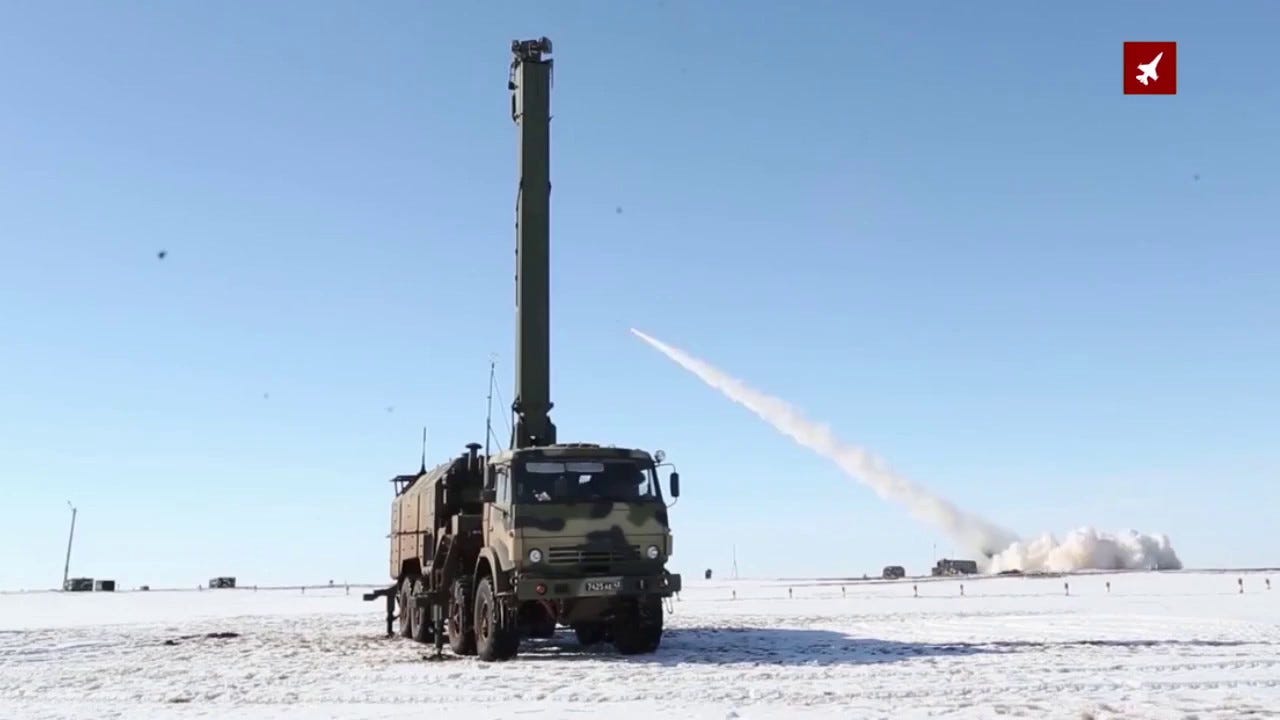
    The Penicillin system offers potent new capabilities to Russia’s counterbattery campaign because it detects enemy artillery batteries not with radar, but with acoustic locating. It sends up a listening boom which, in coordination with a few ground componants, is able to locate enemy guns through seismic and acoustic detection. The advantage of this system is that, unlike a counterbattery radar, which emits radio waves that give away its position, the Penicillin system is passive – it simply sits still and listens, which means it does not offer an easy way for the enemy to locate it. As a result, in the counterbattery war, Ukraine currently lacks a good way to blind (or rather, deafen) the Russians. Furthermore, Russian counterbattery abilities have been augmented by increased use of the Lancet drone against heavy weapons.

    The Penicillin acoustic boom listens for the sound of enemy guns

    All that to say, Russia has been destroying quite a bit of Ukrainian artillery lately. the Russian Ministry of Defense has made a point of highlighting counterbattery success. Now, I know at this point you’re thinking, “why would you trust the Russian Ministry of Defense?” Fair enough – let’s trust but verify.

    On January 20, NATO convened a meeting at Ramstein Airbase in Germany, against a backdrop of a massive new aid package being put together for Ukraine. This aid package contains, lo and behold, a huge amount of artillery pieces. By my count, the aid announced this week includes nearly 200 artillery tubes. Multiple countries, including Denmark and Estonia, are sending Ukraine literally all of their howitzers. Call me crazy, but I seriously doubt that several countries would just spontaneously decide, at the exact same time, to send Ukraine their entire inventory of artillery pieces were Ukraine not facing crisis levels of artillery losses.

    Furthermore, the United States has taken new, unprecedented steps to supply Ukraine with shells. Just in the past week, they have dipped into its stockpiles in Israel and South Korea, amid reports that American stocks are so depleted that they will take more than a decade to replenish.

    Let’s review the evidence here, and see if we can make a reasonable conclusion:

    1. Ukrainian officials admit that their artillery is outgunned by 9 to 1 in critical sectors of the front.
    2. Russia deploys a cutting edge counterbattery system and increased numbers of Lancet drones.
    3. The Russian MoD claims that they have been hunting and destroying Ukrainian artillery systems in large numbers.
    4. NATO has hurried to put together a massive package of artillery systems for Ukraine.
    5. The United States is raiding critical forward-deployed stockpiles to supply Ukraine with shells.

    I personally think it is reasonable, given all of this, to assume that Ukraine’s artillery arm has been largely shattered, and NATO is attempting to rebuild it yet again.

    My kingdom for a tank

    The main point of contention in recent weeks has been whether or not NATO will give Ukraine Main Battle Tanks. Zaluzhny hinted at a badly depleted Ukrainian tank park in his interview with the Economist, in which he pleaded for hundreds of MBTs. NATO has attempted to provide a stopgap solution by giving Ukraine various armored vehicles like the Bradley IFV and the Stryker, which do restore some mobility, but we must unequivocally say that these are in no way substitutes for MBTs, and they fall far short in both protection and firepower. Attempting to use Bradleys, for example, in the MBT role is not going to work.

    Good Morning

    Thus far, it appears that Ukraine is going to receive a small handful of Challenger tanks from Britain, but there is also talk of donating Leopards (German make), Abrams (American), and Leclercs (French). As usual, the battlefield impact of Ukraine receiving tanks is being both greatly overstated (by both Ukrainian shills and pessimistic Russians) and understated (by Russian triumphalists). I suggest a middle ground.

    The number of tanks that can be reasonably given to Ukraine is relatively low, simply because of the training and sustainment burden. All of these tanks use different ammunition, special parts, and require specialized training. They are not the sort of systems that can simply be driven off the lot and directly into combat by untrained crew. The ideal solution for Ukraine would be to receive only Leopard A24s, as these might be available in decent numbers (perhaps a couple hundred), and at least they would be standardized.

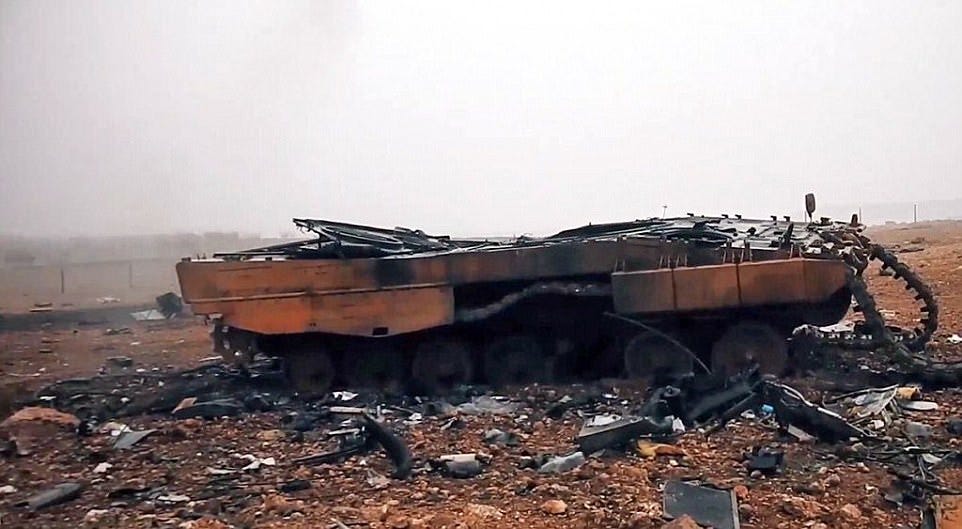
    A burned out Turkish Leopard in Syria

    We should also note, of course, that these western tanks are not likely to be game changers on the battlefield. The Leopard already showed its limitations in Syria under Turkish operation. Note the following quote from this 2018 article:

    “Given that the tanks are widely operated by NATO members – including Canada, the Netherlands, Denmark, Greece and Norway – it is particularly embarrassing to see them so easily destroyed by Syrian terrorists when they are expected to match the Russian Army.”

    Ultimately, the Leopard is a fairly mundane MBT designed in the 1970’s outclassed by the Russian T-90. It’s not a terrible piece of equipment, but it’s hardly a battlefield terror. They will take losses and be attrited just like Ukraine’s prewar tank park was. However, that doesn’t change the fact that a Ukrainian army with a few companies of leopards will be more potent than one without them.

    I think it’s fair to say that the following three statements are all true:

    1. Receiving a mixed bag of western tanks will create a difficult training, maintenance, and sustainment burden for Ukraine.
    2. Western tanks like the Leopard have limited combat value and will be destroyed like any other tank.
    3. Western tanks will raise the combat power of the Ukrainian army as long as they are in the field.

    Now, with that being said, at this point it does not appear that NATO wants to give Ukraine main battle tanks. At first it was suggested that tanks from storage could be dusted off and given to Kiev, but the manufacturer has stated that these vehicles are not in working order and would not be ready for combat until 2024. That leaves only the possibility of dipping directly into NATO’s own tank parks, which thus far they are reticent to do.

    Why? My suggestion would simply be that NATO does not believe in Ukrainian victory. Ukraine cannot even dream of dislodging Russia from its position without an adequate tank force, and so the reticence to hand over tanks suggests that NATO thinks that this is only a dream anyway. Instead, they continue to prioritize weaponry that sustains Ukraine’s ability to fight a static defense (hence, the hundreds of artillery pieces) without indulging in flights of fancy about a great Ukrainian armored thrust into Crimea.

    However, given the intense war fever that has built up in the west, it’s possible that political momentum imposes the choice upon us. It is possible that we have reached the point where the tail wags the dog, that NATO is trapped in its own rhetoric of unequivocal support until Ukraine wins a total victory, and we may yet see Leopard 2A4s burning on the steppe.

    Summary: The Death of a State

    Ukraine’s military is extremely degraded, having taking exorbitant losses in both men and heavy weaponry. I believe Ukrainian KIA are approaching 150,000 at this point, and it is clear that their inventories of both artillery tubes, shells, and armored vehicles are largely exhausted.

    I expect the Bakhmut-Siversk defensive line to be cleared before April, after which Russia will push towards the final (and weakest) defensive belt around Slavyansk. Meanwhile, Russia has significant combat power in reserve, which can be used to reopen the northern front on the west bank of the Oskil and restart offensive operations in Zaporozhia, placing Ukrainian logistics in critical danger.

    This war will be fought to its conclusion on the battlefield and end in a favorable decision for Russia.

    Coda: A Note about Coups

    Feel free to ignore this segment, as it’s a little more nebulous and not concretely related to events in Ukraine or Russia.

    We’ve seen lots of fun rumors about coups in both countries – Putin has foot cancer and his government will collapse, Zelensky is going to be replaced with Zaluzhny, on and on it goes. Patriots in control and all that good stuff.

    In any case, I thought I would just generally write about why coups and revolutions never seem to lead to nice and cuddly democratic regimes, but instead almost always lead to political control passing to the military and security services.

    The answer, you might think, is simply that these men have the guns and the power to access the important rooms where decisions are made, but it is not only that. It also relates to a concept in game theory called Schelling points.

    A Schelling point (named after the gentleman that introduced the concept, an economist named Thomas Schelling) refers to the solution that parties choose given a state of uncertainty and no ability to communicate. One of the classic examples to illustrate the concept is a coordination game. Suppose that you and another person are each shown four squares – three are blue and one is red. You are each asked to choose a square. If you both select the same square, you receive a monetary prize – but you are unable to talk to one another about your choices. How do you choose? Well, most people rationally choose the red square, simply because it is conspicuous – it stands out, and you therefore presume that your partner will also choose this square. The red square isn’t better, per se, it’s just obvious.

    In a state of political turmoil, or even anarchy, the system works itself towards Schelling points – obvious figures and institutions that radiate authority, and are therefore the conspicuous choice to assume power and issue commands.

    The Bolsheviks, for example, understood this very well. Immediately after declaring their new government in 1917, they dispatched commissars to the various office buildings in Saint Petersburg where the Tsarist bureaucracies were headquartered. Trotsky famously turned up at the foreign affairs ministry building one morning and simply announced that he was the new Foreign Minister. The employees laughed at him – who was he? how did he presume to be in charge? – but for Trotsky the point was to insinuate himself on a Schelling point. In the state of anarchy that began to spread in Russia, people naturally look for some obvious focal point of authority, and the Bolsheviks had cleverly positioned themselves as such by claiming control over the bureaucratic offices and titles. On the other side of the civil conflict, political opposition to the Bolsheviks clustered around Tsarist army officers, because they too were Schelling points, in that they already had titles and position within an existing hierarchy.

    All of this is to say that in the event of a coup or state collapse, new governments are virtually never formed sui generis – they always arise from preexisting institutions and hierarchies. Why, when the Soviet Union fell, did political authority devolve to the Republics? Because these Republics were Schelling points – branches that one can grab for safety in a chaotic river.

    I simply say this because I am tired of phantasmagorical stories about liquidation of the regime in Russia and even territorial dissolution. The fall of Putin’s government will not and cannot lead to an acquiescent, western-adjacent regime, because there are no institutions of real power in Russia that are thus disposed. Power would fall to the security services, because they are Schelling points, and that’s where power goes […]

    The original article

    my related pieces

    Russian forces are retreating to the left bank of Dnieper river, are leaving Kherson

    in November 2022

    Strategy in Ukraine, between policy and warfare

    the prospects of destruction of the Ukrainian forces east of Dnieper river

    Countdown of the Atlanticist defeat in Bakhmut

    since early December 20222

    No Panzer counteroffensive is scheduled in Ukraine

    the result of NATO meeting in Ramstein on January 20, 2023