Analista senior di l'intelligenza in u campu di a gestione di i risichi di sicurezza, sò un anzianu tenente detective è ufficiale di l'intelligenza in l'agenzie di u Statu francese. A bona pronuncia hè Николай Чинкуини, in russu
Almost 750 U.S. troops have been wounded or killed in the Middle East since October 2023, an analysis by The Intercept has found. But the Pentagon won’t acknowledge it
Secretary of War Pete Hegseth answers questions as President Donald Trump looks on at the White House on March 24, 2026 (Chip Somodevilla / Getty Images)
U.S. Central Command, or CENTCOM, which oversees military operations in the Middle East, appears to be engaged in what a defense official called a “casualty cover-up,” offering The Intercept low-ball and outdated figures and failing to provide clarifications on military deaths and injuries.
At least 15 U.S. troops were wounded Friday [March 27, 2026] in an Iranian attack on a Saudi air base that hosts American troops, according to two government officials who spoke with The Intercept. Hundreds of U.S. personnel have been killed or injured in the region since the U.S. launched a war on Iran just over a month ago.
President Donald Trump — who wore a blue suit, red tie, and a ball cap to the dignified transfer of the first Americans killed in the war — said casualties were inevitable. “When you have conflicts like this, you always have death,” he said afterward. “I met the parents and they were unbelievable people. They were unbelievable people, but they all had one thing in common. They said to me, one thing, every single one: Finish the job, sir. Please finish the job.”
On Tuesday [March 31, 2026], Trump teased that he would wind down the war with Iran in as little as two weeks despite not achieving many of his stated aims, such as “freedom for the people” of Iran, “tak[ing] the oil in Iran,” and forcing Iran’s “unconditional surrender.” At one point, the president even declared that the war would last “as long as necessary to achieve our objective of PEACE THROUGHOUT THE MIDDLE EAST AND, INDEED, THE WORLD!”
“When you have conflicts like this, you always have death”
CENTCOM has sent outdated statements on casualty numbers, meanwhile, resulting in undercounts, including a statement sent Monday [March 30, 2026] from spokesperson Capt. Tim Hawkins noting that “Since the start of Operation Epic Fury, approximately 303 U.S. service members have been wounded.” The comment was three days old and excluded at least 15 wounded in the Friday attack on Prince Sultan Air Base in Saudi Arabia. The command did not reply to repeated requests for updated figures.
CENTCOM also would not provide a count of troops who have died in the region since the start of the war. An Intercept analysis puts the number at no less than 15.
“This is, quite obviously, a subject that [War Secretary Pete] Hegseth and the White House want to keep under major wraps,” said the defense official who spoke on the condition of anonymity in order to speak frankly.
In 2024, during the Biden administration, the Pentagon provided The Intercept with detailed chronologies of attacks on U.S. bases in the Middle East that listed the specific outpost that was attacked, the type of strike, and whether — or how many — casualties resulted, along with an aggregate count of attacks by country.
The Trump administration’s numbers, by comparison, lack detail and clarity. The current CENTCOM casualty figures do not appear to include more than 200 sailors treated for smoke inhalation or otherwise injured due to a fire that raged aboard the USS Gerald R. Ford before it limped off to Souda Bay, Greece, for repairs. CENTCOM did not reply to close to a dozen requests for clarification on the casualty count and related information sent this week.
“CENTCOM and the White House should be providing accurate and timely information on the costs and casualties involved in this war. After all, it is American taxpayers who are funding it and U.S. economic prosperity and economic wellbeing that is being undermined by it,” Jennifer Kavanagh, the director of military analysis at Defense Priorities, a think tank that advocates for measured U.S. foreign policy, told The Intercept.
“CENTCOM and the White House should be providing accurate and timely information on the costs and casualties involved in this war”
As the U.S. has relentlessly bombed Iran, that country has responded with attacks on U.S. bases across the Middle East using ballistic missiles and drones. CENTCOM refuses to even offer a simple count of U.S. bases that have been attacked during the war. “We have nothing for you,” a spokesperson told The Intercept. An analysis by The Intercept, however, finds that bases in Bahrain, Iraq, Jordan, Kuwait, Qatar, Saudi Arabia, Syria, and the United Arab Emirates have been targeted.
On Tuesday, Hegseth said that Iran retained the ability to retaliate for U.S. strikes but that their attacks would be ineffectual. “Yes, they will still shoot some missiles,” he said, “but we will shoot them down.” On Wednesday morning [April 1, 2026], officials in Bahrain, Kuwait, and Qatar all reported missile or drone attacks from Iran.
Iranian strikes have forced U.S. troops to retreat from their bases to hotels and office buildings across the region, according to the two government officials. The defense official was livid about the Pentagon’s failure to adequately harden the bases and ridiculed Hegseth’s Tuesday prayer at a Pentagon press conference. “May god watch over all of them, each day and each night. May his almighty and eternal arms of providence stretch over them and protect them,” said Hegseth.
“Why didn’t Hegseth protect them?” the defense official asked. “Anyone with a brain knew these attacks were coming.”
Pentagon spokesperson Kingsley Wilson did not respond to multiple requests for comment.
Retired Gen. Joseph Votel, a former head of Central Command, recalled that U.S. troops in the region have faced drone attacks for at least a decade. “At that time we identified a need to protect against this threat, and it has taken far too long for the DoD to respond and provide adequate protection for our deployed troops,” he told The Intercept, referencing drone attacks during the campaign against ISIS in the spring of 2016. “It was a known expectation that, if attacked, Iran would retaliate against our bases, installations, and forces, and I agree that we should have anticipated and been prepared for this inevitability.”
Kavanagh, who previously called attention to the vulnerability of U.S. outposts in the Middle East, echoed Votel. “It has been clear for years that the rapid proliferation of drones and cheap missiles would put U.S. bases and U.S. early detection radars in the region at risk, yet the Pentagon did little to protect them,” she said. “The failure to invest in hardened infrastructure was a choice. Congress should see this failure as evidence that simply giving the Pentagon more money is not a path to national security.”
“We would be better off if bases across the region were closed for good,” she added.
“We would be better off if bases across the region were closed for good”
In public statements, Iran’s foreign minister Seyed Abbas Araghchi called out the U.S. for using civilians in nearby Arab monarchies of the Gulf Cooperative Council states as human shields. “U.S. soldiers fled military bases in GCC to hide in hotels and offices,” he wrote on X last week. “Hotels in U.S. deny bookings to officers who may endanger customers. GCC hotels should do same.”
Votel also expressed concern about troops using hotels and offices, noting it “could turn normal civilian infrastructure into military targets for the regime.”
Last month, an Iranian drone strike on a hotel in Bahrain wounded two War Department employees, according to a State Department cable reviewed by the Washington Post. CENTCOM did not respond to a request to confirm to The Intercept that those injuries stem from a March 2 attack on the Crowne Plaza hotel, a luxury property in Manama, Bahrain’s capital, but one official indicated this was likely.
Votel said that a failure to provide troops with adequate protection may handcuff U.S. operations. “I think this really complicates command and control and could affect unit cohesion and effectiveness,” he told The Intercept, referring to the transfer of troops to hotels and office buildings. “That said, we may not have many options if we cannot protect the military bases where they would normally be bedded down.”
Prior to the current war with Iran, U.S. bases in the Middle East were increasingly targeted by a mix of one-way attack drones, rockets, mortars, and close-range ballistic missiles after Israel’s war in Gaza began in October 2023, most of the attacks occurring in the year following the outset of the conflict. At least 175 troops were killed or wounded in those attacks, including three service members who died in a January 2024 strike on Tower 22, a facility in Jordan. Other attacks targeted al-Asad Air Base, the Baghdad Diplomatic Support Center, Camp Victory, Union III, Erbil Air Base, and Bashur Air Base in Iraq and Al-Tanf garrison, Deir ez-Zor Air Base, Mission Support Site Euphrates, Mission Support Site Green Village, Patrol Base Shaddadi, Rumalyn Landing Zone, Tell Baydar, and Tal Tamir in Syria.
The casualty statistics do not include contractors, most of them foreigners who suffered non-combat injuries. Official U.S. statistics show that there were almost 12,900 cases of injuries to contractors in the CENTCOM area of operations during 2024 alone. More than 3,700 were the most serious non-fatal injuries, including traumatic brain injuries, requiring more than seven days away from work. Eighteen contractors were also killed, all of them in Iraq. The numbers are likely significant undercounts, but if even the fractional number of known contractor injuries is added to the tally, the casualty count for Americans and those on U.S. bases may top 13,600 [end]
In the first week of the US-Israeli aggression on Iran, the Islamic Revolution Guards Corps (IRGC) conducted a series of precision strikes that systematically degraded the much-hyped US integrated air and missile defense architecture across the region
Eisenhower Media Network is an organization of expert former military, intelligence, and civilian national security officials who have an independent, alternative story to tell
The US-funded ecosystem of Iranian ‘rights groups,’ Israeli operatives, and monarchist activists has become a revolving door of unverifiable statistics and atrocity propaganda
As deadly riots burn Iranian cities, Western media ignores the shocking wave of violence, turning instead to US government-funded NGOs for data. The one-sided portrayal has helped push Trump to the brink of authorizing renewed US attacks
In the first week of the US-Israeli aggression on Iran, the Islamic Revolution Guards Corps (IRGC) conducted a series of precision strikes that systematically degraded the much-hyped US integrated air and missile defense architecture across the region
The strikes destroyed or severely damaged at least two AN/TPY-2 THAAD radars, a billion-dollar early-warning radar installation in Qatar, multiple supporting sensor nodes, and critical communications infrastructure.
Executed in a coordinated sequence of precision engagements, Iranian retaliatory operations under the banner ‘True Promise 4’ have significantly disrupted the regional defensive network and forced US commanders to urgently reassess and reconstitute capabilities that took two decades and tens of billions of dollars to deploy.
The scale and sophistication of the Iranian operation mark a significant moment in contemporary warfare, demonstrating that even highly advanced missile defense systems, often presented as near-impenetrable shields, remain vulnerable to determined adversaries equipped with precision guidance, reliable intelligence, and an operational doctrine focused on disabling the core command, sensor, and communications nodes of defensive networks.
As commercial satellite imagery continues to emerge from across the region, the extent of the damage is becoming increasingly difficult to conceal, revealing substantial operational setbacks that raise serious questions about the resilience of the defensive architecture underpinning American force posture from the Persian Gulf to the Korean Peninsula.
The targeting doctrine evident in the strikes reflects years of detailed analysis and planning, with Iranian strategists identifying critical nodes and developing the capability to strike them simultaneously across a wide geographic area.
The coordinated targeting of early-warning radars, fire-control radars, communications infrastructure, and supporting facilities demonstrates a systemic approach to warfare rarely executed at such scale, focusing on neutralizing the command-and-control backbone of the defensive network rather than peripheral elements.
For US commanders currently operating in the region, the immediate challenge lies in sustaining operations with degraded detection and response capabilities, safeguarding remaining strategic assets, and reassuring regional allies whose security frameworks depend heavily on the integrity of these systems.
How these challenges are addressed will shape not only the trajectory of the current war but also the future configuration of American military posture in a region where the balance of power may have shifted significantly in the opening days of March 2026
Muwaffaq Salti Air Base in Jordan
Heart of the beast: Understanding AN/TPY-2 radar’s critical role
The AN/TPY-2 transportable radar represents the technological centerpiece of the Terminal High Altitude Area Defense (THAAD) system. This massive X-band active electronically scanned array (AESA) radar consumes roughly two megawatts of power and is distributed across five forty-foot trailers.
With an antenna area of 9.2 square meters and an instrumental range exceeding 2,000 kilometers in forward-based mode, the radar functions as the primary sensor of the entire THAAD battery. Without it, the launchers and their 48 interceptors are effectively rendered inoperative, deprived of the detection and tracking data required for engagement.
Manufactured by Raytheon using gallium nitride technology, each AN/TPY-2 radar carries an estimated cost ranging from $500 million to $1 billion. Since development began in the 1990s, only about twenty units have been produced worldwide.
The radar performs two distinct operational missions depending on configuration. In terminal mode, it provides fire-control quality tracking data directly to THAAD interceptors during the engagement phase.
In forward-based mode, it feeds detection and tracking data into the broader ballistic missile defense architecture, cueing Aegis warships, Patriot batteries, and other integrated systems. The loss of even a single radar unit can therefore have cascading effects across multiple layers of the defensive network.
Jordan: The first thousand-kilometer precision strike
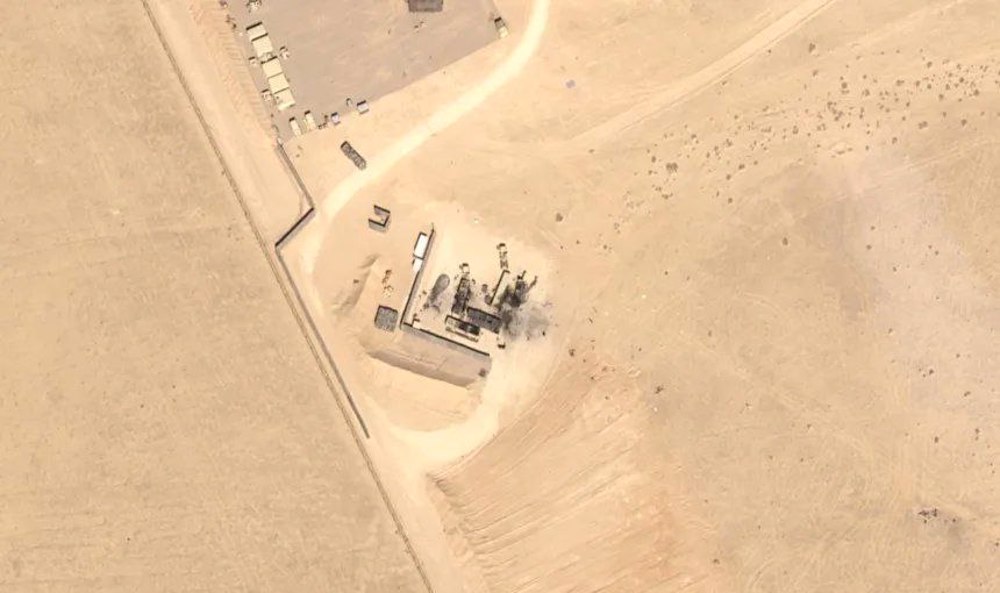
At Muwaffaq Salti Air Base in Jordan, located more than 800 kilometers from the nearest Iranian territory, satellite imagery captured on March 2 reveals the charred remains of an AN/TPY-2 radar that had reportedly been deployed at the base since at least mid-February.
The imagery shows debris scattered across the deployment site, surrounding what appears to have been a fully assembled radar system. Two large impact craters, each roughly thirteen feet in diameter, are visible in the sand nearby, suggesting that multiple precision munitions were employed to ensure the destruction of the system.
Prior to the escalation of hostilities, the base had served as a major hub for American air operations, with more than fifty fighter aircraft visible on the tarmac in pre-war satellite imagery.
The deployment of a THAAD battery at the site fulfilled two key operational objectives: protecting the concentration of air assets from potential ballistic missile threats and extending a defensive coverage umbrella toward Israeli territory.
The strike itself represents a notable demonstration of long-range precision engagement capability, requiring not only a missile with sufficient range but also advanced terminal guidance systems capable of identifying and targeting the radar’s distinctive configuration amid surrounding infrastructure
THAAD base near Al Ruwais in UAE
United Arab Emirates: Systematic elimination of terminal defenses
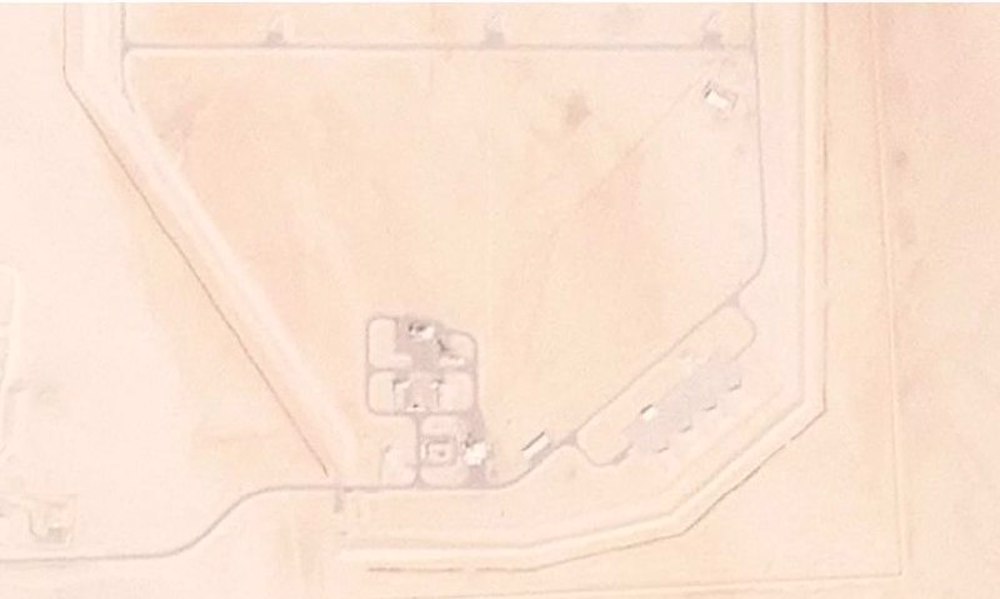
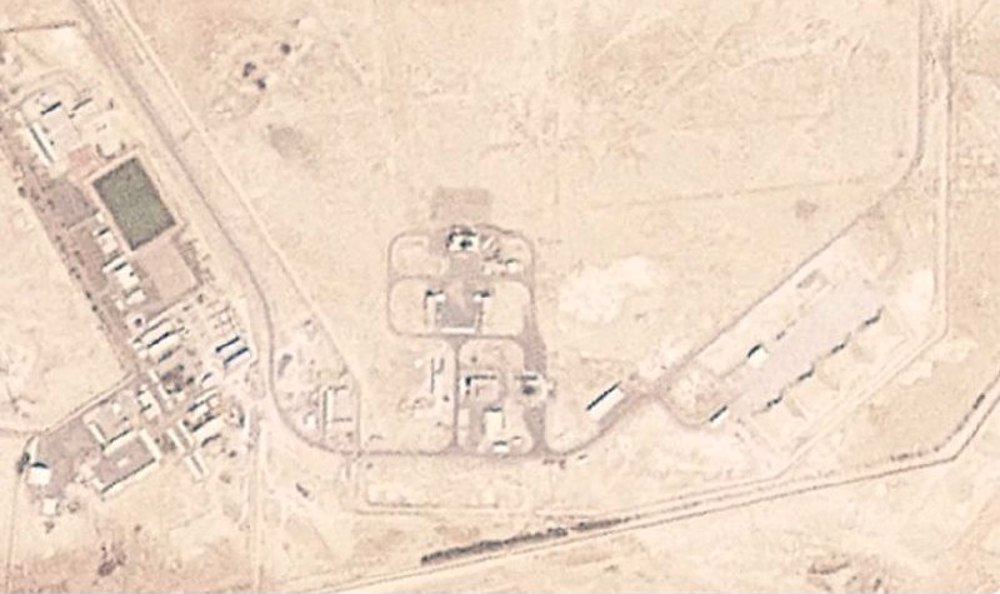
The Al Ruwais facility in the United Arab Emirates, positioned to protect critical energy infrastructure along the Persian Gulf coast, suffered near-simultaneous strikes against both its THAAD radar and the supporting infrastructure that housed the system.
Satellite imagery from March 1, the second day of the war that was imposed on Iran, shows dark markings from apparent strikes on three buildings, including a pull-through vehicle shed specifically designed to shelter the radar system.
The pattern of damage suggests Iranian planners understood not only where the radar would be positioned when active but also where it would be maintained and stored.
At a second UAE installation near Al Sader, satellite imagery reveals an almost identical strike pattern with four buildings damaged, including multiple vehicle sheds configured for radar storage.
The symmetry between the two attacks suggests either simultaneous execution by multiple strike platforms or a methodical campaign that systematically worked through a target list developed over years of surveillance.
Commercial imagery providers captured before and after images that leave little doubt about the severity of the damage, with burned equipment visible at the precise locations where radar components had been regularly observed.
Qatar: Billion-dollar early warning backbone destroyed
The destruction of the AN/FPS-132 Block 5 Upgraded Early Warning Radar at Umm Dahal in Qatar represents perhaps the single most expensive individual loss of the campaign, with that system alone costing approximately one point one billion dollars when installed in 2013.
Unlike the mobile THAAD radars that can theoretically be replaced by redeploying systems from other theaters, the Qatari early warning radar was a fixed installation designed to provide continuous surveillance of ballistic missile launches across a five-thousand-kilometer arc.
The Qatari Ministry of Defence’s rare public confirmation of the radar’s destruction carries strategic significance beyond the military impact, as host-nation acknowledgment forecloses any possibility of concealing the loss and signals to regional allies that American assurances of protective capability may no longer carry their former weight.
The AN/FPS-132 represents the outer layer of the missile defense onion, providing the strategic warning that enables all downstream systems to prepare for incoming threats. Its elimination compresses reaction timelines from minutes to seconds
Al Sader in UAE
Saudi Arabia: Smoke rising from Prince Sultan Air Base
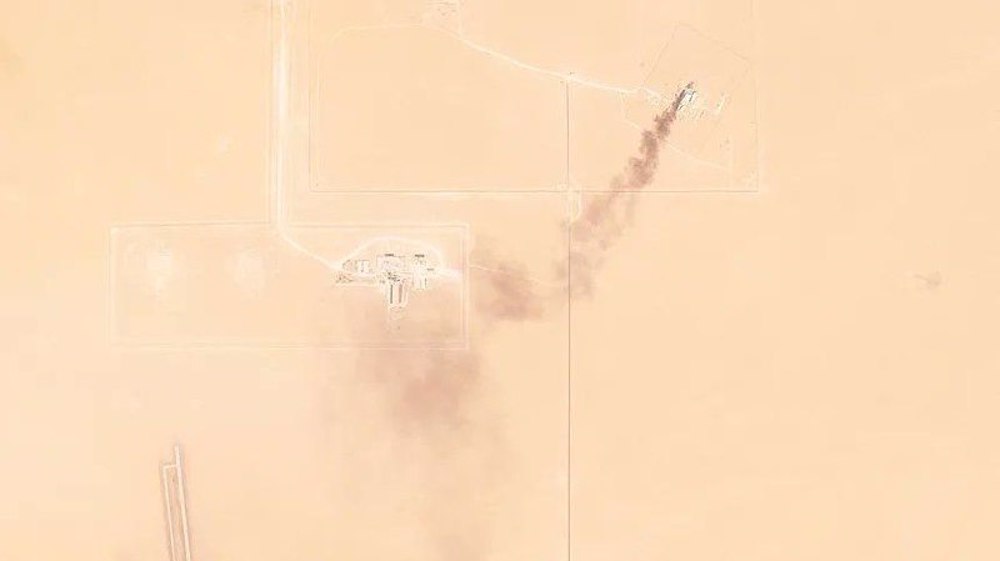
At a site near Prince Sultan Air Base in Al Kharj, Saudi Arabia, satellite imagery captured on March 1 shows smoke rising from a compound where a THAAD radar had been previously positioned, with a tent used to shelter the antenna unit showing extensive charring and debris scattered across the surrounding area.
Imagery from January had shown the radar antenna pointed northeast toward Iran in its operational configuration, suggesting the site was fully functional when struck.
This base hosts dozens of American aircraft and serves as a major command and control node, making the apparent failure to protect a critical sensor positioned within its perimeter particularly embarrassing.
Kuwait: Communications infrastructure and radar domes destroyed
The strikes extended beyond the core missile defense sensors to target the communications infrastructure that enables these systems to function as an integrated network.
At Arifjan base in Kuwait, satellite imagery confirms the destruction of three radomes, the protective spherical structures housing satellite communications antennas that provide the data links connecting distributed sensors to command nodes.
Eight additional buildings related to satellite communications infrastructure were destroyed at separate locations in Kuwait, representing a systematic effort to attack the network backbone.
The AN/GSC-52B radars destroyed in Bahrain represent another category of communications and surveillance assets, providing both satellite communications connectivity and contributing to the space surveillance network.
Their destruction at a facility housing the US Navy’s Fifth Fleet headquarters demonstrates that no American installation in the region can consider itself beyond reach
Prince Sultan Air Base in Saudi Arabia
Strategic calculus: Twenty years of investment destroyed in seven days
The development of the THAAD system began in 1992, with the US Army finally fielding the first operational batteries in April 2012. The journey from initial concept to deployable capability required approximately twenty years and tens of billions of dollars.
The radars now destroyed or severely damaged across at least four countries represent a significant fraction of the total global inventory of approximately twenty units.
Each unit requires years to manufacture, and the destruction of multiple units simultaneously creates a capability gap that cannot be quickly filled.
The financial losses are staggering. Individual AN/TPY-2 radars cost between five hundred million and one billion dollars. The AN/FPS-132 early warning radar cost approximately one point one billion dollars.
The AN/GSC-52B radars, the radomes, the communications buildings, and support infrastructure add hundreds of millions more.
The campaign’s first week has inflicted damages approaching or exceeding ten billion dollars against a target set selected for maximum strategic effect.
Tactical paralysis: The loss means for current operations
The immediate tactical consequence is the effective paralysis of multiple THAAD batteries that now sit blind on their launch positions. Without the AN/TPY-2 radar providing tracking data and fire control solutions, the launchers and their forty-eight interceptors per battery cannot engage incoming threats.
The interceptors themselves, each costing approximately thirteen million dollars, cannot be employed without the radar’s guidance.
The degradation extends to the entire regional defense network. Patriot batteries that relied on THAAD radar data for cueing now face incoming threats with reduced reaction time.
Aegis warships must rely solely on their own SPY radar systems. The integrated battle management system now resembles disconnected nodes fighting local engagements without a common operating picture.
The psychological impact cannot be overstated. Soldiers assured that the most advanced missile defense systems would protect them, but now find their protective shield penetrated repeatedly.
The sight of satellite imagery showing the blackened remains of billion-dollar systems creates a perception of vulnerability that no amount of official reassurance can counter
INFOGRAPHIC: US media point to shortfall in THAAD missile arsenal after nearly a third of its stockpile was deployed in the 12-day war against Iran to defend the Israeli regime.
Global implications: South Korea, Guam, and the strategic reserve dilemma
The destruction of multiple THAAD systems in West Asia has immediate implications for American force posture worldwide, particularly in the Indo-Pacific, where North Korea’s advancing missile program has long justified THAAD deployment.
Reports that Washington is considering relocating THAAD and Patriot systems from South Korea to West Asia reflect the severity of the capability gap.
The THAAD battery in Seongju, South Korea, represents not merely a defensive asset but a political commitment that has survived years of diplomatic tension with China.
Removing it would signal a shift in American priorities, potentially encouraging North Korea to react. Guam, home to another THAAD battery protecting critical American bases, would face similar exposure if its systems were stripped.
The interceptor stockpile faces equally severe pressure. The expenditure of approximately thirty percent of the total THAAD interceptor inventory in a twelve-day aggression in June 2025 demonstrated how quickly these scarce resources can be consumed.
With production capacity limited to approximately eleven to twelve interceptors annually, reconstituting inventory will require years.
Technology question: What Iranian precision reveals about US vulnerabilities
The successful destruction of hardened, defended targets across distances exceeding 800 kilometers reveals Iranian technological capabilities that many Western analysts had previously dismissed.
The terminal guidance required to place a warhead within meters of a specific radar antenna reflects maturation in seeker technology and potentially man-in-the-loop targeting.
The strikes also reveal sophisticated intelligence collection operating for years beneath the threshold of detection, building detailed targeting folders on facilities across multiple countries.
The symmetry between strikes in different countries suggests a targeting process that understood standardized American configurations.
The electronic warfare dimension likely played a critical role in enabling strikes to penetrate defended airspace.
The fact that no Iranian missiles or drones were intercepted before reaching targets across four countries suggests either that defenses were neutralized electronically or that the volume and coordination overwhelmed engagement capabilities
Did you know that Qatar hosts one of the US's biggest military bases in the Persian Gulf, with many air defense systems present, yet none of the American THAAD systems fired a single shot to defend Qatar against the Israeli invasion? pic.twitter.com/GomGDgydQN
Production constraints: Why replacement takes years, not weeks
The industrial base that produces AN/TPY-2 radars operates on peacetime assumptions, with production lines sized to meet gradual replacement requirements rather than the surge demands of major conflict.
The supply chain for specialized components extends across multiple states and countries, with some materials sourced from single suppliers operating at limited capacity.
Even with emergency funding, the time required to produce a single AN/TPY-2 radar cannot be compressed below physical limits.
The most optimistic assessments place replacement timelines in the range of three to five years for a single unit.
The radars destroyed in the first week of March 2026 will not return to the operational inventory until late in the decade at the earliest.
Regional power shift: The new strategic reality
The destruction of America’s premier missile defense assets across four countries fundamentally alters the strategic calculus in West Asia, shifting the initiative decisively toward Tehran.
Iranian military planners who previously had to calculate interception probabilities now face a dramatically reduced defensive threat, enabling expanded targeting options with reduced risk.
Persian Gulf Cooperation Council states that have invested billions in American missile defense now face uncomfortable questions about the wisdom of those investments.
If billion-dollar radars can be destroyed by missiles costing a fraction of that amount, the entire foundation of the Persian Gulf defense relationship requires reexamination.
For the Israeli regime, which has integrated its Arrow and David’s Sling systems with American sensors, the loss of THAAD coverage in Jordan represents a direct blow.
The anti-missile umbrella that previously extended from the Persian Gulf to the Mediterranean now has a gap in its center
The US THAAD missile stockpile was severely depleted during Israel’s war against Iran, raising questions over costs, effectiveness, and the lack of missile defense readiness. https://t.co/aFAbN8RINW
Fiasco verdict: Why two lost radars mean total system failure
Military analysts have begun using language rarely applied to American systems, with experts noting that the loss of a single AN/TPY-2 radar represents an event of significant operational importance while the loss of two constitutes a total fiasco.
The gap between what THAAD was supposed to accomplish and what it achieved against Iranian precision strikes could hardly be wider.
The system’s inability to protect itself while supposedly protecting others constitutes the most damning indictment.
A multilayered air defense architecture should have established protective rings around each THAAD site, with Patriot batteries positioned to intercept threats before reaching billion-dollar radars.
The fact that this protection failed at multiple sites across multiple countries suggests the threat was too sophisticated or the defenders simply overwhelmed.
If radars were struck by ballistic missiles, the embarrassment would be compounded, as this would mean the system designed specifically to defeat ballistic missiles failed not only in its assigned mission but also in self-preservation.
Potential American adversaries from Pyongyang to Beijing study the satellite imagery and draw their own conclusions [end]
Eisenhower Media Network is an organization of expert former military, intelligence, and civilian national security officials who have an independent, alternative story to tell
The US-funded ecosystem of Iranian ‘rights groups,’ Israeli operatives, and monarchist activists has become a revolving door of unverifiable statistics and atrocity propaganda
As deadly riots burn Iranian cities, Western media ignores the shocking wave of violence, turning instead to US government-funded NGOs for data. The one-sided portrayal has helped push Trump to the brink of authorizing renewed US attacks
once more, the US and Israel attack Iran, chronicle
On February 28, 2026, a base of the Islamic Revolutionary Guard Corps (IRGC) is targeted in Damavand, northern Iran (social media)
On June 13, 2025, Israel conducted a surprise attack against Iran, with airstrikes and terrorist operatives on the ground. The first targets were the families residence of high ranking military officials and top nuclear scientists. On June 22, the US bombed nuclear facilities in Fordow, Isfahan and Natanz. The Iranian peaceful nuclear program was a pretext and the actual goal was for the sake of Israel, a regime change in Iran. But after 12 days of Iranian retaliation with swarms of missiles, the assailants begged for a ceasefire
Benjamin Mileikowsky, Netanyahu, a Polish psychopathic settler in the Middle East, whose Donald Trump is the errand boy (Abir Sultan / AFP)
Second try in January 2026: the US had engineered a dollar shortage in Iran, where the currency fell and inflation exploded. That triggered social demonstrations, first peaceful. Mossad and CIA had also spread weapons and the protests turned into deadly riots. But the Iranian society held on and the West lost its last operatives in the country.
Third try: while Epstein case is exhaling the putrid stench of a decaying West, the US and Israel conduct joint surprise airstrikes against Iran on Saturday, February 28, 2026, when stock markets are closed
(RYBAR)That satellite photo is showing after strikes, the compound in Tehran of Ali Khamenei, Supreme Leader of the Islamic Revolution (Airbus)
The targets are military, nuclear and once more, the homes of leaders, whom the assailants want to assassinate. The Supreme Leader of the Islamic Revolution, wise 86-year-old Ali Khamenei, is killed, but the President of the Republic and other officials survive. The State and society hold on, will counterattack
The Islamic Republic of Iran Broadcasting (IRIB) confirms the death of Ali Khamenei
Horror in Minab, southern Iran: because they are daughters of IRGC members, 115 little girls -a provisional toll- are slaughtered in their bombed elementary school
(Social media, screenshot)The mothers of the slain girls (social media)
Deputy Chairman of the Security Council of Russia, Dmitry Medvedev comments
The peacekeeper [Donald Trump] is at it again. The talks with Iran were just a cover. Everyone knew that. So who has more patience to wait for the enemy’s sorry end now? The US is just 249 years old. The Persian Empire was founded over 2500 years ago. Let’s see what happens in 100 years or so…
A retaliation missile flies (Iranian media)
The retaliation is quick and powerful. Missiles and drones are targeting Israel and US military facilities in Bahrain, Iraq, Jordan, Kuwait, Qatar, Saudi Arabia and the United Arab Emirates (UAE)
Iran strikes the 5th Fleet Operations Center in Bahrain (Reuters)An Iranian strike has destroyed the AN/FPS-132 Block-5 radar in Al Udeid base, Qatar (Bismichi Media)
An anonymous official tells The Wall Street Journal that the US has never experienced such a wide-ranging series of simultaneous attacks on its overseas bases before. A few hours after it began, the Western regime–change–through–decapitation operation is already a pathetic failure
In the early hours of the morning, an Iranian missile penetrates the air defense and strikes once more in Bahrain the base of the US 5th fleet. The footage is immediately iconic
https://youtu.be/hvULw2-T57E
Despite a Sunni monarchy, the vast majority of the local population is Shiite and the witnesses cheer the impact.
Iran raises the Red Flag of revenge over the dome of Jamkaran Mosque, in Qom. Grand Ayatollah Nasser Makarem Shirazi declares Jihad against the US and Israel
(Iranian media, screenshot)
This revenge is the religious duty of all Muslims in the world
(Social media, screenshot)
Only Russian and Chinese ships are allowed to pass; Iran has closed the strait of Hormuz. Palauan tanker Skylight has taken a chance, is burning in the morning. At least 150 ships are still west of the strait
(Marine Traffic)
While the belligerents continue to exchange fire, the United States Central Command (CENTCOM) acknowledges that as of 5:30 pm, Tehran time, 3 US service members have been killed and 5 other ones, seriously wounded, since the outbreak of the Western aggression
(Social media, screenshot)
One example of demonstrations of support to Iran in the region: in the evening in Baghdad, the Iraqi people is trying to storm the US embassy in the Green Zone
(Social media)
Meanwhile in Erbil, a blaze is consuming the US base, after an attack that either Iran or the Iraqi resistance has conducted.
After a first day spent depleting enemy munitions, Iran is henceforth using more modern missiles. The Israeli air defense seems inefficient, despite the launch of up to ten interceptors for one assailant. Haifa, Tel Aviv and Jerusalem are pounded. Meanwhile, Western forces start bombing hospitals in Abuzar and Tehran
On February 28, 2026, Donald Trump oversees the attack of Iran from Mar a Lago, Florida (Daniel Torok / White House)
According to Israeli site Ynetnews, Donald Trump is already requesting a ceasefire, via Italian diplomats. The aggressor has originally planned a four-to-five-day operation, according to the same article. That new move is the result of his failed regime change project. And the stock markets will open on Monday. But after the assassinations of Ali Khamenei and almost 200 schoolgirls, Iran is so far refusing.
March 2, 2026
At 9:00 pm, on March 1, London time, 11:00 pm in Cyprus, 12:30 am in Tehran, prime minister Keir Starmer stated
[…] The United States has requested permission to use British bases for that specific and limited defensive purpose. We have taken the decision to accept this request to prevent Iran firing missiles across the region […]
A satellite photo of Akrotiri base on April 4, 2015 (DigitalGlobe)
A few minutes after midnight, Cyprus or Lebanon time, 1:30 am in Tehran, a first drone strikes the RAF base in Akrotiri. More are following
A US pilot surrenders to a Kuwaiti civilian (social media)
At 7:am, local time, their US pilots eject from 3 F-15 jet fighters who fall in Kuwait. According later to the CENTCOM, they were mistakenly shot down by Kuwaiti air defenses
Blaze in Ras Tanura (social media, screenshot)
Later in the morning, Iran strikes ARAMCO refinery in Ras Tanura, Saudi Arabia. Due to similar constraints QatarEnergy ceases its production of liquefied natural gas (LNG) and associated products. On the contrary, stock markets open on Monday and European gas prices surge 50%
European leaders are pathetic, most are blaming Iran, not Israel, lamenting the retaliation strikes in oil-monarchies and demanding a ceasefire. The champion is Bundeskanzler Friedrich Merz who states
Israel, a victim of unjust war, like Ukraine
At 4:00 pm in Florida, 11:00 pm in Jerusalem, 12:45 am in Tehran, the CENTCOM acknowledges 6 killed service members since the beginning of the Western aggression. Meanwhile the US and Israel continue to bomb hospitals in Iran.
March 3, 2026
Shiite majority clashes with security forces in Bahrain. At 3:00 am, local time, several drones manage to hit the US embassy in Riyadh, Saudi Arabia
(Social media, screenshot)
Over the week end, US Marines have shot protestors inside the consulate in Karachi, Pakistan. Later this morning, the diplomatic mission is stormed in Lahore
(Iranian media)
As Minab buries 168 schoolgirls and 14 teachers whom the aggressors slain on February 28 (cf. supra), Israel redoubles its bombing in Lebanon
A hit in Tel Aviv on March 3 (social media, screenshot). Israel is enforcing a strong censorship, in order to prevent such footage from being broadcasted
While the West is depleting its air defense ammunition, Iran is now using cluster warheads
(Russian humor)
Energy prices are still rising in Europe. The day is not good either for the economy in the US, where over $1 trillion is wiped out
Only courageous European countries, Belgium and Spain are slamming the Western aggression as illegal. The second is also banning the US from using its military bases. Hence, Donald Trump decides to stop all trade with Spain.
March 4, 2026
At 2:00 am, Tehran time, Iran claims a hit in the Indian Ocean, 650 km from its coasts, with Qadr [Able] and Talaiyeh [Golden] cruise missiles. The target was a US warship which was refueling
Later, NASA FIRMS satellite monitoring system is showing a thermal anomaly on an Arleigh Burke destroyer in the Arabian Sea
(US Department of Defense, screenshot)
At 5:00 am, local time, 3:00 am in Tehran, a US submarine sinks Iranian Dena frigate in international water. The ship was coming back from an exercise with India. Sri Lankan navy manages to rescue 32 sailors, out of 180
in Tehran on March 4, 2026 (social media, screenshot)
The West is carrying on bombing Tehran, henceforth with rage, in order to liberate the Iranian women. While Israel is also striking Lebanon and invading its southern edge, Hezbollah enters the battle in full swing
Hezbollah demonstration in Beirut on October 20, 2023 (AFP)
The Lebanese Shiite organization is fighting on the ground and targeting Israel with missiles and drones. Israeli Channel 13 quotes an anonymous security source
[…] We were wrong regarding Hezbollah and did not expect them to launch missiles with this range […] We miscalculated the level of force with which Hezbollah joined the battle […]
in Tel Aviv on March 4, 2026 (social media, screenshot)
Despite the Israeli censorship, some amateur videos appear on social media, like that one from Tel Aviv, around 11:30 pm, near the defense ministry. In Shanghai International Energy Exchange, the price of crude oil reaches $100 per barrel.
March 5, 2026
That is not the Star of Bethlehem but an Iranian missile, which after midnight, on March 5, 2026, local time, flies over Netanya, Israel (Jack Guez / AFP)
I answer the questions of a Russian journalist.
Since France announced today that it had authorized the US to use its military bases in the Middle East, they have become, in my opinion, legitimate targets. They are also legitimate from the perspective of Iran, which has already struck military installations in non-belligerent countries, when the facilities were involved in the Western aggression since February 28.
I don’t see so far a world war; the only belligerents are Iran and its Western aggressors: Israel, the US and to lesser extent, their European and Arab lackeys.
The regime-change-through-decapitation operation was already a failure just hours after it began. According to an Israeli journalistic source, Donald Trump even tried, via Italian diplomats, to secure a ceasefire as early as March 1, before the stock market opened the following day.
The struggle has become a war of attrition. The limited size of Israel and the fragility of its infrastructure, the depletion of Western high-end air defense munitions, the blockade of Hormuz strait, constraints on exports from oil monarchies and their worldwide economic consequences… the balance is tipping in favor of Iran.
The only risk of escalation and expansion of the conflict is lying in what Israel and the US might attempt to save face.
On February 28, 2026, a F-18 takes off USS Abraham Lincoln (CENTCOM, screenshot)
At 9:15 pm, Tehran time, the Iranian headquarters state that USS Abraham Lincoln was 340 km from the coasts of Iran, when naval drones attacked. The carrier fled to a distance of 1000 km.
Later, pastors from across the US pray in the White House for Donald Trump, a former friend of Jeffrey Epstein
(White House, screenshot)
May God protect our soldiers. May he continue to give our President the strength he needs to lead our great nation. For all these things, in the name of Jesus, we ask you to pour out your blessings upon him
If I was a believer, I would rather pray for the salvation of his soul.
March 6, 2026
The Dow Jones in the morning of March 6, 2026
That is Friday morning in the US, where the markets have lost more than $2 trillion since Monday, March 2. Russian weekly newspaper Arguments & Facts has published an article which is including my interview yesterday and an interesting analysis of the air war over the Gulf
A launch of Khorramshahr missile on March 6, 2026 (Iranian media, screenshot)
Iran has started using Khorramshahr, a ballistic missile and its 1,800 kg cluster warhead, which is carrying 80 sub-munitions. Israel is feeling so hard its impacts that censorship has become illusory
Iran strikes a 13th vessel which is trying to violate the blockade of Hormuz strait. At 5:30 pm, London time, 9:00 pm in Tehran, the price of Brent crude oil reaches $94 per barrel. Beside, European natural gas is 65% more expensive than the past week
Donald Trump is a lunatic. As a new batch of Epstein files discloses his reprehensible behavior, he demands the unconditional surrender of Iran, which replies
The fate of Iran will be decided only by the proud Iranian nation, not Epstein’s gang
March 7, 2026
As Masoud Pezeshkian, president of Iran, stresses at 5:00 pm, Tehran time, that neighbor Arab countries are hit when attacks on Iran come from their territories, former CIA analyst Larry Johnson assesses that five advanced US radars and three THAAD (Terminal High Altitude Area Defense) systems have been destroyed in one week in the region. Worth roughly $4 billion, the losses are about 30% of these US air defense tools worldwide. Israeli media are complaining that the Iranian successes are easing the penetration of missiles and drones over Israel
A US AN/TPY-2 radar has been destroyed on Muwaffaq Salti airbase, in Jordan (social media)
Infuriated by failure and the Iranian statement, the US strikes half an hour later an Iranian freshwater desalination plant on Qeshm island. According to the Red Crescent, the Western aggressors have bombed so far more than 6,500 civilian sites. That attack has come from a US base in Bahrain and Iran retaliates against military targets in the country. I stress that without their own desalination plants, the oil monarchies would have almost no fresh water.
Journalists question the pedophile rapist about that strike; he replies
Donald Trump on February 28, 2026 (Daniel Torok / White House, detail)
They are among the most evil people ever on earth, they cut babies’ heads off, they chop women in half, what they did, take a look at October 7. If they’re complaining about a desalination plant, we complain about the fact that they shouldn’t be chopping babies’ heads off, okay
Some gross lies, debunked on multiple occasions, that the Israeli disinformation has spread after the Palestinian operation on October 7, 2023. Moreover, Iranians are not Arabs. Through that racist gossip, the uneducated US president rather offends his allies, Sunni Muslim Arabs like in oil monarchies or Jordan
Oil is burning in Tehran on March 7, 2026 (social media, screenshot)
Israel bombs later oil facilities. Iran retaliates with Kheibar Shekan [Fortress Breaker] ballistic missiles, against Haifa refinery.
March 8, 2026
With drones, Iran is conducting surgical strikes against specific hotel rooms in several neighbor Arab countries, in order to kill US operatives and service members who have sought refuge there
A hotel in Kuwait in the night of March 7-8, 2026 (social media, screenshot)
While Israel is bombing Lebanon, Hezbollah is defending it on the ground
On March 8, 2026, an ATGM (Anti-tank Guided Missile) targets an Israeli Merkava tank near Markaba, southern Lebanon (Hezbollah, screenshot)
The US authorities suggest through tips to the media that they are discussing with Israel about
sending special forces into Iran to secure its stockpile of highly enriched uranium
A zany project. Imagine how these people are desperate. The Iranian foreign affairs disclose that behind Western boasts, the US continues mandating third countries to mediate a ceasefire with Iran, which is refusing
(Ella Baron / The Guardian)
Even in the West, the imperialist aggression of Iran is not so popular. Imagine in the wide leftover of the world.
The Chicago Mercantile Exchange opens at 4:00 pm, local time, 11:00 pm in Tel Aviv. Shortly after trading resumes, the price of the Brent crude oil is above $100 per barrel, for the first time in more than three and a half years.
March 9, 2026
His appointment is official at 1:00 am, local time; Seyyed Mojtaba Khamenei is the new Supreme Leader of the Islamic Revolution of Iran.
That man lost his son, wife and mother in the Western attack which assassinated his father on February 28. Imagine how he will conduct that war
(Iranian media)
Vladimir Putin congratulates Mojtaba Khamenei
Esteemed Mr Hosseini Khamenei,
Please accept my sincere congratulations on your election as the Supreme Leader of the Islamic Republic of Iran.
At a time when Iran is confronting armed aggression, your work in this high office will undoubtedly require great courage and dedication. I am confident that you will honourably continue your father’s legacy and unite the Iranian people in the face of these severe trials.
For my part, I would like to reaffirm our unwavering support for Tehran and our solidarity with our Iranian friends. Russia has been and will remain a reliable partner of the Islamic Republic.
I wish you every success in addressing the difficult tasks ahead, as well as sound health and strength of spirit.
Respectfully
Itamar Ben Gvir (Eyal Warshavsky)
Early in the morning, local time, an Iranian strike raises concerns about the physical wholeness of supremacist zealot Itamar Ben Gvir, current Israeli Minister of National Security. A Hezbollah missile dismantles Wadi Aila (Haila, for the Israeli authorities) satellite communication center, south of Tel Aviv
(Social media)
Around 1:00 pm, East Coast time, 8:30 pm in Tehran, an anonymous Israeli official tells the Washington Post
I’m not sure it’s our interest to fight until the regime is toppled. Nobody wants a never-ending story
Later Donald Trump, to CBS
I think the Iran war is pretty much complete
But Iran launches a new wave of ballistic missiles and drones against Israeli and US targets. A very perceptive internet user comments on X
It seems like Israel is blocking videos more than missiles
March 10, 2026
RYBAR analysts summarize the impacts of the Iranian strikes against US bases in the Middle East
In the wake of the outcome of operation Epic Fail, South Korean media are showing that the US is dismantling Patriot and THAAD systems, in order to transfer them to the Middle East
Around noon, East Coast time, 7:30 pm in Tehran, real estate agent Steve Witkoff begs Iran for negotiation
(Screenshot)
Trump is always willing to talk […] Let’s see if Iranians want to talk
US military personnel have been spotted preparing explosive ordnance at an airbase in Gloucestershire (BBC)
At 5:00 pm, local time, the BBC publishes a photo which is showing US service members who handle a heavy bomb at a British air base in Gloucestershire. The site is evidently RAF Fairford, where 3 B-52s and 4 B-1s have arrived since March 6. The US strategic bombers are expected to attack in the Middle East on March 11
around 11:00 pm in Tel Aviv (social media, screenshot)
While Iran continues striking oil fields and US bases in Bahrain, Iraq, Jordan, Saudi Arabia and the UAE, Hezbollah joins the attack against Israel. A troubled night begins in Tel Aviv, where the authorities are preventing the journalists from working.
March 11, 2026
Ukraine is jealous. According to its defense ministry, the Western operation against Iran has consumed more Patriot air defense missiles in three days than the number allocated to Ukraine since February 24, 2022
Thai-flagged cargo ship Mayuree Naree on March 11, 2026 (social media)
Over the day, Iran has stopped three ships which were attempting to cross the strait of Hormuz
(Social media)
After dusk, an oil storage depot is still burning in Salalah, Oman. According to Iran, that attack was an Israeli false flag
(Israeli Channel 13)
Before 10:30 pm, local time, an Israeli military pilot takes this beautiful photo of an Iranian cluster warhead. Around 3:00 pm, local time, Donald Trump is in Kentucky, where he declares
Operation Epic Fury, is that a great name? Well, it’s only good if you win. And we’ve won. Let me tell you, we’ve won. You know, you never liked to say too early you won. We won
(Social media, screenshot)
Almost at the same time, right before midnight in Iraq, naval drones (USV) strike off Umm Qasr two foreign tankers, Marshallese-flagged SafeSea Vishnu and Maltese-flagged Zefyros
The death of Marcus Licinius Crassus (History Quest, screenshot)
In 53 before Yeshua Ben Yosef, Marcus Licinius Crassus hoped that Persia would run out of arrows. Perhaps Donald Trump expected on February 28 that Iran would quickly run out of missiles and drones, but did not foresee his epic fail
March 12, 2026
The aftermath of Israeli attacks in Beirut, Lebanon (AFP)
Around 9:00 pm, local time, a US KC-135 tanker aircraft crashes in Western Iraq. Six crew members are presumed dead. The CENTCOM stresses that the plane was not the target of hostile or friendly fire.
Around 9:10 pm, Tel Aviv time, Benjamin Netanyahu speaks live. His speech is broadcasted worldwide
in France (screenshot)
Problem: his right hand has six fingers. That video is AI-generated and the West is the empire of lies and iniquity. Where is Netanyahu ?
Russian RYBAR analysts release a map of the operations in Iraq, where Iran and the resistance are striking US bases and the West is bombing al Hashd ash Shaabi [Popular Mobilization Forces, PMU], which were raised in 2014 to fight against ISIS jihadists
Around 10:40 pm, local time, 8:40 pm in Paris, with two drones, the Iraqi resistance strikes Black Tiger Camp, 60 km south west of Erbil. At least six French service members are injured, according to the Iraqi authorities
(Social media, screenshot)
March 13, 2026
At 1:30 am, local time, 3:30 am in Baghdad, Emmanuel Macron announces the death of a French serviceman, whom Iraqi strikes killed in Black Tiger Camp a few hours earlier.
Since March 10, US strategic bombers are operating against Iran from RAF Fairford, UK
A US B-1 strategic bomber takes off RAF Fairford on March 13, 2026 (Colin Norwood, screenshot)
The daily US joke comes from Rewards for Justice, an appendix of the State Department
(Rewards for Justice)
So, Mojtaba Khamenei is henceforth wanted. Do you remember the previous notice about a political character in that region ? Tip: he is an al Qaeda jihadist and therefore enemy of Iran
New York Stock Exchange closes at 4:00 pm, East Coast time, 11:30 pm in Tehran. At the end of this second week, the US stock market has lost $2 trillion since the outbreak of the Western aggression against Iran
(Israeli media, screenshot)
At 11:17 pm, local time, 12:47 am in Tehran, an Iranian missile hits something in Negev desert, maybe Nevatim air base.
March 14, 2026
At 2:00 am, local time, Iranian media release a video which is showing scores of Shahed strategic drones, stored in a deep tunnel
On March 13, 7:00 pm, East Coast time, March 14, 2:30 am in Tehran, as retaliation for the blockade of Hormuz strait, Donald Trump announces the bombing of military targets on Kharg island, from where Iran is exporting 90% of its oil products
(Liu Wanli / SF014)
One MEU (Marines Expeditionary Unit, 2,200 service members) is also sailing from Okinawa toward the Gulf. The pedophile rapist is seeking a PR success to save the face.
On March 13, 7:15 pm, East Coast time, March 14, 2:15 am in Riyadh, the Wall Street Journal reports from anonymous officials that in recent days, an Iranian missile damaged five US tanker aircraft on Prince Sultan air base, Saudi Arabia
(Oleg Tsarev)
Around 6:00 am, local time, the Iraqi resistance manages to destroy the C-RAM (Counter Rocket, Artillery and Mortar) air defense system on the roof of the US embassy in Baghdad
(Screenshot)
Later, the resistance releases the video of another successful drone strike this morning, that one inside US Camp Victory, near Baghdad airport
The US and Israel complete a joint air defense exercise on March 31, 2019 (US Army)
According to Semafor, Israel has informed the US this week that it is running critically low on ballistic missile interceptors.
Meanwhile, the whole world is worried about Benjamin Mileikowsky. At 12:45 pm, local time, Israeli media broadcast the speech of Defense minister Israel Katz, during a security briefing with high-ranks officers, that the prime minister used to chair. But he is absent
Humor on social media
There is a body of clues that I will not itemize here. I am quite convinced that for the sake of mankind, Iran achieved a major victory a few days ago.
On social media at 10:00 am, East Coast time, 5:30 pm in Tehran, Donald Trump calls on China, France, Japan, South Korea, the UK and others for help to keep open and safe the strait that his aggression against Iran has closed. Two hours and a half later, the chairman of the Federal Communications Commission (FCC), Brendan Carr, threatens to revoke licenses from media which are running hoaxes and news distortions about the war. The press should not report that the Western aggression is an epic fail.
March 15, 2026
In Hamadan, western Iran, the people bury five victims while bombs are still falling
(Abdolrahman Rafati)
At 2:30 pm, local time, 1:00 pm in Tel Aviv, Iran launches the wave 54 of its retaliation strikes and among various ballistic missiles, for the first time since February 28, two-stages Sejjil [Brimstone] ones
(Iranian media, screenshot)
At 4:34 pm, local time, in an attempt to prove he would be alive and in good shape, a new video is published on Benjamin Mileikowsky’s X account. Goods news: he has now five fingers on each hand
Bad news: according to Hive analysis, the probability that the video is AI-generated is 78.9%. X Grok, whose boss is a South African white supremacist, is not exactly an IRGC fan. Based on technical and scenic aspects, its conclusion is more definite
Yes, upon close analysis of the video, it’s AI-generated
Mileikowsky is dead or at least, badly injured
(Social media, screenshot)
Meanwhile, reports and videos are showing that held in check by Hezbollah in southern Lebanon, Israel is using banned phosphorus munitions.
March 16, 2026
On March 16, 2026, a fuel tank is burning at Dubai airport (AFP)Humor on social media
Failure makes Donald Trump mad. His crisis outbreaks around 7:45 pm, March 15, East Coast time, 3:15 am in Tehran. In a series of rants on social media, he demands treason charges against the radical leftwing media which are covering the war. He also threatens the Western countries which are refusing to rescue the US in the Gulf
(Ben Jennings / The Guardian)
March 17, 2026
Around 2:30 am, local time, the Iraqi resistance achieves a new hit against the US embassy in Baghdad
(Social media, screenshot)
Back in Israel after a mission over Iraq, one US KC-135 tanker aircraft seems unable to land at Ben Gurion airport
(flightradar24 / screenshots)
The plane crashes north of the airport at 3:58 am, local time, when its transponder is cut off. Gag order: the Israeli censorship about the incident is absolute
On March 13, 2026, Ali Larijani marches in Tehran in support to Palestine (Iranian media)
In Tehran, an Israeli attack kills Ali Larijani, Secretary of the Supreme National Security Council.
In the US, Special Operation Forces veteran Joe Kent resigns from his position as Director of the National Counterterrorism Center
I cannot in good conscience support the ongoing war in Iran. Iran posed no imminent threat to our nation, and it is clear that we started this war due to pressure from Israel and its powerful American lobby
In Manbij, Syria, on January 16, 2019, ISIS jihadists killed his wife, Shannon Smith, who was cryptologist in the US Navy (Joe Kent)
That was painful for a real counter-terrorism professional to work for a terrorist government, ally in the Middle East of terrorist entities like Israel and al Qaeda
On September 16, 2012, al Nusra international jihadists, proxies of the West in Syria, attend the funeral in Aleppo countryside of a fellow fighter (Reuters)
According to Reuters, the US is encouraging its al Qaeda ally in the West-friendly jihadist emirate of Syria to consider sending forces in Lebanon, against Hezbollah
On November 13, 2015, the penalty is cruel for the French support to the Sunni radical uprising in Syria. While attending a soccer game in the Stade de France, Saint Denis, François Hollande hears that some of these radicals are attacking in Paris (Franck Fife / AFP)
At 7:00 pm, Tehran time, 5:30 pm in Tel Aviv, the West strikes Bushehr nuclear power plant. As tit for tat, four hours later, Iran targets Negev Nuclear Research Center in Dimona.
March 18, 2026
After midnight, Israel time, Iran offers the fairy-tale spectacle of its cluster warheads in the skies of Tel Aviv and Dubai
(Social media, screenshot)
Iran buries Ali Larijani, Secretary of the Supreme National Security Council, whom an Israeli attack killed in Tehran the day before. French businessman and conservative influencer Laurent Ozon writes
A tribute to Ali Larijani on social media
This story somewhat sums up our world for the past 50 years. An American real estate tycoon who became President through deception of his people, author of « The Art of the Deal », has assassinated an Iranian leader and philosopher on behalf of an Israeli supremacist. That leader had written « The Mathematical Method in Kant’s Philosophy », « Metaphysics and the Exact Sciences in Kant’s Philosophy » and « Reason and Tranquility in Governance ». All that with the support of every horde of malignant, enraged and uncultured lackeys that the West is numbering. The gates of hell are open. They will close
Around noon, Tehran time, with approval of Donald Trump, Israel bombs four plants which in Bandar Kangan region, are processing gas from South Pars, the largest field in the world, located in the Gulf, between Qatar and Iran
(Social media, screenshot)
These facilities are the cornerstone of the Iranian energy system. Qatar regards that attack as irresponsible
(Social media, screenshot)
As legitimate retaliation, Iran strikes in Riyadh, Saudi Arabia, at 7:30 pm, local time, some energy facilities which are hand in glove with the US
At 9:30 pm, local time, Qatar Energy confirms that the Iranian retaliation has also impacted Ras Laffan plant, which like Iran, is exploiting South Pars gas field
(Anadolu Agency)
There are so many targets in the region. Donald Trump has heard loud and clear the message from Iran. At 5:30 pm, East Coast time, 11:30 pm in Tel Aviv and 1:00 am in Tehran, the Wall Street Journal reads that the US president approved the Israeli bombing of Iranian gas processing plants but now opposes further attacks on energy infrastructure
Humor on social media
In the meantime, $800 billion have been wiped from US share market value.
March 19, 2026
On social media at 10:00 pm, East Coast time, 5:30 am in Tehran, Donald Trump blames Israel for the attack against Iranian gas processing plants, promises that no more attacks will be made by Israel, begs Iran to stop striking LNG facilities in Qatar. According later to Qatar Energy CEO, the monarchy has lost 17% of its liquefied natural gas capacity for up to five years
Pete Hegseth in 2019 (social media, screenshot)
After 8:00 am, East Coast time, US Secretary of War Pete Hegseth says in a press conference that the Pentagon needs another $200 billion in funding for the aggression against Iran. In a war it has already lost, 229 days from the midterm elections, the US regime is henceforth bombing in the hope of saving private Trump
(Social media)
Around 5:00 pm, Israel time, 11:00 am in Washington DC, refinery and power plant are hit in Haifa. The site was supplying more than 50% of the national fuel
(Iranian air defense, screenshots)
At the same time, CNN confirms that one US F-35 has made an emergency landing at a US base in the Middle East. The Iranian air defense has managed to spot and hit the stealth fighter jet
(Made with the complicity of an artificial intelligence)
Around 9:00 pm, local time, Benjamin Mileikowsky holds a press conference, actually a televised opening statement, then a virtual Q&A. No journalist is physically present in a room with the prime minister. Released almost three hours later, the video is once more AI-generated.
March 20, 2026
(Earthquake Faction, screenshots)
In the early hours of the morning, militants of The Earthquake Faction, an unknown underground group, penetrate in Pardubice, Czech Republic, a facility of the joint venture of a local company with Elbit Systems, pillar of the Israeli military-industrial complex. They seize documents and set ablaze the building
(Social media)
According to anonymous officials, via the Wall Street Journal, two ballistic missiles would have targeted Diego Garcia, more than 4,000 km from Iran, in Chagos Islands’ morning. Fortunately, the colonial British base was not hit. The Israeli propaganda is exploiting the information as an evidence that Europe could be attacked. But later, Iran denies such a strike
Diego Garcia in 2006 (Wikimedia)
At 5:00 pm, East Coast time, 12:30 am, March 21, in Tehran, NBC reads that the former draft dodger, for fear of fighting in Vietnam,
(Crowd Blue, March 18, 2026)
is weighing whether to send possibly thousands of US troops into Iran as he looks for a way to achieve some of his key goals and end the war
But as usual, nothing is certain.
March 21, 2026
So, maybe boots on the ground. Meanwhile in Baghdad, around 1:00 am, local time, the Iraqi resistance is once more pounding Camp Victory
(Social media, screenshot)
Ironically, in an attempt to stabilize the energy markets, Treasury Secretary Scott Bessent issues at 7:10 pm, 2:40 am in Tehran, a temporary license, which for one month, is lifting sanctions on Iranian oil products
But new humiliation for the US hustlers: Iran has already notified that it has no surplus crude oil to offer to international markets.
At 12:30 pm, local time, the Atomic Energy Organization of Iran (SEA) reports that in the morning, the West has attacked Natanz nuclear plant. According to Israeli media, one or several bunker busters have been dropped
Natanz nuclear plant on March 2, 2026 (Vantor)
Russia denounces that attack and calls for an international investigation. As a restrained retaliation, Iran starts striking at 5:00 pm, Tel Aviv time, Arad and Dimona settlements, where the scientists of the Israeli nuclear program are living
in Dimona (Social media, screenshot)
Later in the evening, the G7, a club of lackeys, condemns Iran, not the aggressors. Confirmation that Israel and its stooges are badly hurt.
The Iranian missiles seem inexhaustible and the Western air defense, henceforth unable to intercept them. Moreover, the West is right to regard the Iranian threat over oil and gas resources in the Gulf as a true nuclear deterrence
People of the world, unite and defeat the American aggressors and all their lackeys (1970)
The Western defeat is evident; India and Japan have started paying in Chinese yuan the right for their oil tankers to cross the strait of Hormuz
IRGC seal
In order to make peace, Iran is demanding full US military withdrawal from Iraq, Syria and the oil monarchies; lifting of all economic sanctions; $500 billion in compensation for decades of economic war.
March 22, 2026
At 7:45 pm, March 21, East Coast time, 3:15 am in Tehran, in a new rant on social media, Donald Trump, maybe drunk, threatens to destroy all Iranian power plants if Iran does not loosen its control over the strait of Hormuz within 48 hours. So, no more boots on the ground ? Targeting the Iranian energy grid is not a good idea and that sole statement will have a terrible impact on markets.
No surprise: the Iranian headquarters spokesman replies that in such a case, all US and affiliated energy, information technology and desalination infrastructure will be struck across the region
(Social media)
Angry toward the successful Iranian retaliation in Arad and Dimona, after the Western attack against Natanz nuclear plant, hordes of Israelis attack Arab villages overnight in the West Bank, where they set ablaze cars and homes.
No AI this time, Benjamin Mileikowsky has emerged from his secret Bunker. Later in the morning, he contemplates his work in Arad, some dividends of his strategic fantasy, but still an insignificant anecdote, compared to the genocide in Gaza
(Avi Ohayon / GPO)
New PR strategy? The Israeli supremacists and their Western supporters haven’t been this whiny in a long time, would be victims of the war they have unleashed. How indecent. How mean. From Arad, Mileikowsky calls on world leaders to join the aggression against Iran. I don’t understand the need of reinforcements; Donald Trump said they had won
(Social media, screenshot)
Meanwhile, thanks to Hezbollah, an Israeli Merkava is burning in southern Lebanon.
March 23, 2026
At 10:00 am, London time, 1:30 pm in Tehran, journalist Paul Nuki and photographer Simon Townsley publish an article titled
But later, on orders from lobbies or the British government, the conservative Daily Telegraph censors its own article
Humor on social media
The collapse of global stock markets begins in Japan and South Korea. At 7:00 am, East Coast time, 2:30 pm in Tehran, Donald Trump announces on social media the postponement of scheduled attacks against the Iranian energy grid and in order to justify that renunciation, invents imaginary negotiations, that Iran denies. Later in a press conference, he blames Secretary of War Pete Hegseth for the aggression against Iran
(Social media, screenshot)
While the US troops are retreating from Iraq to Jordan, Iran and its allies make around 8:00 pm, local time, an offer that Trump cannot refuse : a drone strikes the US consulate in Erbil.
March 24, 2026
(Ohad Zwigenberg / AP)
Iran is pounding Tel Aviv and manages in the morning to wreck the house of Meirav Ben Ari, an Israeli centrist politician, famous for her supremacist comment in October 2023 about the slain children in Gaza
the children in Gaza have brought this upon themselves
al Hashd ash Shaabi [Popular Mobilization Forces, PMU] were raised in Iraq in 2014 and fought with success against ISIS jihadists
After the West bombed the day before intelligence and counter-terrorism headquarters in Baghdad, the Iraqi government officially allows the PMU (cf. supra, March 12) -250,000 men- and army -200,000 men- to defend.
March 25, 2026
While he is fantasizing in public about imaginary negotiations, Donald Trump has actually passed to Iran, via third countries, a 15-point peace plan, which would start with a one-month ceasefire and would end the Iranian support to resistance in Gaza (Hamas) and Lebanon (Hezbollah)
(Bruce MacKinnon / Calgary Herald on March 16, 2026)
Worried about the impact on oil market, Trump is trying to reach a ceasefire since day 2 (cf. supra, March 1) of the Western aggression. Iran already articulated publicly its peace conditions (cf. supra, March 21) and rejects the US proposal.
Later, several amateur videos, from different angles, are showing that an Iranian manPADS (man-portable air-defense system) managed to hit and damage one F-18 fighter jet over Chabahar
(Screenshot)
The Iranian statement clarifies that the aircraft crashed in the gulf of Oman. As usual, the CENTCOM denies the blatancy.
March 26, 2026
(Iranian government on March 25)
According to anonymous officials, via Israeli media, Donald Trump would lean toward a ground invasion in Iran. I foresee that everything would be worse for the US, military defeat and collapse of the Western economies. Global stock markets continue to fall. $1 trillion is wiped today in the US.
March 27, 2026
We must definitely assume that when Donald Trump speaks, he actually addresses the most moronic part of the US populace. I mean people who are reading the New York Post, worshiping Elon Musk or asking Grok for verification. In the morning, one missile and several drones manage to penetrate the air defense and wreak havoc at Prince Sultan air base, Saudi Arabia
Several tanker and AWACS (Airborne Warning and Control System) aircraft are destroyed or damaged; at least ten US service members are injured. Chinese satellite images and the Wall Street Journal will later confirm the success of the retaliation operation.
Foreign affairs minister Abbas Araghchi stresses that since February 28, the West has destroyed more than 600 schools, killed more than 1,000 students and teachers
Western strikes against Arak heavy water reactor (social media)
In the afternoon, the aggressors attack a heavy water reactor (HWR) in Arak, a yellowcake production plant in Ardakan, steel plants in Ahwaz and Isfahan. The Washington Post reads that in four weeks against Iran, the US has burned 850 Tomahawk cruise missiles, roughly a quarter of the inventory. At 600 per year, that is almost 1.5 year of production.
March 28, 2026
At 7:00 am, local time, 6:00 am in Tel Aviv, for the first time since February 28, Yemen targets Israel with ballistic missiles. Later, military spokesman Yahya Saree confirms that Yemen will fight
Military spokesman Yahya Saree on March 28, 2026 (screenshot)
until the aggression against all resistance fronts is crushed
(Mehr News Agency / screenshot)
In Tehran, a toddler is pulled from under the rubble of a bombed building.
March 29, 2026
Photos emerge on social media, are showing a destroyed AWACS (cf. supra, March 27) at Prince Sultan air base, Saudi Arabia
Western media continue distilling that a ground operation would be under preparation. It would be two-month long. The US is actually unable to conquer Iran. Donald Trump is seeking a PR success, in order to save the face.
German BILD tabloid laments
Even Trump’s bombs are powerless
Unbreakable! This is where the mullahs stash their missiles
While the US destroyed parts of Iran’s missile arsenal in the war, a core problem remains: the mullahs’ virtually invulnerable underground fortresses
As retaliation for the latest Western attacks against infrastructure (cf. supra, March 27), Iran strikes Neot Hovav, an industrial zone in Negev desert, south of Beersheba
Blaze in Neot Hovav (social media, screenshot)
Despite previous Iranian warning (cf. supra, March 22), the West attacks the energy system in Tehran and northern Iran, where power outages are reported in the evening
The medical evacuation of injured Indonesian peacekeepers near Adshit al Qusayr on March 29, 2026 (social media, screenshot)
The Israeli artillery is often shelling the positions in southern Lebanon of the UNIFIL (UN Interim Force in Lebanon). After 10:00 pm, local time, Indonesian service members are the target in the vicinity of Adshit al Qusayr. One peacekeeper is killed, several others injured, one badly.
March 30, 2029
On March 30, 2026, for the second time in less than 24 hours, Israel kills Indonesian members of the UNIFIL. Two die when that Humvee is targeted (social media)
While Tsahal continues slaughtering civilians, journalists, paramedics and peacekeepers -three killed Indonesian service members in less than 24 hours- in Lebanon, Israeli media report a positive development after 4:00 pm, local time: the Hezbollah has achieved one more successful ambush.
The authorities are censoring the sensitive and difficult security incident. It would be one of the deadliest in southern Lebanon so far. At least ten helicopters have evacuated dead and wounded soldiers.
March 31, 2026
Israel releases the names of four servicemen, whom Hezbollah killed the day before in southern Lebanon
(Israeli media)
All were in the ranks of recce battalion 934, Nahal brigade. One was captain.
Meanwhile, Spain has banned the US military aircraft from its airspace and Donald Trump is still furious against NATO lackeys -the Daddy mob- which are declining to help in the Gulf
(Iranian media)
Iran advises the employees of US companies to leave the region. Retaliation strikes against these firms will henceforth reward every Western assassination attack.
April 1, 2026
The exact date and location are unknown; this iconic video surfaces on social media after midnight, Tehran time, is showing a missile hitting the position of sheltered US service members
https://youtu.be/Vk3RcsWDEn8
April 2, 2026
The West attacks the construction site of B1 bridge, a major highway project, west of Tehran
(Social media)
In the evening, the large majority of mankind contemplates with glee a successful strike in Tel Aviv. Not the least interception attempt is visible
(CCTV, screenshot)
Later, as retaliation for Western assassination attacks, in accordance with the previous warning on March 31, Iran confirms a strike against an Amazon data center in Bahrain the day before. The IRGC also announces having boinked today an Oracle data center in Dubai. The UAE denies, but is always lying.
While these professionals are trying to explain to the politicians that an escalation against Iran would be a nightmare, Donald Trump and Pete Hegseth start sacking generals, including Randy George, Chief of Staff of the Army
Randy George on October 3, 2023 (William Pratt / US Army)
After his dismissal, he comments
A madman is about to lead the great US military to ruin
April 3, 2026
Iran has managed to shoot down one US F-15 fighter jet. The debris are showing that the aircraft was from RAF Lakenheath, 48th Fighter Wing
(Social media)
With the support of an AC-130 gunship, US special operations forces (SOF) helicopters are trying to rescue the two crew members in southwestern Iran, near border with Iraq and Kuwait
During that Combat Search and Rescue (CSAR) operation, two Black Hawk helicopters are hit and one Thunderbolt attack aircraft, down. As I read on social media
Iran is not for beginners
One damaged Black Hawk helicopter is trying to reach Iraq (social media)
In that context, Washington begs for a 48-hour ceasefire, but Tehran declines.
April 4, 2026
In the morning, Iran strikes the Kirya [Campus], Israeli defense ministry and headquarters of the armed forces in downtown Tel Aviv
(Social media, screenshot)
The US administration starts censoring satellite imagery. By order, the private providers implement an indefinite withhold in the designated Area of Interest (AOI), with retroactive effect from March 9, 2026. The goal of that censorship is propaganda and disinformation for the Western populace, since China and Russia are providing Iran with satellite imagery.
April 5, 2026
After 1:00 am, local time, a new CSAR operation begins with close air support (CAS) and heavy bombing in Kohgiluyeh county, southwestern Iran, where two F-15 crew members were lost on April 3. The pilot has already been rescued during a previous mission. The USSOF manage to find today the weapon systems officer (WSO)
(Social media)
Basij [Mobilization] territorial defense and IRGC are fighting the special forces, who improvise an airstrip. During the battle, the Iranian defenders destroy, at least, two MC-130 transport aircraft, four helicopters and two MQ-9 Reaper drones
The aftermath (Fars News Agency)
The scene reminds operation Eagle Claw, on April 24–25 1980, which was a complete failure and still the origin of a neurosis in the US
(Bahram Mohammadifard / Fars News Agency)
Meanwhile, as retaliation for attacks on B1 bridge (cf. supra, April 2) and other infrastructure, Iran strikes Haifa refinery and US petrochemical facilities in Bahrain, Kuwait and the UAE.
April 6, 2026
In the morning, the West attacks Sharif University of Technology, in Tehran
(Foreign Minister Abbas Araghchi)
Around noon, East Coast time, 7:30 pm in Tehran, Donald Trump is interviewed. The journalist asks
How would it not be a war crime to strike Iran’s bridges and power plants?
Trump is finding out Iran is harder to intimidate than a 13 year old girl
The racism and lies of the pedophile rapist -that is factual- are not new. The same rational is behind the genocide that Israel is committing against Palestinians in Gaza.
April 7, 2026
After midnight, Tehran time, the West starts heavy bombing in several Iranian cities
in Isfahan (social media)
Iran is targeting Saudi Arabia, Bahrain, Kuwait and the UAE, which more than ever, are platforms for the US attacks
In the morning, al Jubail industrial zone is burning in Saudi Arabia.
Later, Israel starts attacking Iranian railways and bridges, then Donald Trump openly fantasizes about causing a whole civilization to die. The IRGC comments
Warning to neighboring countries: restraint is over. We will target the infrastructure of America and its partners in such a way that America and its allies will be deprived of the region’s oil and gas for years
At the United Nations, China and Russia veto a Security Council draft resolution from Bahrain on reopening by force the strait of Hormuz. France, UK and US vote in favor.
From 4:00 pm, local time, 6:30 pm in Tehran, US B-52 strategic bombers take off RAF Fairford, UK. After 10:00 pm, local time, 10:30 pm in Tehran, Israeli officials flee Tel Aviv by air. At the same time, Esmaeil Baqaei, spokesman of the Iranian foreign affairs writes on X
Indeed, those who say « Our Lord is Allah », then remain steadfast, on them shall be no fear, nor shall they grieve
April 8, 2026
At 6:30 pm, April 7, East Coast time, 2:00 am, April 8, in Tehran, Donald Trump pusses out and 90 minutes before the deadline, postpones once more his threat of terrorist attack and genocide.
A ceasefire is enforced and negotiation would begin in Pakistan, where peace would be discussed on the basis of ten Iranian conditions like for example lifting of sanctions, payment of reparations for the Western attack and Iranian control over the strait of Hormuz. The Supreme National Security Council of Iran states
In the Name of God, the Most Gracious, the Most Merciful
It is hereby announced to the noble, great and heroic nation of Iran:
The enemy has suffered an undeniable, historic and crushing defeat in its dishonorable, illegal and criminal war against the Iranian nation. By the grace of the pure and sacred blood of the martyred leader of the Islamic Revolution, Grand Ayatollah Imam Khamenei (peace be upon him), the measures of the Supreme Leader of the Islamic Revolution and Supreme Commander of the Armed Forces, Ayatollah Seyyed Mojtaba Khamenei (may God protect him), the valor and courage of the warriors of Islam on the fronts and especially the historic, enduring and epic presence of you, the dear nation, on the scene from the very first days of the war, Iran has achieved a great victory and forced criminal America to accept its 10-point plan, in which America has principally committed to:
non-aggression, Iran’s continued control over the Strait of Hormuz, acceptance of enrichment, the lifting of all primary and secondary sanctions, the termination of all UN Security Council and Board of Governors resolutions, payment of reparations to Iran, the withdrawal of American combat forces from the region and the cessation of war on all fronts — including against the heroic Islamic Resistance of Lebanon.
We congratulate that victory to all the people of Iran and emphasize that until the details of this victory are finalized, there remains a need for steadfastness and prudence from officials and for the preservation of unity and solidarity among the Iranian people.
Islamic Iran, together with the brave mujahideen of the Resistance in Lebanon, Iraq, Yemen and occupied Palestine, has dealt blows to the enemy over the past 40 days that the historical memory of the world will never forget. Iran and the Axis of Resistance, as representatives of honor and humanity against the most savage enemies of mankind, have, after a historic battle, taught them an unforgettable lesson and have so thoroughly shattered their forces, capabilities, infrastructure and all their political, economic, technological and military capital that the enemy has now fallen into disintegration and desperation and sees no path before it other than surrender to the will of the great Iranian nation and the noble Axis of Resistance.
On the first day, the criminal enemies of Iran launched this unjust war, they imagined they would achieve complete military dominance over Iran in a short time and would force Iran to submit by creating political and social instability. They thought Iran’s missile and drone fire would be quickly extinguished and did not believe Iran could respond so powerfully beyond its borders and across the entire region. The malicious global Zionism had convinced the foolish American president that this war would finish Iran off and that, by eliminating this last bastion of humanity, they could henceforth commit any crime against anyone they wished with ease. They dreamed of partitioning beloved Iran and plundering its oil and wealth and ultimately leaving Iranians adrift in chaos, instability and insecurity for years to come.
The brave warriors of Islam and their courageous allies in the Axis of Resistance — even though their hearts were wounded and shattered by the martyrdom of their Imam — placed their trust in Almighty God and following the example of the Master and Lord of Martyrs, resolved once and for all to teach these enemies a historic lesson, to exact revenge for all previous crimes and to create conditions so that the enemy would forever abandon any thought of aggression against beloved Iran and taste the full bitterness of humiliation and disgrace before the great Iranian nation.
With this strategy and relying on the unprecedented political and social unity that had been established in the country, Iran and the Resistance launched one of the heaviest hybrid battles in history against America and the Zionist regime and during this period, achieved every objective they had designed for this battle.
Iran and the Resistance nearly completely destroyed America’s military machine in the region, dealt crushing and deep blows to the vast infrastructure and assets the enemy had established and stationed around the region over years in preparation for this war against Iran, inflicted massive regional casualties on the criminal American army, struck devastating and crushing blows against the enemy’s forces, infrastructure, assets and properties within the occupied territories and so tightened the noose on the enemy on all fronts that not only were none of the enemy’s primary objectives realized, but the enemy understood approximately 10 days after the start of the war that it would have absolutely no ability to win this war — and for this reason began efforts to establish contact with Iran and request a ceasefire through various channels and methods.
The noble Iranian nation should know that, by the grace of the struggle of their children and their historic presence on the scene, the enemy has been begging for over a month for the cessation of Iran and the Resistance’s fearsome fire, but the country’s officials — because it had been decided from the very beginning that the war would continue until objectives were achieved, including the enemy’s regret and desperation and the removal of long-term threats to the country — gave negative responses to all these requests and the war continued until today, which is the fortieth day. Furthermore, Iran has so far rejected several deadlines presented by the American president and continues to emphasize that it places no importance whatsoever on any type of deadline from the enemy.
We now bring glad tidings to the great nation of Iran that nearly all war objectives have been achieved and your brave children have dragged the enemy into a historic state of helplessness and a lasting defeat. Iran’s historic decision, which enjoys the unified backing of the entire nation, is to continue this battle for as long as necessary, until its great achievements are consolidated and new security and political equations are established in the region, based on the acceptance of the power and sovereignty of Iran and the Resistance.
In this regard and in accordance with the guidance of the Supreme Leader of the Islamic Revolution, Ayatollah Seyyed Mojtaba Khamenei (may God protect him), and the approval of the Supreme National Security Council and given Iran and the Resistance’s upper hand on the battlefield and the enemy’s inability to carry out its threats despite all its claims and the official acceptance of all the rightful demands of the Iranian people, it has been decided that negotiations shall be held in Islamabad, to finalize the details, so that within a maximum of 15 days, Iran’s victory on the battlefield will also be consolidated in political negotiations.
In this regard, Iran, while rejecting all plans presented by the enemy, drafted a 10-point plan and submitted it to the American side through Pakistan, emphasizing fundamental points including: controlled passage through the Strait of Hormuz in coordination with Iran’s Armed Forces — which grants Iran a unique economic and geopolitical position; the necessity of ending the war against all components of the Axis of Resistance — which would constitute a historic defeat of the aggression by the child-killing Israeli regime; the departure of American combat forces from all bases and positions in the region; the establishment of a secure transit protocol in the Strait of Hormuz that guarantees Iran’s dominance according to the agreed protocol; full payment of reparations to Iran according to estimates; the lifting of all primary and secondary sanctions and Board of Governors and Security Council resolutions; the release of all of Iran’s blocked assets and properties abroad; and finally, the ratification of all these items in a binding UN Security Council resolution. It should be noted that the adoption of this resolution would convert all these agreements into binding international law and would constitute a major diplomatic victory for the Iranian nation.
The Honorable Prime Minister of Pakistan has now informed Iran that the American side, despite all its apparent threats, has accepted these principles as the basis for negotiations and has submitted to the will of the Iranian nation. On this basis, at the highest level, it was decided that Iran shall conduct negotiations with the American side in Islamabad for a period of two weeks, solely on the basis of these principles. It is emphasized that this does not mean the end of the war and Iran will only accept the end of the war when — given the acceptance of Iran’s principles in the 10-point plan — the details are also finalized in negotiations.
These negotiations will begin with complete distrust of the American side starting Friday, Farvardin 21 [April 10] in Islamabad, and Iran will allocate two weeks for these negotiations. This time frame is extendable by mutual agreement. It is necessary that during this period, complete national unity be maintained and victory celebrations continue with strength. The current negotiations are national negotiations and a continuation of the battlefield and it is necessary that all people, elites and political groups trust and support this process — which is under the supervision of the Leader of the Revolution and the highest levels of the system — and strongly refrain from any divisive commentary. If the enemy’s surrender on the battlefield is transformed into a decisive political achievement in the negotiations, we shall celebrate this great historic victory together; otherwise, we shall fight side by side on the battlefield until all the demands of the Iranian nation are met.
Our hands are on the trigger and the moment the slightest error is made by the enemy, it will be answered with full force
At 4:50 am, Islamabad time, 7:50 pm, April 7, in Washington DC, Prime Minister of Pakistan Shehbaz Sharif confirms
With the greatest humility, I am pleased to announce that the Islamic Republic of Iran and the United States of America, along with their allies, have agreed to an immediate ceasefire everywhere including Lebanon and elsewhere, EFFECTIVE IMMEDIATELY. I warmly welcome the sagacious gesture and extend deepest gratitude to the leadership of both the countries and invite their delegations to Islamabad on Friday, 10th April 2026, to further negotiate for a conclusive agreement to settle all disputes. Both parties have displayed remarkable wisdom and understanding and have remained constructively engaged in furthering the cause of peace and stability. We earnestly hope, that the ‘Islamabad Talks’ succeed in achieving sustainable peace and wish to share more good news in coming days!
[…] an immediate ceasefire everywhere including Lebanon […]
At 6:30 am, East Coast time, conservative channel Fox News clarifies the ten points for its US public
(Screenshot)
Iran has won and while the US is attempting to disguise its strategic defeat, Israel is fuming. For Russia, Dmitry Medvedev comments
It’s not clear how the truce between Washington and Tehran will play out. But one thing is certain – Iran has tested its nuclear weapons [cf. supra, March 21]. It is called the Strait of Hormuz. Its potential is inexhaustible
in Beirut (social media, screenshot)
But once more, despite a ceasefire, Israel bombs with rage and boasts about it on social media. More than 250 Lebanese are slaughtered in a few minutes, according to a preliminary Civil Defense toll. Iran warns
Within a few hours, if the firing does not stop in Lebanon, the air and missile unit will bomb Tel Aviv
The old pedophile rapist is so substandard that he is not even able to impose a ceasefire on Israel. Polish settler Mileikowsky is actually the boss. At 2:00 pm, East Coast time, 9:30 pm in Tehran, Press Secretary Karoline Leavitt states that the White House threw in the garbage the 10 points on which the US, Pakistan and Iran agreed less than 24 hours before. Brazilian journalist Pepe Escobar summarizes the issue
Epstein Syndicate launched the war. Epstein Syndicate lost the war. Epstein Syndicate begged for a ceasefire. Epstein Syndicate blew up the ceasefire. In less than 10 hours
At 11:00 pm, Tehran time, 3:30 pm in Washington DC, while the US administration and oil monarchies are whining again about it, Iran states that the strait of Hormuz is completely closed.
Army survivors of deadly attack in Kuwait dispute Pentagon’s account, say unit “was unprepared” to defend itself
Former intelligence officer within the US Marines Corps (USMC), then inspector in Iraq for the United Nations, Scott Ritter comments
He [Pete Hegseth] lost the war with Iran. His head needs to roll. He’s also a war criminal
On the ground, the heroic Hezbollah has managed today to fire sixty missiles at Israel. Iran is declining negotiation with the US as long as the Israeli aggression continues against Lebanon.
In the plane to Islamabad, Mohammad Bagher Ghalibaf, speaker of the Iranian parliament, travels with portraits of victims of the Western war crime in Minab on February 28 (Mohammad Bagher Ghalibaf)
A ceasefire is expected the day after in Lebanon and in the evening, the Iranian delegation takes off for negotiation with the US in Islamabad.
April 11, 2026
In Islamabad, Iran is talking so far with Pakistan, which is acting as broker. In order to start direct negotiation with the US, Iran is demanding approval of its control over the strait of Hormuz, war reparations, release of frozen assets and ceasefire in Lebanon
(CENTCOM)
At 12:30 pm, East Coast time, 9:30 pm in Islamabad, while the point is not resolved, the CENTCOM attempts to misinform with a wrong statement
U.S. Central Command (CENTCOM) forces began setting conditions for clearing mines in the Strait of Hormuz, April 11, as two U.S. Navy guided-missile destroyers conducted operations.
USS Frank E. Peterson (DDG 121) and USS Michael Murphy (DDG 112) transited the Strait of Hormuz and operated in the Arabian Gulf as part of a broader mission to ensure the strait is fully clear of sea mines previously laid by Iran’s Islamic Revolutionary Guards Corps.
« Today, we began the process of establishing a new passage and we will share this safe pathway with the maritime industry soon to encourage the free flow of commerce », said Adm. Brad Cooper, commander of CENTCOM.
The Strait of Hormuz is an international sea passage and an essential trade corridor that supports regional and global economic prosperity. Additional U.S. forces, including underwater drones, will join the clearance effort in the coming days
Actually, around noon, local time, 1:00 pm in Islamabad, from a base on the eastern coast of the UAE, USS Michael Murphy, an Arleigh Burke-class destroyer, had entered the strait, but withdrawn under threat of being targeted
In the sea of Oman, USS Frank E. Peterson is also warned (Iranian navy, screenshot)
April 12, 2026
The talks between Iran, Pakistan and the US have lasted 21 hours, end around 7:00 am, Islamabad time
Iranian foreign minister Abbas Araghchi in Islamabad (Iranian media)
Washington was demanding what it had not achieved on the battlefield: lifting of Iranian control over the strait of Hormuz and cession of nuclear materials. The US representatives had already lost the war but tried to dictate their terms in Islamabad. Incredible arrogance
(Elia Baron / The Times)
Still obsessed with Hormuz, Donald Trump decides later to blockade the blockade. He orders the US Navy to board the ships which are paying fee to Iran and are crossing the strait.
Most of these ships are Chinese. He is unable to defeat Iran, then, the strategic genius gets the idea to also confront China and Russia.
April 13, 2026
Chinese defense minister Dong Jun states
Our ships are moving in and out of the waters of the Strait of Hormuz. We have trade and energy agreements with Iran. We will respect and honour them and expect others not to meddle in our affairs. Iran controls the Strait of Hormuz and it is open for us
April 14, 2026
Despite sabre rattling by Donald Trump, four Chinese tankers leave the Gulf, cross the strait of Hormuz and sail beyond
The US Navy does not board them because they did not left Iranian ports and moreover, Chinese Daqing guided-missile frigate is standing 500 nautical miles west of the strait.
April 15, 2026
Despite the US purported blockade, several ships sail through the strait of Hormuz, from and to Iranian ports.
April 16, 2026
Donald Trump announces a ceasefire, which would begin at 5:00 pm, East Coast time, midnight in Lebanon. According to Israeli media, the US has imposed that truce to Benjamin Mileikowsky. It was a demand of Iran (cf. supra, April 8).
April 17, 2026
Iran announces that under its control, the strait of Hormuz is opened for the duration of ceasefire in Lebanon. Of course, Tehran is henceforth charging a fee.
On social media, Donald Trump boasts about that opening, is lying about the terms of the agreement and presenting it as a military victory over Iran. He is always addressing the most moronic part of the US populace, nobody else (cf. supra, March 27).
April 18, 2026
While the diplomatic relations between Israel and France are deteriorating over Lebanon, an Israeli false flag ambush kills one French UNIFIL peacekeeper in the morning. Three others servicemen are injured. Confusion was impossible while the targets were clearing explosive ordnance along a road in Ghanduriyah, where they came under small-arms fire from irregulars shooters who yelled Hezbollah.
According to anonymous officials, via The Wall Street Journal, the US is planning to seize the ships linked to Iran in international waters. Donald Trump is unable to open the strait through military means. As retaliation, he is planning therefore to rely on naval piracy against Tehran.
In the afternoon, Iran broadcasts this VHF message
Attention all ships. Regarding the failure of the US government to fulfill its commitment in the negotiation, Iran declares the Strait of Hormuz completely closed again. No vessel of any type or nationality is allowed to pass through
On social media, Scott Ritter replies to a pro-Israel propagandist from Australia
You are a simple minded propagandist. Trump didn’t live up to his commitment. The US didn’t end the blockade. So Iran doesn’t open the Strait. It’s that easy. Who do you think won this war? It wasn’t Trump. Iran holds all the cards
April 19, 2026
In that context, Iran is declining to participate in a second round of negotiations with the United States
(CENTCOM, screenshot)
Later, the US Navy attacks and seizes Iranian Touska container ship, who was sailing in the sea of Oman to Iran.
April 21, 2026
The wide world does not care about the so-called US sanctions. That is why the US piracy is going on
(Department of War, screenshot)
In the Indian Ocean, between Sri Lanka and Sumatra, the US Navy boards Botswana-flagged Tifani tanker, which was sailing to Singapore with Iranian oil
US at risk of running out of missiles if another war breaks out after depleting stockpiles in Iran operations
At 4:09 pm, East Coast time, 11:39 pm in Tehran, about 20 minutes before the deadline, Donald Trump extends indefinitely the ceasefire enforced on April 8.
April 22, 2026
Iranian speedboats on April 22, 2026 (Copernicus Programme)
Iranian speedboats attack and disable/seize three container ships who had switched off their navigation aid systems and were attempting to leave undetected the Gulf through the strait of Hormuz. Francesca and Euphoria were Panama-flagged. Epaminondas was Liberia-flagged
(Iranian media)
In southern Lebanon, Israel assassinates female journalist Amal Khalil.
April 23, 2026
The announcement is made at 5:30 pm, April 22, East Coast time, 1:00 am in Tehran: Secretary of the Navy John Phelan is dismissed.
At 5:21 pm, East Coast time, 12:51 am, April 24, in Tehran, Donald Trump announces, 24 hours before the deadline, an extension by three weeks of the ceasefire in Lebanon. Actually, Israel is daily attacking southern Lebanon.
April 24, 2026
Iran confirms that China, Russia and Spain are exempted from fee at the strait of Hormuz.
April 25, 2026
Benjamin Mileikowsky is still the boss. Around 9:00 pm, local time, 9:30 pm in Tehran, he disavows the extension of ceasefire in Lebanon that Donald Trump announced less than 48 hours before.
May 4, 2026
At 10:30 pm, East Coast time, 6:00 am, May 4, in Tehran, Donald Trump announce Project Freedom, to free up the ships from the strait of Hormuz
A view of Fujairah oil terminal on May 4, 2026 (social media)
Later that day, Iran exchanges fire with the US Navy, which retreats, then as retaliation, strikes Fujairah oil terminal, which is enabling the UAE to bypass the strait.
May 7, 2026
After 10:00 pm, Tehran time, US warships attack an Iranian tanker in the strait of Hormuz
In the evening of May 7, 2026, an Iranian missile targets US warships in the strait of Hormuz (Iranian media, screenshot)
That triggers a fighting with the Iranian coastal and naval defenses. Under fire and the threat of speedboats, three US destroyers, USS Truxton, USS Rafael Peralta and USS Mason, retreat to the sea of Oman. As retaliation, Iran strikes also the UAE.
June 7, 2026
While the US is regularly challenging the Iranian control over the strait of Hormuz, Israel is carrying on attacking Lebanon. Beirut southern suburb is bombed in the afternoon. As retaliation, Iran strikes Israel in the evening
In Tehran, in the evening of June 7, 2026, Iranians cheer the retaliation against Israel (Majid Asgaripour / WANA)
June 11, 2026
On June 11, 2026, Iran manages to destroy a US long-range early warning radar on Jabal al Dukhan, Bahrain (IRIB)
After midnight, at the instigation of the US, the war resumes with intensity.
June 15, 2026
After midnight in Islamabad, Pakistan, Iran and the US agree on a memorandum of understanding (MoU), that they should sign in Switzerland on Friday, June 19. That is already a humiliating defeat for Israel.
According to Iranian media, here are the 14 articles of the draft agreement
Permanent and immediate cessation of war on all fronts, including Lebanon.
The US commitment to non-interference in Iran’s internal affairs and respect for the sovereignty of the Islamic Republic of Iran.
Complete lifting of the naval blockade within 30 days.
The US commitment to withdraw its forces from around Iran.
Reopening of the Strait of Hormuz within 30 days under Iranian arrangements.
Suspension of sanctions on the sale of oil, petrochemical products and derivatives, and full access of Iran to its financial resources.
The necessity for the US and its allies to present reconstruction plans for Iran amounting to at least 300 billion dollars.
60 days of negotiations to reach a final agreement based on nuclear issues and the complete lifting of primary and secondary US sanctions, and UN Security Council and IAEA Board of Governors resolutions.
Reiteration of Iran’s commitment under the NPT treaty not to produce nuclear weapons.
During the negotiation period, the US has committed not to add forces in the region and not to impose new sanctions.
Release of 24 billion dollars of Iran’s blocked funds during the 60-day final negotiation period. Half of this amount must be made available to Iran before the start of negotiations.
Formation of a supervisory mechanism to implement the agreement.
The final agreement will be approved by a UN Security Council resolution.
Final negotiations will not begin before the release of half of Iran’s blocked funds, suspension of Iran’s oil sanctions and lifting of the naval blockade. The final agreement will only cover the fate of enriched materials and enrichment, lifting of sanctions and Iran’s economic reconstruction plan.
Discussions about Iran’s missile program and support for resistance groups are definitively removed from the agenda
June 19, 2026
The meeting in Switzerland is postponed because Israel continues attacking Lebanon.
June 28, 2026
OK, it’s a draw (French humor)
The US continues challenging Iranian control of the strait and violating several other articles of the MoU. At its initiative, strikes are exchanged again with Iran after midnight
(ABC)
July 18, 2026
As retaliation for a new US escalation, Iran strikes many targets all over the region. In Jordan, the air defense is inefficient and two missiles boink Muwaffaq Salti base after midnight
A US service member records the fall of an Iranian missile at Muwaffaq Salti base (social media, screenshots)
At least 3 US service members are killed there. Dozens are injured and 15 are airlifted to Germany in critical conditions.
the failure of the infamous Israeli attack against Iran, chronicle
The Red Flag of Revenge is flying at the top of Shah Cheragh, Shiraz, late October 2022 (shoma news)
For 615 days, one year, eight months and six days, the colonial, supremacist and apartheid-enforcing regime of Israel, a Western trading post in Palestine, is committing mass war crimes, mass killing of civilians and ethnic cleansing in Gaza Palestinian ghetto
in Gaza Palestinian ghetto on November 19, 2024 (Israeli Channel 14)
In the early morning of June 13, 2025, day of infamy, Israel conducts, without war declaration, a surprise attack against Iran. The first targets are the families residence of high ranking military officials and top nuclear scientists. Dozens people, mostly civilians, are killed.
The Israeli fighter jets are freely refueling over Syria, where international Jihadists and West-backed local Sunni radicals overthrown on December 8, 2024, the secular government of Bashar Assad, an ally of Russia and a determined opponent of Israel
Al Nusra (local branch of al Qaeda) Jihadists attend on September 16, 2012, the funeral in Aleppo countryside, northwestern Syria, of a fellow fighter (Reuters)
200 fighter jets carry out the surprise attack with intelligence and technical support from treacherous Western countries. Israel was planning the operation for a long time, while Donald Trump, whose only consistency is to be errand boy of Israel, was appeasing Iran through his apparent will to negotiate about the Iranian nuclear program. Iran had no intention to develop nuclear weapons and the issue is merely a pretext.
Israel is unable to win a war of attrition against Iran. Benjamin Mileikowsky / Netanyahu is rather gambling on a quick regime change in Tehran or the direct US involvement in the conflict. Greater Israel is his strategic goal and US neocons are agreeing with him. The Western government are supporting the rogue State as a Middle Eastern proxy, a pawn of their desperate attempt, from Ukraine to Africa, to prevent their global hegemony from crumbling
Benjamin Mileikowsky / Netanyahu, a Polish psychopathic settler in the Middle East (Abir Sultan / AFP), what could go wrong ?
However, the psychopathic Polish settler is not adventurous and around noon, while the strikes are going on in Iran, Mileikowsky flees to Greece before any retaliation.
Symbolically, the wheel turns in the evening, when according to the Iranian press, the air defense has managed to shoot down two US-made F-35 fighter jets. Has the right to defend itself [a mantra among supporters of Israel, to justify its action in any circumstances] and before 9:30 pm, local time, Iran fills with happiness the lovers of justice worldwide
in Tel Aviv (Leo Correa / AP)
Dozens ballistic missiles break through the Iron Dome [a major component of the Israeli air defense] and strike their targets all over Israel. The first wave manages to wreck the Kirya [Campus], Israeli defense ministry and headquarters of the armed forces in downtown Tel Aviv
in Tel Aviv (Tomer Neuberg / AP)
Military means from the US, its European stooges and some Arabic puppet States like Jordan are involved in the attempts to intercept incoming missiles. Israeli officials report to the press
unprecedented destruction in the greater Tel Aviv area, the likes of which we have never seen before
over Jerusalem (Chen Junqing / Xinhua)
That is the beginning. Iranian foreign affairs minister states
We no longer accept any calls for restraint
After midnight, Soreq Nuclear Research Center is hit south of Tel Aviv.
June 14, 2025
Iran arrests 73 Indian citizens who were spying for Israel, members of a large network of Israeli operatives, which was involved in the attacks the day before. I guess that one of its missions was to disrupt the Iranian air defense with drones and antitank guided missiles (ATGM)
in Yemen (Iran in Arabic)
In Sanaa, Yemen pays tribute to Iranian martyrs of the preemptive Israeli assassinations. Benjamin Mileikowsky / Netanyahu is threatening Iran from his Greek refuge, where he fled to escape fair retaliation strikes. At various degrees, Russia, the day before, now China, Pakistan and Venezuela express their support to Iran.
Israel is targeting economic infrastructure, like facilities in Bandar Kangan, which are exploiting South Pars gas field in the Persian gulf. Iran claims the destruction of a third F-35 and the capture of a second alive pilot. The chairman of the Iranian National Security Commission discloses that via various countries, Israel has requested the end of the Iranian retaliation strikes.
According in the evening to Israeli Channel 13, the relatives of government members have been evacuated to secret locations. Channel 10 reports that Pakistan has warned the US: any nuclear attack on Iran would trigger a Pakistani nuclear attack on Israel. Moreover, France and the US have been informed that if any country directly intervenes against Iran, Pakistan will be at war against Israel
A witness in Haifa records the fall of a Kheibar Shekan ballistic missile (screenshots)
From 11:15 pm, local time, missiles rain on Haifa refinery.
June 15, 2025
While the Iranian strikes continue in the night, Yemen participates in the operations with Palestine 2 hypersonic ballistic missiles
Benjamin Mileikowsky / Netanyahu has left the Greek refuge where he fled on June 13, is back in Israel, visits ruins in Bat Yam, south of Tel Aviv, where Iran retaliated in the night
(Yael Ciechanover)
Foreign affairs minister Abbas Araghchi states that Iran is ready to conclude an agreement which would guarantee that it will not develop nuclear weapons
(Quds News Network)
However, the nuclear issue is merely a pretext for Mileikowsky and the US neocons. Israel doubles down its attacks in Tehran, where its clandestine network is engaging in terrorism, detonates car bombs
in Tehran on June 15 (social media)
After 4:00 pm, Jerusalem time, Iran retaliates. The Israelis run to the shelters, but their government enforces a gag order, to prevent the broadcast on social media of the successful strikes
in Tel Aviv on June 15 (Israeli TV)
No image but according to Israeli media, Iran has notably targeted Mileikowsky’s villa in Caesarea. In that context, an Israeli internet user writes the Tweet of the Day
Israeli Public Broadcasting Corporation (IPBC, Kan) reports in the evening that Israel has officially requested the establishment of an international coalition to help defend Israel and intercept missiles
in Haifa in the evening of June 15 (social media)
At 8:30 pm, Jerusalem time, Iran and Yemen start a new joint operation. Among other targets, a Rafael Advanced Defense Systems facility is hit in Haifa, as well as Ben Gurion airport in Lod.
According to left-wing newspaper Haaretz
the government has ordered airlines not to take Israelis abroad even when rescue flights begin
June 16, 2025
On May 29, Palestinians gather in their Gaza ghetto to receive aid supplies from the US-backed Gaza Humanitarian Foundation (Ramadan Abed / Reuters)
Meanwhile, Volker Türk is Austrian and the United Nations High Commissioner for Human Rights, stresses that in Gaza, Israel is weaponizing food, calls for investigation into deadly attacks near food distribution sites. I add that in order to attack Hamas, Israel is also supporting in the Palestinian ghetto a bunch of ISIS Jihadists
Iran is dismantling the network of Israeli operatives on its territory, releases the photos of a battery of Spike ATGMs, which were likely used on June 13, to attack the air defense. An Iranian caricature is summing up the overall situation well
(Iran in Arabic)
After 6:30 pm, Tehran time, Israel targets the Islamic Republic of Iran Broadcasting (IRIB). One journalist and one female secretary are killed
Moreover in Israel, the police will no longer allow foreign journalists to cover news in Haifa, where the main refinery of the country has shut down. Arab reporters are arrested for their earlier footage of the ruined facility
(Iraqi Sabereen News agency)
Iranian Tasnim news agency reports that another F-35 has been shot down, that time in Tabriz region. It would be the fourth one
(Screenshot)
After 11:15 pm, Jerusalem time, Tasnim broadcasts a footage of the magical night over the occupied West Bank, where cruise missiles are flying to Israel.
June 17, 2025
Vladimir Harkonnen in Dune (2021)
The alert sounds in Israel before 12:30 am, when in order to achieve a concentration effect, Iran launches ballistic missiles, which are faster and will catch up the cruise ones. Before 1:00 am, visible from the distance, a large blaze confirms that Nevatim air base has been hit in Negev desert. According to the statement of the Islamic Revolutionary Guard Corps (IRGC), the terrorist attack the day before, against the national TV in Tehran, came from that airfield
The whole Israeli establishment is now begging him to enter the war. As usual, he is erratic, has stated everything and its contrary in less than 24 hours. At 1:30 am, Jerusalem time, the obese and vain errand boy of Israel uses social media to threaten Tehran inhabitants with a terror bombing. I guess that Israel was hit hard in the night, perhaps also US service members on Nevatim air base.
In the morning, dozens people are slaughtered in Khan Yunis, Gaza Palestinian ghetto, where an Israeli tank opens fire at a crowd waiting for food aid trucks. After 9:00 am, Jerusalem time, Iran conducts new operations, targets notably the neighborhoods, north of Tel Aviv, where intelligence agencies are headquartered. The two belligerents continue to exchange strikes over the day.
June 18, 2025
From 12:45 am, Jerusalem time, missiles are raining all over Israel. Despite the Israeli gag order, amateur videos surface on social media. The air defense appears unable to intercept the assailants. Israel replies with strikes in Tehran
Iranian missiles take off on June 18 (screenshot)
Tehran has demonstrated its resilience against an assassinations campaign and Israel is unable to destroy the Iranian underground military facilities, when the missiles could ruin the Israeli economy. We should neither forget the demography and sizes of the two countries. Israel cannot win, needs frantically the direct involvement of the United States. Taking into account the risk of a Pakistani intervention (cf. supra, June 14) and the opportunity for Iran to close the strait of Hormuz, I can’t imagine how the US could openly attack
Chinese pop music band innokids expresses with poetry and strength the glee of mankind large majority, when Iranian missiles are raining over Israel, as a fair retribution for the martyrdom of Gaza. That is art against barbarism. The West won’t recover from its depravity
G7 leaders (Morten Morland / The Times, June 18, 2025)
June 19, 2025
Amid usual reciprocal strikes, Iran hits Tel Aviv in the morning. The stock exchange is heavily damaged and closes. Therefore, investors transfer $475 billion to other markets
Tel Aviv on June 19 (screenshot from an amateur video)
While Israelis are complaining about these impacts, their air force is still flattening Gaza strip, bombs Jabalia, in the north
Jabalia on June 19 (social media)
The White House reports that Donald Trump will make a decision in the next two weeks over a possible attack against Iran.
June 20, 2025
Haifa on June 20 (screenshot)
At 3:45 pm, Jerusalem time, Iranian Supreme Leader Ali Khamenei declares that Israel is now receiving its punishment. The censorship has increased: broadcast or even recording of impacts are now a criminal offense in Israel, but a few reports and footage are however surfacing. Beersheba, Tel Aviv and Haifa are hit. Some of the missiles are Sejjil [brimstone], a three-stage ballistic design
(Islamic World News)
At 11:06 pm, Tehran time, Fox News interviews Donald Trump. Here is the dialog
[Journalist] Your intelligence community says they have no evidence Iran is building a nuclear weapon at this point
[Trump] Well then my intelligence community is wrong. Who in the intelligence community said that?
He seems more confident in Benjamin Mileikowsky / Netanyahu than his own DNI. Actually, Trump knows that Gabbard is right. But like in the case of the alleged weapons of mass destruction (WMD) and invasion of Iraq, that Israel demanded in 2003, the president is lying. The nuclear issue is a pretext and the goal is regime change.
June 21, 2025
Amid reciprocal strikes, Israel deepens [Israeli army] its attacks on Isfahan Nuclear Research Center
(Screenshot)
Waves of Israelis are landing in Cyprus, after they fled Israel by sea, because of their ban from flights (cf. supra, June 15).
June 22, 2025
At 3:20 am, Tehran time, Donald Trump announces on social media that the US has carried out air strikes against Iranian nuclear facilities in Fordow, Isfahan and Natanz
The Iranian media report quickly that the three sites, their highly-enriched uranium (HEU) stockpiles, had been evacuated and that there is no risk of radioactive leaks. The analysis of satellite images assesses later that 6 13-ton GBU-57 Massive Ordnance Penetrator (MOP) hit Fordow, where the underground facility was not destroyed
(Maxar & Damien Symon)
According to the Pentagon, a total of 14 MOPs and 30 Tomahawk cruise missiles have been used against the three sites. At 7:45 am, Jerusalem time, Iran retaliates against Israel
The aftermath on June 22 of the strikes in Tel Aviv (Israeli media)
Quickly after the US aggression, the Islamic Revolutionary Guard Corps (IRGC) states that the war has just begun. The New York Times titles U.S. Enters War With Iran
(Elena Shao / The New York Times)
In only 10 days, Iran underwent two surprise attacks, that USrael conducted under cover of deceptive diplomacy, but according to CNN, Washington lunatics are sending messages over the Middle East that they does not intend to carry out further strikes and are seeking negotiations. These thugs behaviors are from a decaying empire
(Wikimedia)
Democratic representative Sean Casten calls the congressionally-unauthorized strikes an unambiguous impeachable offense. In the afternoon, the parliament of Iran votes for the lock of the strait of Hormuz. The final decision rests with Ali Khamenei and the Supreme National Security Council
(IRNA)
At 10:30 pm, Tehran time, Iranian foreign affairs minister Abbas Araghchi lands in Moscow, will meet Vladimir Putin the day after.
June 23, 2025
After midnight in the Middle East and Europe, Donald Trump is carrying on raving on social media, with the spirit poverty which is the mark of his breed. Amazing how quickly he is sabotaging his own presidency, only 5 months after his inauguration
Illma Gore painted Donald Trump in 2016
Among his former electors, many do not understand his warmonger coming out, how the neocons have hijacked their government. They should remember that during his first mandate, on behalf of Israel, he already ordered the assassination, on January 3, 2020, of Qasem Soleimani, the Iranian hero of the fight against the Jihadists in Iraq and Syria
Qasem Soleimani (SNN)
That is the end of the Make America Great Again (MAGA) movement at home and more significant, a terrible blow to the reputation of the US. After the deceptive diplomacy against Iran and the new illustration of the murican submission to Israel, no political leader in the world will grant the US the least confidence
(The Kremlin)
At noon, Kremlin time, Iranian foreign affairs minister Abbas Araghchi meets Vladimir Putin, who stresses that
The completely unprovoked act of aggression against Iran is without foundation or justification […] Russia has long-standing, strong, and trustworthy relations with Iran, and we are committed to supporting the Iranian people through our continued efforts
(teleSUR)
At 7:30 pm, Moscow time, as symbolic retaliation for the US aggression the day before, Iran aims a few missiles at al Udeid, Qatar, the main US air base in that part of the world. In order to prevent human losses, Tehran has given advance notice to Doha.
June 24, 2025
Israel failed to trigger a regime change and in return, Iran has wreaked havoc. To meet his strategic goal, Benjamin Mileikowsky / Netanyahu needs frantically the direct involvement of Washington, but the US air strikes were disappointing (cf. supra, June 22). The West is fearing the closure of the strait of Hormuz and Donald Trump attempts to save face at minimal cost.
At 1:30 am, Tehran time, he boasts on social media over a weird ceasefire he would have brokered. Iran would enforce it 6 hours later, at midnight, New York time, but Israel would not stop bombing until 12 hours later
in Beersheba on June 24 (social media)
Iran retaliates once more and at dawn, achieves in Beersheba an impressive strike. Both belligerents pretend to accept a bilateral ceasefire from 7:00 am, Jerusalem time, that the Israeli psychopaths violate in the afternoon.
The nuclear issue was the pretext for a surprise attack which failed on regime change. But despite the direct involvement of the US, even the nuclear infrastructure has resisted. For the first time, a country has held out against the whole West. On the other side, the pathetic Israeli supremacist settlers had to beg frantically for the murican involvement. Donald Trump did not obliterate the Iranian peaceful nuclear program, but ruined the US reputation, gave Iran a good reason to develop nuclear weapons. These 12 days clearly result in an Iranian victory, on behalf of the large majority of mankind. Here is a summary of the events
June 25, 2025
Iranian lawmakers approve a bill about suspension of cooperation with the International Atomic Energy Agency (IAEA), which has leaked information to Israel before the surprise attack on June 13
(IRNA)
In the frame of the Shanghai Cooperation Organisation (SCO), Iranian defense minister Aziz Nasirzadeh is in China
Supreme leader Ali Khamenei illustrates on social media how Iran has managed to defeat the multi-layered air defense of Israel
Since 2019, the US is bolstering the Israeli defense with its Terminal High Altitude Area Defense (THAAD), a system designated to intercept ballistic missiles. That commitment was increased in October 2024
The US and Israel complete a joint air defense exercise on March 31, 2019 (US Army)
Newsweek reports that since June 13, the US has depleted 15-20% of its global THAAD stockpile, for a cost over $800 million.
June 28, 2025
(Tehran Times)
In Tehran, Iran pays tribute to the victims of the Israeli surprise attack, including the scientists and military commanders who were assassinated on June 13, when their family homes were targeted
Rafael Grossi (Riccardo De Luca / Anadolu)
The surveillance devices of the International Atomic Energy Agency (IAEA) are dismantled in the Iranian nuclear facilities. And henceforth, its Argentine director Rafael Grossi is banned. Already compromised in the Ukrainian file, he is legitimately suspected of having leaked information that USrael has used for its attacks.
July 2, 2025
Atomic Energy Organization of Iran (SEA)
Iranian President Masoud Pezeshkian ratifies the vote of the parliament (cf. supra, June 25) about the suspension of cooperation with the International Atomic Energy Agency (IAEA). Henceforth, any inspection of nuclear facility will require the prior approval from the Supreme National Security Council.
[my illustration : on June 4, 2019, the TIP (east Turkestan Islamic party, Doğu Türkistan İslâm Harriet in Turkish) releases a new propaganda video (screenshot). These Uyghur jihadists are fighting in northwestern Syria, against the Syrian secular forces, within al Qaeda’s local branch (Hay’at Tahrir al-Sham, Organization for the Liberation of the Levant, HTS), which is settled under NATO protection in Idlib pocket]
Foreign jihadists have been appointed in senior positions in the new Syrian military, which is now led by Hayat Tahrir al-Sham (HTS), an offshoot of al-Qaeda that led the offensive that ousted former President Bashar al-Assad.
Syrian sources told Reuters that the foreign fighters appointed to the military include Uyghurs, a Jordanian, a Turk, and an Albanian. “This is a small token of recognition for the sacrifices Islamist jihadists gave to our struggle for freedom from Assad’s oppression,” an HTS source told the media outlet.
Among the Uyghurs is Abdulaziz Dawood Khudaberdi, the commander of the Turkistan Islamic Party’s (TIP) forces in Syria. The TIP’s stated goal is to create an Islamic State in China’s western Xinjiang region. Khudaberdi was named a brigadier general in the Syrian military, and two other Uyghur fighters were appointed colonels.
Sources told Reuters that Turkish citizen Omar Mohammed Jaftashi and Jordanian citizen Abdul Rahman Hussein al-Khatib were also made brigadier-generals. Abdul Jashari, an Albanian fighter who was designated a terrorist by the US Treasury Department, was made a colonel.
HTS is still designated by the US as a foreign terrorist organization, but the Biden administration has celebrated its takeover of Syria. The US has also made clear it’s willing to work with the new government and its de facto leader, Abu Mohammad al-Julani, who has been going by his real name Ahmed al-Sharaa.
Earlier this month, Barbara Leaf, the US Assistant Secretary of State for Near East Affairs, met with Julani and announced the US was removing a $10 million bounty on his head. Julani, a former al-Qaeda leader, appointed other HTS members in senior positions of the “transitional government” and has said elections in Syria probably won’t happen for at least four years [end]
Until recently, a serious geopolitical working hypothesis was that West Asia and Ukraine were two vectors of the standard Hegemon modus operandi, which is to incite and unleash Forever Wars. Now both wars are united in an Omni-War
the jihadist operation in Paris, on November 13, 2015, was the collateral damage of the Western support to the so-called Syrian revolution, a Sunni radical uprising against the secular government of Syria, which began in 2011 and that global jihadists joined from worldwide
[my illustration: on December 11, 2024, an Israeli tank is hanging around near the so-called Alpha line, between the already annexed Golan heights and former secular Syria (Morning Star)]
In the wake of ultra-extremist militants Hayat Tahrir al-Sham seizing Damascus, Zionist entity premier Benjamin Netanyahu gave a smug address from the Golan Heights, Syrian territory illegally occupied ever since 1967. Along the way, he took personal credit for the fall of Bashar Assad’s government and the Syrian Arab Army’s defeat, while pledging the ground on which he stood would be part of Israel “for eternity”. Ever since, Israeli Occupation Forces have pushed ever-deeper into Golan, unimpeded and unopposed.
Tel Aviv’s criminal seizure of yet further territory from its neighbours was an absolutely inevitable upshot of Syria’s collapse. However, some Western journalists and politicians have expressed dismay – in many cases, the same figures were cheering Assad’s fall just 24 hours prior. Consternation has also widely abounded over the foreign-dominated and controlled opposition groups that overran Damascus effusively praising the Zionist entity’s assistance in their offensive against the SAA
HTS militants celebrate after the fall of Damascus
Speaking to Israeli TV on December 2nd, one rebel fighter thanked Tel Aviv for striking Hezbollah and other Resistance groups, stating the opposition was “very satisfied” with the support. They added:
We love Israel and we were never its enemies…[Tel Aviv] isn’t hostile to those who are not hostile toward it. We don’t hate you, we love you very much
‘Striking Deeper’
While never acknowledged in the mainstream, the Zionist entity’s sinister alliance with extremist opposition groups arrayed against Damascus has long-laid in plain sight. A September 2018 investigation by US Empire house journal Foreign Policy spelled out in detail “Israel’s secret program to back Syrian rebels.” It documented how, since 2013, Tel Aviv “armed and funded at least 12 rebel groups” in the country. The ostensible purpose was to “prevent Iran-backed fighters and militants of the Islamic State from taking up positions near the Israeli border.”
The entity’s “military transfers” to anti-Assad opposition groups were vast. They “included assault rifles, machine guns, mortar launchers and transport vehicles.” The materiel was funnelled via the illegally occupied Golan Heights. Israel even “provided salaries to rebel fighters…and supplied additional money the groups used to buy arms on the Syrian black market.” Initially, arms transferred were “mostly US-manufactured”, but these were later “switched” to “non-American weapons…apparently to conceal the source of the assistance.”
Every step of the way, Israel’s backing of the Syrian opposition ratcheted. Foreign Policy attributes this ever-aggressive stance to Tel Aviv’s failed “appeals” to the US and Russia “to secure a deal that would ensure that Iranian-backed militias would be kept away from southern Syria.” This prompted the entity to “[begin] striking deeper inside Syrian territory, targeting not just individual weapons shipments from Iran to Hezbollah but also Iranian bases across the country.”
In providing this largesse, Tel Aviv “relied on relationships it developed with individual commanders” of extremist militias, sending “assistance directly to them.” Representatives of these factions “would communicate with Israeli officials by phone and occasionally meet them face to face” in the Golan Heights. “When commanders switched groups and locations, Israeli assistance followed them” – and the entity’s chosen proxies frequently served as distributors of Zionist-supplied weaponry “to other groups”, giving them “outsized influence” in the dirty war
The IOF careens around Golan Heights
Foreign Policy records, “as a result of Israel’s humanitarian and military assistance, many residents of southern Syria came to perceive it as an ally.” A nameless opposition fighter told the outlet, “Israel is the only one with interests in the region and a little bit of humanity and [provides] assistance to civilians.” However, “as troops loyal to Assad, aided by Russian and Iranian forces, reasserted control over more and more areas of Syria,” Tel Aviv cut a secret deal with Moscow, to the opposition’s detriment.
Under its auspices, SAA forces returned to “areas adjacent to the Golan Heights,” while Russia promised “to keep Iran-backed militias 80 kilometers” from the area, “and not to start hindering Israeli strikes on Iranian targets across Syria.” Despite this, Tel Aviv didn’t desert its murderous surrogates. As government forces closed in, “rebels reached out to their Israeli contacts and asked for asylum.” They and “their immediate family members” were duly permitted to flee to Israel, Jordan, and Turkey, with Tel Aviv’s assistance and protection.
With eerie foresight, Foreign Policy concluded that Israel’s policy of backing the rebels would contribute to significant and enduring unresolved security problems not only in Damascus, but throughout West Asia more widely:
[This] raises questions about the balance of power in Syria as the civil war there finally winds down. With the Iranian forces that helped Assad defeat the rebels showing no inclination to withdraw from Syria, the potential for the country to become a flash point between Israel and Iran looms large. Without deft diplomacy, confrontations in Syria, protests in Gaza, and tensions over the Iran nuclear deal could plunge the Middle East into chaos
‘Military Capabilities’
Foreign Policy was at pains to portray Israel’s assistance to the Syrian opposition as being predominantly informed by a desire to crush ISIS. For example, the outlet claimed Tel Aviv “provided fire support to rebel factions” fighting an Islamic State affiliate near the Yarmouk river. This purportedly extended to drone strikes targeting ISIS commanders, “and precision-missile strikes against the group’s personnel, fortifications, and vehicles during battles with the rebels.” Meanwhile, the Zionist entity “did not extend similar fire support for rebel assaults on regime forces.”
Yet, such an exculpatory narrative is at glaring odds with multiple public admissions by Israeli officials. For example, in April 2017 former entity defence minister Moshe Ya’alon revealed that “recently”, ISIS had “apologised” after “[opening] fire” on Tel Aviv’s forces in the Golan Heights. This contrition was expressed by the terror group despite the IOF responding to this broadside by bombarding Islamic State fighters with airstrikes and tank fire, killing four of them.
One might reasonably ponder why, despite these casualties, the monsters of ISIS felt the need to say sorry. An obvious explanation is the hyper-militant faction did not wish to offend Tel Aviv, lest the entity’s long-running operation to provide medical assistance to insurgents wounded in the Syrian dirty war in field hospitals dotted across Golan be terminated. From 2012 onwards, UN peacekeeping forces consistently testified to witnessing injured Al Qaeda, al-Nusra and ISIS fighters being treated by Israeli military doctors across the region.
Along the way, documentary filmmakers even captured video evidence of this practice. Once tended to, these belligerents were sent straight back into battle by their Zionist protectors, to fight Hezbollah and the Syrian Arab Army. These astonishing scenes went largely unremarked upon in the Western media, although in May 2016, ex-Mossad chief Efraim Halevy proudly boasted Tel Aviv was committed to a strategy of “the enemy of my enemy is my friend” in its crusade to neutralise Assad:
It’s always useful to deal with your enemies in a humane way. When you have people who are wounded, considerations of whether to take them in are not simply whether it’s politically useful…I didn’t say there was no tactical [consideration]. I don’t think there’s going to be blowback…Al Qaeda to the best of my recollection hasn’t specifically targeted Israel…As Hezbollah fighters are concerned, we have a different account
Fast forward to today, and ever since Assad’s fall, Israel has relentlessly blitzed SAA sites in Syria. Entity officials boast the “historic” campaign has “destroyed most of the former [Assad] regime’s strategic military capabilities”, decimating up to 80% of the fallen government’s “strategic weapons stockpiles”. Markedly, there has been no attempt whatsoever by HTS to deter or respond to this bombardment, despite Damascus now being completely defenceless against future incursions from her adversaries. Group spokespeople have moreover actively refused to denounce the attacks.
Nonetheless, longtime Syrian “revolution” activists have expressed shock at Israel’s onslaught against the “newly liberated” country, and further illegal annexation of its territory, demanding Tel Aviv cease its inexorable assaults forthwith. We must ask ourselves whether such reactions are truly borne of ignorance and naivety about Israel’s rapacious expansionism. The reality may be the opposition all along knew precisely what would be unleashed following Assad’s ouster, and welcome it. After all, they were coordinating directly with the Zionist entity at every step of their struggle [end]
Until recently, a serious geopolitical working hypothesis was that West Asia and Ukraine were two vectors of the standard Hegemon modus operandi, which is to incite and unleash Forever Wars. Now both wars are united in an Omni-War
Sebastian Gorka’s involvement with British intelligence cost him a security clearance in Hungary. His longtime mentor is a UK spook currently engaged in covert operations against Russia. Is the Ukraine hawk and Trump counter-terror appointee operating on London time?
Leaked files show top UK military figures conspired to carry out the Kerch bridge bombing, covertly train “Gladio”-style stay-behind forces in Ukraine, and groom the British public for a drop in living standards caused by the proxy war against Russia
the jihadist operation in Paris, on November 13, 2015, was the collateral damage of the Western support to the so-called Syrian revolution, a Sunni radical uprising against the secular government of Syria, which began in 2011 and that global jihadists joined from worldwide
[my illustration: Tintin – Land of Black Gold (1939)]
In the immediate wake of the Syrian government’s abrupt collapse, much remains uncertain about the country’s future. While longtime leader Bashar Assad has sought refuge in Moscow, most of his government and its military, security, and intelligence apparatus remains in Damascus. Calls for reconciliation between officials and the predominantly foreign “opposition” abound, but the prospect of show trials for state apparatchiks is high. After all, elements of Anglo-American intelligence have been planning for such an eventuality since before the Syrian civil war even started.
In May 2011, the Commission for International Justice and Accountability (CIJA) was birthed by shadowy NATO state contractors, ARK and Tsamota. Its first act was to train handpicked Syrian “investigators, lawyers, and activists in basic international criminal and humanitarian law…enabling [them] to link state and non-state actors to underlying criminal acts.” Dedicated “teams of investigators according to their regions” – including Aleppo, Hama, Homs, and Idlib – were created, “and equipped with field investigative kits.”
Their objective was to gather evidence of war crimes committed by Syrian government forces, in support of a “domestic justice process in a future transitional Syria.” We must ask ourselves how such a project came to be before the Syrian army was formally deployed by Damascus, in response to the foreign-fomented crisis that commenced in mid-March that year. Particularly given bringing officials to trial in a “future transitional Syria” was wholly contingent on all-out regime change.
The timing of CIJA’s launch is a palpable indication foreign actors were laying foundations for that eventuality from the very first days of Syria’s “peaceful revolution”, before full-blown civil war had erupted. Given the affiliations of ARK and Tsamota, the pair were well-placed to know in advance of plans by Western governments to topple the Assad government via brute force. Now that has come to pass, it may be time for their long-standing plan to at last be put into action.
‘Regime Change’
Founded by MI6 journeyman Alistair Harris, ARK was one of a constellation of contractors, staffed by military and intelligence veterans, employed by British intelligence at a cost of many millions to conduct covert psychological warfare campaigns in Syria, from the initial days of the crisis. The aim was to destabilise Assad’s government, convince the domestic population, international bodies and Western citizens that genocidal CIA and MI6-backed militant groups pillaging the country were a “moderate” alternative, and deluge media the world over with pro-opposition propaganda.
Under this operation’s auspices, ARK founded and ran numerous ostensibly independent opposition media outlets targeting Syrians of all ages, while tutoring and equipping countless local “citizen journalists”, teaching them “camera handling, lighting, sound, interviewing, filming a story…video and sound editing…voice-over, scriptwriting,” and “graphics and 2D and 3D animation design.” The firm’s students were also instructed in practical propaganda theory, such as “target audience identification, media narrative analysis and monitoring, behavioral identification/understanding, campaign planning, behavioral change, and how communications can influence it”
Such was ARK’s intimate proximity with anti-Assad elements, it boasted in leaked submissions to the Foreign Office of being entrusted by Western governments to develop a dedicated Office for Syrian Opposition Support. This entity identified the most promising groups for the proxy war’s sponsors to finance, in turn “[helping] present them to international donors, and provide access to networks that could deliver assistance.” These efforts intensified “as the conflict deepened and it became apparent that regime change would not occur in the short term.”
Tsamota’s primitive official website describes the company as “a security and justice sector consultancy which provides rule of law, forensics and natural resources advisory services,” working in “in politically, legally, socially and logistically challenging environments” for Western governments. The firm is not a compelling candidate for holding government officials anywhere accountable for war crimes. Tsamota has since inception offered guidance to major corporations on how to maximise profits in the Global South, while limiting their local and international legal liabilities.
In 2013, Tsamota director William Wiley gave a scandalous presentation to Canadian consortium MineAfrica Inc. In it, he set out a series of hypothetical scenarios in which mining companies operating in countries such as the Congo and Mali employed private security firms to crack down on striking workers, or deal with “local militias” interfering with their operations. Wiley outlined a number of means by which companies could be insulated from repercussions of heavy-handed responses to such incidents, up to and including murder
That presentation described Tsamota as composed of “experts” drawn from “national police, military and intelligence forces.” Wiley is no exception, having served in the Canadian military for almost two decades. Subsequently, he turned to international law, among other things overseeing the trial of Saddam Hussein October 2005 – December 2006, for crimes against humanity. Mainstream accounts acknowledge Wiley was imposed on the former Iraqi leader’s defence team without consent – a major breach of basic legal norms – by the US embassy in Baghdad’s Regime Crimes Liaison Office.
After capture, Hussein was initially interrogated by the CIA. Contemporary media reports note there was significant concern within the Agency that “their questioning could become public during his eventual trial,” raising issues around “how to conduct the questioning and record the conversations.” The reasons why were unstated, although a likely explanation was Washington wished to avoid awkward disclosures in court about Hussein’s long-running relationship with the CIA, and active US complicity in many of the most heinous crimes of which he was accused.
To say the least, this was a sensitive role indeed. Even prominent Iraqi supporters of US invasion and occupation charged Baghdad’s “interim” puppet government was seeking “show trials followed by speedy executions” of Hussein et al to boost its credibility. That Wiley was entrusted with this mission speaks volumes about his reliability from the US government’s perspective. It also raises obvious questions about the nature of his relationship with the CIA, and whether that bond influenced CIJA’s creation half a decade later.
‘Moving Documents’
A series of leaked ARK files on CIJA’s activities authored in the years immediately following its creation make grand claims about its achievements. One declares the Commission “innovated in the field of transitional justice…aiding the collection of evidence to document war crimes, crimes against humanity, and other violations of International Humanitarian Law” in Syria. Another states its work represented “a landmark development in international justice: the contemporaneous gathering of evidence of violations of international humanitarian law conducted by regime forces”:
[CIJA], through expert training, effective equipment provision and a commitment to the truth were able to ensure that when the conflict ends, the raw material of a post-conflict war crimes process is ready for trial, in turn providing a key contribution to truth telling, reconciliation and the future of Syria
Elsewhere, ARK boasted how CIJA had seized thousands of kilograms of “contemporaneous documentation”, hundreds of thousands of pages of “evidential material” and thousands of videos from Syria, “all of which had to be hand carried” out of the country. Cut to February 2021, and Commission chair Stephen Rapp, a US diplomatic warhorse, bragged to CBS about the sheer volume of evidence CIJA collected. He claimed the papertrail exposed a systematic strategy of Assad government-directed executions of opposition activists, along with ensuing coverups:
Now we have 800,000 pages of original documents, signed and sealed with original signatures going all the way up to Assad that document this whole strategy…We see reports back about ‘well, we’ve got a real problem here, there are too many corpses stacking up, somebody’s gonna have to help us with that’…Everything is handled in this sort of totalitarian system where they frankly think they can get away with things…they were almost stupid…they created evidence
If such damning, incontrovertible proof was bagged at any stage by CIJA, it has never emerged publicly. Still, throughout the Syrian dirty war, the Commission enjoyed glowing profiles in Western media, while providing journalists and rights groups with multiple scoops supposedly exposing Syrian government atrocities. At no point did any mainstream reporter or NGO question, let alone raise concerns about, the manner in which the Commission garnered the material upon which its cases against government officials in Damascus was “hand carried” out of the country.
CIJA chief Wiley acknowledged in 2014 that his organisation smuggled evidence from Syria by working with every opposition group “up to but excluding Jabhat al-Nusra and Islamic State.” However, a 2019 investigation by The Grayzone amply indicates that CIJA was frequently in extremely close quarters with both groups. Moreover, they were paid handsomely for their assistance in securing documentation. This included material seized in Raqqa after its January 2014 capture by ISIS, right when the ultra-extremist group was massacring Alawites and Christians.
In a 2016 New Yorkerprofile of CIJA, Wiley detailed the practical hassles and financial drain inherent in “moving documents [over] international borders” and opposition-controlled “checkpoints”, while relying on “rebel groups and couriers for logistical support.” He described how bundles of government files “typically” arrived at the Commission’s offices “in a dizzying array of crappy suitcases.” Wiley lamented, “we burn enormous sums of money moving this stuff.”
Accordingly, CIJA received tens of millions of dollars for its efforts from a variety of Western governments, including those at the forefront of the Syrian dirty war. Despite the vast windfall, the Commission’s work produced zero prosecutions for many years. This changed in late 2019, when Anwar Raslan and Eyad Gharib, two former members of Damascus’ General Intelligence Directorate, were indicted in Germany for crimes against humanity.
‘Many Contradictions’
Raslan headed the Directorate’s domestic security unit, while Gharib was one of his departmental subordinates. The pair defected to the opposition in December 2012. Raslan and his family fled to Jordan, where he played “an active and visible role in the Syrian opposition.” He was part of the anti-Assad delegation at the Geneva II conference on Syria in January 2014, and in July that year, was granted asylum in Germany.
After his escape from Syria, Raslan told numerous lurid tales of abuse and atrocities perpetrated by his unit, and the Assad government more widely, during his 20 years of state service. He claimed his defection was spurred after learning an apparent opposition attack in Damascus that he was charged with investigating was, in fact, staged by security forces. Significant doubts about his accounts, and whether his defection was principled or just cynical opportunism, have been raised in many quarters
Artist’s rendition of Raslan’s trial
In a perverse irony, Raslan’s loudmouth propensity was his undoing. His assorted claims post-defection provided grounds for arrest by German authorities, and were used against him and Gharib in their prosecutions. These legal actions heavily relied on documents seized by CIJA, including Central Crisis Management Cell records. This unit was created in March 2011 by Damascus, to manage responses to mass rioting that erupted this month. These documents have been widely described as the “linchpin” of the Commission’s case against “the Syrian regime.”
Yet, as this journalist has previously exposed, the Central Crisis Management Cell files in fact show the Assad government explicitly and repeatedly instructed security forces to protect protesters, prevent violence, and keep the situation under control. The documents also detail how from inception, many “peaceful” demonstrators were extremely violent, while opposition fighters systematically murdered security service operatives, pro-government figures, and demonstrators to foment catastrophe, in a manner eerily similar to many CIA/MI6 regime change operations old and new.
In February 2021, Gharib was found guilty of aiding and abetting crimes against humanity. He received four-and-a-half years in prison. A year later, Raslan was given life for crimes including mass torture, rape, and murder. The pair were not convicted for personally perpetrating these horrors, but serving in the General Intelligence Directorate at the time they were allegedly committed. “Expert” witness evidence provided at their trials left much to be desired.
For example, judges and prosecutors alike expressed disquiet at “many contradictions” in the testimony of “P3”, a Syrian government operative who purportedly worked in a security service “mail department”, and was central to Gharib’s conviction. P3 professed to seeing sensitive documents “related to the transfer of corpses” of opposition activists “to burial sites.” They “provided contradictory information” in statements to German police and the court, and were “visibly nervous” while testifying. Throughout, their seemingly aghast attorney sat nearby “putting his hands behind his head.”
Meanwhile, during Raslan’s prosecution, “P4” – a nameless individual who claimed to have been detained in a Syrian prison, and bribed his way out – testified he saw 500,000 corpses buried via a “bulldozer and a truck” next to his house, in an area which was previously “a desert”. Reports of the trial indicate there “was a feeling” among those present in court, including “the public”, that these numbers were greatly “exaggerated.”
The sense that Gharib and Raslan were prosecuted because they were within easy reach, and CIJA needed something to show for all its well-remunerated efforts, is ineluctable. The Commission had strong grounds to be anxious about failing to fulfill its founding objective. In March 2020, the European Anti-Fraud Office (OLAF) formally accused the organization of “submission of false documents, irregular invoicing, and profiteering” relating to an EU “Rule of Law” project it ran in Syria.
Fast forward to today, and The Guardian reports that “the abrupt implosion of the infrastructure of state terror” in Syria “has made available a huge volume of evidence.” The outlet quoted CIJA chief William Wiley at some length. He compared Assad’s fall to “a situation much like Germany in 1945 or Iraq in 2003,” with “a sudden availability of all state records” making prosecution of state officials a fait accompli:
It’s a very unusual situation, and its suddenness creates challenges and opportunities in simply dealing with the material…If there’s any security intelligence guy that rocks up in Europe, there’s typically going to be enough material already to hand
Until recently, a serious geopolitical working hypothesis was that West Asia and Ukraine were two vectors of the standard Hegemon modus operandi, which is to incite and unleash Forever Wars. Now both wars are united in an Omni-War
Sebastian Gorka’s involvement with British intelligence cost him a security clearance in Hungary. His longtime mentor is a UK spook currently engaged in covert operations against Russia. Is the Ukraine hawk and Trump counter-terror appointee operating on London time?
Leaked files show top UK military figures conspired to carry out the Kerch bridge bombing, covertly train “Gladio”-style stay-behind forces in Ukraine, and groom the British public for a drop in living standards caused by the proxy war against Russia
the jihadist operation in Paris, on November 13, 2015, was the collateral damage of the Western support to the so-called Syrian revolution, a Sunni radical uprising against the secular government of Syria, which began in 2011 and that global jihadists joined from worldwide
The 70th anniversary of Dien Bien Phu and Algeria’s revolution highlights their profound influence on global decolonization. This longread explores their impact on the Palestinian resistance, shedding light on their shared struggle against colonial oppression and their continuing inspiration to the world
(Fourate Chahal El Rekaby)
Introduction
Revolution is not a dinner party, or writing an essay, or painting a picture, or doing embroidery; it cannot be so refined, so leisurely and gentle
Mao Zedong, 1927 (Zedong 1953)
Colonialism is not a thinking machine, nor a body endowed with reasoning faculties. It is violence in its natural state, and it will only yield when confronted with greater violence
Frantz Fanon, 1961 (Fanon 1967)
Imperialism has laid its body over the world, the head in Eastern Asia, the heart in the Middle East, its arteries reaching Africa and Latin America. Wherever you strike it, you damage it, and you serve the World Revolution
Ghassan Kanafani, 1972 (Kanafani 2023)
This year, 2024, coincides with the 70th Anniversary of the Battle of Dien Bien Phu (May 1954), in which Vietnamese revolutionaries inflicted a crushing defeat on French colonialists. It also marks the 70th birthday of the Algerian revolution, which began in November of the same year. The Algerian and Vietnamese resisted colonial oppression for decades before leading two of the most significant revolutions in the twentieth century, against France (and its local collaborators), which was the second biggest European colonial power in the world at the time and which was also supported by NATO forces. No discussion of decolonisation and anti-imperialism can be complete without understanding the importance of Vietnam and Algeria, and how their revolutionary liberation struggles were (and continue to be) so inspiring to oppressed people all over the world, including the Palestinians.
No one revolution exactly resembles another. This is because all revolutions are rooted in a specific national or regional history, are led by particular social and generational forces, and happen at a given moment in the development of a country. However, revolutions all share a common element, without which they would not be called revolutions: the arrival of a new bloc of classes who take up leadership of the state, or the transition from colonial dependence to national independence. In Lenin’s words (external link), ‘For a revolution to take place, it is usually insufficient for the lower classes not to want to live in the old way; it is also necessary that the upper classes should be unable to live in the old way.’ Despite all the elements that might point to continuity, it is this rupture that marks a revolutionary change.
Against this backdrop and understanding, my objectives in this longread are five-fold:
To share some historical reflections on the Algerian and Vietnamese anti-colonial struggles, so as to bring to light important chapters in anti-colonial history.
To draw connections and parallels between the two struggles, and between them and the ongoing Palestinian liberation struggle, to understand how Palestinians have been inspired by both struggles and at the same time themselves continue to inspire the world with their resolute resistance to Zionist settler-colonialism.
To challenge and debunk attempts to portray a false equivalence between colonisers and those who are colonised.
To highlight transnational solidarities between those who are oppressed and colonised.
To firmly place the Palestinian resistance and liberation struggle within the long line of anti-colonial and anti-imperialist struggles going back to the Haitian struggle at the end of the eighteenth century and start of the nineteenth century, when Haitian slaves rebelled against the French empire and established the first Black republic (James 2001)
Colonialism Denies the Colonised Their Own History, National Liberation Re-invents it
National liberation, national renaissance, the restoration of nationhood to the people, commonwealth: whatever may be the headings used or the new formulas introduced, decolonisation is always a violent phenomenon
Frantz Fanon, 1961 (Fanon 1967)
The Algerian independence struggle against French colonialists was one of the most inspiring anti-imperialist revolutions of the twentieth century. It was part of the wave of decolonisation that started after the Second World War in India, China, Cuba, Vietnam and many countries in Africa. It inscribed itself in the spirit of the Bandung Conference and the era of the ‘awakening of the South’, a South that has been subjected for decades (and in many cases for more than a century) to imperialist and capitalist domination under different forms, from protectorates to proper settler colonies (as was the case for Algeria).
Retrospectively, French colonisation of Algeria can be seen as unique, as Algeria was the first Arabic-speaking country to be annexed by the West and one of the first countries in Africa to be officially subjugated by a Western empire, long before the Berlin Conference in 1884, when different European empires (British, French, German, Belgian, Italian, Spanish, Portuguese) met to carve up the continent amongst themselves.
France invaded Algeria in June 1830. The French army was to spend the next 50 years suppressing an insurgency, 15 of them fighting the brilliant, fierce and dedicated resistance leader Abd-El-Kader. France’s war of conquest was conducted without let-up, especially under the command of the ruthless Marshal Bugeaud, who adopted a scorched earth policy (Fisk 2005), committing atrocities ranging from population displacement to land expropriation, massacres, and the infamous enfumades, where the French army eliminated whole tribes through asphyxiation.1
Alongside Marshal Bugeaud’s “pacification” campaign, France actively encouraged colonisation of Algeria by its own population. In a statement before the National Assembly in 1840 Bugeaud said: ‘Wherever there is fresh water and fertile land, there one must locate colons [settlers], without concerning oneself to whom those lands belong’. (This is exactly the approach the Zionists were to apply in Palestine, a century later). By 1841, the number of such colons/settlers already totalled 37,374, in comparison with approximately 3 million indigènes (native peoples) (Horne 2006). By 1926, the number of settlers had reached some 833,000, 15% of the population, and it increased to just under 1 million by 1954.
Colonisation involved the expropriation of the basic factor of production, land, from the indigenous peasantry and its redistribution to the settlers, destroying the foundation of the peasant subsistence economy (Lacheraf 1965). The rural masses fought the encroachment of the colonial army until 1884, but the core of the Algerian rural resistance to colonialism was smashed in 1871, when the big politico-agrarian revolt that had spread over three-quarters of the country was finally crushed. This historic peasant uprising was a reaction to a series of disastrous confiscatory measures during the 1860s that outraged the majority of rural Algerians and led them to fear for their lives and livelihoods. Their situation was made worse by drought, harvest failures, famine, locust invasions and disease, which resulted in the deaths of more than 500,000 victims (around one-fifth of the population). In the period between 1830 and 1870 it is estimated that several million Algerians died (Bennoune 1988, Davis 2007 and Lacheraf 1965).
The Egyptian Marxist Samir Amin has described how the Algerian rural population transformed the colonial conquest into a protracted and devastating war: ‘The collapse of the regency government and the war of extermination undertaken by the French army gave this early period (1830–1884) certain special characteristics, which are not found elsewhere … faced with military power, the urban ruling class was thrown into thorough disarray and could think of no other alternative but flight … as for the peasants, flight was out of the question. Faced with the threat of extermination, they turned the Algerian countryside into the terrain for a fifty-year war which claimed millions of victims‘(Amin 1970).
French colonial rule in Algeria lasted for 132 years (in comparison to 75 years of colonial rule in Tunisia and 44 in Morocco), having a duration and a depth that was unique in the experiences of colonialism in both Africa and the Arab world. In 1881, Algeria was administered for the first time as an integral part of France. With this extension of civilian rule to the country came the application of second-class status to Algeria’s Muslim population. The exclusion of Muslims was reflected at all levels of political representation, anti-Muslim discrimination was built into the electoral system, and the inferior status of Muslims was inscribed in law under the loathsome Code de l’Indigénat of 1881 (McDougall 2006).
After the French success in violently suppressing Algeria’s anti-colonial rebellions, the last of which took place in the 1870s and 1880s, over half a century was to pass before the Algerian resistance movement once again took up the fight, in the shape of Algerian nationalism in its modern form.
8 May 1945: ‘Victory in Europe Day’ and massacres in Algeria
It was at Setifthat my sense of humanity was affronted for the first time by the most atrocious sights. I was sixteen years old. The shock which I felt at the pitiless butchery that caused the deaths of thousands of Muslims, I have never forgotten. From that moment, my nationalism took definite form
Kateb Yacine, Algerian writer and poet (quoted in Horne, 2006)
On 8 May 1945 there were joyful celebrations across Europe as news spread of the Nazi capitulation. France rejoiced at being delivered from a five-year occupation. At precisely the same time, events in Algeria began that would lead to the colonial massacre of thousands of Algerian Muslims over the next two months.
On Victory in Europe Day, while Europeans celebrated, Algerians marched in Setif for independence and an end to colonisation, deploying banners bearing slogans such as ‘For the Liberation of the People, Long Live Free and Independent Algeria!’ They also brandished for the first time what would later become the flag of the Algerian National Liberation Front (FLN) liberation movement. The French colonial authorities violently repressed the march, triggering a rebellion that led to the murder of 103 Europeans.
The colonial retaliation to these murders was savage. The French military (air, navy and army) bombed several regions, and burnt and razed many villages to the ground in Setif, Guelma and Kherrata. Over the space of two months, the French gendarmerie2 and troops, alongside vengeful settlers, slaughtered tens of thousands of Algerian Muslims, with some estimates as high as 45,000.
The parallels between the Setif, Guelma and Kherrata massacres and the 7 October 2023 Al-Aqsa Flood operation by the Palestinian resistance against Israel, and the pitiless genocidal butchery that followed it, is too stark to ignore. In both cases, resistance whether peaceful or violent, was entirely disallowed, and aspirations for self-determination were crushed with grossly disproportionate force.
At the time (in 1945), one analyst, trying to explain the ‘barbarism’ of the colonised and to justify France’s bloody repression, wrote: ‘The call to violence raises from the mountains a kind of evil genie, a wild and cruel Berber Caliban, whose movements can only be stopped by a force greater than his own. This is the historical and social explanation for the events that took place in Sétif on the very day that victory was celebrated‘ (Gresh 2023).
The same supremacist colonial mindset and the same racist, orientalist and essentialist explanations of why the oppressed and colonised revolt persist today: the Palestinian attacks on 7 October are often put down to the pure evil, irrational savagery and timeless barbarism of medieval and sub-human terrorists, far removed from the political context of more than 75 years of settler colonialism, apartheid and occupation.
The massacres that followed the demonstrations of 8 May 1945 had significant repercussions for the Algerian nationalist movement. For the young generation of militants, the Algerian war had already started and the preparation for armed struggle could no longer be postponed. Most historians agree that the massacres of 1945 were traumatic, marking every Algerian Muslim who lived through the period. Moreover, every Algerian nationalist who was prominent in the FLN traces their revolutionary determination back to May 1945. It will not be surprising if future generations of Palestinian and Arab revolutionaries (of all political tendencies) trace their commitment to liberatory struggle to the genocide that followed the 7 October attacks and the heroic resistance in Gaza, which continues at the time of writing.
Ahmed Ben Bella, an FLN leader and head of the Algerian state from 1962 to 1965, had been a much-decorated sergeant in the 7th Regiment of Algerian Tirailleurs, a unit that distinguished itself in battle in Europe. But it was the events of 1945 that launched him on the path of revolution. He later wrote: ‘The horrors of the Constantine area in May 1945 succeeded in persuading me of the only path: Algeria for the Algerian.’ Similarly, for Mohammed Boudiaf, another revolutionary FLN leader and also a future head of state, the colonial massacres of 1945 led him to reject electoral politics and assimilation and to embrace armed resistance and direct action as the only way to achieve liberation (Evans & Phillips 2007).
The traumatic events of 1945 were the first volleys in the Algerian struggle for independence.
Vietnam’s victory is Algeria’s inspiration
Our actions aim to take the war to them, to let the whole world know that the Algerian people are leading a war of liberation against their European occupiers
The Algerian struggle for independence cannot be divorced from the global context of decolonisation. In 1945, the Arab League was formed, committed to Arab unity. In 1947, India won independence from Britain. In 1949, the Chinese Maoist revolution defeated the Nationalists of Chiang Kai-shek and established the People’s Republic of China. 1955 saw the rise of Arab nationalism/Nasserism and the holding of the Bandung Conference in Indonesia, where 29 non-aligned countries from Africa and Asia challenged colonialism and neocolonialism in a context of Cold War tensions.
The FLN leaders were under no illusion about the scale of the task confronting them, but their confidence was bolstered by the humiliating French defeat in Indochina in May 1954. As Frantz Fanon explained, the great victory of the Vietnamese people at Dien Bien Phu was no longer, strictly speaking, just a Vietnamese victory: ‘Since July 1954, the question which the colonized peoples have asked themselves has been “What must be done to bring about another Dien Bien Phu? How can we manage it?”’ (Fanon 1967).
Fanon was fascinated by what the Vietnamese had achieved at Dien Bien Phu. In his view, the Vietnamese victory over the French in this remote Southeast Asian valley had demonstrated that the colonised could generate the revolutionary violence needed to force decolonisation on the coloniser. News of the Vietnamese victory quickly reverberated across the French empire, shattering the myth of the coloniser’s invincibility and initiating cracks in the empire’s structure. The importance of Dien Bien Phu and its impact on the psyche of colonised people can hardly be overstated. Benyoucef Ben Khedda, president of the Provisional Government of the Algerian Republic, recalled: ‘In 7th May 1954, the army of Ho Chi Minh inflicted on the French expeditionary corps the humiliating disaster of Dien Bien Phu. This French defeat acted as a powerful catalyst on all those who had been thinking that an insurrection in the short term is by now the only remedy, the only possible strategy. … Direct action took precedence over all other considerations and became the priority of priorities‘ (Ben Khedda 1989).
Ferhat Abbas, who became the first acting president of the newly independent Algerian Republic, cast the Vietnamese victory at Dien Bien Phu in epoch-changing terms, considering it as significant as the French revolutionary army’s victory over the Prussians in the historic battle of Valmy in 1792: ‘Dien Bien Phu was more than just a military victory. This battle is a symbol. It’s the “Valmy” of the colonised peoples. It’s the affirmation of the Asian and African vis-à-vis the European. It is the confirmation of the universality of human rights. At Dien Bien Phu, the French lost the only source of “legitimation” on which their presence turned, that is the right of the strongest [to rule the weakest]’ (Abbas 1962).
Others have described Dien Bien Phu as the Stalingrad of decolonisation (Meaney 2024).
Holding the Imperial Line and Solidarity Between the Colonised
It is not because the Indo-Chinese has discovered a culture of his own that he is in revolt. It is because “quite simply” it was, in more than one way, becoming impossible for him to breathe
Frantz Fanon (Fanon 1967)
It is hard, at a distance of 70 years, to imagine the impact the first Indochina war, and especially Dien Bien Phu, had on the colonial world, particularly France’s overseas colonies, from Algeria to Senegal and from Morocco to Madagascar. A colonial power had been defeated. A regular army had been beaten!
In the 1940s, during the Second World War, when France was invaded and occupied by Nazi Germany, tens of thousands of Algerians, Moroccans, Senegalese, Vietnamese and others bravely joined the battle for its liberation, which they hoped would in turn lead to their own liberation. But when it finally rose from the ruins, France set about restoring its shattered empire in all its colonial pomp. Despite negotiations in Paris between Jean Sainteny and Ho Chi Minh to find a compromise on the question of post-war Vietnam, and despite the victory of the Left, including the Communists, in the November 1946 French elections, the French government nevertheless decided to reconquer Vietnam. Whether it was led by the right, the centre, or the left, or by forces that were religious or secular, and from one republic to another, France continued to cling to its empire, from the Dien Bien Phu valley to the Kasbah of Algiers (Delanoë 2002).
Following the outbreak of the war in December 1946, from 1947 to 1954, tens of thousands of North Africans were sent to fight for France in Indochina (the figure ultimately reaching 123,000), at a time when their own countries were experiencing the first stirrings of the struggle for independence. Once in Vietnam, hundreds of them deserted and joined the Viet-Minh. In doing so, they were responding to Vietnamese appeals for anti-colonial solidarity (Delanoë 2002). One such appeal was made in a letter a minister in Ho Chi Minh’s government sent to the Moroccan independence leader Abd El-Krim, in exile in Cairo, in early 1949. He wrote: ‘Our struggle is your struggle and your struggle is in no way different from ours. Also, the solidarity of the national liberation movements within the framework of the former French empire is capable of putting a final end to French imperialism. Your Excellency, the government of Ho Chi Minh asks you to use your great spiritual authority to ask the soldiers of North Africa to refuse to leave for Viet Nam, and also asks you to appeal to the dockers to boycott French ships‘ (Saaf 1996).
Abd El-Krim, a revolutionary guerilla leader who had defeated the Spanish army in the epic battle of Annual in 1921 and who had set up the short-lived Republic of the Rif (1921-1926) before being ultimately defeated by the French and Spanish through air raids, gas and napalm bombing, self-propelled guns and tens of thousands of recruits from the Empire (Ayache 1990 and Daoud 1999), replied: ‘The victory of colonialism, even at the other end of the world, is our defeat and the failure of our cause. The victory of freedom anywhere in the world is … the signal of the approach of our independence‘ (Saaf 1996).
The succession of setbacks suffered by the French army in Indochina only heightened awareness of the need for solidarity among colonised people. Responding to this need, Algerian dockers working in the ports Oran and Algiers refused to load war material bound for Indochina (Ruscio 2004).
The Vietnamese also asked Abd El-Krim and the Moroccan Communist Party to send them a North African who could establish a psychological warfare network that would encourage North African troops within the French Expeditionary Corps in the Far East (CEFEO) to desert, rally the Vietnamese, and ultimately return to their home countries to fight the French colonisers. This role was taken on by M’hamed Ben Aomar Lahrach (alias Maarouf). A Moroccan, like Abd El-Krim, Maarouf was a trade unionist and a member of the Moroccan Communist Party (Delanoë 2002). At the end of the 1940s, he travelled to Hanoi. He explained his activities with the North African soldiers who either rallied the Viet Minh or were captured as follows: ‘I try to create real villages for my Arab and Kabyle prisoners, I put them in self-contained huts, I manage to give them a life reminiscent of the country. We mustn’t make these guys Vietnamese; we must repatriate them as quickly as possible! They must remain themselves; they will form the cadres of our liberation armies… I won’t let my Moroccan or Algerian deserters die‘ (Delanoë 2002).
In his appeals to North African soldiers fighting on the French side in Vietnam, and in his political education work with North African captives and rallied soldiers, Maarouf’s message was ‘Go back home: these people, like you in Morocco, are fighting for their independence. … Return home and use your fighting spirit to liberate your country’ (Saaf 1996). Above all, he sought to recuperate North Africans who were being used by the French as cannon fodder, and who found themselves lost in this distant Asian country, with the explicit aim of repatriating them as soon as possible to their own countries.
The effectiveness of Maarouf’s work is best demonstrated by the hundreds of Algerian repatriates who became effective military cadres for the Algerian National Liberation Front starting from 1954/55. Maarouf’s activities were truly heroic; they included participating in the arrest of French General De Castries in Dien Bien Phu. Testifying to the high esteem in which he was held, Ho Chi Minh gave him the name Anh Ma, which literally means ‘Brother Horse’, and the Vietnamese awarded him the rank of general, and decorated him with medals (Saaf 1996 and Delanoë 2002).
For France, Dien Bien Phu became a symbol of anachronistic obstinacy leading to catastrophe. For Vietnam, it was a symbol of the recovery of national independence. But Dien Bien Phu was not just an historical event for these two countries alone: throughout the world, the battle was seen as a turning point that heralded the coming of other battles for liberation. The echo of gunshots had barely subsided in the Tonkin valley before it was heard in the Aurès mountains in Algeria. And within less than a year, the ‘wretched of the earth’ gathered in Bandung (Ruscio 2004). As for the colonialists, De Lattre, France’s commander-in-chief, confided to the officer he had put in charge of creating his Vietnamese army, that they had to hold the imperial line: ‘it’s in Tonkin that we are defending our positions in Africa. Everything must be subordinated to this imperative‘ (Goscha 2022).
Today, it is in Gaza that US-led imperialism seeks to defend its global hegemony.
In the US-Israeli attempt to hold the imperial line in Gaza, they are applying similarly brutal methods to those applied by the French in Vietnam, including starvation of the civilian population. The French focused on breaking the Vietnamese’s access to rice, as part of French General Raoul Salan’s order to ‘Starve the adversary’ (Salan later founded the Organisation Armée Secrète (OAS), a clandestine terrorist organisation that sought to prevent Algerian independence). The use of food as a weapon was by no means new. Imperial armies have practised this form of warfare since antiquity. But the French were the first to apply this approach in a twentieth-century war of decolonisation – with terrible consequences for the Vietnamese. In doing so, they collapsed the dividing line between combatants and civilians, and between the home front and the battle front. This was la guerre totale (total war), as advocated by General Lionel-Max Chassin, commander-in-chief of the French air force in Indochina during the early 1950s. Chassin insisted that this was the only way to win a colonial war, arguing that ‘One must starve people to death’ (Goscha 2022). In 1956, Chassin told his superior that he was ‘convinced that had we killed all of the water buffalos, destroyed all of the rice in Indochina, we would have had the Vietnamese at our mercy whenever we wanted’.
Similar logics prevailed in France’s attempt to ‘pacify’ Algeria between 1954 and 1962, and they are now again at work in Israel’s total war on Gaza. In fact, what is taking place today in Gaza is not just a genocide. Although it is almost impossible to find the right terminology to describe the level of destruction and death Israel is unleashing on Palestinians, a plethora of concepts are now being used to understand the enormity of what is taking place: urbicide, scholasticide, domicide, ecocide, and holocide – the annihilation of an entire social and ecological fabric.
Revolutionary Violence and Urban Guerilla Warfare in a Time of Decolonisation
We are advocates of the abolition of war, we do not want war; but war can only be abolished through war, and in order to get rid of the gun, it is necessary to take up the gun
Mao Zedong (Zedong 1967)
Knowing everything that had happened in our country, it was clear for us there was no option but an armed struggle, and that we had to confront the French, and with violence
Zohra Drif (Drif 2017)
The Indochinese and Algerian wars against French colonialism have become foundational to modern politics in both countries. Both independence struggles were to profoundly shape the character of anti-colonial thought over the subsequent decades.
Christopher Goscha argued in his excellent book The Road to Dien Bien Phu that Ho Chi Minh ended up administering two kinds of wartime states, one capable of holding out against the coloniser, in guerilla form, just as the Algerian FLN were to do in North Africa, the other capable of generating the required military and organisational force needed to defeat a Western colonial army in a set-piece battle, of the kind the Chinese communists had created. Thanks to Chinese military assistance and advisers, instruction in modern military science, and the introduction of the draft and mobilisation laws, the Vietnamese communists presided over a military revolution unknown in any other war of decolonisation in the twentieth century (Goscha 2022). Indeed, the Algerian nationalists were not alone in their inability to transition from guerilla warfare to conventional warfare: in no other twentieth-century war of decolonisation was there to be anything like the People’s Army of Vietnam, and there was never to be another Dien Bien Phu. But that did not mean that colonial powers could not be vanquished in other ways, including guerilla warfare.
The Vietnamese anticolonial fight against the French did not take place independently of other events in Asia. The first Indochina war (1945–1954) was taking place in parallel to the Korean war in a context of an expansion of the Cold War in southeast Asia, where the US saw aiding France as a way to fight the Communists. The resumption of the war in Vietnam in 1960 saw the direct entry of the United State into the fray, with its formidable war technology and its belief that its victory was assured. The United States no longer needed the aid of a third country to inflict decisive blows on the Communists in Asia. The American war against Vietnam was to last 15 years before its ‘invincible armada’ was forced to withdraw without glory, leaving behind a devastated country.
The devastation and violence were not unique to Vietnam’s anti-colonial revolutions. The declaration of war in Algeria on 1 November 1954 also initiated one of the longest and bloodiest wars in the history of decolonisation, replete with merciless atrocities (Stora 2004). The FLN leadership had a realistic appreciation of the military balance of power, which starkly favoured France, whose army was the fourth largest in the world at the time. In response to this reality, their strategy was inspired by Ho Chi Minh’s dictum ‘For every nine of us killed we will kill one – in the end you will leave’. The FLN wanted to create a climate of violence and insecurity that would be ultimately intolerable for the French, to internationalise the conflict, and to bring Algeria to the attention of the world (Evans & Phillips 2007). Following this logic, the revolutionary leaders Abane Ramdane and Larbi Ben M’hidi decided to take guerilla warfare into the country’s urban areas, and specifically to launch the battle of Algiers in September 1956.
There is no better way to fully appreciate this key and dramatic moment of sacrifice in the Algerian revolution than watching the classic realist film by Gillo Pontecorvo, The Battle of Algiers, released in 1966. Initially banned in France, the film powerfully reenacts some of the critical moments of the Algerian resistance in the capital and the French crackdown on it. In one dramatic moment, Colonel Mathieu, a thinly disguised General Massu (who had also fought in the first Indochina War), presents the captured FLN leader Larbi Ben M’Hidi at a press conference, where a journalist questions the morality of hiding bombs in women’s shopping baskets. The journalist asks: ‘Don’t you think it is a bit cowardly to use women’s baskets and handbags to carry explosive devices that kill so many people?’ Ben M’hidi replies: ‘And doesn’t it seem to you even more cowardly to drop napalm bombs on defenceless villages, so that there are a thousand times more innocent victims? Give us your bombers, and you can have our baskets’ (quoted in Fisk 2005).
Djamila Bouhired, a revolutionary icon who has become an inspirational figure in the whole Arab world (especially for Palestinians), as well as beyond, was a key figure in the battle of Algiers and was, alongside Zohra Drif, and Samia Lakhdari and her mother, one of the women who planted bombs across the city. After being captured, raped and severely tortured, she heroically challenged her colonial captors and torturers (external link): ‘I know you will sentence me to death but do not forget that by killing me you will not only assassinate freedom in your country, but you will not prevent Algeria from becoming free and independent.’
Zohra Drif, another heroine of the Algerian War of Independence, well-known for her involvement in the Milk Bar Café bombing in 1956, was an integral part of the FLN’s bombing network in Algiers, working with Ali La Pointe, Djamila Bouhired, Hassiba Ben Bouali and Yacef Saâdi, head of the Autonomous Zone of Algiers. She was eventually captured and was sentenced to 20 years of hard labour by the military tribunal of Algiers for terrorism. Drif was imprisoned in the women’s section of Barbarossa prison. In her memoires, she reflected on the role of Djamila Bouhired: ‘They had their Marianne, we had our Djamila … For colonial France, she was “the soul of terrorism”. For us and for all freedom-loving peoples, she became the soul of liberation and the symbol of Algeria at war, beautiful and rebellious’ (Drif 2017).
Bouhired’s heroic struggle, courage, abnegation, sumud (steadfastness) and sacrifice still reverberate in Palestine and still feed the beating heart and inspire the language and imaginaries of resistance, revolution and the struggle for liberation. Bouhired’s mantle was taken up by the Palestinian freedom fighter Leila Khaled, alongside many others.
The urban revolt in Algiers was eventually crushed without mercy, through the resort to torture on a systematic scale to extract information, including fitting electrodes to genitals (Alleg 1958). By October 1957, the FLN network in Algiers was dismantled, after the blowing up of the last remaining leader Ali La Pointe along with Little Omar, Hassiba Ben Bouali, and Hamid Bouhamidi, in their hiding place in the Casbah. Despite this military loss, the FLN had scored a diplomatic victory: France was isolated internationally because of the scandalous methods of repression it used.
The Algerian experience of urban warfare as part of a decolonisation struggle was not an unprecedented one. Over a decade before the FLN set off bombs in Algiers, the Vietnamese had already fought major urban battles in Saigon, Haiphong and Hanoi. They too were brutal affairs, with the French using tanks, artillery and bombers to blast Vietnamese urban positions. Like the Casbah in Algiers, the Old Quarter of Hanoi was ground zero for the battle for that city (1946–1947). During the fighting, the commander-in-chief of France’s Expeditionary Corps in Indochina, General Jean Vally, instructed his subordinates to ‘hit them hard with the cannon and the bomb….in order to put an end to the resistance and to prove to our adversary the overwhelming superiority of our capabilities’ (Goscha 2022). By the end of the battle, Hanoi’s ‘Casbah’ lay in ruins.
The level of violence inflicted by the French across the Red River Plain and the rest of upper Vietnam from January 1951 until mid-1954 had no equivalent in the preceding history of twentieth-century wars of decolonisation. Among the Vietnamese there were more than a million dead, and hundreds of thousands wounded, including victims of torture, while the losses of the French Expeditionary Corps amounted to 130,000 men. Similarly staggering levels of violence were reached in Algeria. Official estimates suggest a million and a half Algerians were killed in the eight-year war that ended in 1962. A quarter of the population (2.35 million) were confined in concentration camps, at least 3 million people (half the rural population) were displaced, around 8,000 villages were destroyed or burned, hundreds of thousands of hectares of forests were burned or defoliated by napalm bombs, cultivable lands were either sown with mines or declared ‘prohibited zones’, and the country’s livestock was decimated (Bourdieu and Sayad 1964; Bennoune 1973).
In both cases (Algeria and Vietnam), the coloniser’s dirty work of vengeance against the colonised’s daring acts of resistance involved furthering and entrenching the dehumanisation of the ‘other’ and casting hate in racialised terms. For the French and their allies, the Vietnamese and the Algerians were no longer a people, they were bandits, criminals and terrorists. One young French soldier who lost a confidant in Vietnam explained what he wanted to do to the Vietnamese: ‘We have to destroy all of them, without any pity for them, they’re real savages’ (Goscha 2022). The practice of torture was endemic within the French army years before French paratroopers ever set foot in Algiers. The same mechanisms and tactics of dehumanisation are now being used by Israel in Palestine, with Israeli generals, officials and media figures describing Palestinians as ‘human animals’, ‘rats’, ‘barbarians’, and ‘terrorists’ to justify their war crimes, torture and genocidal massacres. Colonialism, and its racialisation strategies, has not ended yet.
In Vietnam, Algeria and Palestine, it is not just the armed forces of the colonial powers that have applied these strategies: the colonists/settlers themselves have also played a role. When the elite paratroopers brought in by the French government to crush the uprising in Algiers, marched down the main street of the city, throngs of ecstatic French settlers came out to greet them. Similar scenes took place in Saigon in 1946 when settlers turned out in droves to welcome the soldiers liberating them from ‘native’ rule (Goscha 2022). In both cases, there was a close alliance between the army and the settler communities, which acquiesced in the colonial violence and cruel repression. Likewise, today, Israeli settler society is overwhelmingly in support of the Israeli military’s genocide in Gaza and pursuit of a full-blown war in the whole region. Countless videos and images show Israelis cheering and celebrating the death of Palestinians and explaining how they would like to see them disappear from the lands they have taken away from them.
Palestine: Taking up the mantle of anti-colonial revolution
What am I driving at? At this idea: that no one colonizes innocently, that no one colonizes with impunity either; that a nation which colonizes, that a civilization which justifies colonization—and therefore force—is already a sick civilization, a civilization that is morally diseased…
Aimé Césaire(Césaire 2000)
We remembered all the miseries, all the injustices, our people and the conditions they lived, the coldness with which world opinion looks at our cause, and so we felt that we will not permit them to crush us. We will defend ourselves and our revolution by every way and every means
What do the Algerian and Vietnamese struggles have to do with the Palestinian struggle today? The answer is that the Palestinian liberation struggle must be uncompromisingly situated within the long line of anti-colonial revolutionary efforts. Despite their own specificities and differences, these three struggles need to be understood as such: as anti-colonial struggles for liberation. At the same time, the events in Palestine, including the current genocide, also demonstrate that the colonial world has not yet been fully dismantled.
The sections below focus on the intersections between the Palestinian liberation struggle and its Algerian and Vietnamese counterparts.
Palestine and Algeria: two sisters in the Arab world
I travelled on an Algerian airplane under Algerian protection as if I was an Algerian envoy, not just a Palestinian one. [Boumediene] wanted to tell the world that Palestinian envoy Yasser Arafat wasn’t coming alone but with Algeria by his side
For obvious reasons, there are multiple connections between the Palestinian and Algerian revolutionary liberation struggles. One of them is the deeply racist, inhumane and genocidal settler-colonial experience both nations have been subjected to, uniquely within the Arab region. Sharing this common experience, Palestinian revolutionaries look up to their Algerian brothers and sisters, while the Algerians see in the Palestinian resistance and revolutionary efforts a mirror image of their revolution against the French colonialists. The Algerian FLN inspired the Palestinian strategy of armed struggle (external link) and the union of different political groups under a common banner. It therefore comes as no surprise that the Algerians have assisted the Palestinians since the 1960s in every realm: diplomatic backing, military assistance, and the provision of weapons and financing.
For a big part of the ‘Third World’, especially those countries that were still under the grip of colonial domination, Algeria’s liberation in 1962 provided hope and a model to follow. Its capital Algiers became a Mecca for revolutionaries from all over the world – from Vietnam to Palestine to southern Africa – who desired to bring down the imperialist and colonial order. The 1964 charter of Algiers declared Algeria’s support for the ‘struggles of other people in the world’, including ‘armed struggle’ (Deffarge & Troeller 1972), and independent Algeria went on to provide asylum and financial support to movements all over the world fighting for independence and against racism, colonialism and imperialism.
In the Arab world, the new regime in Algeria established ties with the Egyptian president Gamal Abdel Nasser, and was firmly part of the anti-colonial wave that chased out the French and the British after their pitiful adventure in the Suez in 1956, and which included independence in Tunisia and Morocco also in 1956, and the overthrow of the monarchies in Iraq (1958) and Northern Yemen (1962). In this period, the Palestinians also initiated their first actions to put their country back on the political map, from which it had been removed (Gresh 2012).
The Palestinian liberation movement actively engaged with Algeria in the years after its independence in 1962, at a time when the country was a meeting point for various Afro-Asian liberation movements. The Palestinian writer and politician Muhammad Abu Meizar, who joined Fatah (the Palestinian National Liberation Movement) in 1962, has described how the first Palestinian meeting with the Cuban revolution took place in 1964, when Che Guevara travelled to Algiers. Palestinians at this time were establishing relations with various liberation movements from Africa, Asia and Latin America. It was also from Algeria that the first Palestinian delegation travelled to China in 1965.
Abu Meizar (external link) describes Algeria’s support to the Palestinian struggle at this time: ‘through Algeria, several interactions took place with liberation movements, the Vietnamese, the Chinese, African movements, it was a meeting place. Algeria also hosted one of the most important institutions, the Cherchell Military Academy, where many Palestinians were enrolled. Until that time Fatah had not fired its first shot. However, through Algeria, it made connections with the Moroccans, the Tunisians, the Africans, the Vietnamese, the Chinese, Southeast Asia, Latin America, and Cuba. These were not minor relationships, they were extremely precious, and valuable.’
The Palestine Liberation Organisation (PLO) opened its office in Algeria in 1965. Its first chairman (1964–1967), Ahmad al-Shukeiri, was known for his ardent support for the Algerian cause: As a representative of Saudi Arabia and then Syria at the United Nations in New York, he played an active role in defending the Algerian revolution from 1955 till 1962, during annual sessions and special meetings. Algeria repaid the debt in kind: the first public support for the Palestinian revolution from any government was from Algeria. It took the form of the cover page of the official newspaper Al-Moudjahid, on 1 January 1965, which bore an article titled ‘The Revolutionaries of the 1st of November Salute the Revolutionaries of the 1st of January’.
During this time, Fatah opened a training camp for Palestinian fighters in Algeria, outside the framework of the Cherchell Military Academy, in coordination with the Algerian Joint Forces Command. A large number of Palestinian volunteers from Europe and the Maghreb, and even from the USA, trained there, some of whom went on to conduct resistance operations, becoming themselves symbols of the liberation struggle, such as Mahmoud al-Hamshari, Ghazi al-Husseini and Abdullah Franji.
Abu Meizar (external link) described Algeria’s support to the Palestinian armed struggle: ‘[In 1967 [w]e secured the first weapons shipment from Algeria to Fatah, with the delivery facilitated by Mohammad Ibrahim al-Ali [Commander of the Syrian Popular Army]. The first plane flew to Damascus loaded with weapons for Fateh. … This was our first weapons deal, but it should be remembered that in the days of Boumediene in 1966, the first official financial support was offered by the Algerian government to Fatah.’
Yasser Arafat, chairman of the PLO from 1969 to 2004, always acknowledged Algeria’s uncompromising and unshakable solidarity with the Palestinian cause, as well as its firm support for pan-Arab war efforts against the Zionist entity. For example, he explained how Algerian President Houari Boumediene sent forces to Egypt to fight in the 1967 Arab–Israeli war. Boumediene also went to Cairo and Damascus to ask what they needed for the war effort, and thereafter visited the Soviet Union to request they send Egypt and Syria tanks and weapons to replace those they had lost. Arafat recounted (external link) the negotiations between Boumediene and the Soviets at this time: ‘They told him they needed more time, and he said if by time they meant money then Algeria would pay. He immediately paid the Soviet Union 200 million dollars which would amount to 2 billion dollars today. He paid to make the Soviet Union expedite the delivery of weapons to Egypt and Syria. No one can forget this.’
After the Naksa (defeat) of 1967, Boumediene declared:
‘History will judge us as traitors and losers … if we accept the defeat … The Arab nation will not kneel. If Israel thinks that it captured the Sinai, the Golan and the west bank, it knows that the Arab depth reaches Algeria … Algeria cannot accept the defeat. Is the Arab nation using all its tremendous human resources? Is it using all the tremendous physical energies it has today … to say that it lost the battle. … The battle is not just a Palestinian battle. It is true that we are far geographically, but we have a role to play.’(Boumaza 2015)
The Algerian troops Boumediene sent remained in Egypt to defend its borders until the 1973 Arab–Israeli war, during which they fought alongside Palestinian troops on the Suez front.
Finally, Algeria’s active support for the Palestinian liberation struggle was also seen in the choice of its capital Algiers as the site for the Declaration of Independence of the State of Palestine in November 1988, announced during the 19th session of the Palestine National Council.
Every day in Gaza there’s another Kham Thien
Like Palestine and Algeria, Palestine and Vietnam have a long history of fraternity. Vietnam’s fight for liberation, which pitted it first against France and then against the United States, inspired Palestinians in their struggle against Israel’s occupation of their lands.
One of the similarities in the Palestinian and Vietnamese struggles is their use of tunnels as a guerilla tactic against a superior and better equipped army. Perhaps inspired by the Chinese communists’ use of tunnels against the Japanese invaders, the Vietnamese first began digging their extensive network of tunnels during the 1940s, to hide from and launch attacks against French colonial troops. The 150-mile-long Cu Chi tunnels, located northwest of Saigon (Ho Chi Minh City), were a strategic stronghold for the Communist guerilla troops, known as Viet Cong (external link). They played a crucial role in the resistance against the American war on Vietnam, including acting as the base of operations for the Tet Offensive in 1968. Today, both the Palestinian and Lebanese resistance movements are using tunnels in their fight against Israel. The tunnels in Gaza serve as a base for the Palestinian resistance, which has used them to inflict significant losses on the Israeli military.
Another parallel between Palestine’s experience and that of Vietnam is the degree of destruction wreaked by their powerful oppressors. For Vietnamese, Israel’s destruction of Gaza today recalls the US bombing raids (external link) in 1972. Then-US President Richard Nixon ordered the bombing of the North Vietnamese capital Hanoi over Christmas 1972. Starting on 18 December and lasting for 12 consecutive days and nights, about 20,000 tonnes of bombs were dropped on Hanoi, as well as on the busy northern port city of Hai Phong and other localities. Hanoi’s Kham Thien neighbourhood suffered the most severe devastation.
These links between Israel’s genocidal war on Gaza and the US war on Vietnam are now being clearly articulated by young Vietnamese activists to introduce the Palestinian cause to new audiences (Dang 2024). The historical echoes of the two wars, including images of the destruction of urban centres (Gaza and Kham Thien), alongside the aggressor states’ violent threats – with Israel declaring it would ‘flatten Gaza’ and the United States declaring it would ‘bomb North Vietnam back to the Stone Age (external link)’ – form part of a reservoir of shared symbols that point to a common history of colonial wars and anti-colonial revolutionary resistance. This shared experience is fuelling a renewed sense of transnational solidarities between the formerly oppressed and currently oppressed peoples.
These solidarities, which are now being renewed, actually go back many years: Vietnam’s support for the Palestinian people and their struggle for liberation was unwavering during the Cold War and into the 1990s. This is undoubtedly because of the belief among the Vietnamese leadership that the Palestinian cause mirrored their own fight for unification and independence against foreign powers. The PLO established relations with North Vietnam in 1968 and set up a resident representative office after the end of the war in Vietnam in 1975. The office soon became the embassy of Palestine in Vietnam. In the 1990s, Vietnam welcomed Palestinian leaders, including Yasser Arafat, on many occasions. On the Palestinian side, the bonds of friendship between the two countries were summed up by Palestinian poet Mahmoud Darwish (external link) in 1973, as the war in Vietnam entered its final phase with the signing of the Paris Peace Accords:‘In the conscience of the peoples of the world, the torch has been passed from Vietnam to us.’ The PLO was among the small minority of groups and countries of the Global South that openly condemned China for its invasion of Vietnam in 1979.
The Battle is Long, and the Road is Hard
When the prison doors are opened, the real dragon will fly out
Ho Chi Minh (Minh 1967)
A freedom fighter learns the hard way that it is the oppressor who defines the nature of the struggle, and the oppressed is often left no recourse but to use methods that mirror those of the oppressor
Nelson Mandela (Mandela 1994)
Gaza was and will remain the capital of steadfastness, the heart of Palestine that does not stop beating even if the world closes in around us. …So hold on to the land as firmly as roots cling to the soil, for no wind can uproot a people who have chosen to live
In the preceding sections I have argued that the Palestinian liberation struggle needs to be (re)situated within the long trajectory of anti-colonial/anti-imperialist/anti-apartheid struggles, and of decolonisation, including the liberation struggles of Haiti, Vietnam, Cuba, Algeria, Guinea Bissau, Cape Verde and South Africa. It is therefore a struggle that should be supported, not demonised. But, as Edward Said once wrote (external link), ‘Palestine is the cruellest, most difficult cause to uphold, not because it is unjust, but because it is just and yet dangerous to speak about…’ Nevertheless, in these times of genocide, we cannot afford to be silent: we must speak about Palestine as honestly and concretely as possible.’
The decolonisation of Palestine would entail the end of occupation, the liquidation of the apartheid regime and the dismantling of Israel as a settler-colonial project. All anti-colonial revolutionaries (whatever their ideology, whether communist, nationalist, religious conservative etc.) have been described by the colonisers and oppressors as terrorists, savages and barbarians. And all colonial powers have responded with savagery and inhumanity to acts of resistance by the oppressed and colonised. It is therefore time we stop entertaining any false equivalence (external link) between the legitimate violence (and right to resist) of the oppressed and colonised (fighting for their own liberation) and the infinitely greater violence of the oppressors and colonisers, which is used solely to enforce an unjust and cruel status quo. The Guyanese revolutionary Walter Rodney articulated this in the following powerful words:
We were told that violence in itself is evil, and that, whatever the cause, it is unjustified morally. By what standard of morality can the violence used by a slave to break his chains be considered the same as the violence of a slave master? By what standards can we equate the violence of blacks who have been oppressed, suppressed, depressed and repressed for four centuries with the violence of white fascists? Violence aimed at the recovery of human dignity and at equality cannot be judged by the same yardstick as violence aimed at maintenance of discrimination and oppression
(Rodney 1969)
In spite of all the horror, apocalyptic destruction and mass slaughter witnessed in Israel’s genocidal assault on Gaza over the last year, by carrying out the 7 October Toufan Al-Aqsa attacks, the Palestinian liberation movement began what may come to be seen as the beginning of the end of Israel’s settler-colonial regime (Pappé 2024). Moreover, despite the targeted assassinations of Hamas and Hezbollah leaders, the resistance forces remain intact and steadfast in the field of battle. Although it is too early to say for sure, what is now taking place in Palestine and Lebanon could turn out to be, like the 8 May 1945 events in Algeria, the first episode in a protracted people’s war to dismantle a settler colony. Hamas has shattered the myth of Israel’s invincibility, and through its heroic resistance in Gaza right now, is asserting itself as the leader of the Palestinian resistance to occupation, apartheid and settler-colonialism, garnering huge sympathy from all over the Arab world and beyond. The unfolding asymmetrical war is not simply a war between Hamas and Israel, it is a Palestinian war of liberation.It is also already a regional war, since Israel and its Western allies (chiefly the US and the UK) are fighting with varying degrees of intensity on five fronts: Gaza/West Bank, Lebanon, Yemen, Iraq/Syria, and Iran.
We need to remember that armed struggle is necessary under certain conditions, and this is the case for occupied Palestine in its struggle against Zionist settler-colonialism. However, it is crucial to subordinate armed struggle to a broader range of revolutionary politics, to ensure it does not become arbitrary or random in its choice of targets. In such an approach, armed struggle can be understood as a tool for mobilising political support and not as a tactic that repels/alienates potential allies. Efficient resistance, as the Pakistani revolutionary scholar Eqbal Ahmad saw it, therefore needs a flexible strategy that mixes different militant and political tactics, based on the position the enemy occupies and the broader political context. In this understanding, violence and nonviolence should not be considered as mutually exclusive strategies standing in a binary opposition, with oppressed peoples needing to choose one or the other. Thus, our analysis of political violence must diverge (external link) from the purely normative/moralistic grounds on which some leftist condemnations of Hamas’s violence are based. Moreover, dismissing anti-colonial resistance because it is Islamist reflects the deeply rooted scourge of Islamophobia, which has unfortunately been internalised by some sections of the Euro-American left.
Since its earliest days, the Palestinian liberation movement has understood the necessity of armed resistance in the face of a cruelly violent colonial, apartheid and occupying regime. At the same time, like its brothers and sisters in Algeria and Vietnam, it also knows that defeating, militarily, a highly sophisticated military power (backed by the US-led imperialist bloc) is an insurmountable task. To succeed and achieve its goals, the Palestinian armed struggle therefore needs to be firmly grounded in a broader revolutionary political strategy and led by a united anti-colonial front.
The truth of this proposition can be illustrated by the Algerian case, and specifically by the approach implemented by Abane Ramdane. Dubbed the architect of the Algerian independence struggle, Ramdane worked to organise the various political and military structures of the Algerian revolution and to create a stronger united front working with other political forces, specifically through the Congress of Soummam in August 1956 (Harbi 2024). It was Ramdane, alongside other brothers in arms, who emphasised the primacy of political action over military operations, but it was also Ramdane who insisted on taking the war to the capital Algiers, in the Battle of Algiers. The Algerian FLN did not win the war against the French militarily, but they did win the more decisive political and diplomatic battles, in terms of isolating and delegitimising the French colonial regime and building strong alliances in the international scene, including at the Bandung Conference in 1955, at pan-African fora, in Europe and at the UN General Assembly in the following years.
Obviously, the global political context has changed dramatically since the 1950s and 1960s. We are no longer living in the era of national liberation and Third-Worldism. Much worse, ours is an era in which international law is openly trampled upon by the most powerful, and in which the Western liberal establishment of human rights and democracy (political, intellectual, cultural and media) is collapsing in front of our eyes and showing its true genocidal and white-supremacist colours. The regional arena is no better: Palestine finds itself surrounded by reactionary and traitorous Arab regimes who have sold out the Palestinian cause to the US and Israel. This extremely challenging climate must be considered when seeking to devise an effective political strategy that can unite the Palestinian anti-colonial forces and efficiently articulate revolutionary tasks at the national, regional and international levels. As part of such a multi-tiered strategy, strengthening Boycott, Divestment and Sanctions (BDS) efforts is of paramount importance.
Gaza has awakened the world, and Palestine has become the quintessential defining struggle of our times. Palestine is the litmus test for progressive movements and organisations, and it is also a test for each and every one of us. As has been cogently argued by Adam Hanieh, the Palestine liberation struggle is not merely a moral and a human rights issue: it is fundamentally a struggle against US-led imperialism and global fossil capitalism, given that the two pillars of US hegemony in the region and beyond are Israel, a Euro-American settler colony, and the reactionary fossil fuel-rich Gulf monarchies, which are a key nodal point in global fossil capitalism. Palestine is thus a global front against colonialism, imperialism, fossil capitalism, and white supremacy. In this respect, the success of struggles (albeit suppressed and defeated for now) to overthrow the regional reactionary Arab regimes – chiefly the Gulf monarchies, and Egypt and Jordan – is essential for the victory of the Palestinian struggle. At the same time, what Israel’s genocidal war has also revealed, beyond the vacuity of the rule-based international (dis)order, is the moral and political bankruptcy of the Arab regimes, some of which gesticulate while doing nothing, and some of which are actively complicit in Zionist crimes (especially the United Arab Emirates, Saudi Arabia, Egypt, Jordan and Morocco). This fact has become starkly clear to Arab populations over the last year. This could consolidate their resolve to overthrow these regimes in the coming years (remembering that the Sudanese and Algerian revolutionary slogans of 2018 and 2019 were ‘Let them all fall’).
The stubborn attempts by the French and their allies to hold the imperial line in Indochina in the 1940s and 1950s in order to defend their positions in Africa are mirrored today in the actions of the US, Israel and their allies to hold the imperial line in Palestine and the wider Middle East region against the axis of Resistance, represented by the Islamic Republic of Iran, Hezbollah and its sister organisations in the Lebanese resistance, alongside Hamas and its partners in the Palestinian resistance, as well as by Ansar Allah (known as the Houthis) in the Yemeni government and an assortment of Iraqi resistance groups. It thus becomes clear that for anti-imperialist forces globally, striking imperialism in Palestine and the Middle East is of utmost strategic importance to serve the world revolution, to borrow the words of the Palestinian revolutionary intellectual, poet and political activist Ghassan Kanafani that were quoted at the start of this article.
My purpose throughout this contribution has not been to uncritically glorify or romanticise the various revolutions and forces of anti-colonial resistance, as these have all had their own problems, contradictions, shortcomings and failings. Moreover, the ‘post-colonial’ realities in the ‘independent’ countries that are the focus of this longread point to the pitfalls of national consciousness and the bankruptcy of certain national bourgeoisies, which were masterfully described by Fanon in his Wretched of the Earth. However, rather than adopting a nihilist stance and retrospectively pronouncing these revolutionary efforts not worthwhile, we need to see revolutions as ongoing long-term processes, with ebbs and flows, rather than as events that either succeed or fail at one particular moment.
To make an adequate materialist assessment of revolutionary struggles, it is also important to simultaneously consider the national, regional and international dimensions of such struggles. Transnational solidarity between oppressed and colonised peoples has been, and continues to be, a driving force in changing the world. We are currently witnessing the power and the significance of such South-South solidarity, in the form of Southern countries’ commitment to the Palestinian cause and efforts to isolate the criminal settler regime of Israel. South Africa’s case against Israel for breaching the Genocide Convention at the International Court of Justice (ICJ) is one such effort, and it is an historic development: African men and women (with their allies) are shaking white-supremacy and colonialism and, to borrow the words of UN Special Rapporteur Francesca Albanese (external link), ‘fighting to save humanity & the international legal system against the ruthless attacks supported/enabled by most of the West’. Watching them wage this fight ‘will remain one of the defining images of our time. … [it] will make history whatever happens.’ At the Hague we saw representatives of the nation that suffered from, and defeated, apartheid standing up for basic human decency, justice and solidarity, and extending their hand to another nation that is undergoing and resisting colonial oppression and genocide while asserting their rights for freedom and justice. The South (whatever its imperfections and contradictions) is teaching the ‘human-rights- and democracy-loving’ North a lesson in political morality. In their actions, the heirs of Mandela are honouring his memory and underlining the truth of his words: ‘…we know too well that our freedom is incomplete without the freedom of the Palestinians’.3
Many countries in the Global South are supporting South Africa’s case. They include Turkey, Indonesia, Jordan, Brazil, Colombia, Bolivia, Pakistan, Namibia, the Maldives, Malaysia, Cuba, Mexico, Libya, Egypt, Nicaragua, the Organization of Islamic Cooperation (made up of 57 members), and the Arab League (made up of 22 members). In contrast, Western powers (the US, UK, Canada, and Germany) back Israel. Germany received a strong rebuke from Namibia, its former colony, shaming its stance of defending Israel’s genocide in Gaza and not learning from its murderous history of committing two genocides in the twentieth century (the genocide of the Herero and Namaqua in Namibia and the Holocaust in Europe). Moreover, Chile and Mexico have called on the International Criminal Court (ICC) to investigate war crimes committed by Israel in Gaza. This, alongside a dozen countries cutting diplomatic ties with Israel and moves by Colombia (and potentially South Africa) to ban exports of coal to Israel, points to a clear demarcation line between North and South (albeit with some unsustainable contradictions, especially when it comes to countries like Jordan and Egypt). These developments strengthen the trend of a move towards a multi-polar world where the South asserts itself politically and economically. We are not yet in a new Bandung phase, but this historical juncture will accelerate the decline (at least ideologically) of the US-led empire and will intensify its contradictions.
The ICJ hearings and the developments that have followed it constitute a serious challenge to the white world (where white is not just a racial category but also an ideological construction), the Western establishment, their crumbling edifice of ‘human rights’ and their ‘universalism’, and may hasten the collapse of the international ‘rules-based’ (dis)order. It is very apparent that Western/Northern bourgeois democracy is undergoing a deep (if not mortal) crisis of legitimacy, and that its global hegemony (in the Gramscian sense) is waning. That explains the clear move towards, and the increasing reliance on, war and the entrenchment of a militarist/genocidal logic. Capitalism-imperialism is entering its openly barbaric stage. As Gramsci wrote (external link): ‘the old is dying and the new cannot be born; in this interregnum a great variety of morbid symptoms appear’.
At a time when the international political and economic system blames its victims rather than those who uphold it, diverts any attention away from the mechanisms of domination, and resorts to culturalist (often racist) explanations for its failures, it is crucial for us to immerse ourselves in revolutionary and progressive projects and experiences from the past. We need such clarity of purpose in order to create a break with the long history of plunder, violence and injustice endured by the majority of the planet. This can also help us to overcome the propaganda of an enslaving system that disguises its chains and shackles through the use of benign phrases like the ‘invisible hand of the market’, ‘happy globalisation’, ‘the humanitarian responsibility to protect’ – or ‘Israel has the right to defend itself’.
It is becoming crystal clear that the oppressed majority can no longer breathe in a system that dehumanises people, a system that enshrines super-exploitation, a system that dominates nature and humanity, a system that generates massive inequality and untold poverty, a system that is prone to war and militarisation, and which causes ecological destruction and climate chaos. Luckily, revolts and rebellions that are fundamentally anti-systemic are taking place on all continents and in all regions. But for these episodic and largely geographically confined acts of resistance to succeed, they need to go beyond the local and to reach the global; they need to create enduring alliances in the face of capitalism, colonialism/imperialism, patriarchy and white supremacy.
Can the various contemporary struggles – from the Arab, African, Asian and Latin American uprisings to Black Lives Matter, the resistance of Indigenous communities and the labour movement, and from the movements for climate justice, food sovereignty and peace, to the student encampments, anti-fascism/anti-racism and Palestinian/Lebanese resistance – converge and build strong global alliances that overcome their own contradictions and blind spots? Can they usher in a new moment where we question the colonial foundations of our current predicaments and truly decolonise our politics, economies, cultures and epistemologies? Such an aim is not only possible but necessary, and transnational solidarities and alliances are crucial in the global struggle for the emancipation of the wretched of the earth. Here, we can take inspiration from the past, by looking at the period of decolonisation, Bandung, Third- Worldism, the Tricontinental, and similar internationalist experiences.
Some histories are ignored, others are silenced in order to maintain certain hegemonies and to hide from view an inspiring era of revolutionary connections between struggles for liberation on different continents. We must dig into the past to familiarise ourselves with these histories, learn from them and discern some potential convergences across ongoing struggles. For example, we need to remember, and learn from the fact, that independent Algeria became a powerful symbol of revolutionary struggle and served as a model for different liberation fronts across the globe. With its audacious foreign policy, in the 1960s and 1970s, the Algerian capital become a Mecca for revolutionaries, as discussed above. It was Amilcar Cabral, the revolutionary leader from Guinea-Bissau, who announced at a press conference on the margins of the first Pan-African Festival held in Algiers in 1969: ‘Pick a pen and take note: the Muslims make the pilgrimage to Mecca, the Christians to the Vatican and the national liberation movements to Algiers!’ Likewise, we should take note of the fact that Vietnam’s struggle against US imperialism in the 1960s was also a rallying cause for progressive movements and influenced the upsurge of a global social revolt that led to the protests of 1968.
It is this global perspective on our struggles that we need to emphasise, in order to overcome the many constraints and limitations imposed on our movements and to embrace a radical internationalism that will actively promote solidarity. It is essential that we rediscover the revolutionary heritage of the Arab world, Africa, Asia, Latin America and the Global South, as recorded in the deeds and words of great minds like George Habash, Mahdi Amel, Frantz Fanon, Amilcar Cabral, Thomas Sankara, Walter Rodney, Ghassan Kanafani, Samir Amin, Che Guevara, Ho Chi Minh and Mao Zedong, to mention just a few. We need to revive the ambitious projects of the 1960s that sought emancipation from the imperialist-capitalist system. Building on this revolutionary heritage, being inspired by its insurgent hope and applying its internationalist perspective to the current context is of utmost importance to Palestine, and to other emancipatory struggles all over the world.
In the conclusion to The Wretched, Fanon wrote:
Come, then, comrades; it would be as well to decide at once to change our ways. We must shake off the heavy darkness in which we were plunged and leave it behind. The new day, which is already at hand, must find us firm, prudent and resolute. … Let us waste no time in sterile litanies and nauseating mimicry. Leave this Europe where they are never done talking of Man, yet murder men everywhere they find them, at the corner of every one of their own streets, in all the corners of the globe. … Come, then, comrades, the European game has finally ended; we must find something different. We today can do everything, so long as we do not imitate Europe, so long as we are not obsessed by the desire to catch up with Europe. … For Europe, for ourselves and for humanity, comrades, we must turn over a new leaf, we must work out new concepts and try to set afoot a new man
(Fanon 1967)
In this vein, it is paramount to continue the tasks of decolonisation and delinking from the imperialist-capitalist system, in order to restore our denied humanity. Through resistance to colonial and capitalist logics of appropriation and extraction, new imaginaries and counter-hegemonic alternatives will be born. Let us not surrender. Let us be ‘a generation that rises from our ashes stronger’ (external link). And, to paraphrase a famous saying that is familiar to many Muslims, let us work for radical change as if it will take an eternity to realise but prepare the ground for it as if it is going to happen tomorrow.
As revolutionaries sang at the Pan-African Festival of Algiers in 1969: ‘Down with imperialism, down with colonialism!’ ‘Colonialism, we must fight until we win! Imperialism, we must fight until we win!’4
To which we can add: ‘From the river to the sea, Palestine will be free!’
Notes and sources
Les enfumades was a technique used by the French expeditionary corps during the conquest of Algeria in 1844/45. It consisted of asphyxiating people who had taken refuge or were trapped in a cave, and involved lighting fires in front of the entrance, which consumed the available oxygen and filled the cave with smoke. People annihilated in this way included women and children, with entire tribes killed, numbering thousands of people. ↩︎
A gendarmerie is a military force that has law enforcement duties within a civilian population. The term gendarme is derived from the medieval French gens d’armes (‘men-at-arms’, literally ‘people of arms’). In France and some Francophone nations, the gendarmerie is a branch of the armed forces that is responsible for internal security in parts of the territory (in the case of France, primarily rural areas and small towns), with additional duties as military police for the armed forces. ↩︎
This quote from Nelson Mandela is from a speech he made during the International Day of Solidarity with the Palestinian People, in Pretoria, South Africa, on 4 December 1997. ↩︎
This is part 2 of “Why There Is Still No Peace on Earth: Washington’s Folly From The Persian Gulf to Ukraine.” Read part 1
[my illustration : on June 4, 2019, the TIP (east Turkestan Islamic party, Doğu Türkistan İslâm Harriet in Turkish) releases a new propaganda video (screenshot). These Uyghur jihadists are fighting in northwestern Syria, against the Syrian secular forces, within al Qaeda’s local branch (Hay’at Tahrir al-Sham, Organization for the Liberation of the Levant, HTS), which is settled under NATO protection in Idlib pocket]
THE FIRST GULF WAR – A CATASTROPHIC ERROR
Confronted with the greatest opportunity for global peace in nearly a century, George H. W. Bush did not hesitate: Upon the advice of his retainers, he immediately elected the path of war in the Persian Gulf.
This endeavor was hatched by Henry Kissinger’s economically illiterate protégés at the National Security Council and Bush’s Texas oilman secretary of state, James Baker. They falsely claimed that the will-o’-the-wisp of “oil security” was at stake, and that 500,000 American troops needed to be planted in the sands of Arabia.
That was a catastrophic error, and not only because the presence of “crusader” boots on the purportedly sacred soil of Arabia offended the CIA-recruited and trained mujahedin of Afghanistan, who had become unemployed when the Soviet Union collapsed.
The CNN-glorified war games in the Gulf during early 1991 also further empowered another group of unemployed crusaders. Namely, the neocon national-security fanatics who had misled Ronald Reagan into a massive military buildup to thwart what they claimed to be an ascendant Soviet Union bent on nuclear-war-winning capabilities and global conquest.
Needless to say, by the 1980s the gray men of the Kremlin were as evil as ever, but they were also quite rational and did not embrace a nuclear war winning strategy in any way, shape or form. That was just a pack of neocon lies, which, in any event, led to a massive defense build-up that had virtually nothing to do with containing the ballyhooed Soviet strategic nuclear threat. As it happened, the latter was being handled well enough by the already built, in-place and paid for strategic nuclear triad – forces which well pre-dated the Reagan build-up.
So when the defense budget rose by a staggering $170 billion, from $134 billion in 1980 to $304 billion in 1989, only a tiny fraction of the increase was applied to upgrading the strategic nuclear deterrent. Instead, this unprecedented 130% peacetime rise (+50% in inflation-adjusted dollars) went overwhelmingly to the building of a globe-spanning conventional forces armadathat was utterly unneeded for America’s homeland security in a world with or without the Soviet Union.
Accordingly, everything on land, sea and air was upgraded and expanded. This included the 600-ship Navy and 12 carrier battle groups; massive upgrades of the fleet of M1 tanks and Bradley Fighting Vehicles; and endless procurement of cruise missiles, fixed-wing planes, rotary aircraft, air-and sea-lift capacity, surveillance and electronic warfare capacity and a black budget so large as to dwarf anything that had gone before.
In a word, the misguided Reagan defense build-up enabled the invasions and occupations that commenced almost instantly after the Soviet demise. That is to say, the neocon defense build-up of the 1980s fathered the “Forever Wars” of the 1990s and beyond.
The folly and deceit of the purportedly anti-Soviet defense build-up was evident enough at the time because by the mid-1980s the Evil Empire was already unraveling at the seams economically. The reason was simply that communism and rigidly centralized command-and-control economics don’t work—as became abundantly clear to the entire world via the spectacle of Boris Yeltsin, vodka flask in hand, facing down the Red Army in 1991.
Like the proverbial last straw on the camel’s back, in the end the mighty Soviet Union was taken down by one of its own drunken apparatchiks.
That is to say, the entire neocon narrative of an ascendant, bent on world conquest Soviet Union was made a mockery. That alone should have sent the neocons into the permanent disrepute and obscurity they so richly deserved.
But Dick Cheney, Paul Wolfowitz and rest of the neocon gang surrounding Bush the Elder managed to deftly pull a “bait and switch” maneuver of no mean extent. Suddenly, it wasn’t about the Soviet Union at all, but the alleged lesson from Washington’s Pyrrhic victory in Kuwait that “regime change” among the assorted tyrannies of the Middle East was in America’s national interest.
More fatally, the neocons now insisted that the first Gulf War proved regime change could be achieved through a sweeping interventionist menu of coalition diplomacy, security assistance, arms shipments, covert action and open military attack and occupation via the spanking new conventional forces armada that the Reagan Administration had bequeathed.
What the neocon doctrine of regime-change actually did, of course, was to foster the Frankenstein that ultimately became ISIS. In fact, the only real terrorists in the world who have threatened normal civilian life in the West during the last three decades were the rogue offspring of Imperial Washington’s post-1990 machinations in the Middle East.
The CIA-trained and CIA-armed mujahedin of Afghanistan mutated into al-Qaeda not because bin Laden suddenly had a religious epiphany that his Washington benefactors were actually the Great Satan owing to America’s freedom and liberty.
His murderous crusade was inspired by the Wahhabi fundamentalism loose in Saudi Arabia. This benighted religious fanaticism became agitated to a fever pitch by Imperial Washington’s violent plunge into Persian Gulf political and religious quarrels, the stationing of troops in Saudi Arabia, and the decade-long barrage of sanctions, embargoes, no-fly zones, covert actions and open hostility against the Sunni regime in Baghdad after 1991.
Yes, bin Laden would have amputated Saddam’s secularist head if Washington hadn’t done it first, but that’s just the point. The attempt at regime change in March 2003 was one of the most foolish acts of state in American history.
Indeed, Bush the Younger’s neocon advisers had no clue about the sectarian animosities and historical grievances that Hussein had bottled up by parsing the oil loot and wielding the sword under the banner of Baathist nationalism. But “shock and awe” blew the lid and the de-Baathification campaign unleashed the furies.
Indeed, no sooner had George Bush pranced around on the deck of the Abraham Lincoln declaring “mission accomplished” than Abu Musab al-Zarqawi, a Jordanian militant and small-time specialist in hostage taking and poisons, emerged as a flamboyant agitator in the now-dispossessed Sunni heartland of Iraq.
The founder of ISIS succeeded in Fallujah and Anbar province just like the long list of other terrorist leaders Washington claims to have exterminated. That is, Zarqawi gained his following and notoriety among the region’s population of deprived, brutalized and humiliated young men by dint of being more brutal than their occupiers.
Indeed, even as Washington was crowing about its eventual liquidation of Zarqawi, the remnants of the Baathist regime and the hundreds of thousands of demobilized republican guards were coalescing into al-Qaeda in Iraq, and their future leaders were being incubated in a monstrous nearby detention center called Camp Bucca that contained more than 26,000 prisoners.
As one former U.S. Army officer, Mitchell Gray, later described it,
“You never see hatred like you saw on the faces of these detainees,” Gray remembers of his 2008 tour. “When I say they hated us, I mean they looked like they would have killed us in a heartbeat if given the chance. I turned to the warrant officer I was with and I said, ‘If they could, they would rip our heads off and drink our blood.
What Gray didn’t know – but might have expected – was that he was not merely looking at the United States’ former enemies, but its future ones as well. According to intelligence experts and Department of Defense records, the vast majority of the leadership of what is today known as ISIS, including its leader, Abu Bakr al-Baghdadi, did time at Camp Bucca.
And not only did the US feed, clothe and house these jihadists, it also played a vital, if unwitting, role in facilitating their transformation into the most formidable terrorist force in modern history.
Early in Bucca’s existence, the most extreme inmates were congregated in Compound 6. There were not enough Americans guards to safely enter the compound – and, in any event, the guards didn’t speak Arabic. So the detainees were left alone to preach to one another and share deadly vocational advice . . .
Bucca also housed Haji Bakr, a former colonel in Saddam Hussein’s air-defense force. Bakr was no religious zealot. He was just a guy who lost his job when the Coalition Provisional Authority disbanded the Iraqi military and instituted de-Baathification, a policy of banning Saddam’s past supporters from government work.
According to documents recently obtained by German newspaper Der Spiegel, Bakr was the real mastermind behind ISIS’ organizational structure and also mapped out the strategies that fueled its early successes. Bakr, who died in fighting in 2014, was incarcerated at Bucca from 2006-’ 08, along with a dozen or more of ISIS’ top lieutenants.”
The point is, regime change and nation building can never be accomplished by the lethal violence of 21st-century armed forces; and they were an especially preposterous assignment in the context of a land rent with 13 century-old religious fissures and animosities.
In fact, the wobbly, synthetic state of Iraq was doomed the minute Cheney and his bloody gang decided to liberate it from the brutal but serviceable and secular tyranny of Saddam’s Baathist regime. That’s because the process of elections and majority rule necessarily imposed by Washington was guaranteed to elect a government beholden to Iraq’s Shiite majority.
After decades of mistreatment and Saddam’s brutal suppression of their 1991 uprising, did the latter have revenge on their minds and in their communal DNA? Did the Kurds have dreams of an independent Kurdistan spilling into Turkey and Syria that had been denied their 30-million-strong tribe way back at Versailles and ever since?
Yes, they did. So the $25 billion spent on training and equipping the putative armed forces of post-liberation Iraq was bound to end up in the hands of sectarian militias, not a national army.
In fact, when the Shiite commanders fled Sunni-dominated Mosul in June 2014 they transformed the ISIS uprising against the government in Baghdad into a vicious fledgling state in one fell swoop. But it wasn’t by beheadings and fiery jihadist sermons that it quickly enslaved dozens of towns and several million people in western Iraq and the Euphrates Valley of Syria.
THE ISLAMIC STATE WAS WASHINGTON’S VERY OWN FRANKENSTEIN
To the contrary, its instruments of terror and occupation were the best weapons that the American taxpayers could buy. That included 2,300 Humvees and tens of thousands of automatic weapons, as well as vast stores of ammunition, trucks, rockets, artillery pieces and even tanks and helicopters.
And that wasn’t the half of it. The Islamic State also filled the power vacuum in Syria created by its so-called civil war. But in truth that was another exercise in Washington-inspired and Washington-financed regime change undertaken in connivance with Qatar and Saudi Arabia.
The princes of the Petro-states were surely not interested in expelling the tyranny next door. Instead, the rebellion was about removing Iran’s Alawite/Shiite ally from power in Damascus and laying the gas pipelines to Europe – which Assad had vetoed – across the upper Euphrates Valley.
In any event, due to Washington’s regime change policy in Syria, ISIS soon had even more troves of American weapons. Some of them were supplied to Sunni radicals by way of Qatar and Saudi Arabia.
More came up the so-called “ratline” from Qaddafi’s former arsenals in Benghazi through Turkey. And still more came through Jordan from the “moderate” opposition trained there by the CIA, which more often than not sold them or defected to the other side.
That the Islamic State was Washington’s Frankenstein monster, therefore, became evident from the moment it rushed upon the scene in mid-2014. But even then, the Washington War Party could not resist adding fuel to the fire, whooping up another round of Islamophobia among the American public and forcing the Obama White House into a futile bombing campaign for the third time in a quarter century.
But the short-lived Islamic State was never a real threat to America’s homeland security.
The dusty, broken, impoverished towns and villages along the margins of the Euphrates River and in the bombed-out precincts of Anbar province did not attract thousands of wannabe jihadists from the failed states of the Middle East and the alienated Muslim townships of Europe because the caliphate offered prosperity, salvation or any future at all.
What recruited them was outrage at the bombs and drones dropped on Sunni communities by the U.S. Air Force and by the cruise missiles launched from the bowels of the Mediterranean that ripped apart homes, shops, offices and mosques which mostly contained as many innocent civilians as ISIS terrorists.
The truth is, the Islamic State was destined for a short half-life anyway. It had been contained by the Kurds in the North and East and by Turkey with NATO’s second-largest army and air force in the Northwest. And it was further surrounded by the Shiite Crescent in the populated, economically viable regions of lower Syria and Iraq.
Absent Washington’s misbegotten campaign to unseat Assad in Damascus and demonize his confession-based Iranian ally, there would have been nowhere for the murderous fanatics who had pitched a makeshift capital in Raqqa to go. They would have run out of money, recruits, momentum and public acquiescence in their horrific rule in any event.
But with the U.S. Air Force functioning as their recruiting arm and France’s anti-Assad foreign policy helping to foment a final spasm of anarchy in Syria, the gates of hell had been opened wide, unnecessarily.
What has been puked out was not an organized war on Western civilization as former French president Hollande so hysterically proclaimed in response to one of the predictable terrorist episodes of mayhem in Paris.
It was just blow-back carried out by that infinitesimally small contingent of mentally deformed young men who can be persuaded to strap on a suicide belt.
In any event, bombing did not defeat ISIS; it just temporarily made more of them.
Ironically, what did extinguish the Islamic State was the Assad military, the Russian air force invited into Syria by its official government and the ground forces of its Hezbollah and the Iranian Revolutionary Guard allies. It was they who settled an ancient quarrel Sunni/Shiite that had never been any of America’s business anyway.
But Imperial Washington was so caught up in its myths, lies and hegemonic stupidity that it could not see the obvious. Accordingly, 31 years after the Cold War ended and several years after Syria and friends extinguished the Islamic State, Washington has learned no lessons.
The American Imperium still stalks the planet for new monsters to destroy – presently in the precincts of Russian-speaking eastern and southern Ukraine that are utterly irrelevant to America’s peace and security.
Next On Deck – The Ukraine Disaster
The present disaster in Ukraine incepted with the Washington-sponsored Maidan coup of February 2014. Among other things it was a “revenge intervention” designed to punish Russia for being so bold as to thwart the neocon regime change adventure in Syria; and especially to haze Putin for persuading Assad to give up his chemical weapons, thereby removing any pretext for Washington military intervention.
As it happened, the Russian-friendly president of Ukraine at the time, Vicktor Yanukovych, had at the last minute in late 2013 ditched a long-pending EU affiliation agreement and IMF stabilization plan in favor of a more attractive deal with Moscow. Under the so-called rule of law, that reversal would hardly seem outside the realm of sovereign prerogative.
But not by the lights of Washington, red-hot from being check-mated in Syria. Accordingly, the neocon operatives in the Obama national security apparatus, spear-headed by the horrid Victoria Nuland, insisted that the Russian deal not be allowed to stand and that Ukraine’s accession to NATO should be fast-tracked.
So doing, they demonstrated an immense ignorance about the 800-year history of the various territories which had been cobbled together in the artificial state of Ukraine, and the long-history of these pieces and parts as vassals and appendages of both Greater Russia and various eastern European kingdoms and empires that had marched back and forth across the pages of history.
In a word, they dove into a rabbit hole that has made Washington’s misadventures in the middle east small potatoes by comparison. But the War Party would not be stopped, believing that its vast conventional military armada and the reach of its global economic sanctions could bring Putin to heel, as well.
In this context, however, it can be truly said that occasionally a few words are worth a thousand pictures–at least when it comes to Ukraine. Here’s one of them:
The Ukrainian leader said that his country hadn’t been willing to cede territory from the beginning. “Had we been willing to give up our territory, there would have been no war,” Zelensky said.
He got that right!
So the question recurs. Why is it worth Washington’s sweeping Sanctions War on Russia, which is destroying the dollar-based global trading and payments system and triggering a worldwide inflationary calamity, to defend every inch of a sketchy map located on Russia’s doorstep? And that’s to say nothing of risking nuclear war!
Indeed, as we elaborate below, the present Ukrainian territorial map exists only due to the handiwork of Lenin, Stalin and Khrushchev. Here is how and when these brutal tyrants attached each piece of today’s Ukrainian map (in purple, light blue and red, respectively) to the territories acquired or seized by the Russian Czars over 1654-1917 (yellow)
Nor should any mystery linger as to where these pieces and parts came from. When the creators of the Soviet Empire carved out a convenient administrative entity during the early 1920s that they were pleased to call the Ukrainian Soviet Socialist Republic they were shuffling around blocks of territory and peoples that had mostly been ruled by Czarist Russia during its final centuries.
In fact, prior to the commie takeover of Russia, no country that even faintly resembled today’s Ukrainian borders had ever existed.
To the contrary, much of the territories which comprise present day Ukraine have been been joined at the hip with mother Russia for most of the last three centuries: During Imperial times that was via old-fashioned vassal protection and sponsorship and during the brutal rule of the Soviet communists between 1922-1991 it was via totalitarian command.
But remove the dastardly work of Lenin, Stalin and Khrushchev during the latter interval, and nothing like today’s map would exist, nor would Washington be starting a global economic war and triggering soaring energy, food and commodity prices. That’s because the four territories recently “annexed” by Russia would already have been integral parts of Russia!
For want of doubt here are sequential maps that tell the story and which make mincemeat of the Washington sanctity of borders malarkey. In fact, the approximate territory of the four annexed regions – Donetsk, Luhansk, Kherson and Zaporizhzhia – plus Crimea are evident in the yellow area of this 220-years ago map (@1800).
Collectively, they were known as Novorossiya or “New Russia” and had been acquired by Russian rulers, including Catherine the Great between 1734 and 1791.
As is evident from the year-markings in red on the map, the Russian Empire had gradually gained control over the area, signing peace treaties with the Cossack Hetmanate (1734) and with the Ottoman Empire at the conclusion of the various Russo-Turkish Wars of the 18th century.
Pursuant to this expansion drive – which included massive Russian investment and the in-migration of large Russian populations to the region – Russia established the Novorossiysk Governaorate in 1764. The latter was originally to be named after the Empress Catherine, but she decreed that it should be called “New Russia” instead.
Completing the assemblage of New Russia, Catherine forcefully liquidated the Zaporizhian Sich (present day Zaporizhzhia) in 1775 and annexed its territory to Novorossiya, thus eliminating the independent rule of the Ukrainian Cossacks. Later in 1783 she also acquired Crimea from the Turks, which was also added to Novorossiya.
During this formative period, the infamous shadow ruler under Catherine, Prince Grigori Potempkin, directed the sweeping colonization and Russification of the land. Effectively, the Russian Empress had granted him the powers of an absolute ruler over the area from 1774 onward.
The spirit and importance of “New Russia” at this time is aptly captured by the historian Willard Sunderland,
The old steppe was Asian and stateless; the current one was state-determined and claimed for European-Russian civilization. The world of comparison was now even more obviously that of the Western empires. Consequently it was all the more clear that the Russian empire merited its own New Russia to go along with everyone else’s New Spain, New France and New England. The adoption of the name of New Russia was in fact the most powerful statement imaginable of Russia’s national coming of age.
Well, yes, but borders!
In fact, the passage of time solidified the border of Novorossiya even more solidly. One century latter the light yellow area of this 1897 map gave an unmistakable message: To wit, in the late Russian Empire there was no doubt as to the paternity of the lands adjacent to the Azov Sea and the Black Sea—they were now part of the 125 years-old “New Russia”.
After the madness of WWI and the Bolshevik Revolution, of course, the borders of much of eastern and central Europe were drastically re-arranged. For instance, at the so-called Versailles Peace Conference in 1919 new countries were fashioned from whole cloth (Czechoslovakia) and long dead countries (Poland) were revived—both upon their own ancient lands as well as those of their former neighbors.
Another of these post-WWI creations was Yugoslavia. The kingdom was formed in December 1918, with Serbia’s royal family, the Karadjordjevics, becoming the monarchs of the new country, which was officially called the Kingdom of the Serbs, Croats and Slovenes until 1929 – when it became Yugoslavia. By 1946 it had been incorporated into the Soviet Warsaw Pact, with the borders and constituent parts shown below.
Needless to say, all of these circa 1919 creations and borders have long ceased to exist.After a decade of civil wars and civilian slaughter in the 1990s, Yugoslavia has become seven independent nations. And not only that: The apparently non-sacrosanct borders of Yugoslavia were rent asunder by NATO bombs, armaments, economic and political aid and covert operations!
And then having torn up the old maps like a mere “scrap of paper”, NATO made the new national entities its very own, with the majority now actually members of the North Atlantic Treaty Alliance – a vestigial organ that was designed to keep the Balkans contained and the Soviet Union throttled, neither of which condition any more even exists.
By the same token, the present-day borders of Poland were moved far to the west at Stalin’s insistence at Yalta. Consequently, the revived nation of “Poland”, which had earlier been created by Woodrow Wilson at Versailles to court the growing Midwestern Polish vote, took on a wholly new map.
That is to say, Poland had been dismembered and deleted from the maps by the European powers in the 1790s; had been revived by Wilson’s ignorant demands at Versailles that moved it deep into historic German territories and provided the political fuel for Hitler’s revanchism; and then drastically rearranged again at Yalta where the cynical Churchill and the malevolent Stalin outmaneuvered the senile Roosevelt.
Thus, the area outlined in dark blue was Wilson’s Poland, but the huge swath in pink was gifted to Stalin by FDR and Churchill at Yalta. At the same time, the brown areas including the free city of Danzig (Gdansk) and the Danzig Corridor to its right were swiped from the remains of Hitler’s Germany and given back to what amounted to Poland 3.0 – and just within the first half of the 20th century!
The same story holds for Czechoslovakia. Its three constituent nations were hammered together at Versailles from the remnants of the Austrian Empire, but eventually went their separate ways after the rule of communism ended in 1991. Today the Czech State and Slovakia exist peacefully side-by-side, and the world is no worse for the wear after their partition.
As it happens, however, there is one politically engineered post-WWI map from the region that hasn’t been undone. For reasons known only by the Washington neocons and Warfare State apparatus, the modern borders of Ukraine – hammered together by the writ of Lenin, Stalin and Khrushchev after 1918 – are apparently the exception to the rule.
Indeed, they are deemed to be so sacrosanct as to justify monkey-hammering the global economy with a destructive Sanctions War, even to the point of risking hot military confrontation between the world’s two major nuclear powers.
Of course, had the above mentioned 20th century communist trio been benefactors of mankind, perhaps their map-making handiwork might have been justified. Under this benign contrafactual, they would have presumably combined peoples of like ethnic, linguistic, religious and politico-cultural history into a cohesive natural polity and state. That is, a nation worth perpetuating, defending and perhaps even dying for.
Alas, the very opposite was true. From 1922 to 1991 modern Ukraine was held together by the monopoly on violence of its brutally totalitarian rulers. And when they temporarily lost control during the military battles of World War II, the administrative entity called Ukraine came apart at the seams.
That is, local Ukrainian nationalists joined Hitler’s Wehrmacht in its depredations against Jews, Poles, Roma and Russians when it first swept through the country from the west on its way to Stalingrad; and then, in turn, the Russian populations from the Donbas and south campaigned with the Red Army during its vengeance-wreaking return from the east after winning the bloody battle that turned the course of WWII.
Not surprisingly, therefore, virtually from the minute it came out from under the communist yoke when the Soviet Union was swept into the dustbin of history in 1991, Ukraine has been engulfed in political and actual civil war. The elections which did occur were essentially 50/50 at the national level but reflected votes of 80/20 within the regions. That is, the Ukrainian nationalist candidates tended to get vote margins of 80% + in the West/Central areas, while Russian-sympathizing candidates got like pluralities in the East/South.
This pattern transpired because once the iron-hand of totalitarian rule ended in 1991, the deep and historically rooted conflict between Ukrainian nationalism, language and politics of the central and western regions of the country and the Russian language and historical religious and political affinities of the Donbas and south came rushing to the surface. So-called democracy barely survived these contests until February 2014 when one of Washington’s “color revolutions” finally “succeeded”. That is to say, the aforementioned Washington fomented and financed nationalist-led coupe d état ended the tenuous post-communist equilibrium.
As to the adverse shock effect of the Maidan coup on Ukrainian governance and external policy with respect to Russia, the maps below tell you all you need to know. The first map is from the 2004 presidential election, which was won by the Ukrainian nationalist candidate, Yushchenko, who predominated in the yellow areas of the map, over the pro-Russian Yanukovych, who swept the blue regions in the east and south.
The second map is from the 2010 election, showing the same stark regional split, but this time the pro-Russian candidate, Yanukovych, won.
In the map below, the dark blue parts to the far east (Donbas) indicate an 80% or better vote for Viktor Yanukovych in the 2010 election. By contrast, the dark red areas in the west voted 80% or more for the Ukrainian nationalist, Yulie Tymoshenko. That is to say, the skew in the Ukrainian electorate was so extreme as to make America’s current red state/blue state divide seem hardly noteworthy by comparison.
As it happened, the sum of the pro-Yanukovych skews from the east and south (Donbas and Crimea) added up to 12.48 million votes and 48.95% of the total, while the sum of the extreme red skews in the center and west (the lands of old eastern Galicia and Poland) amounted to 11.59 million votes and 45.47% of the total.
Stated differently, it is hard to imagine an electorate more sharply divided on a regional/ethnic/language basis. Yet it was one which still produced a sufficiently clear victory margin (3.6 percentage points) for Yanukovych – so as to be reluctantly accepted by all parties. That became especially clear when Tymoshenko, who was the incumbent prime minister, withdrew her election challenge a few weeks after the run-off in February 2010.
At that point, of course, Russia had no beef with the Kiev government at all because essentially Yanukovych’s “Regions Party” was based on the pro-Russian parts (blue areas) of the Ukrainian electorate.
During the next several years the economic basket case which was Ukraine attempted to improve its circumstances by running a bake-off of sorts between the European Union and Russia with respect to aid and trade deals.
And well its leaders might have: After the fall of communism, Ukraine had become a cesspool of financial corruption in which a handful of oligarchs had robbed the country blind. By 2014 its real GDP had consequently fallen to $568 billion (2017$), which amounted to a 37% shrinkage from even the threadbare communist economics of 1990.
Accordingly, the supposedly pro-Russian Yanukovych administration initiated in March 2012 the above-mentioned Association Agreement with the European Union that was to provide trade advantages and an IMF aid package.
However, the EU leaders insisted that no agreement could be ratified unless Ukraine addressed concerns over a “stark deterioration of democracy and the rule of law”, including the imprisonment of Yulia Tymoshenko in 2011. In order to address these concerns, in fact, President Yanukovych urged the parliament to adopt laws so that Ukraine would meet the EU’s criteria.
Crash of Ukraine’s Real GDP, 1990-2014
But it was the parallel $4 billion IMF loan that turned out to be the straw that broke the camel’s back. According to then Prime Minister Mykola Azarov “the extremely harsh conditions” of the IMF loan (presented by the IMF in November 2013) included big budget cuts and a 40% increase in natural gas bills. Those proved to be hills too high to climb for most of the factions within the fractionated Ukraine polity.
Accordingly, the IMF demands became the clinching argument behind the Ukrainian government’s abrupt decision to suspend preparations for signing the Association Agreement with the EU. Instead, Kiev quickly pivoted to a deal with Russia in the fall of 2013, which was willing to offer $15 billion in loans without the harsh IMF pre-conditions. Also, Moscow offered Ukraine a discount on Ukraine’s large gas purchases from Russia.
The rest is history, as it were. As mentioned above, the Washington neocons were not about to accept Kiev’s pivot to Russia come hell or high water.
So they swung into action bringing all the instruments of the Empire – the CIA, the State Department, NED, the NGOs and favored Ukrainian oligarchs – to bear on scuttling the Russian deal and removing Yanukovych from office.
In a later interview with a US journalist, in fact, Ukrainian billionaire oligarch and opposition leader, Petro Poroshenko (who later became president), said quite clearly that the plan was to subvert the nation’s constitution and install an unelected, anti-Russian government that would deep-six the deal with Moscow:
“From the beginning, I was one of the organizers of the Maidan. My television channel – Channel 5 – played a tremendously important role. … On the 11th of December, when we had U.S. Assistant Secretary of State Victoria Nuland and E.U. diplomat Catherine Ashton in Kyiv, during the night they started to storm the Maidan.”
It should never be forgotten, therefore, that the coup which overthrew the constitutionally elected government in Kiev was a $5 billion all-hands Washington undertaking. It would never have come to fruition as a successful regime change putsch without the heavy hands of the US State Department along with the other above-mentioned arms of the empire.
Needless to say, nullification of a country’s election – backed by the stick of NATO’s military might and the carrot of billions from a Washington/EU/IMF consortium – is big league meddling. Well, except by the clueless hypocrisy of the Washington foreign policy blob.
Indeed, as former president Obama told CNN at the time, Washington was just going about its “indispensable nation” business. It had helpfully encouraged another “flowering of democracy” and to that end it had,
“……brokered a deal to transition power in Ukraine.”
Brokered a deal my eye!
This was a blatant and inexcusable breach of so-called “international law” because it served the will-to-power objectives of the Washington neocons and kept the now largely obsolete US foreign policy apparatus in the hegemony game – to say nothing of recruiting a new customer for arms sales.
Never mind that Washington’s massive political and financial support for the Maidan uprising on the streets of Kiev, and then nearly instantaneous recognition of the resulting putsch as the official government of the Ukraine, was a frontal assault on the nation’s sovereignty.
The late and detestable Senator John McCain even went to Kiev to show solidarity with the Euromaidan activists. McCain dined with opposition leaders, including members of the ultra-right‐wing Svoboda Party and later appeared on stage in Maidan Square during a mass rally.
There he stood shoulder to shoulder with Svoboda leader Oleh Tyahnybok, who made no secret of his pro-Nazi convictions.
But McCain’s actions were a model of diplomatic restraint compared to the conduct of Victoria Nuland, the assistant secretary of state for European and Eurasian Affairs, who, by your way, was soon back in the same position in the Biden Administration, conducting the same pro-war neocon policies.
As Ukraine’s political crisis deepened, Nuland and her subordinates became more brazen in favoring the anti‐Yanukovych demonstrators. Nuland noted in a speech to the U.S.-Ukraine Foundation in December 2013, that she had traveled to Ukraine three times in the weeks following the start of the demonstrations. Visiting the Maidan on December 5, she famously handed out cookies to demonstrators and expressed support for their cause.
Washington’s conduct not only constituted meddling, but it also bordered on puppeteering. At one point, US Ambassador Pyatt mentioned the complex dynamic among the three principal ultra-nationalist opposition leaders, Arseniy Yatsenyuk, Oleh Tyahnybok, and Vitali Klitschko
Both Pyatt and Nuland wanted to keep Tyahnybok and Klitschko out of an interim government. In the former case, they worried about his extremist neo-Nazi ties; in the latter, they appeared to want him to wait and make a bid for office on a longer‐term basis (This former boxing champion became the current pugnacious mayor of Kiev).
Nuland thus famously stated that,
“I don’t think Klitsch should go into the government. I don’t think it’s necessary.” She added that what Yatseniuk needed “is Klitsch and Tyahnybok on the outside.”
The two diplomats were also prepared to escalate the already extensive U.S. involvement in Ukraine’s political turbulence by bringing in the Big Guy.
Pyatt stated bluntly that,
“…..we want to try to get somebody with an international personality to come out here and help to midwife this thing [the political transition].”
Nuland clearly had Vice President Joe Biden in mind for that role. Noting that the vice president’s national security adviser was in direct contact with her, Nuland related that she told him,
“…probably tomorrow for an atta‐boy and to get the details to stick. So Biden’s willing.”
That is to say, Victoria Nuland didn’t merely tell some undercover operatives to buy ads on Ukrainian social media, as Russia was accused of doing during the 2016 US election. To the contrary, she actually picked Yanukovych’s successor and the entire cabinet!
And we know this from a hacked phone call between Nuland and the US ambassador in Kiev. In discussing who should lead the Washington-installed government, Nuland made clear who the next prime minister would be and who he should be talking to for advice.
Nuland: I think Yats (Arseniy Yatseniuk) is the guy who’s got the economic experience, the governing experience. … what he needs is Klitsch and Tyahnybok on the outside. He needs to be talking to them four times a week, you know.
As it turned out, the putsch leaders followed Nuland’s advice to the letter, installing “Yats” as the new prime minister. But it also filled four cabinet posts out of eleven with rabid anti-Russian neo-Nazis.
Indeed, at the heart of the putsch were Ukrainian organizations called Svoboda (national socialist party of Ukraine) and Right Sector.Their national hero was one Stepan Bandera – a collaborator with Hitler who led the liquidation of thousands of Poles, Jews and other minorities as the Nazi Wehrmacht, as previously mentioned, made it way through Ukraine toward Stalingrad in the early 1940s.
In fact, another founder and leader of Svoboda, Andriy Parubiy, was given a portfolio which included the Ministry of Defense, the Armed Forces, Law Enforcement, National Security and Intelligence. That the Kremlin was alarmed by these developments and that the Russian-speaking populations of Crimea and the Donbas (the blue areas on the electoral map above) feared an ethnic cleansing led by the new Ukrainian nationalist government in Kiev is hardly surprising.
Indeed, the first legislative act of the new government was the abolition, on February 23, 2014, of the Kivalov-Kolesnichenko law of 2012 which made Russian an official language. As one commentator noted, it was a bit as if putschists decided that French and Italian would no longer be official languages in Switzerland.
The Russian language ban caused a storm in the Russian-speaking population. This resulted in fierce repression against the Russian-speaking regions (Odessa, Dnepropetrovsk, Kharkov, Lugansk and Donetsk) which began in February 2014 and led to a militarization of the situation and some notorious massacres (those in Odessa and Mariupol were the most odious).
By the end of summer 2014, Crimea had return to Mother Russia after an overwhelming plebiscite and the self-proclaimed republics of Donetsk and Lugansk became the object of a vicious civil war conducted by Kiev.
As we have amplified elsewhere, Sevastopol in Crimea has been the homeport of the Russian Naval Fleet under czars and commissars alike. After 171 years as an integral part of the Russian Motherland, it only technically became part of Ukraine during a Khrushchev inspired shuffle in 1954.
The fact is, only 10% of the Crimean population is Ukrainian speaking, and it was the coup on the streets of Kiev by extremist anti-Russian Ukrainian nationalists and proto-fascists that caused the Russian speakers in Crimea to panic and Moscow to become alarmed about the status of its historic naval base, for which it still had a lease running to the 2040s.
Thus, during a referendum in March 2014 83% of eligible Crimeans turned out to vote and 97% of those approved cancelling the 1954 edict of the Soviet Presidium that gifted Russian-Crimea to Ukraine. There is absolutely no evidence that the 80% of Crimeans who thus voted to sever their historically short-lived affiliation with Ukraine were threatened or coerced by Moscow.
Indeed, what they actually feared were the edicts against Russian language and culture coming out of Kiev. And exactly the same thing was true of the overwhelmingly Russian-speaking populations of the Donbas.
So in the context of a relentless and pointless NATO expansion to the very borders of the shrunken Russian state, Washington did not merely sponsor and fund the overthrow of Ukraine’s constitutionally elected government in February 2014. But once it had unleashed a devastating civil war, it also relentlessly blocked for eight years running the obvious alternative to the bloodshed that had claimed 14,000 civilian and military casualties, even before the current hot war commenced.
To wit, Ukraine could have been partitioned with autonomy for the Russian-speaking Donbas provinces – or even accession to the Russian state from which these communities had essentially originated.
So the appalling truth of the matter is this: Adding insult to injury after its blatantly foolish and reckless coup in February 2014, Washington now insists that the grandsons and granddaughters of Stalin’s industrial army in the Donbas are to be ruled by the grandsons and granddaughters of Hitler’s collaborators in Kiev, whether they like it or not.
Yet that historic chasm is exactly where the present civil war originated.
And its also why partition of an artificial polity forced together by 20th century communist dictators is the only way out.
THE NATO FACTOR
The current CIA director, William J Burns, actually recognized the eventual crack-up of Ukraine back in 2008, when he served as U.S. ambassador to Russia. After Ukraine’s NATO aspirations were announced at that year’s Bucharest Security Conference, Burns wrote a secret cable (subsequently published by Wikileaks) entitled,
“Nyet Means Nyet: Russia’s NATO Enlargement Redlines”.
The missive to Washington contained a stern warning of trouble to come:
Ukraine and Georgia’s NATO aspirations not only touch a raw nerve in Russia, they engender serious concerns about the consequences for stability in the region. Not only does Russia perceive encirclement, and efforts to undermine Russia’s influence in the region, but it also fears unpredictable and uncontrolled consequences which would seriously affect Russian security interests.
Experts tell us that Russia is particularly worried that the strong divisions in Ukraine over NATO membership, with much of the ethnic-Russian community against membership, could lead to a major split, involving violence or at worst, civil war. In that eventuality, Russia would have to decide whether to intervene; a decision Russia does not want to have to face.
He got that right!
For more than two decades, Washington’s NATO expansion policy has been a dagger aimed at the heart of an inherently divided Ukrainian polity—a division that had been suppressed by 69 years of brutal communist rule, but which broke into the open after the Soviet Union fell in 1991.
So, as Burns predicted, in response to the 2014 putsch, Russian-speaking Ukrainians in the eastern Donbas region rose up against the coup government in Kiev, which they denounced as an illegitimate Western puppet regime, riddled with anti-Russian Neo-Nazis.
Independence activists declared the creation of two new autonomous states, the Donetsk and Lugansk People’s Republics. In turn, the new anti-Russian Ukrainian government in Kiev, with abundant Western military support and weapons, launched a brutal war against these breakaway republics–an assault that went on until the Russian invasion of February 24, 2022.
As Kiev’s assault in the Donbas unfolded, upwards of 14,000 Ukrainians were killed, and hundreds of thousands more were displaced – all before the Russian invasion commenced.
Moreover, the manner in which the two new breakaway republics armed themselves for combat against Kiev’s forces tells you all you need to know about the deep divisions in the Ukrainian polity. These were fissures which were instantly brought to the surface by the Maidan coup.
According to Jacques Baud, a NATO adviser to Ukraine during that period, the breakaway Republic fighters got their arms mainly from defecting Ukrainian units, not Russia!
Folks, when entire military units defect with their arms and fighting wherewithal, you are not dealing with minor differences of opinion among a nation’s population; it’s a sign of deep and likely irreconcilable strife. As Baud has further noted,
In 2014, I (was) at NATO, responsible for the fight against the proliferation of small arms, and we (were) trying to detect Russian arms deliveries to the rebels in order to see if Moscow (was) involved.
The rebels are armed thanks to the defections of Russian-speaking Ukrainian units which cross over to the rebel side. As the Ukrainian failures progressed, the entire tank, artillery or anti-aircraft battalions swelled the ranks of the autonomists. This is what (drove) the Ukrainians to commit to the Minsk Accords.
Just after signing the Minsk 1 Accords in September 2014, however, then Ukrainian President and corrupt oligarch, Petro Poroshenko, launched a vast anti-terrorist operation against the Donbas. But poorly advised by NATO officers, the Ukrainians suffered a crushing defeat at Debaltsevo, which forced them to commit to the Minsk 2 Agreements in February 2015.
As it happened, these Agreements provided for neither the separation nor the independence of the Republics, but their autonomy within the framework of Ukraine. That is, the ultimate status of the republics was to be negotiated between Kiev and the representatives of the republics, for an internal solution to the crisis of Ukraine’s split polity.
But owing to Washington’s writs this was not to be. Instead, the post-coup Kiev government waged a brutal civil war against the Donbas for eight years. This attack was resisted by Russian-speaking Ukrainians who were deathly afraid of being ruled by the neo-Nazi elements which permeated the Kiev government, military and security forces (SBU).
Indeed, even though he had run as the peace candidate, Zelensky put the kibosh on Minsk 2 soon after he was installed in office in 2019. The Minsk agreements, of course, had detailed how Kiev could reintegrate its breakaway regions by offering them a general amnesty, greater autonomy, and representation in the government.
But after having his very life threatened by the Azov militias embedded in Ukraine’s military, Zelensky and other senior officials declared that the Minsk agreements could not be implemented. Instead, they claimed that they could only proceed with their obligations under the agreements after retaking control of the rebel-held areas.
Needless to say, as far as the breakaway republics were concerned, disarmament first and negotiations later was an absurd non-starter. In fact, after the fall of 2019, the Zelensky government made a bee line toward severe intensification of the raging civil war,
To that end, it caused ascension to NATO to be added to its constitution, even as Zelensky issued at executive order vowing to recover Crimea. Yet as we have frequently explained that territory and the site of Russia’s most strategic naval base had never been part of Ukraine until 1954 when Khrushchev gifted it to the brutal communist rulers in Kiev for their help in securing the succession after Stalin’s death.
Moreover, once Zelensky intensified the civil war the idea that Ukraine had anything to do with a functioning democracy lost all meaning. Zelensky’s government soon arrested the leading opposition politicians, shut-down all opposition media by combing multiple TV outlets into a single government propaganda network and, as we saw earlier, initially even outlawed the use of the Russian language.
So long before Russia invaded on February 24, 2022, a bloody civil war raged in the unnatural polity called Ukraine. The latter was inherently not built to last given its deep ethnic divisions and especially the legacy of the aforementioned bloody history during WWII, when the country was bitterly divided between populations loyal to Hitler’s Wehrmacht versus those aligned with Stalin’s Red Army. Like after the American civil war, the animosity lasted for decades.
So again, as Jacques Baud noted, this was a civil war: There were never major Russian troops in the Donbass before February 24, 2022. Even the US intelligence map published by the Washington Post on December 3, 2021 does not show Russian troops in the Donbass.
Indeed, as far back as October 2015, Vasyl Hrytsak, director of the Ukrainian Security Service (SBU), confessed that only 56 Russian fighters had been observed in the Donbass. It was hardly even comparable to that of the Swiss going to fight in Bosnia during the weekends, in the 1990s, or the French mercenaries who are going to fight in Ukraine today.
The Ukrainian army was then in a deplorable state. In October 2018, after four years of war, Ukraine’s chief military prosecutor, Antoly Matios, said that Ukraine had lost 2,700 men in the Donbass but not from the much larger combat losses. Instead, he referenced losses including 891 from disease, 318 from traffic accidents, 177 from other accidents, 175 from poisoning (alcohol, drugs), 172 from careless handling of weapons, 101 from breaches of safety rules, 228 from murder and 615 from suicide!
In fact, like everything else in Ukraine, the Army has been severely undermined by the corruption of its cadres. According to a UK Home Office report, when reservists were called up in March-April 2014, 70% did not show up for the first session, 80% for the second, 90% for the third and 95% for the fourth.
Thus, to compensate for the lack of soldiers, the Ukrainian government resorted to paramilitary militias. They were essentially made up of foreign mercenaries. As of 2020, they constituted around 40% of Ukraine’s forces and numbered around 102,000 men according to a in-depth Reuters investigation. That is to say, much of what constituted the Ukrainian military force on the eve of the Russian invasions was armed, financed and trained by the United States, Great Britain, Canada and France.
These militias, stemming from the far-right groups that led the Euromaidan revolution in 2014, are made up of fanatical and brutal individuals. The best known of these is the Azov regiment, whose emblem is reminiscent of that of the 2nd SS Das Reich Panzer Division. The latter is the object of nationalist veneration in Ukraine for having liberated Kharkov from the Soviets in 1943.
None of this is a secret, even if it has been banned from the 24/7 news narrative. So the West supports and continues to arm militias that have been guilty of widespread crimes against the civilian populations of the Donbas since 2014, including rape, torture and massacres.
Moreover, the integration of these paramilitary forces into the National Guard was not at all accompanied by a “denazification”, as is frequently claimed. Among the many examples, that of the insignia of the Azov Regiment is edifying:
Finally, on the eve of the invasion the Kiev government moved to drastically intensify the civil war and its brutal campaign against the breakaway republics. Beginning on February 16th – a week before the invasion – Ukrainian artillery shelling of the civilian populations of the Donbass increased dramatically, as shown by the daily reports of OSCE (Organization for Security and Co-operation in Europe) observers.
Naturally, neither the media, nor the European Union, nor NATO, nor any Western government reacted or intervened even verbally.
At the same time, there were also reports of acts of sabotage in the Donbass. On January 18, Donbass fighters intercept saboteurs equipped with Western equipment and speaking Polish seeking to create chemical incidents in Gorlivka.
The Ukrainian artillery bombardments on the populations of Donbass continued to intensify as shown below – so on February 23, the two Republics requested military aid from Russia. And on the 24th, Vladimir Putin invoked Article 51 of the United Nations Charter which provides for mutual military assistance within the framework of a defensive alliance.
At that point, the Ukrainian civil war became international, and the artificial nation that was not “Built to Last” was ushered into its death throes
Indeed, the real truth of the matter is that Imperial Washington is now reaping the whirlwind it sowed over decades by massive interference in the internal politics and governance process of countries all over the world – of which the vignette above about the Ukrainian coup and its bloody aftermath is only the latest flock of chickens to come home to roost.
Contrary to the bombast, jingoism, and shrill moralizing flowing from Washington and the mainstream media, America had absolutely no national security interest – even to this day – in the spat between Putin and the coup that unconstitutionally took over Kiev in February 2014. That changed everything and knocked the props out from under Washington’s current sanctimonious attacks on Putin for finally resorting to its own game.
As we said, Ukraine was “Not Built to Last”. Yet notwithstanding all of these damning realities, Zelensky continues to peevishly and arrogantly demand that Washington and the west stand-up an on-ramp to WWIII (e.g. a No-Fly Zone) in order to defend every inch of this artifact of recent history called Ukraine.
After all, if according to the horse’s mouth itself there would have been no war had Ukraine been willing to give up the historic Russian territories of Crimea and the Donbas in the first place, then why isn’t Washington making a bee line toward the negotiating table to offer just that?
If the truth be told, of course, it is not interested in ending the Ukraine War or saving a nation which cannot and should not be saved.
To the contrary, Washington and its fawning media acolytes have become so crazed with anti-Putin hysteria that they will not be satiated until Russia itself is brought down – even if that threatens to bring down the entire dollar-based global trade and payments system on which America’s tenuous prosperity depends [end]