Analista senior di l'intelligenza in u campu di a gestione di i risichi di sicurezza, sò un anzianu tenente detective è ufficiale di l'intelligenza in l'agenzie di u Statu francese. A bona pronuncia hè Николай Чинкуини, in russu
Exclusive: The British army’s 77th brigade held secret exchanges with the IDF, leaked files reveal
An IDF spokesman falsely claims Hamas has a command centre under Gaza’s largest hospital (IDF)
Britain secretly advised the Israeli military on psychological warfare techniques, Declassified has found.
Leaked documents reveal how the British army’s 77th brigade discussed strategy and tactics with the Israel Defence Forces (IDF).
The 77th brigade uses psychological operations and social media to help fight wars “in the information age”.
It specialises in “non-lethal forms of psychological warfare” such as cyber-attacks, propaganda activities, and counter-insurgency operations online.
Israel’s own information operations have involved using fabricated videos and fake social media accounts to defend the bombing of Gaza.
Two exchanges with the IDF took place at the 77th brigade’s barracks in Hermitage, Berkshire, between 2018-19.
Leaked documents about the encounters originate from a hack of the IDF by a group called “Anonymous for Justice”. The dataset was subsequently published by Distributed Denial of Secrets.
Although some of the documents reference “secret” matters, there is strong public interest in reporting on their contents.
Israel is being investigated by international courts for genocide and war crimes in Gaza, while the UK Ministry of Defence (MoD) refuses to answer freedom of information requests or parliamentary questions about its military assistance to Israel.
Professor Paul Rogers, an honorary fellow of the Joint Service Command and Staff College, commented: “This is a highly significant revelation that shows the extent of high level links between Israeli and British counter-insurgency and psychological warfare operators – and, as ever, the need for greater transparency from the military right across the board”.
An MoD spokesperson said: “We regularly conduct non-operational defence engagements at staff level with partners across the globe. All engagement focuses on best practices and is in compliance with International Humanitarian Law”.
The department refused to clarify whether psychological warfare collaboration with Israel was ongoing.
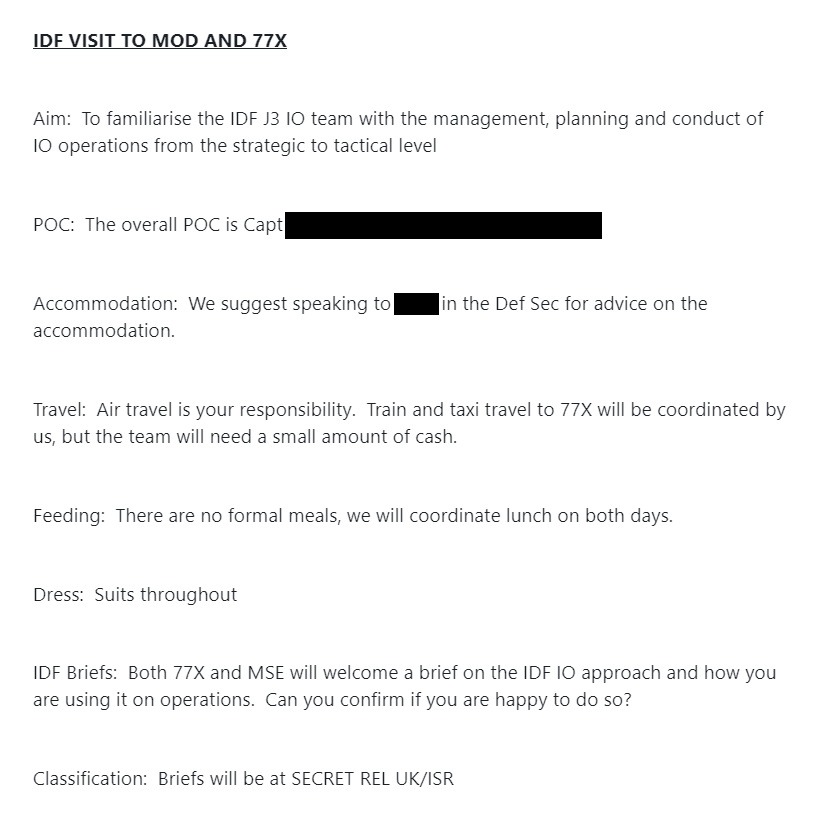
An email from a British officer to the IDF (DDOS)
77th brigade
Israeli officer Benzi Zimmerman began organising a high-level information exchange between the IDF’s J3 operations directorate and the British army in 2018.
The goal was “to familiarise the IDF J3 IO [information operations] team with the management, planning, and conduct of IO operations from the strategic to tactical level”, according to one of the leaked emails.
A British army major subsequently helped to develop a two-day programme for the IDF team, which would be split between the MoD headquarters in Whitehall and the 77th brigade’s barracks in Berkshire.
The itinerary included briefings at the “SECRET REL UK/ISR” classification level on such topics as “strategic operational information operations” and “IDF IO approach and structure”.
IDF information operations chief Avinoam Frenkel was chosen to lead the visit. He was to be joined by IDF officers Oded Gonen and Dan Krinsky, the Israeli defence attaché in London, and Zimmerman.
Information operations
The IDF’s trip to the 77th brigade in November 2018 was unexpectedly cancelled, but plans were put in place to maintain collaboration on information operations.
In February 2019, Erez Maisel, the commander of the IDF’s international cooperation unit, led a delegation to the 77th brigade. There are no further details about this visit.
Over the following months, Britain’s defence attaché in Tel Aviv Ronnie Westerman pushed for the aborted 2018 trip to be rescheduled.
The Israeli embassy in London agreed, registering its “wishes to pursue planning for this visit to go forward”.
By June, the IDF team’s visit to the MoD and 77th brigade had been rearranged on the same lines as “the trip we had to postpone from last year”.
It took place on 10 and 11 July 2019, with one day spent at the 77th brigade’s barracks in Berkshire and the second at the Ministry of Defence.
As previously planned, the exchanges focussed on “the management, planning and conduct of IO operations from the strategic to tactical level”.
The timing was seen to be particularly fortuitous given the 77th brigade’s “Operations Centre Opening Event” and “Cocktail Party” were taking place that week.
Follow on visit
Following the “successful visit” of the IDF team to Britain, 77th brigade commander Daniel Reeve requested that one of his lieutenants “conduct a follow on visit” to Israel.
An army major, who had recently been put in charge of the Middle East Mission Team in the 77th brigade, was chosen to accompany him.
The visit was due to take place between 28 March and 4 April 2020, according to a visitor request issued by the British embassy in Tel Aviv. However it did not go ahead, probably due to Covid travel restrictions.
The application noted how the “subject to be discussed” was “Capacity Development: Information Operations”, with the classification level listed as “Secret”.
Huda Ammori, co-founder of the campaign group Palestine Action, told Declassified: “Psychological warfare and propaganda are tools often used by the Israeli regime to spread disinformation whilst occupying, massacring and torturing the Palestinian people”.
She said the revelations confirm that Britain plays “an active role in repressing Palestinians”.
The IDF did not respond to a request for comment [end]
80 years later, Germany is still on the side of racism, supremacism, inequity, war crime, mass killing and genocide
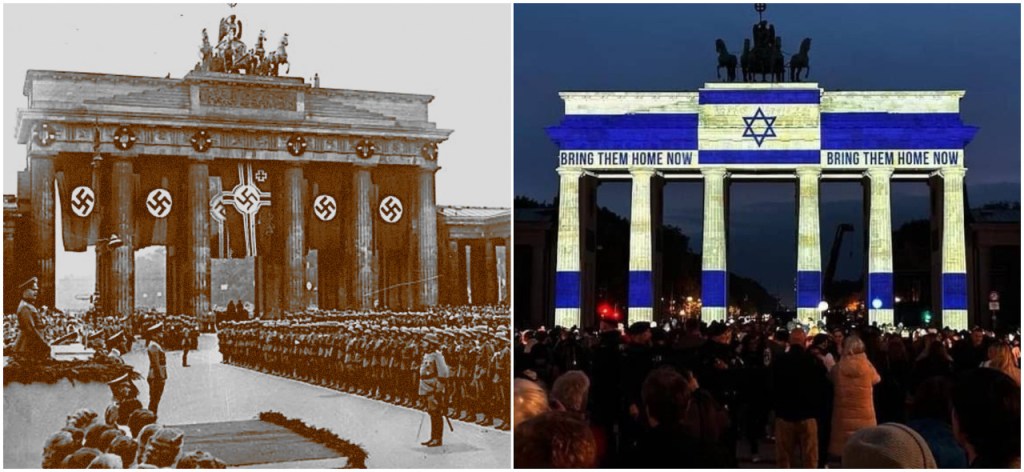
The picture at right is taken at the Brandenburger Tor, Berlin, in the evening of October 7, 2024 (social networks)
On October 7, 2024, at the first anniversary ceremony of Hamas raid from the Palestinian ghetto of Gaza, Israel prime minister Benjamin Netanyahu states
We are the Eternal People. A people which is fighting to bring light to this world, which is aspiring to spread good and eradicate evil
Adolf Hitler added on March 30, 1942
This is a war of extermination
On May 2, 1945, Yevgeny Khaldei takes that photo at the Brandenburger Tor, after the Soviet victory over Nazi Germany
Putin’s race is not yet run because NATO’s game plan remains the same one of subjugating Russia and, mad though it seems, using it as a springboard to dismember China
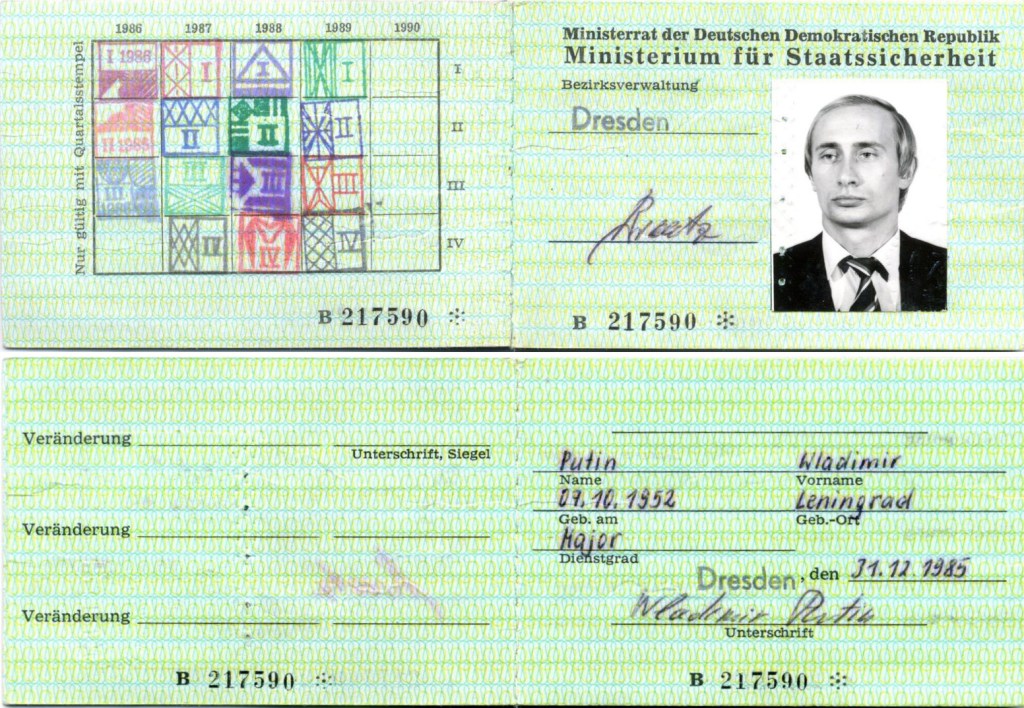
[my illustration, from the archives of the Ministerium für Staatssicherheit der DDR]
Though Russian President Putin has reasons galore to be quietly cheerful when he marks his 72nd birthday this Monday, 7th October, chief of these are that he has been loyal to his faith, his family and his motherland. Were his mother or his elder brother, who died as an infant in Finland’s Siege of Leningrad, to testify to us from beyond the Styx, they would be rightly very proud of how Vladimir Vladimirovich Putin not only stayed true to all of them but to Mother Russia as well.
The collapse of the Soviet Union around Putin’s ears was a pitiable sight. Red Army soldiers in Budapest sold their kits for pennies to passersby, vodka and depression slashed the life expectancy of Russia’s males, patriotic Russian teachers were paid with cabbage heads and Western gangsters, together with their local collaborators, robbed Russia blind. To the extent that Putin has reversed all of that, he and his helpers should be immensely proud of the work they have done thus far.
Not that those enemies have gone away. They have not and one very important vector worth examining is the soft war NATO is directing through the cross dressing Ukrainian dictator Zelensky and Russian fifth columnists like the Pussy Riot slappers, who enjoy the same considerable support amongst the brothels and bordellos of Eastern Europe that the Gestapo did in occupied France.
That Putin’s most vehement Ukrainian critics have, like Hitler’s French collaborators, degenerated into nothing more than hired hitmen, should not unduly surprise us, as they were nothing much better to begin with. What is, at first glance, far more noteworthy is the unrelenting attack on everything Russian, from the great Dostoevsky to the equally great Masha and the Bear, which makes no sense until we read this very day that children in Ukraine are still being brutalised for speaking their Russian mother tongue, the same mother tongue they share with the cross-dressing Ukrainian dictator and far too many immortal musicians, artists and authors to adumbrate here.
Although those attacks, in the context of the Ukrainian conflagration, might seem trivial, they are anything but. Their purpose, when juxtaposed with the elevation of Pussy Riot, Zelensky and similar Central Asia civil society degenerates, is to demean, denigrate and marginalise all of Russia. Although all that might seem crazy to us, no less a figure than Herr Hitler would have understood its pivotal role in helping NATO physically and spiritually divide and conquer Russia which, as these NATO links here, here, here and here detail, remains its post-Putin Ukrainian end game.
But Putin, it seems, is going nowhere anytime soon, at least not until his work of consolidating Russia within and without is done. Although the Pussy Rioters are a cancer that must be excised, the Ukrainian conflict must get priority. Although Russia’s recent capture of the fortress city of Vuhledar portends well, so do recent pronouncements of Ukrainian dictator Zelensky and serial British philanderer Boris Johnson.
Because Zelensky implored American companies to invest in Ukraine’s energy grid during his recent American junket, the Russian air force must now reduce that infrastructure to dust to show that investing in Zelensky’s Ukraine has no upside. As regards Poundland Dr Strangloves like Boris Johnson, who demand that NATO should help its Ukrainian proxies to blitz Moscow and St Petersburg, Putin must show such charlatans that such bravado carries personal risk to obese armchair generals like them.
Either way, if Russia is to survive, Putin must show NATO and their Ukrainian proxies that their dreams of conquest are not worth the candle and, if the Romanian or Polish juntas or, heaven help us, the non-entity who is Prime Minister of Denmark, have problems with that, so be it, and let the cards fall where they will.
Although Putin unquestionably has his critics, much of that criticism is no more than cat yowling. Take, for example, this fine BBC piece, where Mariana Katzarova tells us of Putin’s ‘systematic crackdown’ on human rights since the Ukraine invasion. A fine demolition job on Putin, until we check Katzarova’s Wikipedia entry, which tells us that this Bulgarian brasser makes her living writing screeds like that, and that she knows no more about the internal dynamics of Russia than you or I do about the Yaifo tribe of the East Sepik province of Papua New Guinea who, to give them their due, are far more honest and honourable than carpetbaggers like Katzarova.
Although NATO is also raising the stakes on Russia’s border with Japan, the key to these border brush fires is crushing NATO in Ukraine, so that all 14 countries that border Russia get the message that the Russian bear retains a fearsome bite.
With her borders secure, Putin can then concentrate on the no less important task of securing Russia’s economic future with trade and other agreements with countries, great and small, that are not NATO’s cats’ paws. Though two of the most important of such countries are North Korea and China. Israel has also made Russian cooperation with Iran far more important than it was even a fortnight ago.
The key to such co-operation is for each participant to know and to agree upon the extent and depth of their co-operation. Fortunately for Putin and for Russia, NATO’s Ukrainian adventurism has made that co-operation between Russia and a host of other Asian and African countries that bit easier.
All of that said, Putin’s race is not yet run because NATO’s game plan remains the same one of subjugating Russia and, mad though it seems, using it as a springboard to dismember China. When we look at Russia in NATO’s global context, we can see how cautious Putin must be and what a monumental thorn in the side of NATO he is. That said, in the wider context of Russian and, indeed, European history, that is something Vladimir Vladimirovich Putin and those who work closest with him can be immensely proud of as they have measured themselves against Russia’s Immortal Regiment and they have passed with flying colours. Now, that is something for the septuagenarian Putin to be very happy about, indeed [end]
for Palestine, for Lebanon, for Syria, for the world, justice, peace and harmony
(Abir Sultan / AFP)
Here are on October 1, 2024, the flags of resistance
Postscript
Civilization could not stay idle, while Israel was carrying on with mass-killing of civilians in Palestine and Lebanon, assassinations up to Iran of political opponents, while the whole West, servile auxiliaries of the US, except a few righteous countries like Spain or Ireland, was watching these crimes with complacency, in a Middle-East regarded as a new battlefield for the desperate defense of a collapsing Western hegemony.
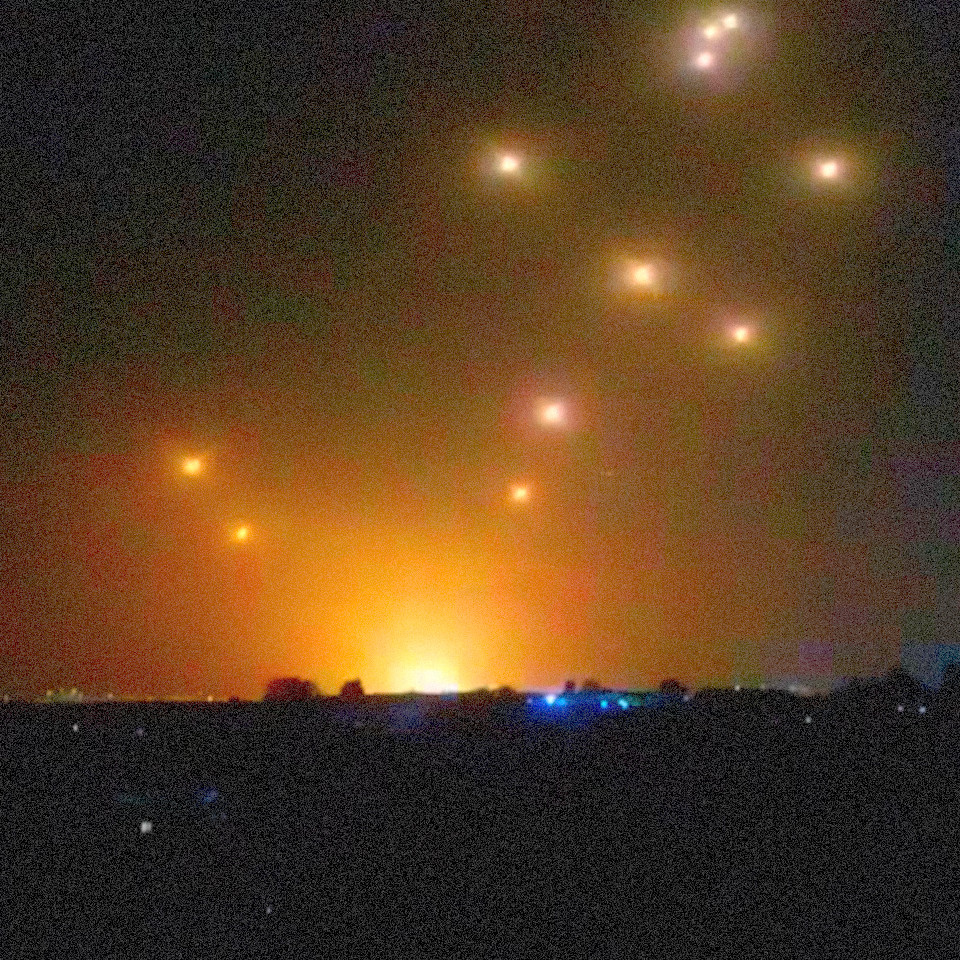
In the evening of October 1, 2024, Iran achieves a large retaliation operation against Israel. Social networks are flooded with amateur videos, from Israeli witnesses and ecstatic Palestinian neighbors, which are showing the successful strikes. In these videos, about one tenth of the missiles are appearing intercepted. The other ones are hitting their targets
That is the assessment I have gleaned from talking to Israeli intelligence sources, whose analysis is that Iran plans to launch a missile attack against Israel at 12:30 p.m. Eastern time, which is 7:30 p.m. in Israel. The attack is planned in two waves 15 minutes apart, and each wave will involve 110 ballistic missiles, the Israelis said.
The Iranian missiles are aimed at three targets. First, the headquarters of the Mossad, Israel’s foreign intelligence service, near Tel Aviv. Second, the Israeli air base at Nevatim, and third, the Israeli air base at Khatzirim; both bases are in the south of Israel in the Negev desert. The Israeli officials are particularly concerned about any strike on Mossad headquarters because it is in the densely populated north Tel Aviv suburb of Ramat Hasharon. It is also not far from the Israeli defense intelligence headquarters, Unit 8200
The videos are suggesting that Iran manages to saturate the Israeli air defense of the targeted areas. Moreover, some of the missiles are hypersonic ones. Fattah [Victorious] was introduced in 2023
(IRGC)
The Revolutionary Guards (IRGC) state later that more than 80% of the missiles in the first wave hit the intended targets
On October 2, 2024, Mark Austin (left), a so-called Sky News reporter, makes laugh Seyed Mohammad Marandi, professor of English literature in Tehran (screenshot)
Hilarious, on October 2, are the contortions of most Western mainstream media, totally discredited for years, which are peddling once more the Israeli propaganda. According for example to Sky News –the end of Western hegemony seems so painful for British elites and their lackeys-, its reporter in Israel, the Iranian attack would have failed and very few of the missiles would have got through the Iron Dome. A so servile report, a lie and a factual nonsense.
Abstract: This study analyses the nature and extent of involvement by neo-Nazi and other far-right Ukrainian organisations in the Donbas war (2014-2022) and the Odesa massacre (2014). This issue is highly politicised with contrasting narratives. The Russian and Donbas separatist governments, as well as their media, have contended that Ukraine has been a Nazi or neo-Nazi regime since a fascist coup took place in 2014, while Ukrainian and Western governments and media have maintained that such elements in the Ukrainian far-right were marginal, trivial, even non-existent. The article interrogates the historical record with primary sources in the three most relevant languages—Ukrainian, Russian, and English. The investigation reveals crucial far-right involvement in both the early stages of the war in Donbas and the Odesa massacre. Although the percentage of far-right supporters and fighters in Ukraine was relatively small, they exercised disproportionate influence in the country due to their greater reliance on violence and armed formations. The Russian government, however, exaggerated the role of the neo-Nazis in Ukraine to publicly justify the illegal invasion in February 2022.
Introduction
This study analyses the nature and extent of involvement by neo-Nazi and other far-right Ukrainian organisations during both the Donbas war from its start in April 2014 until the Russian invasion in February 2022 and the Odesa massacre on 2 May 2014. Other than the Maidan massacre in February 2014, these were the most significant and contested cases of political violence in Ukraine from its independence in 1991 to the commencement of the Russia-Ukraine war on 24 February 2022.1 The role of far-right Ukrainian groups during these major episodes of political violence is controversial because they are beset by duelling, self-serving narratives. Russian President Vladimir Putin has claimed that the principal goal of the invasion is to “denazify” Ukraine.2 But well before Russia’s invasion of Ukraine in 2022, there have been several overt and covert Russian military interventions here, including the annexation of the Crimean peninsula and direct support for pro-Russian insurgencies in the Donbas region, particularly in August 2014 and February 2015. Following the overthrow of the pro-Russian Ukrainian government in February 2014, the United States and other Western governments have consistently opposed Russia’s interventions and backed the current central government of Ukraine. In addition to political support, financial and military assistance has been provided, including training during the Obama presidency.3 To justify this support, the US and other Western governments disputed any real power or even the existence of neo-Nazi armed formations in Ukraine or claimed that they abandoned their far-right elements. Understanding the contested issue of far-right involvement in the Donbas war (2014-2022) and the Odesa massacre (2014) is valuable not only for elucidating intrinsically important historical episodes of political violence but also due to the contemporary relevance given the ongoing Russia-Ukraine war.
This article proceeds in five sections. The first section highlights the contribution of our study by describing the weakness of the extant academic literature and our methodological approach to filling in important lacunae in the research landscape. The second section details the duelling of contemporary narratives over the political violence by the far-right in the war in Donbas and in the Odesa massacre. The third and fourth sections develop qualitative case studies with process tracing to illuminate the role of the far-right in the Donbas war and the Odesa massacre. The fifth section presents the conclusion.
Developing the Extant Literature
Research on the far-right in Ukraine since the Euromaidan has been spotty. Studies on neo-Nazi and other far-right organisations in Ukraine following the Euromaidan have been limited in quantity, quality, and scope. Most studies have been produced by researchers outside academe in partisan think tanks or non-government organisations, as well as by journalists who did not subject their work to peer review.4 Such assessments are more likely to be politically driven and less likely to exhibit methodological rigour, even professionalism. For example, Anton Shekhovtsov, the former leader of the Crimean branch of the pro-Russian far-right Eurasian Youth Union, likened the Trade Union building arson attack during the Odesa massacre on 2 May 2014, to his killing of Colorado potato beetles by collecting them in a box and burning them alive. He directly inferred that this was a massacre with far-right involvement but omitted this in his publications.5 Other works have relied on narrow metrics such as the vote-share of far-right parties in Ukraine, without assessing the violence itself in terms of the perpetrators and effects.6 Some researchers have claimed that the presence of Russian speakers in the Azov regiment and other neo-Nazi-led armed formations is evidence of their relative tolerance and asserted that the Azov regiment had moderated by abandoning its far-right roots.7 Such analyses have tended to uncritically rely on Ukrainian and Western government narratives, accepting their claims at face value.
By contrast, other studies suggest a greater degree of far-right involvement in Ukrainian political violence. One quantitative study found that far-right groups in Ukraine, such as Svoboda and Right Sector, fielded the most violent perpetrators and committed the lion’s share of attacks.8 That study is restricted temporally, however, to the 2014 Maidan protests, which led to the violent overthrow of the relatively pro-Russian government and ultimately spiralled into the civil war in Donbas, the Russian annexation of Crimea, and Russian military interventions in these regions of Ukraine.9 Similarly, qualitative studies have presented evidence in the form of videos, eyewitness testimonies, confessions, and forensic examinations of Svoboda and Right Sector involvement in the Maidan massacre.10 Some other studies have focused on specific aspects of the far-right paramilitary and other armed formations during the war in Donbas.11 One academic publication is specifically devoted to the Odesa massacre, which is called “The Odesa Tragedy,” though it concentrates on the public perceptions rather than the perpetrators and their consequences.12 This list of prior works is intended to be illustrative rather than exhaustive. The research landscape around these issues is growing, but uneven in scope and reliability; a lacuna remains in the literature in terms of evaluating rigorously, comprehensively, and dispassionately the nature and extent of far-right involvement in the Donbas war and Odesa massacre, which matters in terms of our understanding of the Russia-Ukraine conflict and political violence more generally.
To elucidate this understudied topic of the far-right in Ukraine, this study makes substantial use of primary source materials in Ukrainian and Russian—the main languages in Ukraine—as well as in English. This linguistic capability is conducive to a more nuanced, accurate assessment. Methodologically, the two case studies employ qualitative process tracing with the benefit of fluency in all three languages.13 The substantive focus and period of analysis are both tightly bounded; the role of the far-right on the Russian side and in the Russia-Ukraine war since February 2022, as well as during the Euromaidan, are weighty topics explored in our other works but fall outside the scope of this study.
The term “far-right” denotes ultranationalists and both racial and ethnic supremacists in accordance with prior scholarship.14 The term “neo-Nazi” refers to far-right organisations that revamp elements of Nazi ideology, particularly its racial and ethnic supremacism, and use symbols associated with Nazi Germany or their stylised versions. As with Nazis, neo-Nazi organisations represent a form of fascism. Major neo-Nazi organisations in Ukraine during the time period covered by this study include the Social-National Assembly, its paramilitary wing Patriot of Ukraine, the National Corps, the White Hammer, and C14. Also included in the analysis are paramilitary and other armed formations organised and led formally or informally by these neo-Nazi organisations, such as the Azov battalion and regiment. Admittedly, militant groups are known to exhibit ideological heterogeneity.15 Within the political violence literature, a burgeoning area of research emphasises that members of the rank-and-file may be motivated by a variety of factors that diverge from the leadership, leading to a principal-agent problem.16 In this study, we classify organisations as neo-Nazi, or at least neo-Nazi-led, when commanders are neo-Nazi, even if not all members can be presumed to share this exact ideology.
A prominent example is Andriy Biletsky, the leader of Patriot of Ukraine and the Social-National Assembly (SNA), both of which were transformed along with the Azov battalion and regiment veterans into the National Corps Party in 2016. He called the ideology of Patriot of Ukraine and SNA “Social Nationalism.” In a collection of his articles published in 2013, he described that social nationalism, as the name suggests, combines elements of ultranationalism of the Organisation of Ukrainian Nationalists with elements of national socialism and called both radical nationalism and national socialism “great ideas.” He wrote that social nationalism is based on “Sociality, Racism, and Great Power.”17 Specifically, it is based on the ideas that the “white race” is “superior” to other races and is the foundation of the Aryan Ukrainian nation; the Ukrainian nation is a “blood-racial community”; and that “the historical mission of our Nation (…) is to head and lead the White Peoples of the world in the last crusade for their existence, a march against the Semitic-led subhumans.”18 Biletsky openly made antisemitic and racist statements, such as his claim that the Jew is “an economic and political parasite.” He saw “a serious clash of native European peoples with foreign colonisers, mainly of African and Muslim origin” and believed that “an ethnic civil war can be won by the native Europeans only under the banner of the New Right National Revolutions.”19
Biletsky was called the “White Leader” and his writings were published by both SNA and Patriot of Ukraine. He was the first commander of the Azov battalion, which was organised and led by Patriot of Ukraine and SNA in May 2014. Patriot of Ukraine, SNA, and the Azov battalion all used a symbol resembling a stylised swastika and Wolfsangel. Azov commanders and their historian, who himself serves in Azov, called the symbol the “Idea of the Nation” and claimed that it is an ancient Ukrainian symbol, even though it was created in 1992 for the Social National Party of Ukraine (SNPU). The creator of this symbol acknowledged that it was called “Idea of the Nation” to represent the radical nationalist ideas of the Organisation of Ukrainian Nationalists (OUN). He also admitted that SNPU deliberately chose this symbol with the Latin letter N, instead of the equivalent Ukrainian Cyrillic letter, fully aware of its resemblance to Nazi symbols and association with the swastika for many Ukrainians, in particular in Lviv. As with other extremist groups that rebrand out of political expedience, the Social National Party of Ukraine changed its name to Svoboda in 2014, because the Nazi association was politically inconvenient.20 However, this symbol was retained by the SNA and by Patriot of Ukraine, whose Kharkiv branch split from SNPU because of these changes.21 The Azov battalion and its propaganda magazine, which was named Black Sun, also used the Black Sun symbol, an ideological symbol used by Nazis and various neo-Nazi organisations. In addition, groups and individuals—including Patriot of Ukraine, SNA, National Corps, and Azov battalion and regiment leaders, commanders, and members—have displayed on their uniforms various neo-Nazi and Nazi symbols, such as the swastika, the SS sign, and 88 (Heil Hitler code). These, along with Hitler images, Nazi flags, and Totenkopf have also been seen in the form of patches, photographs, flags, and tattoos.
Although the term far-right incorporates both ultranationalist and neo-Nazi organisations, they are not ideologically identical despite their frequent overlap. This study empirically investigates the role of Ukrainian ultra-nationalist organisations such as Svoboda, the Right Sector, the Ukrainian National Assembly–Ukrainian People’s Self-Defence (UNA-UNSO), and Bratstvo; neo-Nazi organisations such as the Social-National Assembly, Patriot of Ukraine, the White Hammer, and C14; and various other paramilitary formations, special police forces, and National Guard units organised and controlled to various extents by them. These armed units include the Azov battalion and regiment, Dnipro, Donbas, Aidar, Sich, Carpathian Sich, OUN, and St. Mary’s battalions, and the Ukrainian Volunteer Corps. To assess these actors, this study analysed thousands of Russian and Ukrainian primary sources: online recordings of live broadcasts, videos of the armed conflict in Donbas and Odesa, and information posted on websites and social media by far-right organisations, their armed units, and activists. It also analysed media reports in Ukrainian, Russian, and English from diverse outlets such as Ukrainska pravda, Strana, BBC, The Guardian, The Washington Post, The New York Times, YouTube, Telegram, V Kontakte, Facebook, and Twitter. To mitigate bias, the authors analysed the primary source materials rather than relying on secondary interpretations.
The Conflicting Narratives
Assessments of the far-right in Ukraine have been wracked by self-serving and thus unreliable perspectives. Russian and separatist leaders, as well as the media, have described the post-Maidan violence in Ukraine, especially in Donbas and Odesa, as perpetrated by “fascists” and “Nazis” akin to genocidal massacres against Jews, Belarusians, Russians, and Ukrainians during the Holocaust and World War Two.22 They often called the Odesa massacre the “Odesa Khatyn,” a reference to the large-scale massacre of Belarusian villagers in 1943 by the Nazis and an auxiliary police battalion, which was based on a paramilitary formation of the Melnyk faction of the Organisation of Ukrainian Nationalists. Based on this narrative, President Putin and his allies have claimed that invading Ukraine is not only justified, but “inevitable” to counter the “Nazi” or “Neo-Nazi regime” in Kyiv.23 Putin and his government thus declared the “de-Nazification” of Ukraine as a key goal of “the special military operation” launched in February 2022.24 This perspective—in its entirety—is widely assailed in the West.25
By contrast, the Ukrainian and Western governments and the media tend to claim that the far-right—including neo-Nazis—is marginal, even non-existent in Ukraine.26 They argue that since Euromaidan, Ukrainian fighters have almost entirely—if not entirely—shed their far-right elements, particularly neo-Nazi. To this end, it is a common point that the Azov Battalion ceased to be led by the neo-Nazi Patriot of Ukraine, a paramilitary wing of the SNA, since integrating into the National Guard as one of its regiments. Kyiv has stressed that the integration of Azov in November 2014 is proof of its transition to moderation and the absence of extremist fighters post-Maidan.27 Ukrainian President Volodymyr Zelensky awarded “Hero of Ukraine” titles in 2022 to prominent Azov leaders such as regiment commander Denys Prokopenko, deputy commander Sviatoslav Palamar, and senior officer Oleh Khomenko.28 After the commencement of the Russia-Ukraine war in February 2022, many Western media outlets, politicians, government officials, and academics adopted this stance that Azov and other controversial Ukrainian fighters on the far-right had not only abandoned extremist elements, but were heroes against Russia’s illegal invasion.29
The Indexing Theory of political communications emphasises that Western media follow narratives of its governments in covering foreign conflicts, including in post-communist countries.30 In some cases, Western media may have taken their cues directly from the Ukrainian government. After the Odesa massacre on 2 May 2014, the Foreign Ministry of Ukraine blamed the arson attack on provocateurs that were “paid generously by the Russian special services”, and the New York Times immediately adopted the same line that pro-Russia groups may have been responsible for torching the building.31 The Western narrative of the far-right in Ukraine since the Euromaidan is not without controversy. Volodymyr Ishchenko, a Ukrainian sociologist who specialises in the far-right in Ukraine, concludes: “The dominant narrative since Maidan in Ukrainian and much of the Western public spheres has been systematically downplaying the problem” by arguing that “the Ukrainian far-right” is “small and marginal.” He stated that “often, the far-right is just ignored.”32
Notably, Western concerns over far-right fighters in Ukraine were more prevalent before the February 2022 invasion. For example, The Nation described Azov in 2018 as “pro-Nazi, as evidenced by its regalia, slogans, and programmatic statements.”33 In 2019, Radio Free Europe called Azov “far-right.”34 In 2020, The Guardian referred to Azov as a “neo-Nazi extremist movement.”35 Consistent with Indexing Theory, such coverage of the neo-Nazis in Ukraine before the February 2022 Russian invasion overlapped with similar expressions by Western governments. In its 2018 Human Rights report, the US State Department called the political wing of the Azov Regiment “a hate group.”36 In 2019, ambassadors from G7 countries warned against “extreme political movements in Ukraine, whose violent actions are worrying in themselves.” The warnings referred specifically to the Azov movement and its violence during the 2019 presidential elections.37 The US Congress has displayed longstanding ambivalence over its designation of Azov. In 2018, forty Congress members signed a letter to the State Department with the request to designate Azov as a terrorist organisation because of its links to terrorist attacks in multiple countries and its recruitment of neo-Nazis in its ranks.38 A defence appropriations bill amendment was adopted by the entire US Congress in 2018, which banned US government funding and training of the Azov regiment due to concerns over its neo-Nazi views and members. Such concerns had been expressed by American officials for several years after the Euromaidan. The amendment was first unanimously adopted by the US House of Representatives in 2015. Congressman John Conyers put it bluntly, “I am grateful that the House of Representatives unanimously passed my amendments last night to ensure that our military does not train members of the repulsive neo-Nazi Azov Battalion.”39 Under pressure from the Pentagon, however, Congress subsequently removed this first amendment. A similar amendment, proposing a ban on US military assistance to radical nationalist and neo-Nazi organisations, voluntary police, and paramilitary formations under their command, was blocked in Congress in 2014.40
In general, however, American and European governments have been careful not to issue public statements against the far-right in Ukraine or to call attention to it. This hesitancy began after the Euromaidan and became starker following the February 2022 Russian invasion. Indeed, Western governments and media increasingly whitewashed the empirical record to present the Ukrainian far-right formations as categorically moderate in order to boost international support. In June 2024, the US State Department stated that the Azov brigade was eligible to receive US weapons under the “Leahy Law” because it was cleared of human rights violations. It made this determination after claiming that the Azov brigade is a new unit that is not subject to the previous Congressional ban, even though in reality this brigade was created on the basis of the Azov regiment, celebrated the 10th anniversary of the Azov battalion creation as its own anniversary, and is led by original Azov battalion commanders.41 However, a subsequent amendment, which was included in the US defence bill which was passed by the US House of Representatives, specifically stated that “none of the funds appropriated or otherwise made available by this Act may be used to provide arms, training, intelligence, or other assistance to the Azov Battalion, the Third Separate Assault Brigade, or any successor organisation.”42
Such instrumental portrayals of allies are not limited to this conflict. Other recent cases of political violence have also featured public relations campaigns by governments and media to present allies as arguably more moderate than their history and contemporary ideology indicate. For example, in the Syrian war, anti-Assad jihadist organisations allied with the West were euphemistically referred to as “rebels,” sometimes “moderate” ones, even when they fought under the direction of a Foreign Terrorist Organisation, as designated by the US State Department.43 A large body of literature within terrorism studies has found that the labelling of violent perpetrators by governments and media is not value-neutral, but expedient to serve political agendas.44 Particularly in these controversial cases of political violence, academe can play an important role in interrogating the empirical record to adjudicate the truth.45
The Far-Right in the Donbas War
Research within the field of terrorism studies has repeatedly noted the difficulty of determining the ideological beliefs of participants in political violence.46 However, fine-grained knowledge of the organisations can substantially increase confidence. Svoboda and the main organisations that remained within the Right Sector after the Euromaidan were widely understood as far-right for maintaining ultra-nationalist and ethnically supremacist views. They openly described themselves as the natural successors of the Organisation of Ukrainian Nationalists (OUN) and the Ukrainian Insurgent Army (UPA), inspired by the notorious OUN leader and Nazi collaborator, Stepan Bandera.47 Along with the UNA-UNSO, these organisations used the “Glory to Ukraine! Glory to the Heroes!” slogan, the official greeting of the Bandera faction of the OUN (OUN-B). This greeting, along with a fascist-style hand salute, was modelled on greetings and salutes of other well-known fascist parties in European history, from the Nazi party in Germany to the Ustashe party in Croatia.48 The Right Sector also adopted its red and black flag from the OUN-B and the UPA, which symbolized Ukrainian blood and soil, which were also pervasive in Nazi ideology and flags.49 But the existence of these symbols alone offers weak evidence of far-right influence in the Donbas war without understanding the cultural and historical context.
The violent overthrow of the Viktor Yanukovych government by means of the Maidan massacre triggered the resurgence of separatism in Donbas.50 After his overthrow in February 2014, far-right parties and organisations in Ukraine expanded and organised their armed formations. Along with Ihor Kolomoisky, an oligarch who became the head of the Dnipropetrovsk regional administration, the Right Sector was instrumental in the formation of the Dnipro battalion in the spring of 2014.51 The Azov battalion, notorious for its use of neo-Nazi symbols in its official insignia, was also organised in the spring of 2014 and led by the SNA and the Patriot of Ukraine with the involvement of the Radical Party. As mentioned, “White Leader” Andrii Biletsky was the first commander of Azov.52 Based in Mariupol, the St. Mary’s battalion was formed in the fall of 2014 and led by the far-right Bratstvo party, which is described by its leader (Dmytro Korchynsky) as the “Christian Taliban.”53 Around this time, the Aidar battalion, nominally subordinated to the Ministry of Defence of Ukraine, was formed by the Maidan Self-Defence. One of its platoons was led by the White Hammer, a neo-Nazi organisation belonging to the Right Sector during the Euromaidan. Ilia Kiva, a Right Sector member, was the commander of another volunteer police battalion. A previously convicted criminal with a swastika tattoo became the commander of the Tornado Company, a special police unit. He and seven other members of his company were arrested and convicted for various crimes in the warzone, such as torturing detainees. A Nazi-style flag with a swastika was found in their prison cell.54 These units were all under the formal jurisdiction of the Ministry of Internal Affairs, the National Guard, or the Ministry of Defence. From the start of their formation, they remained under de facto command of radical nationalist or neo-Nazi organisations. These armed formations sprouted up in the early stages of the conflict in Donbas and were stationed there in an attempt to suppress pro-Russian separatism in the region by force. The Right Sector and the Organisation of Ukrainian Nationalists actively organised various militia and paramilitary units that were not subordinate to the central government of Ukraine. The Volunteer Ukrainian Corps, the largest paramilitary formation, was formed and led by the Right Sector specifically for the war in Donbas, though it also included battalions in Western Ukraine.55
The paramilitary formations, special police, and National Guard units, organised and led by far-right organisations such as the Right Sector, the Social National Assembly, Patriot of Ukraine, Svoboda, C14, and Bratstvo, constituted a small minority of Ukrainian fighters in the Donbas. Based on reports, we estimate the number of members of radical nationalist and neo-Nazi organisations who served in various far right-led, regular, and other armed formations in the Donbas, at around five thousand. This estimate is conservative and represents just one percent of approximately 400,000 people who participated in this war on the side of the central government.56 Additional metrics of influence, however, are also important to consider.
Despite their relatively small numbers, far-right fighters exercised disproportionate influence in the Donbas civil war, particularly in the early stages before the first direct Russian military intervention in August 2014. Far-right Ukrainian groups proliferated after the Euromaidan because they were eager to fight and were responsible for a disproportionate level of violence, especially against civilians and prisoners of war in Mariupol and Krasnoarmiisk. Far-right organisations and far-right-linked battalions thus played a crucial role in escalating the armed conflict in the Donbas. Svoboda and C14, an avowedly neo-Nazi group affiliated with Svoboda until the summer of 2014, organised and led the Sich battalion from June 2014 onwards.57 Meanwhile, the Right Sector carried out a deadly attack on a separatist checkpoint in Sloviansk on 20 April 2014. While Ukrainian and Western media denied far-right involvement in these events, the evidence to the contrary includes business cards linked to far-right members found after the attack. As well, Ukrainian court proceedings revealed that the weapons used by the Right Sector checkpoint attackers were the same as the snipers from this group who killed and wounded police during the Maidan.58 And two years after the attack on the separatist checkpoint, Dmytro Yarosh—the leader of the Right Sector—admitted his personal involvement in thisattack.59 Oleksandr Turchynov, then acting president of Ukraine, and Kolomoisky’s deputy in the Dnipropetrovsk regional administration, reportedly orchestrated this Right Sector operation, aimed to seize and destroy a television transmitter near Sloviansk, several days after this area was seized by the Strelkov-led armed group of Russian nationalists and Ukrainian separatists.60 This attack by the Right Sector constituted a major escalation of the conflict in Donbas because it broke both the Geneva Agreement signed on 17 April 2014 by Ukraine, Russia, the EU, and the US for a peaceful resolution of the conflict, as well as the Orthodox Easter truce between the Ukrainian government and separatists in Donbas.
Far right-led armed formations were also behind many other violent attacks in the Donbas, further escalating the conflict into a civil war. Videos, media reports, and admissions from commanders and other members of the Azov and Dnipro battalions indicate that they participated in the storming of the district police headquarters in Mariupol on 9 May 2014. Approximately ten people, including at least one protester, were killed.61 Analysis of online video streams, media reports, and Ukrainian government documents, also make clear that Azov played a major role in taking back the city of Mariupol from the control of separatists in June 2014.62 The Dnipro battalion, along with other units, seized civilians in the Donetsk Region to prevent the separatist referendum on 11 May 2014. Videos show them shooting unarmed pro-separatist protesters with Kalashnikovs, killing two locals. The Ukrainian government denied the presence of the Dnipro battalion, but it was confirmed by other credible sources, including admissions by battalion members in videos, like Volodymyr Parasiuk’s statement on social media, who became the People’s Deputy of Ukraine.63
The far-right-led armed formations perpetrated a disproportionate amount of violence in the first few months of the Donbas conflict and thus played a major role in escalating it into a larger civil war because the radical nationalist and neo-Nazi-led groups were far more willing to use force at that time. The Ukrainian armed forces, the security service, police and National Guard units were more reluctant to use force against the separatists in Donbas because their commanders and members were publicly blamed by the new government for attempting to forcefully suppress the Maidan protests—and in particular, for the Maidan massacre. Because the new Maidan government came to power through violence, which included the killing of police and protesters, it lacked legitimacy among many military, police, and SBU members in the Donbas region during this initial period of the conflict. Further, compared to the newly ascendant far-right groups in the aftermath of Euromaidan, the regular Ukrainian armed forces, the security service, the police and National Guard units were known for lower morale and higher desertions. Examples of this included the Donetsk SBU Alfa commander and Luhansk Berkut members, who joined the separatists.64
The relative role of the far-right in the political violence was not constant; it began to decline in the Donbas when newly elected president Petro Poroshenko ordered the Ukrainian military, SBU, police, and National Guard to wield lethal force against the separatists and launch the offensive in June 2014.65 The war was most intense and violent in 2014 and 2015, but the fighting declined significantly following the Minsk Agreements in 2015. However, ultra-nationalist and neo-Nazi fighters continued to exert a non-trivial role, even after the Ukrainian military intensified its operations in Donbas and purported to moderate the far-right fighters. After its formal incorporation into the National Guard of Ukraine, the Azov regiment and its commanders maintained a close organisational and ideological relationship with the neo-Nazi National Corps party. This party was formed by the Azov battalion founder and the first commander on the basis of neo-Nazi SNA and Patriot of Ukraine, and it included many Azov battalion and regiment veterans. The Azov regiment functioned as a military wing of the National Corps, which, in essence, represented overlapping elements of the same Azov movement.66 Indeed, Azov regiment commanders shared a neo-Nazi background and had served in the neo-Nazi-led Azov battalion.67 In other words, the rebranding from “battalion” to “regiment” did not alter the key personnel.68 For example, Azov regiment commander Denys Prokopenko was a member of the neo-Nazi White Boys Club, which was formed by the ultras of the Dynamo Kyiv football club. This group of ultras displayed various Nazi symbols and the Nazi salute on their social media and during football games. His Azov battalion platoon had used the Totenkopf insignia of the Nazi SS.69 Andriy Biletsky became the commander of the Third Assault Brigade, which was created by veterans of the Azov battalion and regiment and activists of his neo-Nazi group, the National Corps.70 In 2023, he stated in an interview with Ukrainian media that the united Azov movement included this Azov brigade under his command along with the Azov regiment and the Kraken unit.71 Such admissions in Ukrainian media highlighting enduring far-right allegiances seldom make their way into the Western press.
Importantly, Azov commanders never publicly renounced their neo-Nazi views, symbols, and organisations. In fact, Azov leaders routinely denied in media interviews that they, their units, and organisations, were neo-Nazi, claiming that the well-documented Nazi symbols were fakes or Russian propaganda. Our research of Ukrainian social media as well as other researchers of the far-right in Ukraine, such as Lev Golinkin and Moss Robeson, have identified over one hundred cases of Nazi and neo-Nazi displays by at least several hundred Azov commanders and other members from 2014 to 2022. This number includes displays on uniforms, patches, photographs, flags, and tattoos of neo-Nazi and Nazi symbols, such as the swastika, SS sign, 88 (Heil Hitler code), Hitler images, Nazi flags, and Totenkopf, and a fascist hand salute.72 The continued relevance of far-right extremism in Azov was evident at the very top. Arsen Avakov, the Minister of Internal Affairs, was personally involved in the Azov battalion formation and its later expansion to a regiment.73 President Petro Poroshenko circulated photographs awarding Ukrainian national medals and commendations to some of the most well-known neo-Nazis in Azov.74 The Nazi connection to Azov was clearly not due to a loss of agency control.
Amnesty International and Human Rights Watch reported that Azov was involved in many cases of torture, illegal detention, and disappearances during the war in Donbas.75 The impact of these far-right organisations cannot be measured strictly in terms of the direct physical effects, as terrorism researchers have emphasised in many other contexts.76 Ultra-nationalist and neo-Nazi organisations were instrumental in blocking or “spoiling” a peaceful resolution of the armed conflict in Donbas, another well-established source of leverage for extremists.77 Far-right groups such as the Right Sector, Svoboda, and the Radical Party opposed the adoption by the parliament of Constitutional amendments based on provisions from the Minsk Agreements.78 To this end, Svoboda activists launched a grenade attack on 31 August 2015 in front of the Ukrainian parliament, killing four and wounding dozens of policemen and National Guard troops, which helped to block these amendments, undercutting the logic of implementation.79
Far-right groups also challenged the implementation of President Volodymyr Zelensky’s electoral promise to peacefully resolve the Donbas war.80 In October 2019, Zelensky travelled to a front-line position in Donbas to personally convince the Azov fighters to stop blocking the implementation of the Minsk agreements by withdrawing along with separatist troops from the frontline, as he agreed during the summit with Putin and German and French leaders in Paris. But video of the encounter shows that Zelensky was taunted by activists of this neo-Nazi organisation who flouted his appeal.81 According to the Associated Press, thousands of far-right and nationalist activists shouting the far-right OUN and UPA slogan “Glory to Ukraine. Glory to the Heroes” marched through Kyiv protesting against a peace plan for eastern Ukraine.82
The radical flank threatened Zelensky for implementing Minsk on other occasions as well. In May 2019, Dmytro Yarosh, the former Right Sector leader, publicly threatened to hang the new Ukrainian president on a tree if he fulfilled his election promise of a peaceful resolution of the conflict in Donbas.83 In 2021, Yarosh, the commander of the Ukrainian Volunteer Army organised by the Right Sector, was appointed Adviser to the Commander-in-Chief of the Armed Forces of Ukraine, Valerii Zaluzhnyi.84 In the same year, videos, photos, and Ukrainian media reports show police standing down while neo-Nazi and other far-right protesters attacked the Office of the President of Ukraine and painted swastikas on its walls.85 The Russia scholar Stephen F. Cohen concluded that Zelensky “can’t go forward with peace negotiations” because “crazy fascist movements” in Ukraine “literally threatened his life.”86 Although far-right peace rejectionists posed political problems for Zelensky, they were also known to work closely with him. An activist of the neo-Nazi Patriot of Ukraine and former deputy commander of the Azov regiment was appointed the acting head of the National Police of Ukraine during the Poroshenko presidency and then became a deputy minister of Internal Affairs during the Zelensky presidency.87 Prime Minister Oleksii Honcharuk spoke at a “veterans party” organised by a front organisation for the neo-Nazi C14 with a stylised swastika of a neo-Nazi rock band behind him.88 The advisory council of the Ministry of Veteran Affairs under Zelensky retained activists of this neo-Nazi group, including those charged with assassinating the prominent opposition journalist, Oles Buzyna, in 2015.89
In sum, ultra-nationalist and neo-Nazi militant organisations were deeply involved on the side of the central government throughout the Donbas conflict. Although representing a small fraction of Ukrainian forces throughout the conflict, they committed a disproportionate amount of violence, particularly before President Poroshenko ordered the Ukrainian military to increase its use of force against the separatists in the summer of 2014. The much-touted absorption of Azov and other extreme right-wing militia under the official Ukrainian National Guard, police, and military command did not change either their command or their ideological displays. Many of the fighters worked closely with the Kyiv political leadership across administrations, when not using de facto veto power to block peaceful resolution of the conflict in this region.
This interpretation departs from others that rely strictly on vote-share as the proxy for far-right influence. The influence of the far-right in Ukraine after the Maidan far exceeded its electoral support and membership. Svoboda and Right Sector leaders each won only one percent of the votes in the snap presidential elections in May 2014. In the parliamentary elections of October 2014, Svoboda narrowly failed to clear the five percent threshold, receiving 4.7 percent. The Right Sector fared even worse, receiving only two percent of the votes. Ruslan Koshulynsky, one of Svoboda leaders, who was backed by the Right Sector, OUN, and C14, received only 1.7 percent of the votes in the 2019 presidential elections, while Svoboda won 2.2 percent of the votes in the 2019 parliamentary elections. These weak electoral results indicate the limited national support of the far-right in Ukraine, but not its outsized role in the Donbas conflict.
The Far-Right in the Odesa Massacre
Other than the Donbas war, the Odesa massacre was the most significant and deadly instance of political violence after the Maidan massacre in Ukraine since its independence in 1991 until the Russia-Ukraine war in February 2022. The violence took place on 2 May 2014, between a “United Ukraine” rally and pro-Russian separatists, carried out with petrol bombs, gunfire, and rock-throwing, which ended up killing 48 people, primarily separatist protesters.90 The vast majority of the fatalities took place in the Trade Unions House, where 42 separatist activists and employees (forty men, seven women, and one boy) were killed when the building was set ablaze.91
This massacre contributed to the escalation of the separatist conflict in Donbas into the civil war. As noted, the massacre was presented by separatist and Russian leaders and the media as akin to the Nazi massacre of Khatyn in Belarus, and many Odesa separatists joined the separatist forces in Donbas. Despite the importance of this massacre, the International Advisory Panel of the Council of Europe, among other international authorities, has noted that the Ukrainian government failed to properly investigate and prosecute those responsible.92 To ascertain the role of far-right groups in the Odesa massacre, a broad range of key information resources can be analysed, including videos and recordings of live broadcasts of the political violence (and the lead-up to it); published reports; primary source media in Ukrainian, Russian, and English; statements of responsibility; interviews; and testimonies from participants and eyewitnesses on both sides, as well as police commanders.
On 1 May 2014, the day before the mass violence, separatists protested in Odesa to demand a referendum on the newly installed government in Kyiv, which they blamed on far-right activists and Western interference.93 Based on testimonies from a special parliamentary commission report in the immediate aftermath of the May 2014 massacre, Ukrainian and regional government officials planned to use far-right activists and the Maidan Self-Defence to suppress the separatists in the Odesa region and disperse those who were encamped near the Trade Union building.94 Extensive evidence indicates that the police and firefighters were ordered by their superiors to stand by and not interfere during attacks. For instance, a special plan to deal with mass disturbances launched by the Odesa regional police was not authorised, reportedly because of decisions at the Ministry of Internal Affairs’ top level.95 Similarly, top regional officials of the police and other law enforcement agencies were ordered to attend a meeting with their national counterparts before and during the start of the clashes.96 The presence of Andriy Parubiy and five hundred Maidan Self-Defence members, who deployed from Kyiv to Odesa on the eve of the massacre, further suggests that the violent dispersal of the separatist camp by far-right activists was orchestrated by top government leaders.97 Parubiy was a founder and leader of the neo-Nazi Patriot of Ukraine, a paramilitary wing of the Social National Party of Ukraine in the 1990s. He was the head of the Maidan Self-Defence during the Euromaidan and headed the National Security and Defence Council at the time of the Odesa massacre. The State Bureau of Investigations of Ukraine launched a criminal investigation into Parubiy for the Odesa massacre soon after he was replaced as the ex-head of the Ukrainian parliament following the early parliamentary elections in 2019.98 One of the participants acknowledged in an Israeli documentary that he engaged in “provocations” in the Odesa massacre under the command of Parubiy, who had issued orders to attack the separatists and “burn everything.” We assess this acknowledgement as credible because he was filmed along with Maidan activists in the left wing of the Trade Union building in Odesa when the deadly fire began to burn the central entrance.99 He and five other Georgian ex-military members also stated in American, Italian, and Israeli TV documentaries, Russian media interviews, on Macedonian TV, in depositions to Berkut lawyers for the Maidan massacre trial, and in testimonies to the Prosecutor General Office of Belarus for the Prosecutor General Office of Ukraine investigation that their groups of Georgian, Baltic, and far-right-linked Ukrainian snipers received weapons, payments, and orders from specific Maidan and Georgian politicians, including Parubiy, to engage in a mass killing of police and protesters.100 The Maidan massacre trial subsequently confirmed their identities.101
A march led by the Right Sector and football ultras on 2 May 2014 was used as cover to implement this plan to destroy and burn the separatist tent camp.102 The SBU in the Odesa Region received advanced information about planned “provocations” and violent clashes between football ultras and pro-Russian separatists on game day between the Odesa and Kharkiv teams on 2 May. A special train transported hundreds of football ultras from Kharkiv to Odesa.103 Football ultras in Ukraine were notorious for displaying neo-Nazi symbols and expressing neo-Nazi slogans during games and have historically linked up with the Right Sector and other far-right organisations, as during the Maidan protests.104 Both the Right Sector and football ultras in Odesa and Kharkiv were dominated by the neo-Nazi Social National Assembly/Patriot of Ukraine, which organised the Azov battalion right after the Odesa massacre.
Odeska Druzhyna, a small separatist organisation in Odesa, was present among other separatist activists based on evidence from internet streams, videos, testimonies of participants and eyewitnesses, and special parliamentary commission reports.105 Odeska Druzhyna used identifiable red tape labels, and were not Right Sector agent provocateurs, as the Russian media and separatists claimed. However, the Ukrainian government and media also mischaracterised the involvement of Odeska Druzhyna by overstating its coordination with other separatist activists.106 The balance of forces was asymmetric; the groups of numerically superior activists of the Right Sector from Odesa and Kharkiv led by the neo-Nazi Social National Assembly/Patriot of Ukraine, far-right football ultras, and Maidan Self-Defence units from Odesa and other regions attacked the separatists. Numerically disadvantaged, the latter took cover behind a police cordon.107
An Odeska Druzhyna activist was filmed shooting in the direction of the far-right protesters with an AK-74-type assault rifle.108 The official investigation and the May 2 Group maintained that a Right Sector activist was killed by this separatist group member with a 5.45mm calibre bullet.109 However, leaked forensic medical expert reports describe a 5.65mm calibre bullet extracted from his body.110 This bullet reportedly disappeared and reappeared during the investigation. The fact that it did not match bullet samples of any legally registered firearms, the weak sound of the gunshots, as well as the lack of a recoil observed in the videos of the shooting, also suggest that the far-right protester may not have been killed by this separatist, who maintained that the weapon seen in the video was a movie studio prop.111 The killing of the Right Sector activist was not visible in that video nor in any videos of clashes. The investigation and various videos at the scene did not reveal the exact time or location of his killing, or the direction of the gunshot. An Odesa deputy police chief, who was filmed around the time of this killing before he himself was wounded, stated that he saw snipers in camouflage shooting from the second floor of a hotel there. He relayed that they killed this Right Sector activist and the second protester in order to blame the separatists for their killing and provoke a violent response against the separatists.112 Videos filmed before and after his shooting suggest that the second pro-Maidan activist was killed around the same time in the same area during the violent clashes with separatists and shooting from a Kalashnikov-type weapon by one of the separatists.113 However, the government forensic examination determined that he was killed by a bullet from a pneumatic sport-type weapon. Nobody was charged with his killing, and the moment and other circumstances of his killing remain not publicly known.114
In the clashes that followed the killings of these two pro-government protesters, four separatist protesters were killed and many other separatist protesters, policemen and at least one local journalist were wounded. The forensic examination determined that three separatists were killed with hunting ammunition.115 A pro-government activist was filmed shooting with a hunting rifle in the direction of these separatists.116 This pro-government activist was later identified by the Minister of Internal Affairs as a Right Sector member.117 The government investigation charged him with killing at least one of the separatists. However, he was released from arrest and his trial was suspended indefinitely because of threats by the Right Sector and other far-right activists against judges during his trial.118 Evidence—including a recorded phone call—revealed that the events on May 2nd were coordinated by the Odesa regional administration official in charge of law enforcement agencies, and involved the participation of the Maidan Self-Defence commander, Right Sector activists, football ultras, and Maidan Self-Defence units.119 They attacked and burned the tent camp of various separatist organisations, whose activists and supporters then escaped to the nearby Trade Union building and tried to barricade the main entrance doors. Videos, internet streams, and testimonies of eyewitnesses show that attackers threw Molotov cocktails and burning tyres at the main entrance, set the entrance doors on fire, and blocked other exits. Videos, recorded calls to firefighters, and eyewitness reports reveal that the fire and thick smoke started from those burning tyres and Molotov cocktails thrown at the main entrance.120 The evidence does not support claims that the separatist protesters killed in this incident were Russian citizens, that they burned themselves by throwing Molotov cocktails from the roof of the Trade Union building or inside of the building, or that there was no far-right involvement in their killing.
After initial denials, the May 2 Group admitted that the deadly fire started at the main entrance. The May 2 Group was a nominally independent association of mainly journalists, formed after the massacre supposedly to investigate it. It was created with the involvement of the Governor of the Odesa region who was appointed by Ukrainian President Petro Poroshenko within a week of the massacre.121 This governor represented not only the central government, but also the Kolomoisky’s oligarchic network, which financed the Right Sector volunteers from the Volyn Region in the Azov battalion and the Right Sector-led Dnipro battalion.122 The Azov battalion was organised by the neo-Nazi SNA and its paramilitary wing, Patriot of Ukraine, which dominated the Right Sector in Odesa and Kharkiv, a few days after the Odesa massacre. But the May 2 Group still claimed that it was impossible to determine who started the fire because both sides were throwing Molotov cocktails. However, there is no public evidence of Molotov cocktails being thrown by separatists at the main entrance; on the contrary, numerous videos feature the far-right protesters throwing Molotov cocktails and burning tyres into the Trade Union building at that time.123
Within Ukraine, far-right activists—particularly from the Right Sector and the SNA— were notorious for using tyres and Molotov cocktails to burn public buildings. Forensic examinations in the government investigation, recordings of radiocommunications by SBU Alfa group, an unpublished admission by a far-right activist to a French journalist, and an academic study determined that the Trade Union headquarters in Kyiv were burned by Maidan activists, including far-right ones, in order to stop its takeover by the Security Service of Ukraine Alfa unit.124 Far-right protesters also started fires by burning tyres in the Inter TV channel building and threatened to burn down the parliament of Ukraine, the Lutsk City Council, the Sviatoshyn District Court that heard the Maidan massacre case, the Constitutional Court, and Inter and 112 Ukraina TV channels buildings by placing tyres next to their entrances.125 Prior usage of the same tactics by the far-right increases the likelihood of their direct involvement.
Analysis of online video streams, government investigation findings, May 2 Group reports, forensic medical examinations, eyewitness testimonies, and other evidence strongly indicate that 42 people perished as a result of the fire, smoke, and from trying to jump from the upper floors of the Trade Union building with far-right activists beating them on the ground and blocking the exits.. The victims were unarmed and included mainly separatists, their supporters, and several employees, in particular women, who were in the building at the time.126 Some of the strongest evidence of far-right involvement in the arson attack comes from the far-right itself, in the form of credit claiming. A growing body of research within terrorism studies focuses on credit claiming. An important finding is that perpetrators are far more likely to deny responsibility for their attacks than to take credit for ones that they did not perpetrate.127 This is particularly true when the targets are civilians. Nonetheless, many extremist groups do claim credit for civilian attacks.128 Statements posted by the Right Sector, the SNA, and the neo-Nazi Misanthropic Division on their websites and social media sites admitted the involvement of their organisations in the massacre. The Right Sector celebrated on its website the massacre by describing it as “another bright page in our fatherland’s history.” Claiming responsibility for the slaughter, it wrote: “In the first minutes of the battle, the ‘Right Sector’ activist was seriously wounded in the stomach. Several more PS [Right Sector] activists received injuries of varying degrees of severity. However, this did not prevent the rest of the PS fighters, together with football fans, from repelling the attack of pro-Russian provocateurs, and as a result, they successfully countered attempts to seize buildings in Odesa. Standing shoulder to shoulder, Odesa activists, football fans and ‘Right Sector’ fighters defeated the forces of pro-Russian mercenaries. Order has been restored in Odesa.”129 The Right Sector—which was dominated in Odesa and Kharkiv by the Social National Assembly and its paramilitary wing, Patriot of Ukraine—and the neo-Nazi Misanthropic Division (which joined the Azov battalion after the massacre) admitted on the social media platform V Kontakte and in other public statements that the fire was set deliberately.130
The official investigation of the Odesa massacre was a farce. Nobody was found guilty of perpetrating this mass killing. As noted, the Right Sector shooter was initially arrested but then released. Only separatists were among those arrested and tried for the Odesa massacre. The Odesa massacre trial of separatists resulted in their acquittal by a local court. The Ukrainian court based its decision on the lack of evidence in support of prosecution charges. Even the verdict acknowledged both the weakness of the investigation into the perpetrators and the role of Parubiy and other government officials.131 The Council of Europe and the UN Special Commission reports also noted the destruction of evidence.132 A report by the special commission of the Council of Europe found that the Ukrainian government’s investigation of the Odesa Massacre was inadequate, politically selective, and featured the falsification of evidence, despite the existence of video footage showing who threw the Molotov cocktails at the building.133
The Ukrainian media cited SBU sources that a far-right activist, who headed the Right Sector in Odesa during the Odesa Massacre, was a secret agent of the Security Service of Ukraine (SBU) and that he and far-right associates were paid by SBU to attack opposition politicians, threaten judges, and conduct other illegal actions.134 This would be consistent with the fact that the Right Sector was not investigated for the Odesa massacre even though the Right Sector publicly admitted involvement. His secret collaboration with SBU would also be consistent with the fact that SBU and the Prosecutor General Office refused to charge him for killing another person in Odesa in 2018. Moreover, in 2020, the SBU gave this far-right activist the status of a victim in this case, even though he streamed this killing on his social media account and the police investigation determined that he was the killer.135 In this sense, the Odesa massacre was not entirely anomalous; it featured post-Maidan far-right involvement with apparent support from high-level political leaders in a corrupt country where investigations and media have inconsistently followed the evidence.
Conclusion
This study assesses the role of the far-right in post-Maidan Ukraine, specifically, in the Donbas war and the Odesa massacre. These were two of the biggest episodes of political violence in the country leading up to the February 2022 Russian invasion. This area of research is worth close investigation because it represents intrinsically important episodes of political violence that have not attracted objective analysis based on available primary sources in Ukrainian, Russian, and English. Investigating the role of the far-right is also timely because the far-right in Ukraine is riven by duelling, self-serving contemporary narratives.
The predominant narratives propagated by governments and the mainstream media in Ukraine, the West, Russia, and separatist-controlled Donbas, concerning the role of the far-right in the war in Donbas and the Odesa massacre, have evidently been partisan. Contrary to the Russian government, separatists, and associated media, the Ukrainian government and military are not Nazi or even neo-Nazi. There were no neo-Nazis among the upper echelon of the Ukrainian government. President Zelensky is certainly not a Jewish neo-Nazi. He tried to placate and mainstream the far-right for political reasons, but has no observable personal affinity to that extreme ideology.
Neo-Nazis constituted only about one percent of the Ukrainian forces before the Russian invasion in 2022, and there is weak electoral support for neo-Nazi parties throughout the country. Similarly, the policy of glorification of the OUN-UPA, their leaders, such as Stepan Bandera, and the adoption and use of their “Glory to Ukraine! Glory to the Heroes!” greeting by the state and the military, including Zelensky, do not make Ukraine a Nazi state. While the OUN and the UPA were far-right terrorist organisations, which collaborated with Nazi Germany and perpetrated the mass murders of Jews, Poles, and Ukrainians, they were not Nazis. Ukrainians could not join the Nazi party because Hitler and other Nazi leaders regarded Ukrainians as racially inferior and opposed independence of Ukraine while also dismissing the attempt to create even a puppet state by the Bandera faction of the OUN in Lviv shortly after the Nazi invasion of the Soviet Union. Thus, Putin cannot credibly justify the illegal invasion in February 2022 as a war to “de-Nazify” the “Nazi regime.”136 The power of the far-right and the glorification of the OUN and the UPA in Ukraine under Poroshenko and Zelensky were exaggerated and exploited by the Russian leaders to justify the invasion.
But the West’s efforts to whitewash the far-right in Ukraine also rests on empirically shaky grounds. Despite their relatively small numbers militarily and politically, the far-right in Ukraine exercised outsized power. The far-right organisations, volunteer battalions, and paramilitary units organised and led by them played, along with separatists and Russian nationalists, a significant role in starting and escalating the incipient civil war in the Donbas and then impeding its peaceful resolution. Even after technically integrated into the official Ukrainian forces, Azov and other far-right groups continued to harbour extremist views. Often brandishing the same extremist symbols, the core leaders and members remained and even ascended within the police, military, and security services during the Donbas war. Western media accounts have drawn heavily from biased Ukrainian sources, including “official” investigations and the May 2 Group. Across numerous primary sources in Ukrainian, Russian, and English, we find evidence that the Right Sector, Social-National Assembly, its paramilitary wing Patriot of Ukraine, and groups of far-right football ultras from Odesa and Kharkiv played a critical role in the Odesa massacre against separatist protesters on 2 May 2014. Neo-Nazi SNA/Patriot of Ukraine, which dominated the Right Sector in Odesa and Kharkiv, organised the Azov battalion right after this massacre.
Despite the lack of international consensus over the definition of terrorism, a common interpretation is the use of violence by non-state actors aimed at creating fear for political ends, particularly when the targets are civilians.137 Depending on one’s definition, some attacks within the episodes of political violence covered in this study, such as the Odesa massacre, could, therefore, arguably be classified as terrorism. What is clear is that neither of the duelling narratives accurately captures the role of the far-right. This study has helped to fill that research lacuna by making use of substantial primary source materials in Ukrainian, Russian, and English. Besides the Maidan massacre, the Donbas war and the Odesa massacre are the two most substantial episodes of political violence from the independence of Ukraine in 1991 to the February 2022 illegal Russian invasion [end]
Ivan Katchanovski is a Ukrainian and Canadian political scientist. He teaches at the School of Political Studies and the Conflict Studies and Human Rights Program at the University of Ottawa in Canada. He specialises primarily in politics, conflicts, political violence, and the far right in Ukraine. His academic publications include five books, 21 articles in peer-reviewed journals, and twelve book chapters.
Max Abrahms is a professor of public policy and political science at Northeastern University, where he specialises in international security. Abrahms has published extensively in leading academic and popular outlets such as International Organization, International Security, International Studies Quarterly, Security Studies, Comparative Political Studies, Harvard Business Review, Foreign Affairs, Foreign Policy, New York Times, Washington Post, USA Today, Newsweek, The Atlantic, and Los Angeles Times.
I disagree with the authors on two points
Stepan Bandera & friends were Nazis. How can the authors identify some neo-Nazis in modern Ukraine, while not regarding their historical mentors as Nazis ? Before WW2, they were praising either Adolf Hitler or Benito Mussolini. Their political project was authoritarian, racist and criminal. They were dreaming of ethnic cleansing. De facto during WW2, they committed mass killing of Jews and Poles.
Terrorism is not restricted to non-state actors. Terrorism is violent action to terror civilians, in order to achieve a common political goal. This is not even a value judgement, but Hiroshima bombing was terrorism. The Israeli targeting and mass killing of civilians, in the prospect of ethnic cleansing in Gaza, is terrorism.
chronicle of censorship, fake news, whitewashing of the Ukrainian Nazism and war crimes, for the sake of the proxy war that NATO is conducting in Donbass and Ukraine, against Russia
Endnotes
Arel, Dominique and Jesse Driscoll. 2023. Ukraine’s Unnamed War. Before the Russian Invasion of 2022. Cambridge: Cambridge University Press; Black, J.L. and Michael Johns (Eds.). 2016. The Return of the Cold War: Ukraine, the West and Russia. Abingdon: Routledge; Hahn, Gordon M. 2018. Ukraine Over the Edge: Russia, the West and the “New Cold War.” Jefferson, NC: McFarland Books; Katchanovski, Ivan. 2016a. “The Separatist War in Donbas: A Violent Break-up of Ukraine?” European Politics and Society, 17 (4), 473-489; Kudelia, Serhiy. 2016. “The Donbas Rift.” Russian Politics & Law, 54 (1), 5-27; Pikulicka-Wilczewska, Agnieszka and Richard Sakwa (Eds.). 2015. Ukraine and Russia: People, Politics, Propaganda and Perspectives. Bristol: E-International Relations; Sakwa, Richard. 2015. Frontline Ukraine: Crisis in the Borderlands. London: I.B.Tauris. ↩︎
Danciu, Gabriela-Cătălina. 2023. “A Perspective on Justifying the Ukraine–Russia War. Elements Of Propaganda.” International Journal of Social and Educational Innovation, 10 (19), 224-239; “Address by the President of the Russian Federation” (2022, February 24) http://en.kremlin.ru/events/president/news/67843. ↩︎
Black, J.L. and Michael Johns (Eds.). 2016. The Return of the Cold War: Ukraine, the West and Russia. Abingdon: Routledge; Katchanovski, Ivan. 2023a. “The Maidan Massacre Trial and Investigation Revelations and Their Implications for the Ukraine-Russia War and Relations.” Russian Politics, 8 (2),181-205. ↩︎
See, for example, Colborne, Michael. 2022. From the Fires of War: Ukraine’s Azov Movement and the Global Far Right, Stuttgart: Ibidem; Davidzon, Vladislav. 2023. “The Search for Neo-Nazis Under the Bedsheets Reflects American Progressive Hysteria, Not Ukrainian Reality.” Tablet Magazine, July. ↩︎
Umland, Andreas. 2019. “Irregular Militias and Radical Nationalism in PostEuromaydan Ukraine: The Prehistory and Emergence of the “Azov” Battalion in 2014.” Terrorism and Political Violence, 31 (1), 105- 131. ↩︎
Umland, Andreas. 2020. ‘The Far Right in Pre- and Post-Euromaidan Ukraine: From Ultra-Nationalist Party Politics to Ethno-Centric Uncivil Society.’ Demokratizatsiya, 28 (2), 247-268. ↩︎
Ishchenko, Volodymyr. 2016. “Far right participation in the Ukrainian Maidan protests: an attempt of systematic estimation.” European Politics and Society, 17 (4), 453-472. ↩︎
Hahn, Gordon M. 2018. Ukraine Over the Edge: Russia, the West and the “New Cold War.” Jefferson, NC: McFarland Books; Katchanovski, Ivan. 2016b. “The Maidan Massacre in Ukraine: A Summary of Analysis, Evidence, and Findings.” In The Return of the Cold War: Ukraine, the West and Russia, eds. J.L. Black and Michael Johns. Abingdon: Routledge, pp. 220-224; Katchanovski, Ivan. 2020. “The far right, the Euromaidan, and the Maidan massacre in Ukraine.” Journal of Labor and Society, 23 (1), 5-29; Katchanovski, 2023a; Katchanovski, Ivan. 2023b. “The “Snipers’ Massacre” on the Maidan in Ukraine.” Cogent Social Sciences, 9 (2); Katchanovski, Ivan. 2024. The Maidan Massacre in Ukraine. London: Palgrave Macmillan. ↩︎
Khalil Mutallimzada and Kristian Steiner, (2022), Fighters’ motivations for joining extremist groups: Investigating the attractiveness of the Right Sector’s Volunteer Ukrainian Corps. European Journal of International Security, 1–23. Ilmari Käihkö, (2018), A nation-in-the-making, in arms: control of force, strategy and the Ukrainian Volunteer Battalions. Defence Studies 18:2, 147–166; Tetyana Malyarenko and David J. Galbreath, (2016), Paramilitary motivation in Ukraine: beyond integration and abolition, Southeast European and Black Sea Studies 16:1, 113–138. ↩︎
Hale, Henry E., Oxana Shevel and Olga Onuch. 2018. “Believing Facts in the Fog of War: Identity, Media and Hot Cognition in Ukraine’s 2014 Odesa Tragedy.” Geopolitics, 23 (4), 851-881. A poll commissioned for that study found that 44% of Ukrainians believed that this mass killing was committed by provocateurs from Russia, while 11% blamed pro-Russian residents of Odesa. Ten percent of the respondents said that the Odesa massacre was perpetrated by “Ukrainian nationalists from Odesa” and 3% by “pro-Ukrainian” residents of Odesa. ↩︎
Van Evera, Stephen. 1997. Guide to Methods for Students of Political Science. Ithaca: Cornell University Press. ↩︎
Griffin, Roger with Matthew Feldman (Eds.). 2003. Fascism: Critical Concepts in Political Science. London: Routledge. ↩︎
Brahimi, Alia. “Ideology and terrorism.” The Oxford handbook of terrorism (2019): 298. ↩︎
See, for example, Jadoon, Amira, Andrew Mines, and Daniel Milton. “Targeting quality or quantity? The divergent effects of targeting upper verses lower tier leaders of militant organizations.” Journal of Conflict Resolution 67, no. 5 (2023): 1007-1031; Schram, Peter. “Self-managing terror: Resolving agency problems with diverse teams.” Games and Economic Behavior 130 (2021): 240-257; Abrahms, Max, and Philip BK Potter. “Explaining terrorism: Leadership deficits and militant group tactics.” International Organization 69, no. 2 (2015): 311-342; Popovic, Milos. “The perils of weak organization: Explaining loyalty and defection of militant organizations toward Pakistan.” Studies in Conflict & Terrorism 38, no. 11 (2015): 919-937. ↩︎
Biletsky 2013; Biletsky, Andriy. “Nedochytanyi Franko.” Patriot Ukrainy, (2008). https://web.archive.org/web/20101120085407/http://patriotukr.org.ua/index.php?rub=stat&id=409. Also, please note that the ADL has adopted the spelling of “antisemitism” instead of “anti-Semitism.” After reviewing the history and consulting with other leading experts, they determined that this is the best way to refer to hatred toward Jews, so we have adopted the same spelling convention here. ↩︎
Clarke, Colin P. “The Terrorist Diaspora.” Testimony, House Homeland Security Committee Task Force on Denying Terrorists Entry into the United States (2017). ↩︎
Boyd-Barrett, Oliver. 2016. Western Mainstream Media and the Ukraine Crisis: A Study in Conflict Propaganda. New York: Routledge. ↩︎
Some researchers and Zelensky have cited the presence of Russian-speakers in the Azov regiment and other neo-Nazi-led armed formations as evidence of their relative tolerance and moderation and argued that the Azov regiment distanced itself from its far-right roots. (See Umland 2019; “Zelensky refutes Russian propaganda claim that Azov Regiment is ‘neo-Nazi.’” The New Voice of Ukraine (2022, May 2), https://news.yahoo.com/zelensky-refutes-russian-propaganda-claim-131100438.html. However, these formations were organized and led by neo-Nazi organizations, which had a racist ideology and cast themselves as defenders of the White race. For this reason, they included not only large numbers of Russian speakers from Ukraine but also neo-Nazis from Russia, Belarus, and the Western countries, such as Australia, Sweden, and the US. ↩︎
“Ukraine war: Ros Atkins on… Putin’s false ‘Nazi’ claims.” BBC, (2022, March 26) https://www.bbc.com/news/av/world-europe-60853404; Five Azovstal defenders were awarded the title of Heroes of Ukraine. Svidomi, (2022, October 3). https://svidomi.in.ua/en/page/five-azovstal-defenders-were-awarded-the-title-of-heroes-of-ukraine. Loyd, Anthony. “‘Nonsense’: Heroes of Mariupol Denied US Weapons Over neo-Nazi Past.” Times, (2024 May 2). https://www.thetimes.com/world/russia-ukraine-war/article/nonsense-heroes-of-mariupol-denied-us-weapons-over-neo-nazi-past-kwnr0r0pw; “Boris Johnson Praises Nazi Azov Battalion,” YouTube. (2024, May 23). https://www.youtube.com/watch?v=_6g7i-4wswk. There was similar systematic and politically motivated whitewashing of the far-right in Ukraine in Wikipedia, especially, after the Russian invasion. A small number of Wikipedia editors systematically whitewashed neo-Nazi and other far-right parties, organizations, and their leaders, such as Azov regiment, Patriot of Ukraine, Svoboda, National Corps, the OUN, the UPA, Stepan Bandera, Roman Shukhevych, etc. They removed or deliberately excluded scholarly studies and other evidence of the extremist ideology and involvement in mass murder of the far-right, such as the Maidan and Odesa massacres, the Holocaust, and the Lviv pogrom in Ukraine and smeared in biographical entries scholars and other experts whose studies show such ideology and political violence by the far-right in Ukraine. (See, for example, Azov Brigade, https://en.wikipedia.org/wiki/Azov_Brigade; Patriot of Ukraine, https://en.wikipedia.org/wiki/Patriot_of_Ukraine; 2014 Odesa clashes, https://en.wikipedia.org/wiki/2014_Odesa_clashes; Far-right politics in Ukraine, https://en.wikipedia.org/wiki/Far-right_politics_in_Ukraine. They included editors who misrepresented the Holocaust in Poland using similar tactics in Wikipedia, which is unreliable but widely accessed source, compared to academic studies (Grabowski, Jan, and Shira Klein. 2023. “Wikipedia’s Intentional Distortion of the History of the Holocaust.” Journal of Holocaust Research 37 (2): 133–90). ↩︎
Katchanovski, Ivan and Alicen Morley. 2012. “Politics of US Television Coverage of Post-Communist Countries.” Problems of Post-Communism, 59 (1), 15-30. ↩︎
Bhatia, Michael. 2008. “Fighting words: naming terrorists, bandits, rebels and other violent actors, ”Third World Quarterly, 26 (1), 5-22; Schmid, Alex P. 2012. “The revised academic consensus definition of terrorism.” Perspectives on Terrorism, 6 (2), 158-159; Ganor, Boaz. 2002. “Defining terrorism: Is one man’s terrorist another man’s freedom fighter?” Police Practice and Research, 3 (4), 287-304. ↩︎
Although the focus of this analysis is on the portrayal of the far-right in Ukraine, a related narrative dispute has been over whether to characterise the conflict in the Donbas as a civil war. The Ukrainian and Western governments and the media described the war in Donbas as an interstate war between Russia and Ukraine or a hybrid war while denying that there was a civil war. By contrast, the Russian and Donbas separatist governments and associated media denied any Russian military involvement in the war and called it a purely civil war. The majority of scholars and datasets such as the Correlates of War Project and the Uppsala Conflict Data Program classified it as a civil war or an intrastate conflict, while also noting the Russian military interventions in Donbas prior to the Russian invasion of Ukraine in See, for example, Arel and Driscoll 2023; Black and Johns 2016; Hahn 2018; Katchanovski 2016a; Kudelia 2016. ↩︎
Abrahms, Max. “What terrorists really want: Terrorist motives and counterterrorism strategy.” International Security 32, no. 4 (2008): 78-105. ↩︎
Rossolinski-Liebe, Grzegorz. 2014. Stepan Bandera: The life and afterlife of a Ukrainian nationalist. Stuttgart: Ibidem. ↩︎
Yeomans, Rory, (Ed.). 2016. The Utopia of Terror: Life and Death in Wartime Croatia. Rochester: University of Rochester Press; Katchanovski, Ivan. 2015. “Terrorists or National Heroes? Politics and Perceptions of the OUN and the UPA in Ukraine.” Communist and Post-Communist Studies, 48 (2-3), 217-228. ↩︎
Rudling, Per Anders. 2011. “The OUN, the UPA and the Holocaust. A Study in the Manufacturing of Historical Myths.” Carl Beck Papers in Russian and East European Studies, #2107, Center for Russian and East European Studies, Pittsburgh University. ↩︎
See Katchanovski, 2016a; Katchanovski, Ivan. 2006. Cleft Countries: Regional Political Divisions and Cultures in Post-Soviet Ukraine and Moldova. Stuttgart: Ibidem. ↩︎
Umland, Andreas. 2019. “Irregular Militias and Radical Nationalism in PostEuromaydan Ukraine: The Prehistory and Emergence of the “Azov” Battalion in 2014.” Terrorism and Political Violence, 31 (1), 105-131. ↩︎
Mueller, John E. 2006. Overblown: How politicians and the terrorism industry inflate national security threats, and why we believe them. New York: Simon and Schuster; Abrahms, Max. 2006. “Why terrorism does not work.” International Security, 31 (2), 42-78. ↩︎
Kydd, Andrew, and Barbara F. Walter. 2002. “Sabotaging the peace: The politics of extremist violence.” International Organization, 56 (2), 263-296. ↩︎
“Zvit tymchasovoi slidchoi komisii Verkhovnoi Rady Ukrainy z pytan rozsliduvannia faktiv zahybeli hromadian u mistakh Odesi, Nariupoli, a takozh inshykh mistakh Donetskoi ta Luhanskoi oblastei Ukrainy.” (2014, September 5). Verkhovna Rada Ukrainy. http://w1.c1.rada.gov.ua/pls/zweb2/webproc4_1?pf3511=52134↩︎
Abrahms, Max, and Justin Conrad. “The strategic logic of credit claiming: A new theory for anonymous terrorist attacks.” Security Studies 26, no. 2 (2017): 279-304. ↩︎
Schmid, Alex. “Terrorism-the definitional problem.” Case W. Res. J. Int’l L. 36 (2004): 375; Schmid, Alex P. “The definition of terrorism.” In The Routledge Handbook of Terrorism Research, pp. 39-157. Routledge, 2011; Schmid, Alex P. “Discussion 1-Revisiting the wicked problem of defining terrorism.” Terrorism: Its Past, Present & Future Study A Special Issue to Commemorate CSTPV at 25 (2020): 3. ↩︎
The detention of Pavel Durov is being portrayed as a result of the EU Digital Services Act. But having spent my day reading the EU Services Act (a task I would not wish upon my worst enemy), it does not appear to me to say what it is being portrayed as saying.
EU Acts are horribly dense and complex, and are published as “Regulations” and “Articles”. Both cover precisely the same ground, but for purposes of enforcement the more detailed “Regulations” are the more important, and those are referred to below. The “Articles” are entirely consistent with this.
So, for example, Regulation 20 makes the “intermediary service”, in this case Telegram, only responsible for illegal activity using its service if it has deliberately collaborated in the illegal activity.
Providing encryption or anonymity specifically does not qualify as deliberate collaboration in illegal activity.
(20) Where a provider of intermediary services deliberately collaborates with a recipient of the services in order to undertake illegal activities, the services should not be deemed to have been provided neutrally and the provider should therefore not be able to benefit from the exemptions from liability provided for in this Regulation. This should be the case, for instance, where the provider offers its service with the main purpose of facilitating illegal activities, for example by making explicit that its purpose is to facilitate illegal activities or that its services are suited for that purpose. The fact alone that a service offers encrypted transmissions or any other system that makes the identification of the user impossible should not in itself qualify as facilitating illegal activities
And at para 30, there is specifically no general monitoring obligation on the service provider to police the content. In fact it is very strong that Telegram is under no obligation to take proactive measures.
(30) Providers of intermediary services should not be, neither de jure, nor de facto, subject to a monitoring obligation with respect to obligations of a general nature. This does not concern monitoring obligations in a specific case and, in particular, does not affect orders by national authorities in accordance with national legislation, in compliance with Union law, as interpreted by the Court of Justice of the European Union, and in accordance with the conditions established in this Regulation. Nothing in this Regulation should be construed as an imposition of a general monitoring obligation or a general active fact-finding obligation, or as a general obligation for providers to take proactive measures in relation to illegal content
However, Telegram is obliged to act against specified accounts in relation to an individual order from a national authority concerning specific content. So while it has no general tracking or censorship obligation, it does have to act at the instigation of national authorities over individual content.
(31) Depending on the legal system of each Member State and the field of law at issue, national judicial or administrative authorities, including law enforcement authorities, may order providers of intermediary services to act against one or more specific items of illegal content or to provide certain specific information. The national laws on the basis of which such orders are issued differ considerably and the orders are increasingly addressed in cross-border situations. In order to ensure that those orders can be complied with in an effective and efficient manner, in particular in a cross-border context, so that the public authorities concerned can carry out their tasks and the providers are not subject to any disproportionate burdens, without unduly affecting the rights and legitimate interests of any third parties, it is necessary to set certain conditions that those orders should meet and certain complementary requirements relating to the processing of those orders. Consequently, this Regulation should harmonise only certain specific minimum conditions that such orders should fulfil in order to give rise to the obligation of providers of intermediary services to inform the relevant authorities about the effect given to those orders. Therefore, this Regulation does not provide the legal basis for the issuing of such orders, nor does it regulate their territorial scope or cross-border enforcement
The national authorities can demand content is removed, but only for “specific items”:
51) Having regard to the need to take due account of the fundamental rights guaranteed under the Charter of all parties concerned, any action taken by a provider of hosting services pursuant to receiving a notice should be strictly targeted, in the sense that it should serve to remove or disable access to the specific items of information considered to constitute illegal content, without unduly affecting the freedom of expression and of information of recipients of the service. Notices should therefore, as a general rule, be directed to the providers of hosting services that can reasonably be expected to have the technical and operational ability to act against such specific items. The providers of hosting services who receive a notice for which they cannot, for technical or operational reasons, remove the specific item of information should inform the person or entity who submitted the notice
There are extra obligations for Very Large Online Platforms, which have over 45 million users within the EU. These are not extra monitoring obligations on content, but rather extra obligations to ensure safeguards in the design of their systems:
(79) Very large online platforms and very large online search engines can be used in a way that strongly influences safety online, the shaping of public opinion and discourse, as well as online trade. The way they design their services is generally optimised to benefit their often advertising-driven business models and can cause societal concerns. Effective regulation and enforcement is necessary in order to effectively identify and mitigate the risks and the societal and economic harm that may arise. Under this Regulation, providers of very large online platforms and of very large online search engines should therefore assess the systemic risks stemming from the design, functioning and use of their services, as well as from potential misuses by the recipients of the service, and should take appropriate mitigating measures in observance of fundamental rights. In determining the significance of potential negative effects and impacts, providers should consider the severity of the potential impact and the probability of all such systemic risks. For example, they could assess whether the potential negative impact can affect a large number of persons, its potential irreversibility, or how difficult it is to remedy and restore the situation prevailing prior to the potential impact.
(80) Four categories of systemic risks should be assessed in-depth by the providers of very large online platforms and of very large online search engines. A first category concerns the risks associated with the dissemination of illegal content, such as the dissemination of child sexual abuse material or illegal hate speech or other types of misuse of their services for criminal offences, and the conduct of illegal activities, such as the sale of products or services prohibited by Union or national law, including dangerous or counterfeit products, or illegally-traded animals. For example, such dissemination or activities may constitute a significant systemic risk where access to illegal content may spread rapidly and widely through accounts with a particularly wide reach or other means of amplification. Providers of very large online platforms and of very large online search engines should assess the risk of dissemination of illegal content irrespective of whether or not the information is also incompatible with their terms and conditions. This assessment is without prejudice to the personal responsibility of the recipient of the service of very large online platforms or of the owners of websites indexed by very large online search engines for possible illegality of their activity under the applicable law.
(81) A second category concerns the actual or foreseeable impact of the service on the exercise of fundamental rights, as protected by the Charter, including but not limited to human dignity, freedom of expression and of information, including media freedom and pluralism, the right to private life, data protection, the right to non-discrimination, the rights of the child and consumer protection. Such risks may arise, for example, in relation to the design of the algorithmic systems used by the very large online platform or by the very large online search engine or the misuse of their service through the submission of abusive notices or other methods for silencing speech or hampering competition. When assessing risks to the rights of the child, providers of very large online platforms and of very large online search engines should consider for example how easy it is for minors to understand the design and functioning of the service, as well as how minors can be exposed through their service to content that may impair minors’ health, physical, mental and moral development. Such risks may arise, for example, in relation to the design of online interfaces which intentionally or unintentionally exploit the weaknesses and inexperience of minors or which may cause addictive behaviour.
(82) A third category of risks concerns the actual or foreseeable negative effects on democratic processes, civic discourse and electoral processes, as well as public security.
(83) A fourth category of risks stems from similar concerns relating to the design, functioning or use, including through manipulation, of very large online platforms and of very large online search engines with an actual or foreseeable negative effect on the protection of public health, minors and serious negative consequences to a person’s physical and mental well-being, or on gender-based violence. Such risks may also stem from coordinated disinformation campaigns related to public health, or from online interface design that may stimulate behavioural addictions of recipients of the service.
(84) When assessing such systemic risks, providers of very large online platforms and of very large online search engines should focus on the systems or other elements that may contribute to the risks, including all the algorithmic systems that may be relevant…
This is very interesting. I would argue that under Article 81 and 84, for example, the blatant use of both algorithms limiting reach and plain blocking by Twitter and Facebook, to promote a pro-Israeli narrative and to limit pro-Palestinian content, was very plainly a breach of the EU Digital Services Directive by deliberate interference with “freedom of expression and information, including media freedom and pluralism”.
The legislation is very plainly drafted with the specific intent of outlawing the use of algorithms to interfere with freedom of speech and public discourse in this way.
But it is of course a great truth that the honesty and neutrality of prosecution services is much more important to what actually happens in any “justice” system than the actual provisions of legislation.
Only a fool would be surprised that the EU Digital Services Act is being shoehorned into use against Durov, apparently for lack of cooperation with Western intelligence services and being a bit Russian, and is not being used against Musk or Zuckerberg for limiting the reach of pro-Palestinian content.
It is also worth noting that Telegram is not considered to be a very large online platform by the EU Commission who have to date accepted Telegram’s contention that it has less than 45 million users in the EU, so these extra obligations do not apply
If we look at the charges against Durov in France, I therefore cannot see how they are in fact compatible with the EU Digital Services Act.
Unless he refused to remove or act over specific individual content specified by the French authorities, or unless he set up Telegram with the specific intent of facilitating organised crime, I do not see how Durov is not protected under Articles 20 and 30 and other safeguards found in the Digital Services Act.
The French charges appear however to be extremely general and not to relate to particular specified communications. This is an abuse.
What the Digital Services Act does not contain is a general obligation to hand over unspecified content or encryption keys to police forces or security agencies. It is also remarkably reticent on “misinformation”.
Regulations 82 or 83 above obviously provide some basis for “misinformation” policing, but the Act in general relies on the rather welcome assertion that regulations governing what speech and discourse is legal should be the same offline as online.
So in short, the arrest of Pavel Durov appears to be pretty blatant abuse and only very tenuously connected to the legal basis given as justification. This is simply a part of the current rising wave of authoritarianism in western “democracies” [end]
Craig Murray is an author, broadcaster and human rights activist. He was British Ambassador to Uzbekistan from August 2002 to October 2004 and Rector of the University of Dundee from 2007 to 2010
en Anglais, chronicle of censorship, fake news, whitewashing of the Ukrainian Nazism and war crimes, for the sake of the proxy war that NATO is conducting in Donbass and Ukraine, against Russia
It is essential to close the circle of Nazi existence. The defeat of the Kiev regime is a fundamental step in this direction
(Public domain)
The infiltration of Nazis, Nazi sympathizers, descendants or not from Nazis, and Nazi collaborators, into the corridors of Western power does not mean a newly seized opportunity for the glorification and whitewashing of all those who were on the opposite side of the Russian, Soviet or Bolshevik divide. This authentic movement to rewrite history and reuse the ideological potential that has been installed represents, above all, the closing of a historical circle, initiated by the most reactionary and fascistic sectors of the Western elite.
Canada is the perfect example of this historical loop closure, namelly, about reusing this ideological installed capacity and recycling it (and bleaching it) in historical terms. That’s why the episode that took place in the Canadian House of Representatives, which in unison paid tribute to Yaroslv Honka as a fervent freedom fighter, as having “fought the Russians in the Second World War”, was very far from being a simple fluke, a lapse of judgment on the part of Anthony Rota — the House speaker — or a mere courtesy on the occasion of Volodomyr Zelensky’s visit.
Like Yaroslav Honka, countless figures from the Ukrainian diaspora, especially from Galicia, who have been documented as having collaborated with the Nazi forces and, above all, as having participated in crimes against humanity, have been or are remembered, honored and paid tribute to, on an ongoing basis, in Ukrainian society. From involvement in political parties, to public office election, to the funding and promotion of educational and academic activities, these figures with a dark past have found in contemporary Canada the perfect habitat for their historical recycling and recovery. Just as they have found in this country the perfect refuge for their economic recovery.
When Franklin Roosevelt, on the subject of the “Safe Haven” project — which aimed to identify and seize the wealth that the Nazi elite kept in neutral countries — said that if the Nazi elite managed to keep their wealth, they could later use it to regain power, perhaps he wasn’t too far off the mark. Indeed, Roosevelt should not have been unaware that people like the Dulles brothers (Allan Dulles and John Dulles) supported the Third Reich in various ways — including by raising funds on Wall Street — and, at the same time, not only participated in the U.S. Council of Foreign Relations, but, in the case of Allan Dulles, was also an agent of the OSS (Office of Strategic Services), which preceded the CIA (Central Intelligence Agency).
People like the Dulles brothers, supporters of the project to rearm Nazi Germany in order to use it as an element in the fight against “communism”, promoted this operation, supporting it financially in banks like the BIS (Bank of International Settlements), or even in J.P. Morgan, which called Roosevelt a “class traitor”, not only supported the strengthening of Nazi Germany and the Berlin-Rome axis, but later recruited prominent Nazi operatives to establish what would become the CIA and the U.S. secret services, in general.
This is why what is happening in Canada, particularly at the University of Alberta — but not only there — and with the CIUS (Canadian Institute of Ukrainian Studies), represents nothing more than the materialization of the fears of people like Roosevelt, who, while not fervent communists, were also far from representing the most reactionary factions of the Anglo-American financial elite.
Thus, when Petro Savaryn founded CIUS, it was he himself who made real the fears of those who knew what it would mean to house people of Bandera’s stature in free societies. Having been whitewashed and retrained, these figures, with their in-depth knowledge of how to fight — with extreme violence, it must be said — the Soviet enemy first and the Russian enemy second, could now be used as if they were prominent examples of the fight for freedom. In its memorial, the UCC (Ukrainian Congress of Canada) gives a recent account of Savaryn’s life, but carefully erases everything that didn’t happen in Canada. The dark past is not to be repeated, and to achieve this outcome these people relied on the description and complicit silence from Canadian authorities. Thus, Savaryn is presented as an honorable Ukrainian who, from “1982 to 1986, was Chancellor of the University of Alberta,
The University of Alberta’s memorial to Petro Savaryn says everything about this historical recycling and whitewashing: not a word about his participation in the infamous Waffen-SS Galician Division, which committed such brutal massacres against civilian populations of Poles, Jews, Gypsies and Soviets. It’s as if no such thing had ever happened and as if the most important event in Petro (Peter) Savaryn’s life was the founding of CIUS and not his collaboration with the Nazi forces. To say that Ukrainian diaspora organizations in Canada honor and sing the stories of Petro Savaryn in their ceremonies would be redundant. After all, Canada was one of the destinations for thousands of these operatives, who emigrated there from 1945 onwards. Many of them should have been present at Nuremberg, but instead they are honored in the “very democratic” Western parliaments.
However, Petro Savaryn’s example is far from the only one, and it has to be said that this reality is not unknown to the Canadian public. Several media outlets — more alternative than mainstream — have warned of the real scandal of “Nazi” subsidies at the University of Alberta. The “Honka” episode triggered the unearthing of a reality that was supposed to remain hidden for some time, until nothing could be done. Or until the generations who remember the Nazi horror die off. That’s why the Governor General of Canada’s office itself apologized for awarding the Order of Canada to a veteran of the Ukrainian SS Galicia Division. The recipient was none other than Petro Savaryn. Was it incompetence? Lack of knowledge? Don’t you investigate someone before awarding him or her a prize? Believe what you like, but it’s the practice that counts.
And the fundamental question remains. How is it possible that people like Savaryn, or Petro (Peter) Jacyk — who applied for conscription to the same Nazi forces and who has his name engraved on countless initiatives, organizations and academic programs in Ukraine, Canada and the USA — have managed to go unnoticed by anyone who repudiates Nazi ideology, however masked as it is?
This question is answered by the attitudes that today whitewash Stepan Bandera and the Kiev regime’s cult of this figure, as well as the slide of Western politics to the most backward ideologies (in so many ways), under the cover of this whitewashing and the resurgence of Russophobia, Islamophobia, xenophobia and the deepest and most atrocious reactionaryism. Petro Savaryn himself was president of the Progressive Conservative Association of Alberta, a so called “center-right” movement with a name likely to encompass the entire liberal, neoliberal and conservative political center.
People like Honka, who contributed $30,000 to CIUS, a sum that the University of Alberta has said it will return, are just the tip of a veil that courageous people like Owen Schalk, Taylor C. Noakes, Pers Rudling and Harrison Samphir have been uncovering and denouncing. Other paradigmatic examples of Nazi collaborationists who have gone unscathed and whose finances and CVs have flourished in the so-called “liberal democracies” are Levko Babij or Roman Kolinsnyk, both also from the SS Galician Division. The fact that there are monuments across Canada glorifying the 14th SS Division (14th Waffen SS Grenadier Division (1st Galician)) and the fact that they have been “vandalized” with graffiti denouncing their Nazi record, was not enough to cause an uproar, nor even from from those who present themselves as champions of Western democracy.
Millions of dollars for scholarships and study programs on “Ukrainian nationalism”, told under the fashion that, for example, appears in the Ukrainian Encyclopedia translated and published by CIUS, whitewashing Nazi collaborationism on the part of “Ukrainian nationalists” and sneaking Nazi-fascist ideology into Western academia, explain much of what is happening today and why it is possible to witness this Russophobic drift that could lead the world to a nuclear confrontation, without a vehement and comprehensive peace movement emerging. This episode, which took place in Canada, is no different from what is happening in many other places, particularly in the U.S. and throughout Europe. In Ukraine, it’s not even worth talking about. No one can say they don’t know.
But then, why don’t Jewish academics say anything? Why don’t they denounce it? This is where the connections are made between twin doctrines, daughters of the same father and mother, equally supremacist, extremist, sectarian and segregationist. This is the case of Zionism and Nazism. As Jeremy Appel points out in the “Expats & Allies” podcast, the exchange is simple: Ukrainian academics flag students and professors who take anti-Israel stances and, in return, the powerful Zionist academic diaspora turns a blind eye to the growing Nazism in Western academia.
For those who consider the Zionist-Nazi connection impossible and have learned nothing from the experience of Theodor Herzl (one of the fathers of Jewish Zionism), who considered anti-Semites to be his main allies, history has proved him right once again. When it comes to Palestine and the suppression of its national identity, Zionism’s most urgent priority, Nazism allies itself with this equally supremacist, extremist, genocidal and dictatorial form of governance. And this is another circle that is closing, demonstrating that the whitewashing and recycling of Nazi ideology is not a historical accident, but a project, which initially failed because the strength of the USSR and its peoples defeated it, but which, reused, recycled and whitewashed by the USA and its allies, is now, in a second historical opportunity, fulfilling its original role. The establishment of a world superfederation under U.S. leadership. The same superfederation that Mackinder spoke of with regard to the British Empire and its salvation.
The reality we are witnessing now is nothing more than the closing of a circle that began with the creation of fascism at the beginning of the 20th century, during the period of the decline of the British Empire, and which Cinthya Chung describes so well in her masterly book “The Empire on Which the Black Sun Never Set: The Birth of International Fascism and Anglo-American Foreign Policy”, in which she masterfully exposes, documents and substantiates how fascist doctrines were an instrument of the British and Western imperial and capitalist elite. In that initial phase of the fascist circle, which resulted in Nazism itself, at a time of vital challenge imposed by the very existence of the USSR, it wasn’t as easy as it is today to clearly identify in these doctrines their instrumental character in relation to Anglo-Saxon imperialism and the advanced, Western capitalist system itself, today known as neoliberalism, globalism or North American hegemonism and which corresponds to the imperialist phase of capitalism itself.
However, at the end of this circle, Nazism and its father, fascism, are once again used as an instrument of aggression against peoples who oppose Western imperialism, now in the era of financialized, transnational, imperial capitalism. Financial, rentier capitalism and its transnational, federative dimension, of which Ursula Von Der Leyen’s European Union is a corollary, emerged in the upper phase of capitalism. Once again, Nazism, as with Germany in the 1930s, is used, this time in relation to Ukraine, to contain, combat and attack any Russian, Chinese or other opponent that represents an acute or strategic threat to Anglo-American hegemonic designs.
In this sense, Zionism is not a different experience, implemented in a similar way by academia and the centers of political power. In this case, Israel and Jewish Zionism, as a reactionary, colonial and supremacist expression of Judaism, are used against the peoples in the Middle East who oppose U.S. hegemonic domination. Just like in Taiwan, the Philippines, or what about Venezuela, Argentina or Brazil, where the most reactionary and traitorous bigots, reminiscent of Pinochet and today (wrongly in my view) directly linked to Trump, is used to contain movements that resist handing over their natural resources to the supranational power of the USA.
And all this is happening at breakneck speed, not with Trump, but with the Biden administration. And right in the era of Macron, Von Der Leyen, Baerbock, Sholz, Costa and Sunak, in which the European Union is once again governed by a majority of ultra-reactionary, Russophobic executives, who make the rewriting of the history of the Second World War their red carpet (save the etymological error of the color used) for power. A power that annihilates sovereignties and submits peoples to rentier elites who make happen what they claimed that would only happen under socialism, but which is now happening instead and precisely under the advanced phase of capitalism: the suppression of individual property held by the working classes and its transformation into rentier property by the richest 1%.
Fascism, in the form of Nazism or Zionism, will always be the most violent, reactionary, chauvinistic and supremacist form of protecting the vital interests of the elite owners in the age of advanced capitalism. First, in its nationalist form, and today, taking it and using it as a way of imposing rentier, hegemonic and globalist imperialism. One and other coincide in handing over the property to a restricted owner elite, protected, rewarded and fed by the neoliberal state, born out from the Washington consensus and the Chicago school of thought.
And lest there be any doubt about the importance of this inhuman doctrine — such as Ukrainian Nazism — for neoliberal, globalist, transnational and supranational capitalism, disguising it under a cloak of “libertarian nationalism” against Russia’s opponent, Nazi-fascist ideology coexists not only with the most aggressive Zionism, but also with the most radical Wokism. Who hasn’t seen headlines like “Ukraine is gay” or “Azov is gay”? Who hasn’t seen the news in the NYT about the creation of LGBTQIA+ units in the Ukrainian army? Another circle closing!
They are tools of the same reality, covering a wide range of sectors in Western societies. From the radical feminist, to the homosexual, to the tattooed, machine-gun-wielding male, everyone feels comfortable under the Ukrainian trident flag, the Star of David or the U.S. flag, NATO or the starry blue of the EU. There is something that unites them all, even if, here and there, they sometimes seem different. This unity is built on the idea that, under the aura of empire, everyone fits in, as long as they don’t want the forbidden fruit of fighting imperialism and defending the sovereignty of the people. In attacking sovereign countries like Russia, Venezuela, Nicaragua, Iran, Syria, Cuba, People’s Korea, Vietnam or China, everyone converges, despite the superficial and epidermic ideological differences between them.
Both the LGBTQIA+ and the more musculated Trumpists coincide in their defense of the Kiev regime, their attack on Bolivarian Venezuela or Sandinista Nicaragua. Basically, those are all forms of affirmation of national sovereignty, of nation states that don’t bow to the Western superfederative yoke. No, it’s not communism that scares them: it’s the sovereignty of the peoples. And under this umbrella, everyone is united, with or without rainbows, with or without Palestine. The Palestinian struggle, in this respect, represents no more than a setback, not divisive enough to alienate them. Because the Palestinian struggle can be transported to the individualistic dimension of human dignity.
But when they address those who defend, with violence if necessary, this national dignity, aiming to reclaim it as a pillar of a desired nation-state, as a proud sovereign people and not as an oppressed people or as ”helpless” victims of Zionist brutality, Trumpists and LGBTs don’t hesitate to agree again and to consider Hamas a “terrorist” entity. When the victim turns to armed resistance and starts conquering it’s future collectively and through war — and even brutality — then all the previous Palestinian victims are suddenly classified as terrorists, by the same that vowed to defend them as unprotected victims. However, the same that classify those Palestinian fighters as “terrorists”, are the same that only exceptionally classify Israel as a terrorist state, and never, but never, classify it’s vital supporter — USA — under such designation.
After all, it’s Hamas that’s fighting, and with Hamas the poor man’s discourse ends and the fight against what unites them begins: the empire that convinces them that they live in freedom. Even though, every day, more and more of them wake up without a home, without a job, without their health and without prospects in life. Forced to emigrate and forced to receive emigration, because it’s important for those in charge to keep wages low and accumulation circles ever more intense. This is not about praising Hamas or not, it’s about recognizing that, when treated with violence, every victim has the write to use it against the oppressor and, it’s not possible to treat someone with violence and not expect violence in return.
This puerile idealism and political childishness, which does not take into account real life but an image constructed and implanted in their minds by a system of education created and perfected for this purpose, is the same thing that explains why Nazi ideals have been able to coexist, shape and prosper in a society that believes itself to be free. Because this society doesn’t take into account what is real, what is practical, as Marx and Engels pointed out, but an idyllic construction that exists less and less in their lives. What matters is “being”, even if you “are” living under a bridge, starving and with no prospects in life.
Freedom doesn’t lie in being independent of material economic burden; freedom is sold as a discourse that can be shared. Sharing discourse is very easy, it’s more difficult to share wealth. And in this fair sharing, yes, there would be the most challenging of freedoms and the most realistic of democracies, a democracy that is not measured by the amount of money with which each person lobbies, finances, promotes and makes famous their favorite candidates. Only then would their choice be validated by the blind vote of the masses.
And this is how Western history, in the aftermath of the Second World War, secretly took advantage of, recycled and promoted the Nazi potential that had been installed, without seeming to do so. When the Canadian parliament welcomed Yaroslav Honka, it was simply giving voice to the normal practice that exists in society. The practice that nobody sees, but which exists, despite the idealistic appearance that says it doesn’t accept Nazism! Only those who start from concrete, objective practice can identify it. And this is a merit not to be overlooked when seen in the light of socio-political engineering. How can you do something while, on the surface, you appear to be doing the opposite?
After all, when something reaches a parliament, it means that the practice that embodies that proposal already exists in practice, in real life. Therefore, the tribute to the member of the SS Galicia was only intended to formally recognize a practice that had already been instituted and especially promoted and intensified after the start of the Special Military Operation. Did all the idealists wake up at that point? Where were they until then? Where were they when people like Honka and Savaryn were thriving in Canadian society? Calling those who denounced them as “Putin propagandists”!
All of this is the result of a lengthy process, which began, first, with the whitewashing of Nazism and fascism, comparing it to communism — when you compare something unacceptable to something accepted, you make the unacceptable acceptable and the acceptable unacceptable — denigrating the USSR by system and by resorting to the worst and most perverse infamies invented — or inventable — by Goebbels. On the other hand, this misrepresentation was done by hiding the still existent Nazism, pointing to the non-existent communism — read also “Russianism” — as the main enemy. We’ve even gone so far as to find the “conservative” press accusing China of being the main promoter of the globalist hegemonic strategy of Davos. As if all the Western elites in power weren’t triumphantly parading in Davos, and as if the Chinese weren’t there in disguise and to make up the fluff (like many others and carefully chosen).
And this is how populations end up hating what is not a threat and not knowing what deeply threatens them. This is a very well thought-out process, which finds its practical expression in the naturalization of the Nazi past by those who, instead of being sent to Nuremberg for the trial they deserved, went to London, Toronto or Washington.
In this upper phase of the circle, the collective West, the Western superfederation, is betting everything! It is once again in this mortal struggle that we find ourselves and it is in this historical period, both dangerous and fascinating, that we are moving and that we will see the final defeat of a project that began a century ago. Will the peoples of the world be able to defeat it? The answer lies in the multipolar world and its ability to provide the world with an alternative model. Without this alternative model, we are doomed, because without it, what already exists will always prevail, using fascism and Nazism as an instrument of domination. Again and again, as many times as necessary.
It is essential to close the circle of Nazi existence. The defeat of the Kiev regime is a fundamental step in this direction [end]
en Anglais, its roots before WW2, its collaboration with Nazi Germany, its legacy in modern Ukraine, how NATO has continually supported Nazism in Ukraine
The stink emerging from the River Seine – possibly the world’s biggest open sewer – is the groaning reality dump on Western duplicity and pretensions
(Strategic Culture Foundation)
The Paris Summer Olympic Games opened last Friday to a global controversy with the organizers accused of offending billions of Christians and Muslims around the world through profane depictions of Jesus Christ (a revered prophet in Islam) surrounded by drag queens.
It wasn’t just the alleged scurrilous debasement of Da Vinci’s iconic Last Supper tableau. The entire opening ceremony of the XXXIII Olympiad was a kitsch spectacle that seemed to be reduced to a tawdry Gay Pride event. The Paris 2024 organizers claimed that the theme was meant to convey “inclusiveness” and humanitarian tolerance – although, indicative of fault, they later offered a groveling apology for offending.
The controversy continued during the first week of sporting events when the triathlon swimming in the Seine River was initially canceled due to dangerous pollution levels and then ordered to go ahead despite concerns for the safety of participants. Athletes complained that they were forced to swim through sewage and rat-infested waters so that the French organizers would not lose face over a public relations disaster.
The pollution fiasco could serve as a metaphor for how Western elitist politicians have lost the plot on the realities of today’s world. No amount of fancy French perfumery can hide the stink behind the cheap politicization of the Games.
After spending over $1.5 billion on purportedly cleaning it up, the Seine is as toxic from contamination as it ever was since public bathing was banned in the river a century ago.
Western politics has likewise become a deceitful charade and parody of liberalism. No amount of whitewashing can conceal the burgeoning detritus of lies and corruption emanating from Western capitals. On the one hand, politicians talk about the lofty values of democracy and rules-based order, while on the other hand, they drop bombs on civilians with rainbow flags painted on the warheads. Or they sponsor NeoNazi killers in Ukraine wearing Gay Pride logos.
Uniting humanity through sports is supposed to be the Olympian principle of the modern Games which first took place in 1896 in Greece as conceived by Frenchman Pierre de Coubertin. Over the decades, the world’s foremost sporting event has been disrupted by wars and geopolitics, especially during the Cold War years when the Games were boycotted in 1980 and 1984. Despite the vagaries over the years, there was always a semblance of neutrality in international politics.
Not anymore. The current Paris Olympics have become flagrantly politicized. Russia and Belarus have been banned due to the conflict in Ukraine after the Western-dominated International Olympic Committee declared “solidarity with Ukraine”.
This is an absolute disgrace for the IOC and the Games. The hypocrisy is putrid. Never was it considered to ban the United States and its NATO allies over the many illegal wars that they engaged in, from the invasion and occupation of Iraq and Afghanistan, among other aggressions.
Arguably, the war in Ukraine is a proxy war waged by the U.S. and its NATO allies against Russia. The history of the conflict points to Western responsibility and calculated provocation. To define the conflict as solely down to “Russian aggression” is a dubious political position, one that the West promulgates but which is not shared by many other nations.
It is an abuse of its credentials for the IOC to adopt a partisan position on the Ukraine war.
The double standard is brazen when one considers that Israel is free to send its national delegation to the Olympics without any official reservations. Yet the International Court of Justice has ruled Israel’s conduct of hostilities in Gaza constitutes a genocide. It is a sordid spectacle when Israeli athletes are afforded untrammeled participation while their state has killed over 40,000 Palestinians, mainly women and children, during the past nine months of unrelenting violence. Western capitals have given the Israeli regime diplomatic cover and vital military support to conduct this genocide. The horrendous massacres in Gaza from refugee camps being blown up and whole families slaughtered in cold blood continue unabated while the Games are televised around the world.
The juxtaposition of this Western-enabled barbarism in Gaza amid Games that champion “diversity and tolerance” is too sickening and perverse for words. Indeed, one could say without any equivocation that the Paris Olympics are morally depraved given the abomination of mass murder in Gaza.
That the organizers of the Paris event seek to cover their proceedings with a veneer of supposedly sophisticated inclusion and humanitarianism is doubly obscene. The moral decadence is manifest in the blasphemous insults towards religious beliefs. Nothing is sacred, it seems, except Western notions of elitism. Criticism is not permitted without incurring petulant accusations of bigotry and ‘Transphobia”.
French President Emmanuel Macron has boasted about the Paris Games being a “crazy idea being made real”. One can say that again, with absolute contempt.
Macron and other Western political leaders are encumbered with narcissistic notions that they represent noble values of “liberal democracy”.
This is while Macron and his Western cohorts have recklessly fueled the slaughter in Ukraine and Gaza. Then they have the gall to ban Russia and Belarus from the Games.
The edifying concept of the Olympics has been debased to a gaudy propaganda show aimed at promoting pretensions of Western virtue.
However, the reality is that this is not a demonstration of supposed tolerance and inclusivity but rather an imposition of twisted Western elite ideology on the majority of humanity.
One might argue the toss about whether the offense against Christianity and Islam was an unfortunate mistaken interpretation of French artistic license.
But what is inarguable is the heinous hypocrisy demonstrated over the Western-enabled genocide in Gaza and the sanctioning of Russia over Ukraine.
No wonder many people around the world have lost the usual interest in the “Jeux Olympiques”. The Paris event has alienated much of the planet because of its cheap and dirty politicization.
The stink emerging from the River Seine – possibly the world’s biggest open sewer – is the groaning reality dump on Western duplicity and pretensions [end]
parmi les plus vains et vaniteux, les Français étaient naturellement les plus à même de démontrer de façon éclatante que l’Occident en déclin accéléré n’est plus en capacité à prétendre à une quelconque universalité
The US military has been flying covert planes to Israel from RAF Akrotiri since the bombing of Gaza began, Declassified has discovered
Flight path of an unmarked US Air Force plane that flew from RAF Akrotiri to Tel Aviv on 26 June (screengrab: Radarbox)
Unmarked planes are being used by US forces to fly from Cyprus to Israel, including as recently as June 26
The aircraft are believed to be used by highly secretive 427th Special Operations Squadron and the CIA
Declassified also finds 26 huge US military transport planes have landed at UK base on Cyprus, believed to be carrying weapons for Israel
Revelations could further implicate British ministers in war crimes
The US Air Force has been sending unmarked planes from Britain’s base on Cyprus to Israel since it began bombing Gaza, it can be revealed.
The planes are all C-295 and CN-235 aircraft, which are believed to be used by American special forces.
Declassified has found 18 of these aircraft which have gone from the sprawling British air base on Cyprus, RAF Akrotiri, to Israel’s coastal city Tel Aviv since October 7.
Akrotiri is the key node in the international effort to arm and provide logistical support for Israel’s assault on Gaza.
But the UK government has always refused to divulge any information about US activities at Akrotiri, which is known to include transporting weapons to Israel.
Asked in May how many US Air Force (USAF) flights had taken off from the base since October 7, defence minister Leo Docherty said: “The Ministry of Defence does not comment on the operations of our Allies.”
But Declassified discovered the unmarked planes that flew from Akrotiri to Israel from November to June have a serial number showing they are operated by the USAF. Most of these journeys had the flight number GONZO62.
Six more unmarked C-130 planes have gone from Akrotiri to Tel Aviv since the bombing of Gaza began, which are believed to be USAF, but it was not possible for Declassified to locate their operator.
The C-130 can carry 128 combat troops and almost 20 tonnes of cargo.
The new information could further implicate British ministers in war crimes in Gaza. In November 2023, a US military official revealed that American special forces were stationed in Israel and “actively helping the Israelis”.
A spokesperson for the UK Ministry of Defence would only tell Declassified: “In response to the situation in Israel and Gaza, we are working with international partners to de-escalate the conflict, reinforce stability and support humanitarian efforts in the region. Any use of UK bases will be in line with these objectives”
A CN-235 plane operated by the 427th Special Operations Squadron, a secretive unit of the US Air Force, arriving at Prestwick Airport in Scotland (photo: Alamy)
Fort Liberty
Most of the unmarked planes show that they were recently at Fayetteville, North Carolina, which is home to Fort Liberty, the largest US Army base by population with nearly 50,000 active-duty soldiers.
Formerly called Fort Bragg, it is home to the 1st Special Forces Command (Airborne) which “assigns, equips, trains, certifies, and validates [Army Special Operations Forces] Soldiers and units to conduct global operations”.
The Pentagon says this unit is “the most adaptable and capable enabling force in the United States military.”
The planes, the C-295 and CN-235, are produced by Airbus and believed to be used by 427th Special Operations Squadron which has been described as USAF’s “most secretive squadron” and is based at Fort Liberty.
After a reporter filed a Freedom of Information Act request, the Air Force told him the unit supports “training requirements… for infiltration and exfiltration” – a reference to the covert deployment and extraction of special forces behind enemy lines.
The aircraft’s primary military roles include maritime patrol, surveillance, and air transport. It can carry 70 military personnel or 48 paratroopers.
In February 2023, an unmarked CN-235 went to eastern Europe to support President Joe Biden’s trip to Ukraine and Poland.
This plane arrived at the USAF base in Britain, RAF Mildenhall in Suffolk on February 17, where it spent the night before leaving for Poland the following day.
One journalist noted: “Sporting a single-tone slate grey livery, this rare, secretive [Air Force Special Operations Command] aircraft wore no identifiable national markings, air arm/unit insignia or serial number details.”
But the serial number of the US plane at RAF Mildenhall was eventually located and is the same as the plane that has flown from Akrotiri to Israel five times since March, including as recently as June 26.
Aerial view of Pope Airfield in Fayetteville, North Carolina, where records have placed the covert US Air Force planes (screengrab: Google Earth)
Transport flights
Declassified has also found 26 marked USAF planes have arrived at RAF Akrotiri since the bombing of Gaza began. These have included 16 huge C-17 military transport aircraft from US bases in Germany, Spain and Kuwait.
The C-17 is capable of transporting 134 personnel and many types of military equipment, including Abrams tanks and three Black Hawk helicopters. The US military notes that its role is to “rapidly project and sustain an effective combat force close to a potential battle area”.
Respected Israeli newspaper Haaretzreported in October 2023 that over 40 US transport aircraft had already flown to RAF Akrotiri carrying equipment, arms and forces. It is unclear where they got this figure from.
Haaretz reported that the planes were loaded with cargo from strategic depots belonging to the US and NATO in Europe. Around half the US flights were said to be “delivering military aid”.
Declassified has found that during the six days from February 4 to 9 there was a flurry of USAF activity at RAF Akrotiri when six C-17s arrived from Ramstein air base in Germany. All soon returned to their bases.
On June 24, a US-operated C-17 was sent from RAF Akrotiri to Tel Aviv, before flying on to Ramstein. It is possible this plane was transferring weapons to Israel.
USAF planes arriving at Akrotiri since October 7 have also included five C-130 planes coming from the US base Incirlik at Adana in Turkey. The UK government has refused to disclose what they had onboard.
The US Department of Defense did not respond to a request for comment.
Matt Kennard is Head of Investigations at Declassified UK. He was a fellow and then director at the Centre for Investigative Journalism in London. Follow him on Twitter @kennardmatt
France’s recent parliamentary elections indicate a rapid political shift to the right. Africans both on the continent – where several nations remain French neo-colonies – and in France will undoubtedly experience the impact of this in the form of increased exploitation, reactionary immigration policy, and xenophobic oppression
Elections for the European Parliament took place on June 9, 2024. These elections are generally shunned by the French electorate, and the latest was no exception with nearly 50% abstaining from voting. This is one of the highest abstention rates in the region – a clear sign of the disconnect between the people and its institutions. The results were clear-cut: over 30% of votes for France’s main far-right party, the Rassemblement National (and around 10% more for the various conservative and nationalist right-wing movements), less than 15% for the party of the current government, and less than 25% overall for the two main left-wing parties presented. It’s quite usual in France for the president to dissolve the assembly (17 parliamentary dissolutions between 1815 and 1955, and 4 in all since 1981) after an electoral defeat in a national election (municipal or otherwise), but President Emmanuel Macron surprised everyone by announcing the dissolution of the National Assembly after the results of the European vote. This move succeeded in totally eclipsing the crises threatening French imperialism, notably:
An ever-growing pro-Palestinian movement, shaking the foundations of long-established state Zionism (The French state has incorporated anti-Zionism into the definition of anti-Semitism under pressure from Zionist lobbies such as the CRIF. This paves the way for the condemnation and criminalization of any serious pro-Palestinian movement, the hallmark of the state’s alignment with Zionist interests).
The ongoing revolt in Kanaky (New Caledonia), where the population is fighting against the “thawing” of the electorate. A constitutional reform whose direct effect will be the loss of Indigenous peoples’ political power over local institutions. This was a power obtained by the natives through struggle. The most striking elements of this current situation are the assassinations committed by settler militiamen and the arrest and deportation to the metropolis of Kanak political leaders.
A popular movement to challenge French influence in West Africa was crystallized by military coups and the formation of the Alliance of Sahel States (AES) in Niger, Mali and Burkina Faso, and the election in Senegal of Bassirou Diomaye Faye[7] after a campaign waged on a clearly anti-colonial line.
Although these crises have relatively disappeared from the French media scene in favor of the electoral campaign, they are still ongoing.
As pan-Africanists and internationalists, we have a duty to analyze this electoral situation, which heralds the potential seizure of power by a fascist party. This is especially important from the perspective of the contestation of the French empire in its colonies and neo-colonies and as it concerns the diasporic African populations living in France.
I. The French Far-Right and Africa
The genesis: the Front National, the anti-colonial counter-revolution’s political arm
At first glance, far-right nationalism in France seems to be a strictly domestic affair, one of isolationism and sovereignty. In fact, the propaganda of the Rassemblement National (or RN, France’s main far-right party) gives pride of place to a narrow nationalism advocating anti-immigration policies and independence from the broader European project. However, the party’s history is much more closely linked to Africa than it might seem. Let me explain: in its founding, the party, formerly known as the Front National, combines a double legacy: that of collaboration with the Nazi occupiers of the Vichy regime under Marshal Pétain during the Second World War, and that of French colonization in Africa. Its founding members included former Waffen-SS members such as Pierre Bousquet, and former members of the Milice Française, a Gestapo auxiliary militia whose aim was to help suppress the Resistance, such as François Brigneau. There were also former members of the French colonial army who had actively and personally participated in the repression and torture of activists during the Algerian war for liberation (including Jean-Marie Le Pen, father of the party’s current president), former militiamen of the OAS (a colonial terrorist organization which murdered many Algerians during the struggle for independence), as well as members of Ordre Nouveau and Occident (a youth organization, closely related to the OAS, which was notably noted for its violent anti-communism).
The FN, now RN, was born in a particular context, not unlike that of today. Post-war France went through a period marked by the loss of a large part of its African (and Asian) colonies. Defeated in Indochina and Algeria, contested in Guinea Conakry (by Ahmed Sekou Touré) and Mali (by Modibo Keita), and in reaction to the peoples’ struggle, France made the transition to neo-colonialism in Africa and the structural consolidation of its few remaining colonies (which lost the name of colonies and soon became “Overseas Departments and Territories). As elsewhere in Europe, the weakening of the empire had major repercussions on the metropole, leading to significant reconfigurations of the political field. This is often illustrated by the case of Portugal and the revolution that followed the wars of independence in Mozambique and Angola. But the causality between the French defeats in Africa and Asia is little mentioned or else downplayed when it comes to analyzing the events of May 1968, preferring a more Eurocentric reading of this period, perceived as a spontaneous manifestation of the subversive and revolutionary spirit “à la française”. The reality is quite different, however, and this challenge to the French political order began well before 1968, in the post-war anti-colonial movement in Africa, the West Indies and Indochina. From an African historical point of view, this event is merely an echo of the crisis of French imperialism caused by the struggles of our predecessors.
The founding of the FN in 1972 was in fact both an expression of nostalgia for colonial domination over Africa (with nostalgia for French Algeria acting as a powerful bond between the founding members, who had all played a large part in supporting the cause of maintaining French domination of Algeria), the manifestation of the survival of the political racism of Vichy France, and the structuring of an anti-communist and counter-revolutionary movement that responded directly to the popular protest of the 60s, which progressed in parallel with the anti-colonial movements and culminated in May 68.
Imperial sovereignty: the African consequences of a French far-right policy
Given this history, it would be dangerous to take seriously the isolationist stance of the Rassemblement National and the French Far-Right in general. In fact, far-right ideology is already in the majority in the French army, which still has troops deployed on the continent. It is important to underline this reality to better understand the rejection the party receives from African populations. Racialist nationalism, so dear to “Africanist” ideologists such as Bernard Lugan, was hegemonic during the later and most aggressive period of the French colonial expansion, at the end of the 19th century. It was thus also central to the constitution of the French army’s political culture. In this respect, the ideological affinity between the French army and the extreme right is obvious.
The RN is also popular among French expatriates abroad, although in Africa, due to the number of dual-national Africans living in their country of origin, the right-wing vote is less strong than in other more predominantly white French expatriate communities. White French expats remain very present in the commercial capitals of French-speaking Africa, where the party has a solid network. Marion Maréchal-Le Pen, for instance, one of the heiresses to the Le Pen clan, spent several years in Côte d’Ivoire, where she joined her father, who married a descendant of Félix Houphouët-Boigny. Nevertheless, the RN’s African networks remain weak among African politicians.
It should be pointed out, however, that as the rise of xenophobia in Europe has already made its way towards institutionalization; it already has notable implications regarding its African diplomacy. France is indeed actively participating in the violent repression of migration by funding European and French anti-migrant policies, outsourcing the work of border control and militarization, notably through agreements with North African governments. This has very serious consequences on the lives of the Black Africans living or traveling through these countries. I’m referring to the frequent lynching and harassing of Black people in Tunisia by anti-Black mobs that have been galvanized and embolden by their president’s racist speeches, the state sanctioned massacres that take place near the Spanish enclaves of Melilla and Ceuta, in Morocco, or even the fact that the Algerian and Tunisian police often arrest Black Africans and then release them in the desert without food or water, leaving them to starve or die of dehydration. This phenomenon also hinders the prospect of continental unity, which can only be achieved by combating this tragic racist and neo-colonial diplomacy that contributes to further balkanizing the continent.
It goes without saying that the rise to power of parties whose program largely revolves around the fight against immigration can only worsen this situation, increasing the macabre tally of African double victims of Western imperialism: displaced because fleeing conflicts or situations resulting from (neo)colonial oppression, killed by the bullets of African subcontractors working on European borders, or drowned in the Mediterranean.
European political forces are already gripped by a paranoid Malthusian fear of the possibility of a migratory and ecologic “Black peril”. Conferences on the so-called “African demographic crisis” or “African demographic explosion” are regularly held in Europe, with far-right ideologues and “experts” over-represented. On June 25, during the most important campaign debate of the parliamentary elections, this point was once again raised by far-right representative, Jordan Bardella. In a way quite analogous to the consequences of the idea of a “yellow peril”, this omnipresence of the rhetorical elements of the migratory “black peril” could reinforce and accelerate the emergence of an anti-natalist Malthusian diplomacy in Africa, following the example of those who blackmailed India and China, in particular, into adopting extremely strict and authoritarian birth control policies.
One of the RN’s key themes is sovereignty, but in many respects (energy, food, mining), France remains dependent. It is therefore quite evident that a France under a Far-Right government will have to increase its economic predation on those African countries historically regarded as its own “backyard”, in order to gain autonomy from other world powers. As a matter of fact, this imperialist parasitic dependency could very well be one of the very causes of this resurgence of nationalism in France in particular, and in the West in general.
The colonial reflex, A Nkrumahist analysis of the rise of the far right in France
Rather than the theses on populism and “the affects” popular with Western leftists, Kwame Nkrumah built on Lenin’s investigation of the parasitic relations between the imperialists and its dependencies, offering an anti-colonial analysis of the fluctuations in the political system of colonial metropoles. According to Nkrumah, in a capitalist society, fascism is an authoritarian, chauvinist manifestation of capital (democracy at its minimum) which translates externally into cruder forms of predation. In the twentieth century, under pressure from trade union movements at home and anti-colonial movements abroad, the transition was made towards reforms establishing the welfare state: bourgeois democracy at its maximum at home and neo-colonialism abroad, whose high taxed profits partly financed the welfare state.
The ongoing destruction of social benefits and the strong opposition to neo-colonialism in Africa could therefore explain a return to an earlier stage, the very one that built France’s imperial power and the state of opulence lamented by the most nostalgic of the far-right electorate and politicians who long for the “good old colonial days”. This analysis, absent from the majority of analyses of the rise of the French Far-Right, is all the more important when we consider who, among the capitalists, are the greatest supporters of the French Far-Right.
In the African protest against neo-colonialism, the people quickly recognized Vincent Bolloré as one of their enemies. Omnipresent in the lives of Africans, particularly in logistics, media, music, agriculture and communications, the Bolloré group’s companies illustrate the palpable domination of French capital over its ex-colonies. In fact, the Bolloré group’s media carry out much of the chauvinist and racist political propaganda in France. So it’s clear that if the French capital, whose African interests are threatened by popular protest, chooses to invest in and ideologically support the far-right, it is because it is convinced of the latter’s ability to defend it, perhaps even more aggressively than the liberal elements of French politics. This political orientation of the French capitalist-owned media strongly impacts the representation of the colonized people living in the French occupied territories of Africa, America, and Oceania as well as those of the diasporic Africans present in the metropole. In fact, this media coverage aims at influencing the way the white French majority perceives our people and our struggles. Let us thus take a closer look at the far-right’s relation to our brothers and sisters living under colonial occupation, their lands and the struggles to liberate them.
II. The French Far-Right and the overseas colonies
These terms are deliberately chosen to refute the operation to change the status and name of the colonies, which is nothing more than a neo-colonial strategy designed to conceal the colonial reality and weaken the nationalist and independence struggles waged in French Guiana and the occupied African islands of the Indian Ocean, the Caribbean and Oceania
The RN’s electoral success in the colonies, as symptomatic of a colonial ailment.
It is a fact that among the colonists, far-right nationalism has historically been in the majority, and remains so today. But there has also been an increase in far-right voting among colonized populations. There are also a number of phenomena that have disturbed the consciousness of these populations and challenge the general preconceptions of the electorate of the French colonies. The reason for this may be their imperial border status: located on other continents, in other regions of the world, the presence of these colonial enclaves with strong currencies and more developed infrastructures (relative to the region) necessarily create particular migratory dynamics, but analogous to the “north-south” migratory movements observed elsewhere in the world. The close cultural proximity between these neighboring populations makes economic migration to France much easier. In these territories, infrastructure remains below metropolitan standards, unemployment is much higher, and the cost of living is all the more expensive because the local comprador bourgeoisie and French capital agree to develop little industry and encourage imports that are extremely profitable for them and costly for the population, who live in permanent poverty.
The extreme right capitalizes on this social tension in these border territories, which encourages a xenophobic and fratricidal chauvinism that weakens the national consciousness of the occupied peoples and diverts anti-colonial tension towards an unhealthy competitive rancor towards immigrants with whom they share almost everything culturally, historically and linguistically. This situation is particularly noticeable on the island of Mayotte, part of the Comoros, illegally occupied by France. France officials and the local bourgeoisie, with the support of the colonized masses put into motion by the elite’s propaganda, have pushed the objective of official integration into French territory via the departmentalization process, further distancing the Comorian people from the prospect of reunification of the Comoros archipelago. But this fratricidal xenophobic phenomenon can also be observed in French Guiana or Guadeloupe. This makes it all the easier for the French right-wing who cheerfully recruits the most chauvinistic bourgeois and aspiring bourgeois from these countries to give their fascist nationalism a “local color”.
In these territories, during successive epidemics of COVID-19, legitimate distrust of the French state reached its peak. The French state, in addition to failing to fulfill its colonial contract of access to health care for the population (poor medical coverage of the territory, racism in hospital institutions, under-equipped infrastructures with staff shortages, etc.) was also found to have participated in and covered up a health scandal. Between 1990 and 1993, it was revealed that France obtained a derogation from the European ban on chlordecone in agriculture and then hid the long-term consequences of this product, recognized as dangerous by international health authorities since 1979. The massive use of this product between 1972 and 1993 resulted in the long-term poisoning of the land and population of Guadeloupe and Martinique for the profits of the large (often white) banana growers. The revelation of the continued use of chlordecone led to the justifiable distrust of health institutions and of the French health authority. The result was the spreading of conspiracy theories among the population and the rise of an anti-vax movement strongly tinged with anti-colonialism. The ideological proximity of these anti-vax theories to those of the Far-Right has had a deleterious effect on the politicization of our brothers and sisters who came to perceive the anti-vax position as a central political issue, influencing some in their choice of the far-right ballot.
Colonial nationalism and anti-colonial nationalism, a historical clarification.
Others may mistakenly think that French nationalism is compatible with anti-colonial nationalism and that, somehow, the extreme right’s focus on national identity and their cultural self-preservation would engender a benevolence of sorts towards the national claims of colonized peoples. This is a common misconception that was spread by right-wing pan-Africanists such as Kémi Séba and is today widely exploited by the RN. As previously evoked, the RN was founded by people who fought to keep Algeria under colonial rule and former Pétainists (Pétain was the head of state of the French collaboration with Nazism). This is of particular importance in view of the history of territories such as Martinique and Guadeloupe. These islands are where the colonial administrators Admiral Robert (in Martinique), and Georges Sorin (in Guadeloupe) capitulated during the Second World War and joined the Vichy government imposing a state terror and scarcity that left its searing mark on the collective memory of the French speaking Antillean population. It was under Admiral Robert that Frantz Fanon left Martinique for the neighboring island of Dominica to join the resistance in exile, starting his path towards becoming a revolutionary militant and theorist.
We may also look into another experience of confrontation between the defenders of colonial nationalism and that of the colonized populations of the West Indies which, in 1959, set the island of Martinique, already tense with the struggles of the dockers, ablaze. Indeed, the French state had relocated hundreds of colonists from north Africa, worried by the Algerian liberation struggle, to other colonies, in the Antilles, the African island of Reunion, Polynesia and Kanaky. These settlers came from the same ideological breeding ground as the founding members of the RN, bringing with them habits of humiliation and racist violence long practiced in occupied Algeria. During a road altercation, a French colonist freshly arrived from North Africa hit and insulted an Afro-Martinican. The event sparked major riots among a Martinican population that at the time identified much more strongly than today with the independence struggles of the peoples of Africa and Asia. Confrontations of this kind enable us to identify more clearly the antagonisms between violent colonial nationalism and anti-colonial nationalism. Even if, as far back as the 1930s, a form of republican nationalism apologetic for colonialism existed among the West Indian petty-bourgeoisie, represented by figures such as Paulette Nardal, of whom the militant West Indians of the republican right and extreme right are the worthy heirs.
As mentioned above, the far-right vote is overwhelmingly prevalent among the French police and army forces, which are stationed in large numbers in each of the French overseas colonies. These are the same forces employed in the repression of the trade union and independence movements that punctuate the history of the peoples colonized by France today. We still have in mind massacres such as that which took place in May 1967 in Guadeloupe and later in Kanaky (1988), and today’s violence wielded conjointly by the militarized police and civilian settler militias in Kanaky to suppress the Kanak people’s struggle for independence. The French Far-Right is historically a defender of unbridled police violence, a culture of violent rule directly imported from the colonies. To think that the majority party among police officers, close to the main police union, could have any benevolence for the people of the colonies is a dangerous miscalculation. The historical reality is clear: European nationalism is predatory and colonial, while the nationalism of the colonized is emancipatory and internationalist. Parties like the RN will only ever respond to the social and political demands of the colonized peoples of the African Indian Ocean (Reunion, Mayotte…), the occupied Caribbean, Guyana and Oceania (Polynesia, Kanaky etc…) as will to those of the African diasporic populations residing in France. Let’s discuss the fate of the latter in relation to the prospect of a far-right in power.
III. The Far-Right and Africans in France
The African post-colonial migration, both exploited and oppressed
African populations in France stem from several migratory movements. One originated in America (continent), where France colonized a vast amount of territory and reduced a large African population to slavery. Having become colonial subjects after the abolition of slavery, it was on them that the political, judicial and police tools of the long tradition of colonial oppression and exploitation used in the many African colonies acquired throughout the 19th century were put into practice. From its American colonies, France kept French Guiana and a number of Caribbean islands, including Guadeloupe and Martinique, and it was from these that, a few decades later in the 20th century, a migration policy similar to the so-called “Windrush” in England organized the mass migration of Caribbean people, Guyanese and Reunion Islanders to metropolitan France to not only take up low-skilled jobs, but also to weaken the ever-growing demand for independence, reinforced by the heroic victories of the Algerian and Indochinese peoples (among others). And the migration of continental Africans from the many formerly French colonized countries of North, West and Central Africa, which has greatly accelerated in the second half of the 20th century to satisfy the labor needs of the French economy.
Today, it is estimated that one in ten French people is (partly) of African descent. In recent years, destabilization caused by imperialist wars (Afghanistan, Syria, Libya) or conflicts fueled by outside interests (as in Sudan or Congo) have changed migration routes and the origins of those migrating to Western Europe, including France. Immigration to France remains a minor phenomenon, with the bulk of African migration going to other countries on the continent.
Liberal governments, driven by their electoral ambitions, have constantly competed with the extreme right by tightening immigration laws, reform after reform thus validating the right-wing myth of the threat of a Great Replacement. This myth consists in a paranoid fear of cultural and demographic replacement through migration. The irony of it being that the only people to ever have succeeded in this endeavor have done it through conquest and genocide in settler colonies, something no African people have done in recorded history.
Neoliberal pseudo-fascism: systemic racism in the neo-liberal state
The successive liberal governments have also implemented liberal reforms to the healthcare, unemployment and education systems, all of which have very negatively impacted the lives of people living in the french African diaspora. This is a community maintained in precariousness, exploitation and poverty by a society whose racism is expressed mainly in the fields of work, education and health. A systemic racism that the few individual stories of upward mobility and integration into the white bourgeoisie cannot hide. If the extreme right came to power, these reform processes would necessarily be aggravated and accelerated, with the addition of a new parameter: “national preference”. Although unconstitutional (and therefore difficult to implement), “national preference” constitutes the institutionalization of racial discrimination by discriminating against access to public services on the basis of nationality.
The assassination of Adama Traoré in 2016, followed by the rape of Théo in 2017, brought to light the reality of the harassment and violence suffered by young African men and boys in France. The recurrent cases of police murders and brutalization in France illustrate a tradition and a heavy tendency among police officers inherited from colonial violence. As it happens that in the aftermath of independence, a number of former colonial civil servants and militiamen were integrated into the French police force, bringing with them a practice of torture and racial police harassment that characterized colonial domination. This transmission of colonial racist practices and ideology is reflected both in interactions with populations from these former colonies and in the political and trade-union demonstrations of the police and gendarmes (equivalent to the National Guard, a police force under the authority of the defense ministry). Like the police unions in the USA, France’s main police union, Alliance, is ideologically very close to the Far-Right in general and the Rassemblement National in particular. Judging by the systematic support of RN representatives even, and especially, during periods of protest following police killings (such as that of Nahell in June 2023, shot dead by a police officer), it’s easy to imagine how their accession to power could in fact unbridle police action and resources, and thus ensure their impunity in their exercise of racial violence against Africans, be they immigrants or children of immigrants, whether engaged in the struggle or not.
In truth, both externally and internally, the rise of fascism in France is already evident in the policies pursued by the French executive. Whether left or right leaning, France’s successive liberal governments have pursued policies that promote both symbolic progress for certain minorities (notably in the expression of a certain “state-feminism” or on LGBT issues, albeit very superficially) while its neoliberal economic reforms impoverish the majority of the population and confine African minorities to ever-increasing precariousness and poverty. Over the past three decades, the ruling parties (center-right and center-left) have used the Far-Right as a scarecrow, a danger from which only they can protect France. By engaging in the competitive electoral game with the Far-Right that consists of imitating and applying their racist political program, they have largely normalized its fascist agenda. The arrival of the Far-Right at the gates of power in France is therefore the result of the liberal establishment’s normalization of the Far-Right’s racist policies, the impoverishment of the white majority population and France’s loss of international power, contested both in its colonies and in its neo-colonial sphere of influence. Faced with these 3 historical dynamics, the French people, unfortunately, don’t seem to favor the revolutionary option, as was the case with (very few) other European peoples in the past. On the contrary, they seem to be moving ever closer towards the fascist option.
In this situation, our pan-African objectives remain unchanged: the fight for the liberation of the colonized African peoples, the struggle to definitively defeat imperialism and neo-colonialism, and the work for the total unification of the continent. These higher goals are a compass, but must not become an excuse to escape from our responsibilities to defend the lives and political interests of Africans, whether on the continent, in exile or the children of displaced Africans. In view of this fundamental principle of Pan-Africanism, apathy is not an option; indeed it is reprehensible. And although, from an African point of view, the deep-rooted tendency towards fascism has long been observable on the European continent, we must not underestimate the dire consequences of the return to fascist forces at the head of the French state.
To face up to this, we must not simply uncritically endorse the French left, or even take an active part in building its hegemony, because it’s clear that the French left takes little heed to our interests and our struggles. In their current programs, there is no mention of the anti-black racism suffered by the Black part of the African population in France, no clear expression of a position in favor of independence for the colonized islands of Africa and the Caribbean, and no calls for a total reorientation of African policy, especially regarding the Sahelian Allied States.
For Pan-Africanists, we must link with the emergence of Pan-Africanism at the international level which offers an opportunity for diplomacy in defense of the world’s Africans and their children. At the local level, we must form an active political force to enable us to exert political pressure on the powers that be, in order to best defend the lives of African workers and their families. Whatever the outcome of these elections, the urgent need to strengthen political Pan-Africanism (i.e. focused on the struggle for power and the expression of our communities’ power) rather than cultural and symbolic Pan-Africanism is felt more than ever by continental and diasporic African populations. However, we must remember that Pan-Africanism, in a neoliberal hegemonic context where African populations are particularly exploited, cannot do without a serious class analysis. Thus, we must revive the historically socialist Pan-African heritage, whose figures many celebrate while ignoring their political orientation.
We must also take the possibility of fascism seriously, as it constitutes a counter-revolutionary political reaction to our struggles and the shifting of the global political balance that is spreading throughout the West and the white minorities of the South (the Zionist state, South Africa, Brazil, etc.). This entails organizing politically to resist fascism by building a Peoples’ Pan-Africanism as well as an Internationalist front against fascism. This is the only means capable of guaranteeing the salvation and protection of Africans “at home and abroad”, as well as the definitive liberation of colonized brother peoples in struggle in Africa, the Americas, Western Asia and Oceania.
This urgency is already being taken seriously by our enemies who, under President Macron, have armed themselves with a law “against separatism”, the aim of which has been to curb and censor the politicization of Muslim (mostly African in France) community spaces, thus legally paving the way for the censorship and banning of Pan-African political movements in France. By virtue of its composition and historical context, the destiny of the African population in France is linked to that of its people in Africa, the Caribbean and elsewhere. And in the face of a France that is making its return to nationalism clearer by the day, African people still find themselves enjoined to take up the generational challenge posed by Frantz Fanon: our generation must “discover its mission, fulfill it or betray it” [end]
Kossi Paul is a worker, Panafrican and anti-colonial militant, member of the A-APRP, of Afro-Caribbean and north-African descent based in Paris, France