Nicolas Cinquini

Analista senior di l'intelligenza in u campu di a gestione di i risichi di sicurezza, sò un anzianu tenente detective è ufficiale di l'intelligenza in l'agenzie di u Statu francese. A bona pronuncia hè Николай Чинкуини, in russu

Tag: gabrielrockhill

  • [Sharing] How The CIA Conjured Ukrainian Nationalism – Kit Klarenberg

    A bitter row has erupted between Kiev and Warsaw, after Volodymyr Zelensky renamed a Ukrainian military unit the “Heroes of the UPA”. The UPA – Ukrainian Insurgent Army – was an ultranationalist faction heavily implicated in the Holocaust, which slaughtered up to 100,000 Polish civilians during World War II. In addition to commemorating the mass-murdering militant group, the corpse of Andriy Melnyk, leader of UPA parent the Organisation of Ukrainian Nationalists (OUN-B), was reburied in Kiev. At a grand accompanying ceremony, Zelensky declared:

    Today we all see that the Ukrainian idea can overcome what once seemed absolutely insurmountable. Now, when we are on Ukrainian soil, under our Ukrainian flag, to the sound of the Ukrainian national anthem, paying due tribute to our Ukrainian heroes, we feel in our hearts everything Ukrainians were forced to go through, everything our people had to endure

    The unspeakable horrors inflicted upon Poles – and Communists, Jews, Romani and other “undesirables” – by Melynk and his fellow Nazi collaborators were of course unmentioned. So too that the genocidal nationalism practiced and preached by Melynk was covertly promoted and sponsored for decades by Anglo-American intelligence, within and without Ukraine. The ongoing proxy conflict is a direct product of this little-known spectral meddling, which was specifically concerned with promoting cultural and ethnic difference, and enmity, between Russians and Ukrainians globally
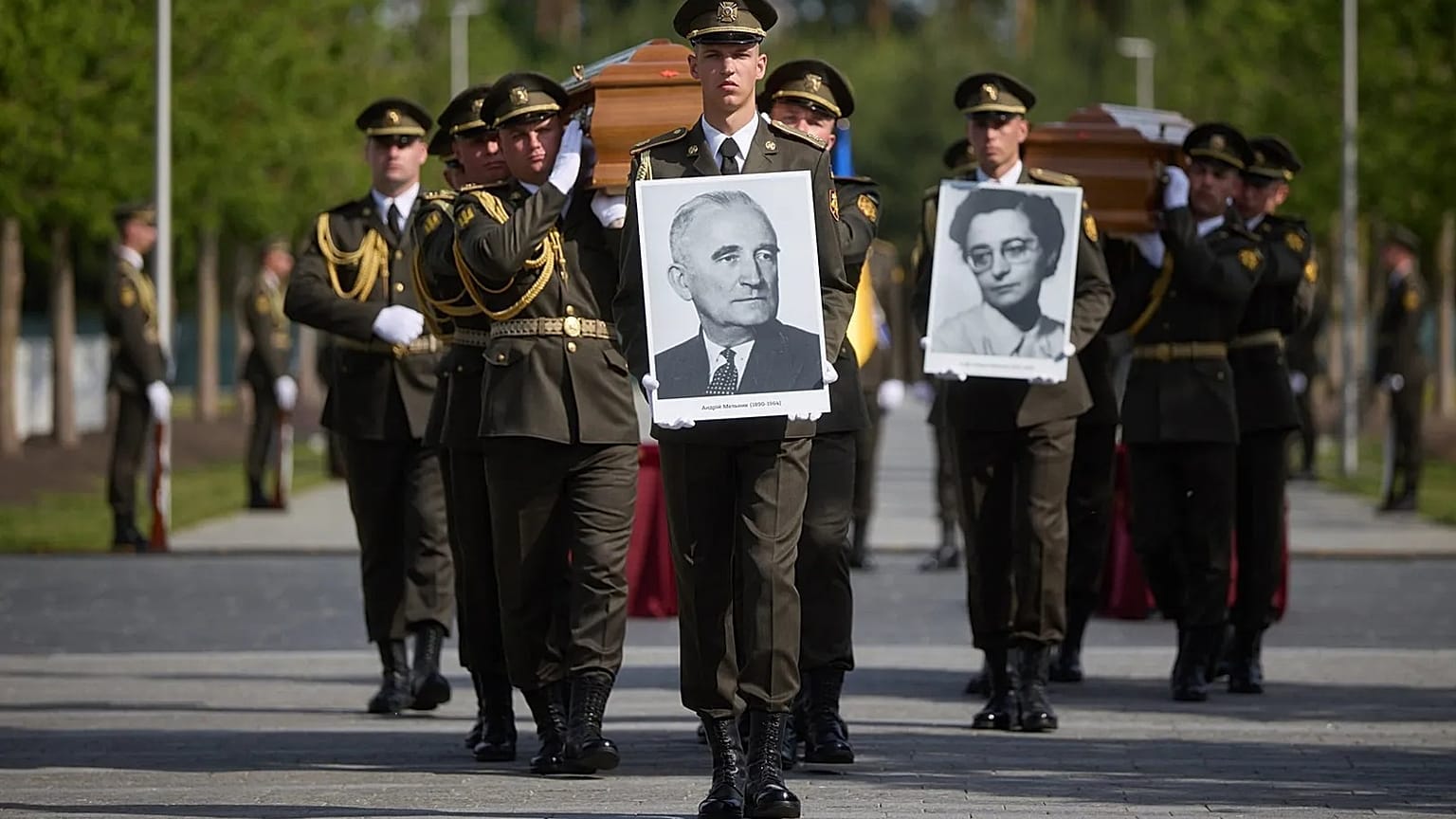
    Ukraine reburies remains of divisive nationalist World War II leader |  Euronews
    Andriy Melnyk’s remains, long-buried in Luxembourg, are returned to Ukraine

    As this journalist has previously revealed, in August 1957 the CIA secretly drew up elaborate plans for a US special forces invasion of Ukraine. Intended to collapse the wider Soviet Union, the Agency’s conspiracy depended heavily on recruiting local fascists as footsoldiers. A significant stumbling block to the Agency’s plot, however, was much of Ukraine’s population actually harbouring “few grievances” against Russians or Communism. “Points of conflict” between Russians and Ukrainians, which could be exploited by the CIA to foment a mass uprising, were scant.

    The Agency lamented how “the long history of union between Russia and Ukraine, which stretches in an almost unbroken line from 1654 to the present day,” had resulted in “many Ukrainians” having “adopted the Russian way of life.” Moreover, the similarity of their “languages, customs, and backgrounds,” and the “great influence” of Russian culture in Ukraine, meant the overwhelming majority of Ukrainians felt “little national antagonism.” Yet, the CIA believed “important grievances exist,” and “under favorable conditions” Ukrainians would assist US invaders.

    Unmentioned in the invasion planning documents, the CIA had since 1949 been covertly striving to create those “favorable conditions.” A key Agency asset used for the purpose was OUN-B chief Mykola Lebed. In 1943, he proposed to “cleanse the entire revolutionary territory” – today’s western Ukraine – of its Polish population, to prevent any future Polish state from claiming the region. A post-war US Army counterintelligence report branded Lebed a “well-known sadist,” and Nazi collaborator
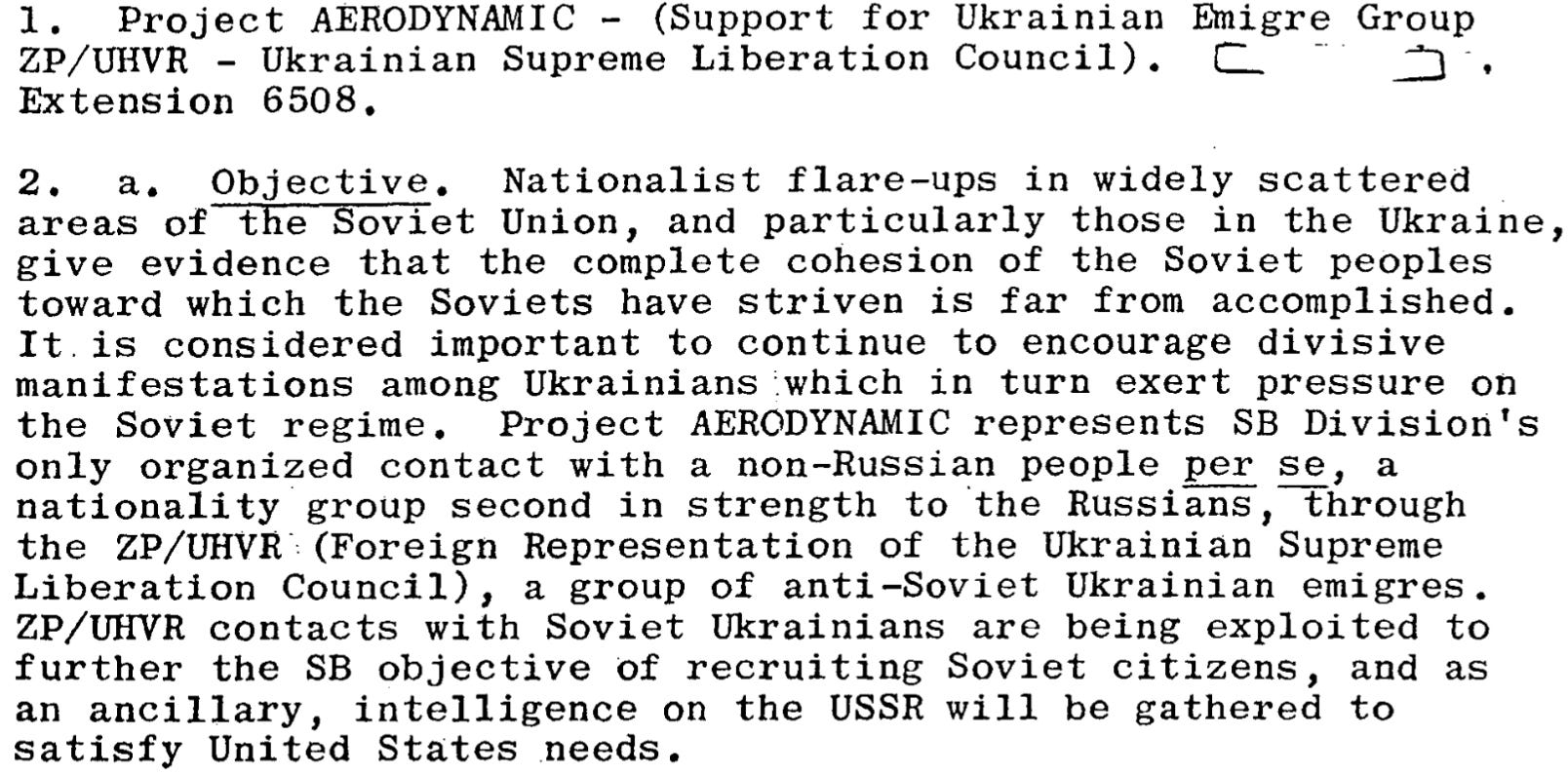
    The nucleus of Lebed’s international fascist agitation was Prolog, a New York-based publishing firm. A 1966 CIA memo noted this “cover organization” for the Ukrainian Supreme Liberation Council (ZP/UHVR) was established to conduct “clandestine activity.” It approvingly added that Prolog’s work “contributes to Ukrainian nationalist ferment and to intellectual resistance to Soviet repression by exploiting existing and encouraging new deviationist tendencies” in Ukraine. Elsewhere, the Agency declared it was “important to continue to encourage divisive manifestation” of this sort. The explicitly stated objective was triggering “nationalist flareups” in the USSR:

    [ZP/UHVR] were sent from the Ukraine in 1945 by the Ukrainian Supreme Liberation Council to make contact with Western intelligence representatives and to act in behalf of the homeland…[ZP/UHVR] organized a net of collaborators throughout Western Europe and the United States…the feeling of nationalism is very much alive. ZP/UHVR has proved realistic in its approach to operational matters and its propaganda activity

    ‘Existing Suspicions’

    A late 1953 Agency memo documents how the CIA for years broadcasted “black radio transmissions” in Ukrainian from a secret CIA installation in Athens, Greece. “Soviet officialdom, Soviet military forces stationed in the Ukraine, the indigenous civilian population…the underground movement and the Ukrainian Insurgent Army (UPA)” were an intended target audience of 40 million people, upon whom the Agency wished to have a “significant propaganda impact.” Produced by ultranationalist emigres who’d fled Ukraine after World War II, the project sought to foment insurrectionary anti-Communist violence:

    Furnish evidence of outside sympathy and understanding for the Ukrainian peoples; intensify anti-regime disaffection by encouraging resentment, bitterness, and distrust of the Soviet regime and its personalities; maintain national consciousness among the Ukrainians and urge them to maintain pride in the individuality and heritage of their culture; create dissatisfaction among Ukrainian military personnel within the Soviet armed forces stationed in the Ukraine; create and intensify dissatisfaction among the Ukrainian civil authorities to the Soviet regime

    Publicly, the station’s US-made broadcasts – which included Ukrainian folk songs – were “attributed to a notional group of Ukrainian Anti-Communists.” There was no connection “actual or implied, with any established Ukrainian emigre group.” It was of the utmost importance too the CIA’s hand in creating and running the station was concealed – “every effort will be made to keep this risk at a minimum.” However, the operation’s ruinous spoils were considered well-worth the hazards
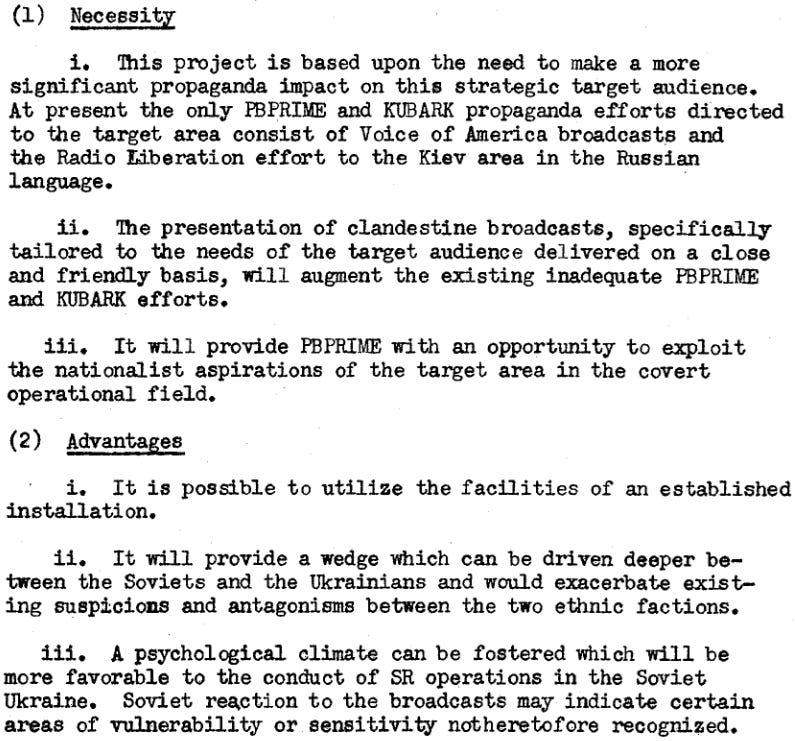
    “It will provide a wedge which can be driven deeper between the Soviets and the Ukrainians and would exacerbate existing suspicions and antagonisms between the two ethnic factions,” the CIA declared. The Agency also sought to create a wider “psychological climate” among Ukrainian audiences which would be “more favorable” to other anti-Soviet operations it was simultaneously conducting. Moreover, it was forecast “Soviet reaction to the broadcasts may indicate certain areas of vulnerability or sensitivity not heretofore recognized,” which could be further exploited.

    ‘Imperial Policy’

    The CIA’s efforts to encourage Ukrainian nationalism and separatism endured throughout the Cold War. Via avowed CIA front the National Endowment for Democracy, overt US assistance was provided to Rukh (The People’s Movement of Ukraine). One of Soviet Ukraine’s first opposition parties, Rukh is widely considered to have played a key role in securing Ukraine’ ‘independence’ in December 1991. Four months earlier, US President George H W Bush had visited Kiev and given an infamous speech in which he cautioned Ukrainians against embracing “suicidal nationalism based upon ethnic hatred.”

    His comments enraged Ukrainian nationalists, and Stateside anti-Soviet hawks. Yet, Bush’s fears were well-founded. By this point, Yugoslavia was rapidly disintegrating, engulfed by ever-violent fratricidal tensions. His administration was thus formally committed at this time to preserving the Soviet Union in some form, and undertook ill-fated measures in service of this goal. Too little, too late, that mission’s failure set Ukraine hurtling towards all-out conflict with Russia. As long-desired by the CIA, “antagonisms between the two ethnic factions” now run deep.

    In a bitter twist, it was precisely because the NED-orchestrated February 2014 Maidan coup was led by rabidly anti-Russian nationalist elements that a majority of Ukrainians did not support the Maidan movement. As a contemporary Washington Post analysis noted, Viktor Yanukovych remained “the most popular political figure in the country,” and no poll conducted to date had ever indicated mass support for the uprising. Surveys conversely showed “large majorities” of Ukrainians opposed the violent storming of regional governments by Maidan insurrectionists.

    This hostility was spurred by “anti-Russian rhetoric and the iconography of western Ukrainian nationalism…not [playing] well among the Ukrainian majority.” Washington Post noted how Neo-Nazi party Svoboda was at Maidan’s forefront. Its leader Oleh Tyahnybok had infamously praised the UPA for fighting “against the Moskali [Russians], Germans, Zhydy [Jews] and other scum.” His words were not well-received by the 50% of Ukraine’s population residing in regions that had “strongly identified with Russia” for over two centuries. “Nearly all are alienated by anti-Russian rhetoric and symbols”:

    Anti-Russian forms of Ukrainian nationalism expressed on the Maidan are certainly not representative of the general view of Ukrainians. Electoral support for these views and for the political parties who espouse them has always been limited. Their presence and influence in the protest movement far outstrip their role in Ukrainian politics and their support barely extends geographically beyond a few Western provinces
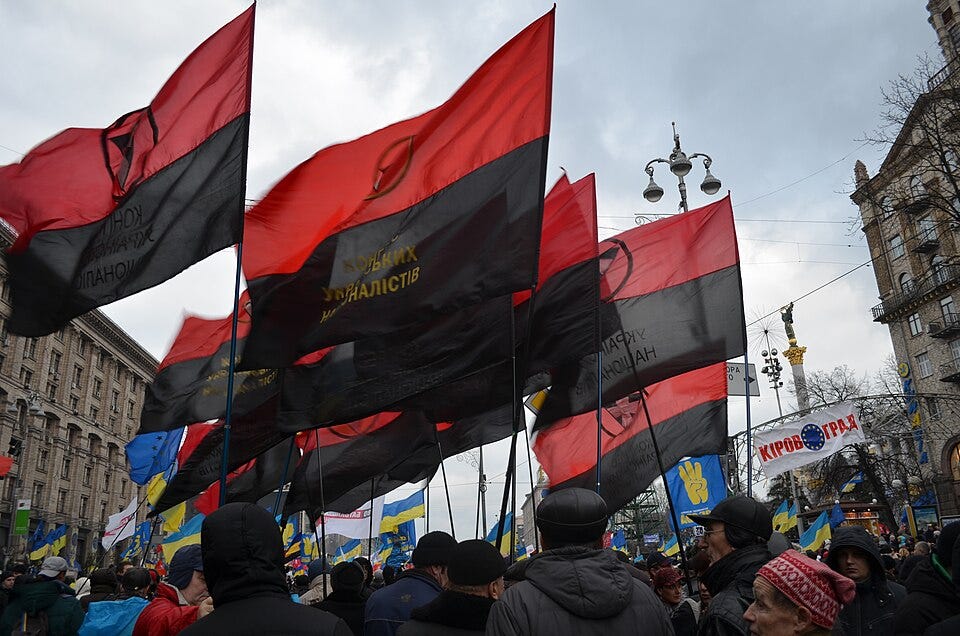
    File:Euromaidan-01-dec-2013 41. JPG
    Congress of Ukrainian Nationalists flags at a December 2013 Maidan protest

    Fast forward to now, and in response to Ukraine’s state-level glorification of the ultranationalist UPA and its lead genocidaire Andriy Melnyk, Polish President Karol Nawrocki has announced he will seek to strip Zelensky of the Order of the White Eagle, Warsaw’s highest honour, bestowed in 2023. Meanwhile, premier Donald Tusk has cursed the Ukrainian leader’s actions as “[wounding] our historical sensitivity,” and “worrying from the point of view of our relations.”

    Authorities in Kiev appear entirely unconcerned their close neighbour and proxy war ally has been so egregiously insulted. A Foreign Ministry spokesperson claimed Zelensky had not wished to cause any offence. “Our history confirms only Moscow benefits from disputes between Ukrainians and Poles,” they said. Besides, for Ukrainian soldiers, “the struggle of the UPA symbolises strictly the opposition to Moscow’s imperial policy.” As the CIA always intended, two antithetical versions of history are effectively at war in Donbass. A more devastating modern day example of divide and conquer in action one would be hard-pressed to identify [end]

    The original article

    Related

    Nazism in Ukraine

    its roots before WW2, its collaboration with Nazi Germany, its legacy in modern Ukraine, how NATO has continually supported Nazism in Ukraine, chronicle

    August 17, 2025: Declassified: CIA’s Covert Ukraine Invasion Plan – Kit Klarenberg

    April 2, 2025: It’s Official: Ukraine Conflict is British ‘Proxy War’ – Kit Klarenberg

    March 26, 2025: “Ukrainian History X”: How the State Department Secretly Funded the Azov* Regiment – Andrey Zhuravlev

    With the start of the Special Military Operation in February 2022, the nationalist Azov Regiment became one of Ukraine’s most widely recognized military formations. Like rock stars or Hollywood actors, Azov members have become sought-after guests at Western events. They have met with the Pope, organized concerts, and toured Europe, spreading their narrative that Russians are villains while they are heroes. Only in Russia is this regiment, along with similar formations, officially recognized as a terrorist organization

    February 8, 2025: ‘Aiding chaos’: USAID’s role in engineering regime change, social unrest worldwide – Maryam Qarehgozlou, Press TV

    After President Donald Trump’s executive order suspending all US foreign aid programs, the US Agency for International Development (USAID) has again come under intense scrutiny

    November 16, 2024: Leaks expose secret British military cell plotting to ‘keep Ukraine fighting’ – Kit Klarenberg, The Grayzone

    Leaked files show top UK military figures conspired to carry out the Kerch bridge bombing, covertly train “Gladio”-style stay-behind forces in Ukraine, and groom the British public for a drop in living standards caused by the proxy war against Russia

    July 28, 2024: Ultra-nationalist linked to Maidan false flag assassinated – Kit Klarenberg, The Grayzone

    The killing of ultra-nationalist Ukrainian politician Iryna Farion at the hands of a Neo-Nazi is filled with irony. Linked to the Maidan false flag massacre, Farion was instrumental in bringing fascist forces into the mainstream

    June 26, 2024: The Franco-British Plot to Dismember Russia [1917 – ?] – Kit Klarenberg

    June 6, 2023: First there were Neo-Nazis, then there were no Nazis, then there were – Patrick Lawrence, ScheerPost

    October 14, 2020: Liberalism And Fascism: Partners In Crime – Gabriel Rockhill, Counterpunch

  • [Sharing] Declassified: CIA’s Covert Ukraine Invasion Plan – Kit Klarenberg

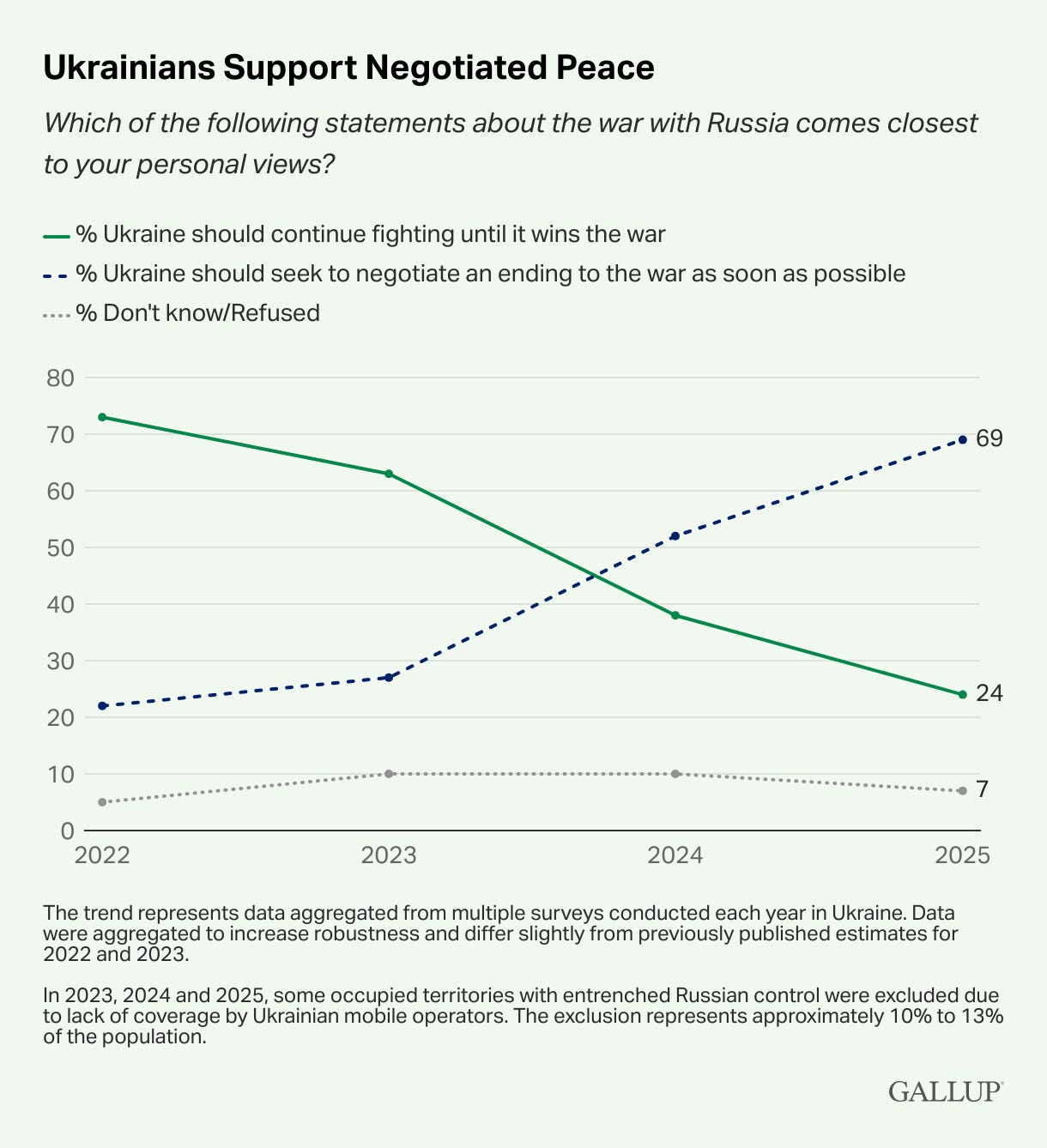
    On August 7th, US polling giant Gallup published the remarkable results of a survey of Ukrainians. Public support for Kiev “fighting until victory” has plummeted to a record low “across all segments” of the population, “regardless of region or demographic group.” In a “nearly complete reversal from public opinion in 2022,” 69% of citizens “favor a negotiated end to the war as soon as possible.” Just 24% wish to keep fighting.  However, vanishingly few believe the proxy war will end anytime soon.

    The reasons for Ukrainian pessimism on this point are unstated, but an obvious explanation is the intransigence of President Volodymyr Zelensky, encouraged by his overseas backers – Britain in particular. London’s reverie of breaking up Russia into readily-exploitable chunks dates back centuries, and became turbocharged in the wake of the February 2014 Maidan coup. In July that year, a precise blueprint for the current proxy conflict was published by the Institute for Statecraft, a NATO/MI6 cutout founded by veteran British military intelligence apparatchik Chris Donnelly, who now oversees London’s management of the proxy conflict

    In response to the Donbass civil war, Statecraft advocated targeting Moscow with a variety of “anti-subversive measures”. This included “economic boycott, breach of diplomatic relations,” as well as “propaganda and counter-propaganda, pressure on neutrals.” The objective was to produce “armed conflict of the old-fashioned sort” with Russia, which “Britain and the West could win.” While we are now witnessing in real-time the brutal unravelling of Donnelly’s monstrous plot, Anglo-American designs of using Ukraine as a beachhead for all-out war with Moscow date back far further.

    In August 1957, the CIA secretly drew up elaborate plans for an invasion of Ukraine by US special forces. It was hoped neighbourhood anti-Communist agitators would be mobilized as footsoldiers to assist in the effort. A detailed 200-page report, Resistance Factors and Special Forces Areas, set out demographic, economic, geographical, historical and political factors throughout the then-Soviet Socialist Republic that could facilitate, or impede, Washington’s quest to ignite local insurrection, and in turn the USSR’s ultimate collapse

    The mission was forecast to be a delicate and difficult balancing act, as much of Ukraine’s population held “few grievances” against Russians or Communist rule, which could be exploited to foment an armed uprising. Just as problematically, “the long history of union between Russia and Ukraine, which stretches in an almost unbroken line from 1654 to the present day,” resulted in “many Ukrainians” having “adopted the Russian way of life”. Problematically, there was thus a pronounced lack of “resistance to Soviet rule” among the population.

    The “great influence” of Russian culture over Ukrainians, “many influential positions” in local government being held “by Russians or Ukrainians sympathetic to [Communist] rule, and “relative similarity” of their “languages, customs, and backgrounds”, meant there were “fewer points of conflict between the Ukrainians and Russians” than in Warsaw Pact nations. Throughout those satellite states, the CIA had to varying success already recruited clandestine networks of “freedom fighters” as anti-Communist Fifth Columnists. Yet, the Agency remained keen to identify potential “resistance” actors in Ukraine:

    Some Ukrainians are apparently only slightly aware of the differences which set them apart from Russians and feel little national antagonism. Nevertheless, important grievances exist, and among other Ukrainians there is opposition to Soviet authority which often has assumed a nationalist form. Under favorable conditions, these people might be expected to assist American Special Forces in fighting against the regime

    ‘Nationalist Activity’

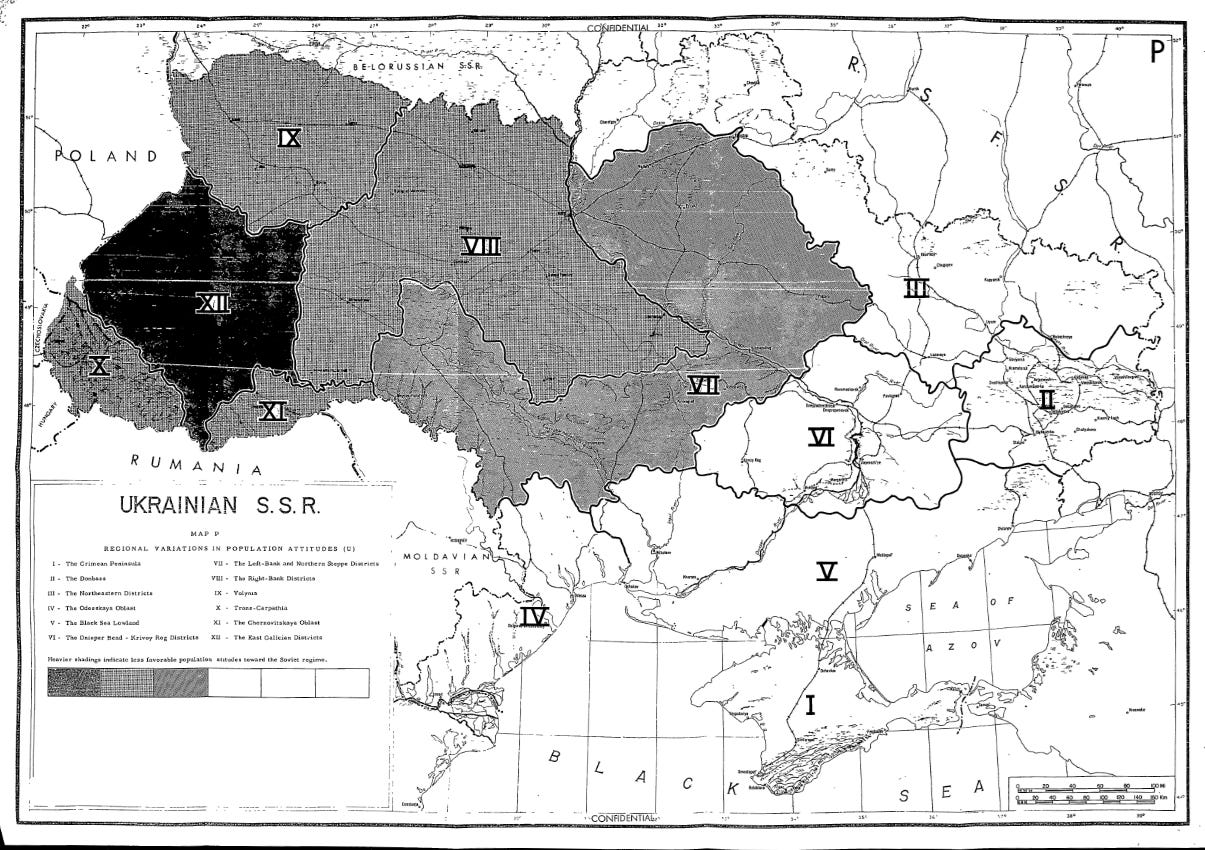
    A CIA map split Ukraine into 12 separate zones, ranked on “resistance” potential, and how “favorable population attitudes [are] toward the Soviet regime.” South and eastern regions, particularly Crimea and Donbass, rated poorly. Their populations were judged “strongly loyal” to Moscow, having never “displayed nationalist feelings or indicated any hostility to the regime,” while viewing themselves as “a Russian island in the Ukrainian sea.” In fact, as the study recorded, during and after World War I, when Germany created a fascist puppet state in Ukraine:

    Inhabitants of Donbass strongly resisted Ukrainian nationalists and at one point created a separate republic, independent of the rest of Ukraine. In the following years, they defended Soviet rule and Russian interests, often attacking the Ukrainian nationalists with more zeal than the Russian leaders themselves. During the German occupation in the Second World War, there was not a single recorded case of support for the Ukrainian nationalists or Germans

    Still, invading and occupying Crimea was considered of paramount importance. On top of its strategic significance, the peninsula’s landscape was forecast as ideal for guerrilla warfare. The terrain offered “excellent opportunities for concealment and evasion,” the CIA report noted. While “troops operating in these sectors must be specially trained and equipped,” it was forecast the local Tatar population, “which fought so fiercely” against the Soviets in World War II, “would probably be willing to help” invading US forces.

    Areas of western Ukraine, including former regions of Poland such as Lviv, Rivne, Transcarpathia and Volyn, which were heavily under control of “Ukrainian insurgents” – adherents of MI6-supported Stepan Bandera – during World War II, were judged most fruitful “resistance” launchpads. There, “nationalist activity was extensive” during World War II, with armed militias opposing “pro-Soviet partisans with some success.” Conveniently too, mass extermination of Jews, Poles and Russians by Banderites in these regions meant there was virtually no non-ethnic Ukrainian population left.

    Furthermore, in the post-war period, “resistance to Soviet rule” had been “expressed on a great scale” in western Ukraine. Despite “extensive deportations”, “many nationalists” remained in Lviv et al, and “nationalist cells” created by Bandera’s “task forces” remained dotted around the country. For example, anti-Communist “partisan bands” had taken up residence in the Carpathian Mountains. The review concluded, “it is in this region [US] Special Forces could expect considerable support from the local Ukrainian population, including active participation in measures directed against the Soviet regime.”

    It was also determined that “Ukrainian nationalist, anti-Soviet sentiment” in Kiev was “apparently moderately strong,” and elements of the population “might be expected to provide active assistance to Special Forces.” The capital’s “large Ukrainian population” was reportedly “little affected by Russian influence,” and during the Russian Revolution “provided greater support than any other region for Ukrainian, nationalist, anti-Soviet forces.” Resultantly, “uncertainty about the attitudes of the local population” prompted Moscow to designate the Ukrainian SSR’s capital, which it remained until 1934.

    The CIA document further offered highly detailed assessments of Ukrainian territory, based on their utility for warfare. For example, “generally forbidding” Polesia – near Belarus – was noted to be “almost impossible” to traverse during spring. Conversely, winter provided “most favorable to movement, depending on the depth to which the ground freezes.” Overall, the area had “proved its worth as an excellent refuge and evasion area by supporting large-scale guerilla activities in the past.” Meanwhile, “swampy valleys of the Dnieper and Desna rivers” were of particular interest:

    The area is densely forested in its north-western part, where there are excellent opportunities for concealment and manoeuvre…There are extensive swamps, interspersed with patches of forest, which also provide good hiding places for the Special Forces. Conditions in the Volyno-Podolskaya Highlands are less suitable, although small groups may find temporary shelter in the sparse forests

    ‘Strongly Anti-Nationalist’

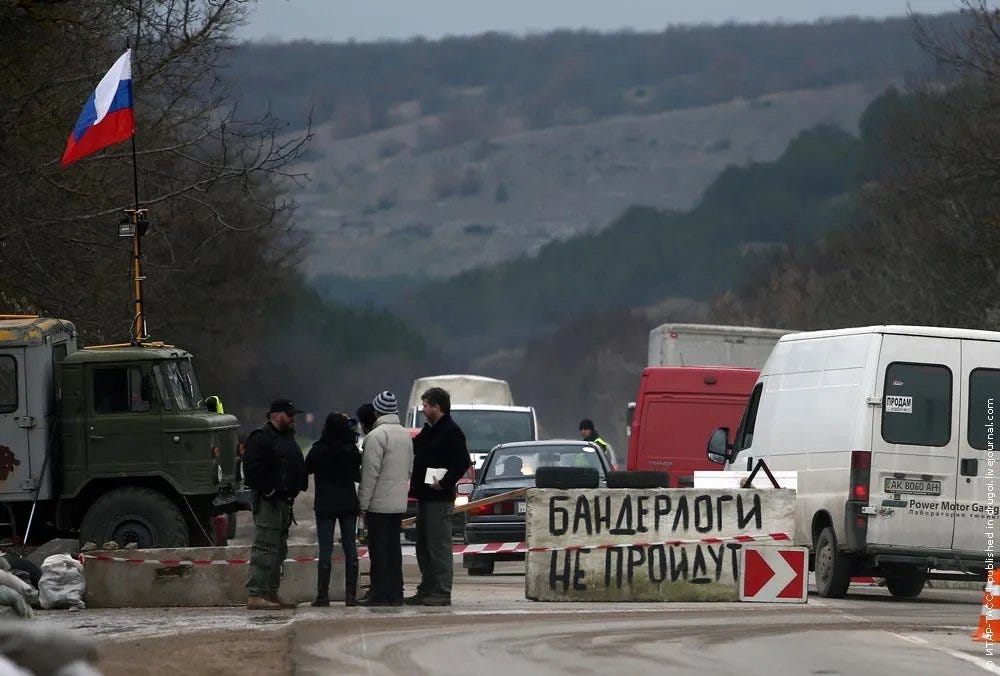
    The CIA’s invasion plan never formally came to pass. Yet, areas of Ukraine forecast by the Agency to be most welcoming of US special forces were precisely where support for the Maidan coup was highest. Moreover, in a largely unknown chapter of the Maidan saga, fascist Right Sector militants were bussed en masse to Crimea prior to Moscow’s seizure of the peninsula. Had they succeeded in overrunning the territory, Right Sector would’ve fulfilled the CIA’s objective, as outlined in Resistance Factors and Special Forces Areas

    A civilian defence barricade constructed to prevent Right Sector entering Crimea, February 2014

    Given what transpired elsewhere in Ukraine following February 2014, other sections of the CIA report take on a distinctly eerie character. For instance, despite its strategic position facing the Black Sea, the Agency warned against attempting to foment anti-Soviet rebellion in Odessa. The agency noted the city is “the most cosmopolitan area in Ukraine, with a heterogeneous population including significant numbers of Greeks, Moldovans and Bulgarians, as well as Russians and Jews.” As such:

    Odessa…has developed a less nationalistic character. Historically, it has been considered more Russian than Ukrainian territory. There was little evidence of nationalist or anti-Russian sentiment here during the Second World War, and the city…was in fact controlled by a strongly anti-nationalist local administration [during the conflict]

    Odessa became a key battleground between pro- and anti-Maidan elements, from the moment the Maidan protests erupted in November 2013. By March the next year, Russophone Ukrainians had occupied the city’s historic Kulykove Pole Square, and were calling for a referendum on the establishment of an “Odessa Autonomous Republic”. Tensions came to a head on May 2nd, when fascist football ultras – who subsequently formed Azov Battalion – flooded Odessa and forced dozens of anti-Maidan activists into the Trade Unions House, before setting it ablaze.

    In all, 42 people were killed and hundreds injured, while Odessa’s anti-Maidan movement was comprehensively neutralised. In March this year, the European Court of Human Rights issued a damning ruling against Kiev over the massacre. It concluded local police and fire services “deliberately” failed to respond appropriately to the inferno, and authorities insulated culpable officials and perpetrators from prosecution despite possessing incontrovertible evidence. Lethal “negligence” by officials on the day, and ever after, was found to go far “beyond an error of judgment or carelessness.”

    The ECHR was apparently unwilling to consider that the lethal incineration of anti-Maidan activists was an intentional and premeditated act of mass murder, conceived and directed by Kiev’s US-installed fascist government. However, the findings of a Ukrainian parliamentary commission point ineluctably towards this conclusion. Whether, in turn, the Odessa massacre was intended to trigger Russian intervention in Ukraine, thus precipitating “armed conflict of the old-fashioned sort” with Moscow that “Britain and the West could win” is a matter of speculation [end]

    The original article

    Related

    Nazism in Ukraine

    its roots before WW2, its collaboration with Nazi Germany, its legacy in modern Ukraine, how NATO has continually supported Nazism in Ukraine, chronicle

    The Atlanticist defeat in Donbass and Ukraine

    chronicle of a new catastrophic NATO venture

    June 11, 2025: Secret British plans to ‘defeat entire Russian Black Fleet’ revealed in leaks – Kit Klarenberg, The Grayzone

    Leaked files reviewed by The Grayzone expose the covert war waged by British intelligence against Russia in the Black Sea, outlining Ukrainian “honey trap” plots along with blueprints for blowing up the Kerch Bridge

    May 9, 2025: Victory Day

    April 2, 2025: It’s Official: Ukraine Conflict is British ‘Proxy War’ – Kit Klarenberg

    March 26, 2025: “Ukrainian History X”: How the State Department Secretly Funded the Azov* Regiment – Andrey Zhuravlev

    With the start of the Special Military Operation in February 2022, the nationalist Azov Regiment became one of Ukraine’s most widely recognized military formations. Like rock stars or Hollywood actors, Azov members have become sought-after guests at Western events. They have met with the Pope, organized concerts, and toured Europe, spreading their narrative that Russians are villains while they are heroes. Only in Russia is this regiment, along with similar formations, officially recognized as a terrorist organization

    February 8, 2025: ‘Aiding chaos’: USAID’s role in engineering regime change, social unrest worldwide – Maryam Qarehgozlou, Press TV

    After President Donald Trump’s executive order suspending all US foreign aid programs, the US Agency for International Development (USAID) has again come under intense scrutiny

    November 16, 2024: Leaks expose secret British military cell plotting to ‘keep Ukraine fighting’ – Kit Klarenberg, The Grayzone

    Leaked files show top UK military figures conspired to carry out the Kerch bridge bombing, covertly train “Gladio”-style stay-behind forces in Ukraine, and groom the British public for a drop in living standards caused by the proxy war against Russia

    August 11, 2024: Western globalism and its Nazi-fascist instrument will be defeated in Kiev – Hugo Dionisio, Strategic Culture Foundation

    It is essential to close the circle of Nazi existence. The defeat of the Kiev regime is a fundamental step in this direction

    July 28, 2024: Ultra-nationalist linked to Maidan false flag assassinated – Kit Klarenberg, The Grayzone

    The killing of ultra-nationalist Ukrainian politician Iryna Farion at the hands of a Neo-Nazi is filled with irony. Linked to the Maidan false flag massacre, Farion was instrumental in bringing fascist forces into the mainstream
    June 26, 2024: The Franco-British Plot to Dismember Russia [1917 – ?] – Kit Klarenberg

    April 9, 2024: Secret list of a French intelligence officer: how NATO soldiers end up in Ukraine – Zvezda

    [it was with great pleasure that I have been involved in an investigation by Zvezda, the channel of the Russian Ministry of Defense]

    February 2, 2024: EPER, personne morale

    deux Français sont tués en Ukraine le 1er février 2024

    January 19, 2024: Russian Missile Strike on French Contractor Base in Ukraine Highlights Heated Franco-Russian Cold War – Military Watch Magazine

    June 6, 2023: First there were Neo-Nazis, then there were no Nazis, then there were – Patrick Lawrence, ScheerPost

    October 14, 2020: Liberalism And Fascism: Partners In Crime – Gabriel Rockhill, Counterpunch

  • [Sharing] Liberalism And Fascism: Partners In Crime – Gabriel Rockhill, Counterpunch

    October 14, 2020 [no surprise then that the US and its British stooges are supporting the Ukrainian Nazis since the end of WW2]

    The intellectuals cast a veil over the dictatorial character of bourgeois democracy not least by presenting democracy as the absolute opposite of fascism, not as just another natural phase of it where the bourgeois dictatorship is revealed in a more open form

    – Bertolt Brecht

    Time and again we hear that liberalism is the last bulwark against fascism. It represents a defense of the rule of law and democracy in the face of aberrant, malevolent demagogues intent on destroying a perfectly good system for their own gain. This apparent opposition has been deeply engrained in contemporary so-called Western liberal democracies through their shared origin myth. As every school child in the U.S. learns, for instance, liberalism defeated fascism in World War II, beating back the Nazi beast in order to establish a new international order that—for all of its potential faults and misdeeds—was built upon key democratic principles that are antithetical to fascism.

    This framing of the relationship between liberalism and fascism not only presents them as complete opposites, but it also defines the very essence of the fight against fascism as the struggle for liberalism. In so doing, it forges an ideological false antagonism. For what fascism and liberalism share is their undying devotion to the capitalist world order. Although one prefers the velvet glove of hegemonic and consensual rule, and the other relies more readily on the iron fist of repressive violence, they are both intent on maintaining and developing capitalist social relations, and they have worked together throughout modern history in order to do so. What this apparent conflict masks—and this is its true ideological power—is that the real, fundamental dividing line is not between two different modes of capitalist governance, but between capitalists and anti-capitalists. The long psychological warfare campaign waged under the deceptive banner of ‘totalitarianism’ has done much to further dissimulate this line of demarcation by disingenuously presenting communism as a form of fascism. As Domenico Losurdo and others have explained with great historical precision and detail, this is pure ideological pap.

    Given the ways in which the current public debate on fascism tends to be framed in relationship to purported liberal resistance, there could scarcely be a timelier task than that of scrupulously re-examining the historical record of actually existing liberalism and fascism. As we shall see even in this brief overview, far from being enemies, they have been—sometimes subtle, sometimes forthright—partners in capitalist crime. For the sake of argument and concision, I will here focus primarily on a conjunctural account of the non-controversial cases of Italy and Germany. However, it is worth stating at the outset that the Nazi racial police state and colonial rampage—which far surpassed Italy’s capabilities—were modeled on the United States.

    Liberal Collaboration in the Rise of European Fascism

    It is of the utmost importance that Western European fascism emerged within parliamentary democracies rather than conquering them from the outside. The fascists rose to power in Italy at a moment of severe political and economic crisis on the heels of WWI, and then later the Great Depression. This was also a time when the world had just witnessed the first successful anti-capitalist revolution in the U.S.S.R. Mussolini, who had cut his teeth working for MI5 to break up the Italian peace movement during WWI, was later backed by big industrial capitalists and bankers for his anti-worker, pro-capitalist political orientation. His tactic was to work within the parliamentary system, by mobilizing powerful financial supporters to bankroll his expansive propaganda campaign while his black shirts rode roughshod over picket lines and working-class organizations. In October of 1922, magnates in the Confederation of Industry and major bank leaders provided him with the millions necessary for the March on Rome as a spectacular show of force. However, he did not seize power. Instead, as Daniel Guérin explained in his masterful study Fascism and Big Business, Mussolini was summoned by the king on October 29th and was, according to parliamentary norms, entrusted with forming a cabinet. The capitalist state turned itself over without a fight, but Mussolini was intent on forming an absolute majority in parliament with the help of the liberals. They supported his new electoral law in July 1923 and then made a joint slate with the fascists for the election on April 6, 1924. The fascists, who had only had 35 seats in parliament, gained 286 seats with the help of the liberals.

    The Nazis rose to power in much the same way, by working within the parliamentary system and courting the favor of big industrial magnates and bankers. The latter provided the financial support necessary to grow the Nazi party and eventually secure the electoral victory of September 1930. Hitler would later reminisce, in a speech on October 19, 1935, on what it meant to have the material resources necessary to support 1,000 Nazi orators with their own cars, who could hold some 100,000 public meetings in the course of a year. In the December 1932 election, the Social Democrat leaders, who were far to the left of contemporary liberals but shared their reformist agenda, refused to form an eleventh-hour coalition with the communists against Nazism. “As in many other countries past and present, so in Germany,” wrote Michael Parenti, “the Social Democrats would sooner ally themselves with the reactionary Right than make common cause with the Reds.” Prior to the election, the Communist Party candidate Ernst Thaelmann had argued that a vote for the conservative Field Marshal von Hindenburg amounted to a vote for Hitler and for war. Only weeks after Hindenburg’s election, he invited Hitler to become chancellor.

    Fascism in both cases came to power through bourgeois parliamentary democracy, in which big capital bankrolled the candidates who would do its bidding while also creating a populist spectacle—a false revolution—that marshaled or suggested mass appeal. Its conquest of power took place within this legal and constitutional framework, which secured its apparent legitimacy on the home front, as well as within the international community of bourgeois democracies. Leon Trotsky understood this perfectly and diagnosed what was going on at the time with remarkable insight:

    The results are at hand: bourgeois democracy transforms itself legally, pacifically, into a fascist dictatorship. The secret is simple enough: bourgeois democracy and fascist dictatorship are the instruments of one and the same class, the exploiters. It is absolutely impossible to prevent the replacement of one instrument by the other by appealing to the Constitution, the Supreme Court at Leipzig, new elections, etc. What is necessary is to mobilize the revolutionary forces of the proletariat. Constitutional fetishism brings the best aid to fascism.

    Once its power was secure, however, fascism revealed its authoritarian face, transforming itself into what Trotsky referred to as a military-bureaucratic dictatorship of the Bonapartist type. It unflinchingly set about—at a rather different pace in Italy than in Germany—completing the task it had been hired to accomplish by crushing organized labor, eradicating opposition parties, destroying independent publications, putting a halt to elections, scapegoating and eliminating racialized underclasses, privatizing public assets, launching projects of colonial expansion and investing heavily in a war economy beneficial to its industrial supporters. In establishing the direct dictatorship of big capital, it even destroyed some of the more plebeian and populist elements in its own ranks, while crushing many confused liberals under the juggernaut of repressive class warfare.

    It was not only within Italy and Germany that bourgeois democracy allowed for the rise of fascism. This was also true internationally. Capitalist states refused to form an antifascist coalition with the U.S.S.R., a country that fourteen of them had invaded and occupied from 1918 to 1920 in a failed attempt to destroy the world’s first workers’ republic. During the Spanish Civil War, which historians like Eric Hobsbawm have characterized as a miniature version of the great mid-century war between fascism and communism, Western liberal democracies did not officially support the left-leaning government that had been elected. Instead, they stood idly by while the Axis powers provided massive support to General Francisco Franco as he oversaw a military coup d’état. It is highly revealing that Franco, a self-declared fascist who is often sidelined in discussions of European fascism, understood with remarkable clarity why the epiphenomenal characteristics of fascism would differ considerably based on the precise conjuncture: “Fascism, since that is the word that is used, fascism presents, wherever it manifests itself, characteristics which are varied to the extent that countries and national temperaments vary.” It was the U.S.S.R. that came to the aid of the Republicans battling fascism in Spain, sending both soldiers and materials. Franco would later return the favor, so to speak, by deploying a volunteer military force to fight godless communism alongside the Nazis. Franco would also, of course, become one of the great postwar allies of the United States in its fight against the Red Menace.

    In 1934, the United Kingdom, France and Italy signed the Munich Agreement, in which they agreed to allow Hitler to invade and colonize the Sudetenland in Czechoslovakia. “The sheer reluctance of Western governments to enter into effective negotiations with the Red state,” wrote Eric Hobsbawm, “even in 1938-39 when the urgency of an anti-Hitler alliance was no longer denied by anyone, is only too patent. Indeed, it was the fear of being left to confront Hitler alone which eventually drove Stalin, since 1934 the unswerving champion of an alliance with the West against him, into the Stalin-Ribbentrop Pact of August 1939, by which he hoped to keep the U.S.S.R. out of the war.” This non-aggression pact was then disingenuously presented in the Western media as an undeniable indication that the Nazis and communists were somehow allies.

    International Capitalism and Fascism

    It was not only large industrialists and bankers, as well as landowners, within Italy and Germany that supported and profited from the fascist rise to power. This was equally true of many of the major corporations and banks whose headquarters were in Western bourgeois democracies. Henry Ford was perhaps the most notorious example since in 1938 he was awarded the Grand Cross of the Supreme Order of the German Eagle, which was the highest honor that could be bestowed upon any non-German (Mussolini had received one earlier the same year). Ford had not only funneled ample funding into the Nazi Party, he had provided it with much of its anti-Semitic and anti-Bolshevik ideology. Ford’s conviction that “Communism was a completely Jewish creation,” to quote James and Suzanne Pool, was shared by Hitler, and some have suggested that the latter was so close ideologically to Ford that certain passages from Mein Kampf were directly copied from Ford’s anti-Semitic publication The International Jew.

    Ford was only one of the American companies invested in Germany, and many other U.S. banks, firms and investors profited handsomely from Aryanizations (the expulsion of Jews from business life and the forced transfer of their property into ‘Aryan’ hands), as well as from the German rearmament program. According to Christopher Simpson’s masterful study, “a half-dozen key U.S. companies—International Harvester, Ford, General Motors, Standard Oil of New Jersey, and du Pont—had become deeply involved in German weapons production.” In fact, American investment in Germany sharply increased after Hitler came to power. “Commerce Department reports show,” writes Simpson, “that U.S. investment in Germany increased some 48.5 percent between 1929 and 1940, while declining sharply everywhere else in continental Europe.” The German subsidiaries of U.S. companies like Ford and General Motors, as well as several oil companies, made wide use of forced labor in concentration camps. Buchenwald, for instance, provided concentration camp labor for GM’s enormous Russelsheim plant, as well as for the Ford truck plant located in Cologne, and Ford’s German managers made extensive use of Russian POW’s for war production work (a war crime according to the Geneva Conventions).

    John Foster Dulles and Allen Dulles, who would later respectively become the Secretary of State and the head of the CIA, ran Sullivan & Cromwell, which some consider to have been the largest Wall Street law firm at the time. They played a very important role in overseeing, advising and managing global investment in Germany, which had become one of the most important international markets—particularly for American investors—during the second half of the 1920s. Sullivan & Cromwell worked with nearly all of the major U.S. banks, and they oversaw investments in Germany in excess of a billion dollars. They also worked with dozens of companies and governments all over the world, but John Foster Dulles, according to Simpson, “clearly emphasized projects for Germany, for the military junta in Poland, and for Mussolini’s fascist state in Italy.” In the postwar era, Allen Dulles worked tirelessly to protect his business partners, and he was remarkably successful in securing their assets and helping them avoid prosecution.

    Whereas most liberal accounts of fascism focus on its political theater and epiphenomenal eccentricities, thereby avoiding a systemic and radical analysis, it is essential to recognize that if liberalism allowed for the growth of European fascism, it is capitalism that drove this growth.

    Who Defeated Fascism?

    It is not surprising that the bourgeois democracies of the West were extremely slow to open the Western front, allowing their erstwhile enemy, the U.S.S.R., to be bled by the pro-capitalist Nazi war machine (which received ample funding from White Russians). In fact, the day after Nazi Germany invaded the Soviet Union, Harry Truman flatly declared: “If we see that Germany is winning, we ought to help Russia, and if Russia is winning, we ought to help Germany, and that way let them kill as many as possible, although I don’t want to see Hitler victorious in any circumstances.” After the U.S. entered the war, powerful officials like Allen Dulles worked behind the scenes to try and broker a peace deal with Germany that would allow the Nazis to focus all of their attention on eradicating the U.S.S.R.

    The widespread idea, at least within the U.S., that fascism was ultimately defeated by liberalism in WWII, due primarily to the U.S. intervention in the war, is a baseless canard. As Peter Kuznick, Max Blumenthal and Ben Norton reminded listeners in a recent discussion, 80% of the Nazis who died in the war were killed on the Eastern Front with the U.S.S.R., where Germany had deployed 200 divisions (versus only 10 in the West). 27 million Soviets gave their lives fighting fascism, whereas 400,000 American soldiers died in the war (which amounts to approximately 1.5% of the Soviet death toll). It was, above all, the Red Army that defeated fascism in WWII, and it is communism—not liberalism—that constitutes the last bulwark against fascism. The historical lesson should be clear: one cannot be truly antifascist without being anti-capitalist.

    The Ideology of False Antagonisms

    The ideological construction of false antagonisms, in the case of liberalism and fascism, serves multiple purposes:

    + It establishes the primary front of struggle as one between rival positions within the capitalist camp.

    + It channels people’s energy into fighting over the best methods for managing capitalist rule rather than abolishing it.

    + It eradicates the true lines of demarcation of global class struggle.

    + It attempts to simply take the communist option off the table (by removing it entirely from the field of struggle, or disingenuously presenting it as a form of ‘totalitarianism’).

    Not unlike sporting events, which are very important ideological rituals in the contemporary world, the logic of false antagonisms amps up and overinflates all of the idiosyncratic differences and personal rivalries between two opposing teams to such an extent that the frenzied fans come to forget that they are ultimately playing the same game.

    In the reactionary political culture of the U.S., which has attempted to redefine the Left as liberal, it is of the utmost importance to recognize that the primary opposition that has structured, and continues to organize, the modern world is the one between capitalism—which is imposed and maintained through liberal ideology and institutions, as well as fascist repression, depending on the time, place and population in question—and socialism. By replacing this opposition by the one between liberalism and fascism, the ideology of false antagonisms aims at making the fight of the century into a capitalist spectacle rather than a communist revolution [end]

    The original article

    Gabriel Rockhill is a Franco-American philosopher, cultural critic and activist. He the founding Director of the Critical Theory Workshop and Professor of Philosophy at Villanova University. His books include Counter-History of the Present: Untimely Interrogations into Globalization, Technology, Democracy (2017), Interventions in Contemporary Thought: History, Politics, Aesthetics (2016), Radical History & the Politics of Art (2014) and Logique de l’histoire (2010). In addition to his scholarly work, he has been actively engaged in extra-academic activities in the art and activist worlds, as well as a regular contributor to public intellectual debate. Follow on twitter: @GabrielRockhill

    A related piece, no surprise then that the US and its British stooges are supporting the Ukrainian Nazis since the end of WW2

    Nazism in Ukraine