Nicolas Cinquini

Analista senior di l'intelligenza in u campu di a gestione di i risichi di sicurezza, sò un anzianu tenente detective è ufficiale di l'intelligenza in l'agenzie di u Statu francese. A bona pronuncia hè Николай Чинкуини, in russu

Tag: CSIS

  • [Enemy British media] Claude: tyranny’s little helper – Peter Frankopan, UnHerd

    Our enemies are weaponising AI [mwahaha]

    Over the past year, the AI community has become increasingly worried over the behaviour of autonomous agents. Over the past week, that worry has hardened into panic — not least given the chatter, if vague and hard to verify, about a significant advance in recursive self-improvement at one of the world’s biggest frontier firms. Yet amid rumours and counter-rumours, and the recent suggestion by Donald Trump that “whoever wins AI wins”, one document may offer answers — less about the existential dangers of AI, and more about the threat it poses in the here-and-now.

    Over 154 pages, a new report by Anthropic details some of the ways in which its Claude model has been misused over the past several months. With its talk of cyber-attacks, espionage and propaganda, it makes for terrifying reading, especially given how many actors — from Russian hackers to Chinese spies to Iranian propagandists — are now using the technology. As for Anthropic, it is able to monitor and assess how its systems are being used in real time, allowing the firm’s threat-intelligence team to track how Claude is being used.

    One of the most eyebrow-raising examples comes from Yemen, particularly striking given the Houthis have established a presence on Perim Island, a strategically important position in the Bab al-Mandab Strait. Control of the island could strengthen the militants’ ability to threaten shipping through this narrow southern gateway to the Red Sea and Suez Canal, the primary maritime corridor linking Asia and Europe.

    It’s striking, then, that Anthropic’s team identified a weapons-engineering cell in the north of the country that used Claude to work on three distinct programmes, including a guided rocket and a ballistic missile with a range exceeding 2,000 kilometres. Tracking this activity made it possible to reconstruct the militia’s engineering workflows.

    To put simply: the Houthis — or their affiliates or hired helpers — effectively used Claude Code as a substitute for software engineers, getting it to help develop guidance, navigation and control systems; integrate an open-source autopilot into a flight computer; tune controls; and even run simulations. Several Claude operations ran at once: one coding, another researching, and a third checking the first agent’s work. This was not mere experimentation by geeks with laptops. After all, it apparently resulted in the test-firing of a guided rocket. When this seemingly failed, the results were quickly plugged back into Claude to diagnose what had gone wrong.

    Anthropic says it has no evidence that an operational weapon was ultimately fielded, but the episode exposes an uncomfortable weakness in the way AI safety controls currently work. It is worth noting that Claude would not simply agree to design a missile on request; in fact, Anthropic says its safeguards blocked many of the Houthi cell’s requests. Still, they did not block all of them. By disguising the purpose of individual requests, and distributing the work across multiple sessions, the engineers were able to bypass controls.

    Next stop: Iran. Here, we’re shown evidence of how Claude has been used to support propaganda, espionage and domestic repression. Again, this was not simply a matter of asking a chatbot to knock out a few inflammatory posts. Anthropic describes three operations in which Claude helped construct the machinery of an influence campaign: including writing campaign manuals; designing fake online personas; and compiling databases of people and organisations to target.

    In one example, official intelligence bulletins were fed into Claude and transformed into content for different audiences — from Farsi to Arabic, Urdu to English — with the tone shifting alongside the language.

    Iran also used Claude to disguise government narratives as the work of foreign writers. One network produced material intended for more than 100 online Iranian channels, including ones linked to the IRGC. More than that, Anthropic found evidence that Iranian propaganda was being camouflaged, falsely attributing arguments and findings to respected Western institutions like CSIS or the Brookings Institute.

    More specific examples of Iranian AI-built propaganda are just as disturbing. Tehran-linked actors have been using Claude to build detailed profiles of hundreds of Israelis, and members of the Jewish diaspora, installing malicious software to steal people’s usernames, passwords and other login details. Elsewhere, Claude built a system to track US naval forces, securing personnel information from military photographs, among other sources.

    The implications here are stark. Iran is hardly a superpower — and the Houthis certainly aren’t either — yet AI allows both to develop systems that would once have taken armies of engineers, programmers, analysts and linguists. That, in turn, opens the door to further disruption by non-state actors, causing chaos on the cheap. If the war in Ukraine shows how drones and other simple gadgets can nonetheless hamstring a well-armed opponent, AI could now do the same for espionage, cyber-warfare, propaganda and weapons development.

    It’s telling, here, that even serious powers are learning these lessons too. After all, Anthropic’s tools have also been extensively used in Russia, despite the latter already boasting a formidable espionage apparatus of its own. That, however, hasn’t stopped Moscow from using Anthropic’s tech to make its activities better, faster and harder to tackle. That’s clear enough in the case of Midnight Blizzard, a hacking group closely linked to, or indeed part of, Russia’s SVR foreign intelligence service.

    In practice, the hackers seemingly used Claude to make phishing attacks more convincing, while also helping them break into computer systems more effectively. For instance, hackers used the AI to double-check whether security software had spotted newly installed malware and, if it had, rewrite the code and try again until it slipped past the defences. These tools were then deployed against a swathe of targets outside Russia: including government ministries, intelligence and defence bodies, think-tanks, and more. Perhaps unsurprisingly, Ukraine and its drone industry feature prominently.

    It has been fascinating, too, to see Claude turning up in the toolkit of another major power: China. Again, the examples here are remarkable in their scope, with an outfit likely based in central China using Claude to spy on roughly 50 organisations worldwide, spanning industries from energy and healthcare to finance and technology.

    One obvious question is why China would plump for the foreign-made Claude, not least given the People’s Republic has DeepSeek, Qwen, Kimi and other domestic AI tools to choose from. Though Anthropic’s report does not address this, the obvious explanation is that, for some jobs — not least a Chinese police-surveillance project — China thought Claude was the best option: particularly for coding, technical research, and coordinating complicated tasks.

    According to Anthropic’s report, Chinese companies have also attempted to scale and distil Claude’s capabilities. Again, China hardly lacks engineers, data or computing power. But, just as a pace-setter is invaluable in a marathon, so too can Anthropic be exploited by its rivals, another reason to doubt Trump’s latest claims.

    Nevertheless, it would be a stretch to conclude, as Trump has done, that America is winning, let alone has “won”, the AI race. If anything, indeed, the episode illustrates the peculiar nature of that contest. American companies may build the most capable models — but once those capabilities exist, the US’s adversaries can use them to their own advantage.

    In a broader sense, meanwhile, these varied use cases put a subtler spin on all that breathless talk of AI collapse. The technology has hardly invented espionage, or propaganda, or ballistic missiles. But it is reducing the amount of expertise, labour and time required to do them all. Whatever the claims of looming extinction, the technology is being used, in nefarious ways, by a variety of flesh-and-blood actors right now. Rather than mass suffering and death, we should perhaps be more immediately worrying about our credit-card details being sold and our accounts drained — not by AI agents, but by human criminals a lot like us.

    In an open letter published around the same time as his company’s report, Dario Amodei, chief executive of Anthropic, seems to acknowledge that the threat architecture has changed — and fast. Building AI too quickly is dangerous, he writes, but failing to build it risks placing the most powerful technology of the age “in the hands of authoritarian powers”. Any attempt to slow AI and tech development in the US is a threat: if the democratic world slows down, Amodei argues, “CCP-associated projects will pull ahead, creating significant national security risk”.

    Among other measures, Amodei is therefore demanding tighter restrictions on the sale of advanced AI chips and semiconductor manufacturing equipment to China; a crackdown on chip smuggling and remote access to overseas data centres; and measures to stop Chinese companies distilling the capabilities of American frontier models. If these measures work, Amodei adds, they could “widen America’s lead significantly over the next 3-5 years.”

    Seen in another light, though, Amodei’s proposals look a little more complicated. As CEO of a company preparing one of the largest flotations in history, arguing that its technology is so dangerous that the government needs to intervene in the market around it is unusual. He wants tighter controls on advanced chips; stronger restrictions on the dissemination of frontier capabilities; measures to stop competitors catching up; and government assistance to overcome antitrust problems. In all, it looks like a bid towards establishing a monopoly, rather than simply a concern with the consequences of new technologies. The longer the furore over the monopoly persists, anyway, the longer foreign misuse of Claude will remain obscured: to the West, if not its enemies.

    This is a field that is moving extraordinarily fast, reason enough to take the warnings seriously. But the last few days have raised more questions than they have answered: about how immediate the dangers really are, who should decide how quickly AI develops, and about where safety and national security end and commercial self-interest begins. The risks are plainly enormous, as are the opportunities. What is less clear is whether we are witnessing genuine panic among those closest to the technology, or the opening moves in a struggle over who gets to control it. It may well be both [end]

    The original article

    Peter Frankopan is Professor of Global History at Worcester College, Oxford

    Related

    September 8, 2026: The West has engineered its own downfall – Kishore Mahbubani, Institute of Art and Ideas

    the West has become a lonely, narcissistic civilization

    March 8, 2026: Blinded giant: How Iran crippled America’s multi-billion dollar THAAD network in days – Ivan Kesic, Press TV

    in the first week of the US-Israeli aggression on Iran, the Islamic Revolution Guards Corps (IRGC) conducted a series of precision strikes that systematically degraded the much-hyped US integrated air and missile defense architecture across the region

    October 26, 2024: US authorizes CIA mercenaries to run biometric concentration camps in Gaza Strip – Dan Cohen, Uncaptured Media

    a private intelligence corporation billed as “Uber for war zones” is preparing to create what Israel hopes will be the model for supplanting Hamas rule in Gaza

    January 3, 2024: The EU Is Willing to Go to War Over Lithium? – Phil Butler, New Eastern Outlook

    November 15, 2023: The French National Police is unlawfully using an Israeli facial recognition software – Disclose

    in 2015, law enforcement secretly acquired surveillance video image analysis software from the Israeli company Briefcam. For eight years, the Ministry of the Interior concealed the use of his tool, which enables facial recognition


    January 28, 2023: The Battle for Ukraine’s Titanium – David Brennan, Newsweek

  • [Sharing] The Flamingo Effect – Scott Ritter

    Ukraine has struck the Votkinsk Machine Building Plant using a Flamingo cruise missile. The ramifications of this event could reverberate globally

    On the night of February 20-21, 2026, Ukraine launched an intermediate-range missile at the Votkinsk Machine Building Plant, a strategic defense industrial facility located in the Republic of Udmurtia, some 1,300 kilometers from the Russian-Ukrainian border. The missile, equipped with a 1,000-kilogram warhead, struck a building housing Workshop 19, which houses a critical electroplating and stamping workshop. It is here that Russian technicians carry out the metal stamping and forming processes related to the manufacture of missile body elements, as well as the galvanic processing of parts, including the application of protective and functional coatings and surface preparation for further assembly. Workshop 19 plays a critical role in the manufacture of some of Russia’s most strategically vital ballistic missiles. The Flamingo’s warhead blasted a 30-by-24-meterhole in the roof of the structure, setting its interior on fire. At least 11 workers were wounded in the attack.

    It is not known the extent to which the attack on Workshop 19 has impacted Russia’s ability to produce strategically important missiles such as the Topol-M and Yars intercontinental ballistic missiles (ICBMs), the Bulava submarine-launched ballistic missile. The Iskander and Oreshnik missiles are manufactured at the Votkinsk plant, as well as research and development on follow-on strategic delivery systems like the Kedr ICBM.

    What is known is that the Ukrainian’s have struck at the very heart of Russia’s strategic defense industry, delivering a blow which is not just politically damaging in terms of the image it creates regarding the status of Russia’s war with Ukraine, which is entering its 5th year, but also potentially crippling Russia’s ability to keep pace with any increase in strategic nuclear delivery systems now that the last remaining arms control treaty between the US and Russia—New START—has expired

    Russian President Putin meets with the Russian Security Council to discuss an draft agreement of strategic stability in Europe

    Russia has long been alerted to this very possibility. Back in December 2021, Russia sent a clear signal to both the United States and NATO that it viewed the stationing of intermediate- or short-range missiles on the territory of Ukraine was a red line which, if crossed, presented an unacceptable threat to the security of Russia. In draft treaties addressed to both parties, Russia defined one of the bedrock conditions needed to be met for stability in Europe. Article 6 of the US treaty stated that “The Parties shall undertake not to deploy ground-launched intermediate-range and shorter-range missiles outside their national territories, as well as in the areas of their national territories, from which such weapons can attack targets in the national territory of the other Party.” Article 5 of the draft NATO treaty likewise stated that “The Parties shall not deploy land-based intermediate- and short-range missiles in areas allowing them to reach the territory of the other Parties.”

    In the weeks prior to the Russian initiation of the Special Military Operation, the Russians went out of their way to communicate to the Biden administration the seriousness to which they attached this issue. Senior Biden administration officials acknowledge that Russian President Vladimir Putin had specifically accused the United States of seeking to place missiles inside Ukraine, something the Biden administration assured Russia it had no intention of doing. While the US declared that it was open to “discussing the future of certain missile systems in Europe, along the lines of the INF treaty, which Russia violated and the previous U.S. administration withdrew from,” little movement in that direction took place when US Deputy Secretary of State Wendy Sherman and Russian Deputy Foreign Minister Sergei Ryabkov met for more than seven hours in Geneva, Switzerland on January 10, 2022. The two sides talked cross purposes, with Russia looking for a concrete response to its December draft treaties, and the US indicating there could be no agreement without additional consultation with allies, including Ukraine

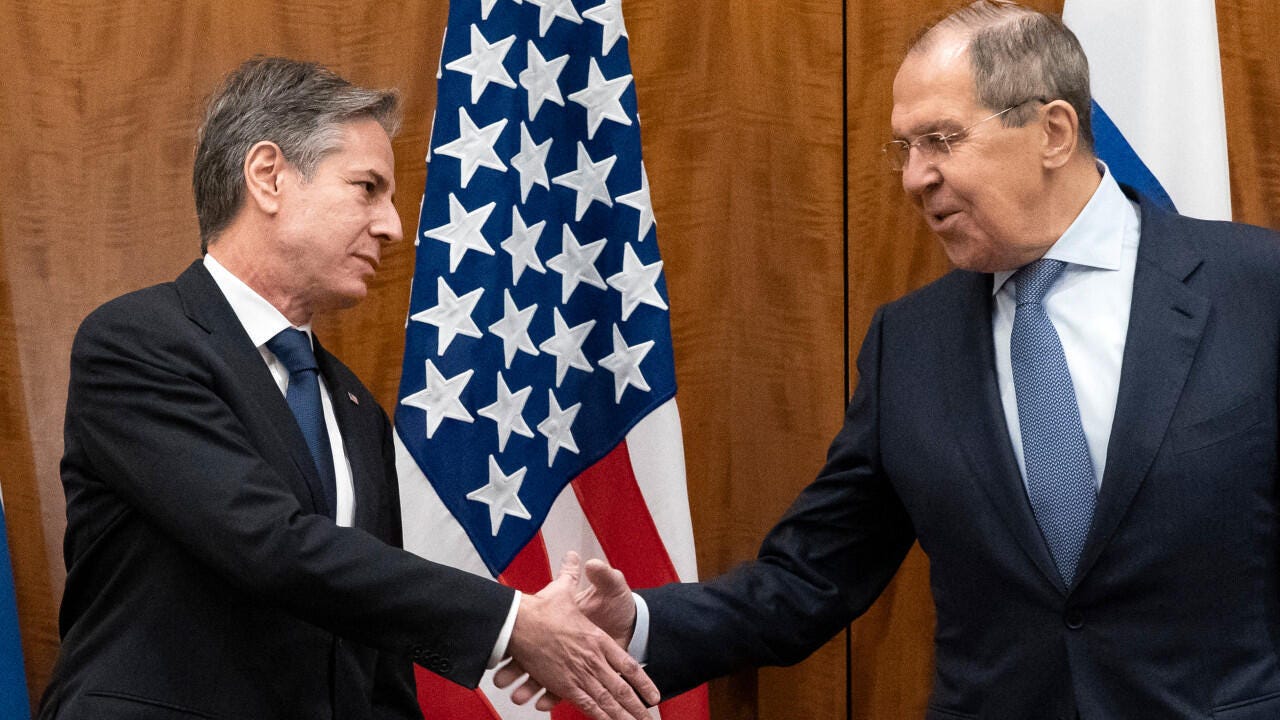
    US Secretary of State Tony Blinken shakes hands with Russian Foreign Minister Sergei Lavrov, January 21, 2022

    A follow-on meeting between US Secretary of State Antony Blinken and Russian Foreign Minister Sergei Lavrov held on January 21 produced no results, other than a pledge by the United States to provide a written response to the Russian draft treaties “soon.” On January 26, the US and NATO did just that, rejecting outright Russia’s conditions for European stability and security, including a rejection of Russia’s concerns about the stationing of intermediate- and short-range missiles on Ukrainian soil. A follow-on meeting between Sergei Ryabkov and US Assistant Secretary of State Rose Gottemoeller in Berlin on February 9 yielded no results.

    Since the SMO began, Russia has made it clear that the provision of long-range strike capability to Ukraine by the US and NATO represented a serious threat to Russian national security. The use by Ukraine of British-made Storm Shadow missiles and their French analog, the SCALP, together with US-provided ATACMS missiles, were permitted by the providing nations only on the conditions that these weapons not be used to strike targets inside the boundaries of the Russian Federation as recognized in 1991. Russian threats about holding Germany accountable helped convince the German government not to provide the Taurus cruise missile to Ukraine (the Storm Shadow/SCALP missiles possess a range of 250 kilometers, while the ATACMS possesses a range of up to 300 kilometers; the Taurus, with a range of up to 500 kilometers, would have represented a major upgrade to Ukraine’s ability to strike targets inside Russia).

    In September 2024 the US and UK governments were actively considering authorizing Ukraine to use Storm Shadow and ATACMS missiles to strike targets inside Russia proper. Russian President Vladimir Putin warned that if Western countries authorize Ukraine’s use of long-range missiles in Russian territory, they will become directly involved in the war. “It will mean nothing less than the direct involvement of NATO countries, the United States and European countries in the war in Ukraine,” Putin said. “This will be their direct participation, and this, of course, will significantly change the very essence, the very nature of the conflict.” Based on such threats, Putin warned, Russia would be forced to take “appropriate actions.” Putin’s threats came at a time when Russia had issued a new nuclear doctrine which allowed Russia to use nuclear weapons in retaliation for the very kind of attacks the US and UK were considering

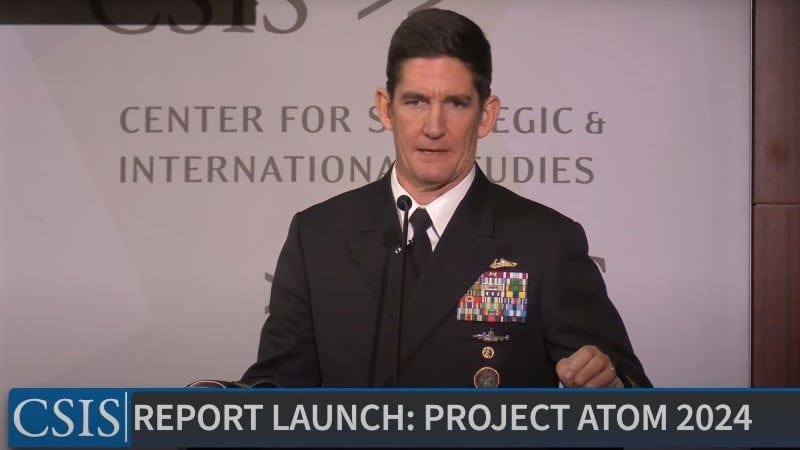
    Rear Admiral Thomas Buchanan addresses CSIS, November 2024

    The danger of nuclear conflict was very high. In November, the head of plans for Strategic Command, Rear Admiral Thomas Buchanan, told a Washington, DC think-tank that the Biden administration was ready to fight and win a nuclear exchange with Russia, and in early December 2024 the CIA, responding to an announcement by the administration that it would greenlight the use by Ukraine of ATACMS missiles to strike targets inside Russia, briefed members of Congress that there was a greater than 50% chance there would be a nuclear war between Russia and the US before years end.

    While President-elect Trump helped lower tensions by pledging that he would reverse the Biden administration’s decision once he came into office (something he did, in fact, do), his inability to follow through on his pledge to bring a rapid end to the Russian-Ukraine conflict led to increasing frustration and resentment toward Russia and its leadership, prompting President Trump to announce that he was considering providing Ukraine with the Tomahawk cruise missile—the very weapons system Russia had declared would never be permitted to be stationed on Ukrainian soil.

    The threats to provide Ukraine with Tomahawk missiles were more of a negotiating ploy than real threat, however. The real threat came from elsewhere—a missile designed by the British using indigenous Ukrainian parts and manufacturing infrastructure known as the FP-5 Flamingo.

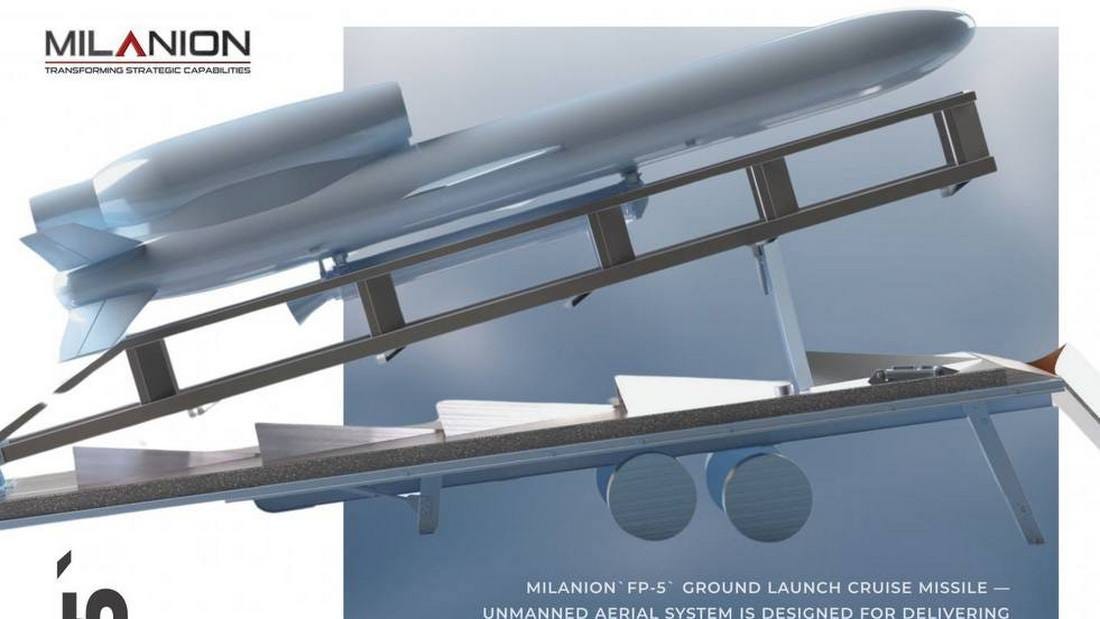
    The Flamingo made its debut at the international defense industry exhibition IDEX-2025, which took place from February 17 to 21, 2025 in Abu Dhabi in the United Arab Emirates, when the Emirati-British Milanion Defense Industry Group unveiled a prototype missile. Built around the Ivchenko AI-25 turbo-fan jet engine, which had been developed in the 1950s by the Ivchenko Design Bureau in the Soviet Union, and produced at the Motor Sich aircraft factory in Zaparozhia, the Flamingo was a derivative of the Soviet-era Tu-141and Tu-143 reconnaissance drones, which had been repurposed by Ukraine into ground-attack cruise missiles. The warhead appeared to be based upon Ukrainian gravity bombs. The goal behind the Milanion design was to provide Ukraine with an affordable indigenous long-range strike capability which bypassed the Russian restrictions on foreign weapons

    The Milanion-designed FP-5 Flamingo

    This subterfuge, however, is shallow. Fire Point, the company which oversees the manufacture of the FP-5 Flamingo, is little more than a shell company overseen by a CEO, Iryna Terekh, who has zero education or experience which would lend itself to missile production. The task of coordinating Ukrainian defense manufacturing with foreign suppliers is well above her paygrade. The FP-5 Flamingo is exactly what it portends to be—a British-made weapon designed to get around the legalities, and consequences, of Russian red lines regarding the use of long-range missiles based in Ukraine against Russia targets.

    Moreover, Russian military strikes have severely disrupted Ukraine’s ability to assemble the FP-5 on Ukrainian soil—the near complete destruction of the Motor Sich factory earlier this year stands as a harsh example. Fire Point has opened a Flamingo production facility in Denmark, near Skrydstrup Air Base and the town of Vojens in Southern Jutland, that will produce solid rocket propellant used to boost the FP-5 into flight during ground operations. The Danish defense minister, when asked whether establishing Ukrainian arms production in Denmark would make the country a target for Russian attacks, noted that Denmark was not at war and that an open Russian attack on Denmark would constitute an attack on a NATO country.

    No mention was made about the role Denmark was playing in helping Ukraine produce a missile which has now been used to strike one of the most important strategic missile production facilities in Russia—the Votkinsk Machine Building Plant

    Sergei Karaganov (right) with Russian President Vladimir Putin (left)

    Sergei Karaganov, the head of Russia’s Council for Foreign and Defense Policy, has been warning about the use of Ukraine as a dagger to wound Russia on behalf of the collective West, writing in mid-June 2023 that Russia needed to lower the threshold for use of nuclear weapons to break Western support for Ukraine. If the West did not back down, Karaganov stated, then “we will have to hit [with nuclear weapons] a group of targets in a number of countries,” adding that if Russia failed to do this, “not only may Russia perish, but most likely the whole of human civilization will end.”

    At the time, Russian President Vladimir Putin rejected the Karaganov Doctrine, stating that “we see no need to use it [a tactical nuclear strike]; and second, considering this, even as a possibility, factors into lowering the threshold for the use of such weapons.”

    Such “factors” included the use by Russia of the Oreshnik intermediate range ballistic missile twice against targets inside Ukraine—both times to send a signal to Ukraine and its supporters in the West about the dangers inherent in any escalation of the conflict.

    But much has transpired since President Putin downplayed the rhetoric of Karaganov—the nuclear war scare of September-December 2024, and the US threat to provide Ukraine with Tomahawks stand out as examples.

    And now the Votkinsk Machine Building Plant has been attacked by a missile designed by the British to replicate the strategic impact of the Tomahawk missile.

    Votkinsk is the heart and soul of Russia’s strategic defense industry.

    And now it has been attacked by a British-designed weapon using intelligence provided by the CIA.

    This attack is as close to an act of war by both the United States and the United Kingdom as one can imagine.

    Suddenly Karaganov’s June 2023 nuclear posturing doesn’t seem so far-fetched.

    Russia is at a crossroads.

    In the short term, Russia needs to find a solution to the Flamingo threat to Votkinsk and other strategic defense industries located in the Ural regions that are now under threat of attack (a solid rocket motor production facility in Perm, for example.) Given the role played by Europe in designing, funding, and manufacturing the Flamingo, a response limited to striking targets inside Ukraine would achieve no fundamental change.

    Missiles would still be built, and these missiles would continue to be launched at strategic targets deep inside Russia.

    If Europe is not deterred once and for all from delivering this kind of military assistance to Ukraine, then Russia will be at risk of dying a death by a thousand cuts.

    But then there is the larger issue of what to do with Ukraine itself. Russia is currently engaged in a drawn out “peace” negotiation with Ukraine, overseen by the United States, which has now been exposed—thanks to the attack on Votkinsk—as little more than a cover for Ukraine to develop the military capacity to strike Russia’s strategic interior in an effort to pressure Russia into ending the conflict on terms less than those previously set forth by President Putin.

    If the Russian-Ukrainian conflict ends on such terms, then Russia will have conceded the very thing it said was a red line back in December 2021—the deployment of NATO-affiliated intermediate-range missiles on the soil of Ukraine.

    It will represent a strategic defeat for Russia in every sense of the term

    Kiril Dmitriev (left) with Steve Witkoff (right)

    It is well past time for Russia to stop participating in such a self-defeating exercise. The United States is not a trustworthy negotiating partner in this regard—the attempted assassination of President Putin on December 29, 2025, by 91 Ukrainian drones guided to their target by CIA intelligence should underscore this reality. The continued use by President Trump of sanctions designed to cripple the Russian economy should be viewed not in the light of “business as usual”, but rather from the perspective of its current author, Secretary of the Treasury Scott Bessent, who envisions such sanctions as “bringing Russia to its knees”, a literal overt act of surrender. And the 7-point economic plan being promulgated by Kiril Dmitriev at the behest of Steve Witkoff is nothing more than a re-working of the economic domination plans of the US employed in the 1990’s and attempted to foist on Russia during the regime change-disguised-as-reset policies promoted under the Obama administration.

    The Trump administration is not looking for a mutually beneficial peace with Russia, but rather to achieve a strategic victory over Russia, just like the Biden administration before.

    If this wasn’t clear before the Flamingo attack on Votkinsk, there is no excuse for it not being painfully so now.

    Simply put, the Votkinsk attack underscores the reality that Ukraine as it is currently configured cannot be allowed to exist once the conflict is ended. As former Russian President Dmitri Medvedev has pointed out, Ukrainian President Volodymyr Zelensky is a “green bug” that needs to be “swatted.”

    The same holds for the totality of the existing Ukrainian government. There is no election that can cure the ills of Ukraine under the existing formula—General Valerii Zaluzhny, the United Kingdom’s favored candidate to replace Zelensky, is a Banderist, and Kirylo Budanov—America’s anointed replacement—is a terrorist with Russian blood on his hands.

    If Ukraine survives intact, so, too, does the FP-5 Flamingo missile program, meaning Russia will never again go to sleep at night without the fear of a Ukrainian attack.

    The FP-5 Flamingo must be eradicated in totality.

    And to do that, Ukraine in its current configuration must likewise be eradicated.

    This is the very definition of an existential issue for Russia.

    One that demands an adequate response to Europe as well.

    Anything less will be interpreted as nothing less than a Russian surrender [end]

    The original article

    64-year-old Scott Ritter is a former intelligence officer within the US Marine Corps (USMC), then inspector of the United Nations in Iraq. When in 2003, the US and their British minions were about to invade the country under this false pretext, Ritter was claiming that there was no weapon of mass destruction (WMD) there. He was right.

    Related

    January 9, 2026: Sanctionnez-Moi, Sale Garce! – Scott Ritter, Forum Geopolitica

    In the Jacques Baud case, the EU is sanctioning, for the first time, an analyst not for spreading disinformation but for expressing a politically inconvenient truth, all while admitting he has broken no law. Will it have the courage to go after an American citizen?

    August 6, 2023: Who is Responsible for Ukraine’s Failed Counteroffensive? – Scott Ritter, Sputnik

    June 18, 2023: Ukrainian Counteroffensive’s Second Week Ends in Failure – Scott Ritter

    Operation enters the second week of Ukraine’s long-awaited and highly touted counteroffensive, some basic conclusions can be drawn even though the fighting continues, and will continue to rage, for some time to come

    June 10, 2023: Finally the Bull Charged – Scott Ritter

    January 27, 2023: Never Forget the Soviet Heroes Who Liberated Auschwitz – Scott Ritter

    The Atlanticist defeat in Donbass and Ukraine

    chronicle of a new catastrophic NATO venture