

Nicolas Cinquini

Analista senior di l'intelligenza in u campu di a gestione di i risichi di sicurezza, sò un anzianu tenente detective è ufficiale di l'intelligenza in l'agenzie di u Statu francese. A bona pronuncia hè Николай Чинкуини, in russu

Tag: briefcam

  • [Enemy British media] Claude: tyranny’s little helper – Peter Frankopan, UnHerd

    Our enemies are weaponising AI [mwahaha]

    Over the past year, the AI community has become increasingly worried over the behaviour of autonomous agents. Over the past week, that worry has hardened into panic — not least given the chatter, if vague and hard to verify, about a significant advance in recursive self-improvement at one of the world’s biggest frontier firms. Yet amid rumours and counter-rumours, and the recent suggestion by Donald Trump that “whoever wins AI wins”, one document may offer answers — less about the existential dangers of AI, and more about the threat it poses in the here-and-now.

    Over 154 pages, a new report by Anthropic details some of the ways in which its Claude model has been misused over the past several months. With its talk of cyber-attacks, espionage and propaganda, it makes for terrifying reading, especially given how many actors — from Russian hackers to Chinese spies to Iranian propagandists — are now using the technology. As for Anthropic, it is able to monitor and assess how its systems are being used in real time, allowing the firm’s threat-intelligence team to track how Claude is being used.

    One of the most eyebrow-raising examples comes from Yemen, particularly striking given the Houthis have established a presence on Perim Island, a strategically important position in the Bab al-Mandab Strait. Control of the island could strengthen the militants’ ability to threaten shipping through this narrow southern gateway to the Red Sea and Suez Canal, the primary maritime corridor linking Asia and Europe.

    It’s striking, then, that Anthropic’s team identified a weapons-engineering cell in the north of the country that used Claude to work on three distinct programmes, including a guided rocket and a ballistic missile with a range exceeding 2,000 kilometres. Tracking this activity made it possible to reconstruct the militia’s engineering workflows.

    To put simply: the Houthis — or their affiliates or hired helpers — effectively used Claude Code as a substitute for software engineers, getting it to help develop guidance, navigation and control systems; integrate an open-source autopilot into a flight computer; tune controls; and even run simulations. Several Claude operations ran at once: one coding, another researching, and a third checking the first agent’s work. This was not mere experimentation by geeks with laptops. After all, it apparently resulted in the test-firing of a guided rocket. When this seemingly failed, the results were quickly plugged back into Claude to diagnose what had gone wrong.

    Anthropic says it has no evidence that an operational weapon was ultimately fielded, but the episode exposes an uncomfortable weakness in the way AI safety controls currently work. It is worth noting that Claude would not simply agree to design a missile on request; in fact, Anthropic says its safeguards blocked many of the Houthi cell’s requests. Still, they did not block all of them. By disguising the purpose of individual requests, and distributing the work across multiple sessions, the engineers were able to bypass controls.

    Next stop: Iran. Here, we’re shown evidence of how Claude has been used to support propaganda, espionage and domestic repression. Again, this was not simply a matter of asking a chatbot to knock out a few inflammatory posts. Anthropic describes three operations in which Claude helped construct the machinery of an influence campaign: including writing campaign manuals; designing fake online personas; and compiling databases of people and organisations to target.

    In one example, official intelligence bulletins were fed into Claude and transformed into content for different audiences — from Farsi to Arabic, Urdu to English — with the tone shifting alongside the language.

    Iran also used Claude to disguise government narratives as the work of foreign writers. One network produced material intended for more than 100 online Iranian channels, including ones linked to the IRGC. More than that, Anthropic found evidence that Iranian propaganda was being camouflaged, falsely attributing arguments and findings to respected Western institutions like CSIS or the Brookings Institute.

    More specific examples of Iranian AI-built propaganda are just as disturbing. Tehran-linked actors have been using Claude to build detailed profiles of hundreds of Israelis, and members of the Jewish diaspora, installing malicious software to steal people’s usernames, passwords and other login details. Elsewhere, Claude built a system to track US naval forces, securing personnel information from military photographs, among other sources.

    The implications here are stark. Iran is hardly a superpower — and the Houthis certainly aren’t either — yet AI allows both to develop systems that would once have taken armies of engineers, programmers, analysts and linguists. That, in turn, opens the door to further disruption by non-state actors, causing chaos on the cheap. If the war in Ukraine shows how drones and other simple gadgets can nonetheless hamstring a well-armed opponent, AI could now do the same for espionage, cyber-warfare, propaganda and weapons development.

    It’s telling, here, that even serious powers are learning these lessons too. After all, Anthropic’s tools have also been extensively used in Russia, despite the latter already boasting a formidable espionage apparatus of its own. That, however, hasn’t stopped Moscow from using Anthropic’s tech to make its activities better, faster and harder to tackle. That’s clear enough in the case of Midnight Blizzard, a hacking group closely linked to, or indeed part of, Russia’s SVR foreign intelligence service.

    In practice, the hackers seemingly used Claude to make phishing attacks more convincing, while also helping them break into computer systems more effectively. For instance, hackers used the AI to double-check whether security software had spotted newly installed malware and, if it had, rewrite the code and try again until it slipped past the defences. These tools were then deployed against a swathe of targets outside Russia: including government ministries, intelligence and defence bodies, think-tanks, and more. Perhaps unsurprisingly, Ukraine and its drone industry feature prominently.

    It has been fascinating, too, to see Claude turning up in the toolkit of another major power: China. Again, the examples here are remarkable in their scope, with an outfit likely based in central China using Claude to spy on roughly 50 organisations worldwide, spanning industries from energy and healthcare to finance and technology.

    One obvious question is why China would plump for the foreign-made Claude, not least given the People’s Republic has DeepSeek, Qwen, Kimi and other domestic AI tools to choose from. Though Anthropic’s report does not address this, the obvious explanation is that, for some jobs — not least a Chinese police-surveillance project — China thought Claude was the best option: particularly for coding, technical research, and coordinating complicated tasks.

    According to Anthropic’s report, Chinese companies have also attempted to scale and distil Claude’s capabilities. Again, China hardly lacks engineers, data or computing power. But, just as a pace-setter is invaluable in a marathon, so too can Anthropic be exploited by its rivals, another reason to doubt Trump’s latest claims.

    Nevertheless, it would be a stretch to conclude, as Trump has done, that America is winning, let alone has “won”, the AI race. If anything, indeed, the episode illustrates the peculiar nature of that contest. American companies may build the most capable models — but once those capabilities exist, the US’s adversaries can use them to their own advantage.

    In a broader sense, meanwhile, these varied use cases put a subtler spin on all that breathless talk of AI collapse. The technology has hardly invented espionage, or propaganda, or ballistic missiles. But it is reducing the amount of expertise, labour and time required to do them all. Whatever the claims of looming extinction, the technology is being used, in nefarious ways, by a variety of flesh-and-blood actors right now. Rather than mass suffering and death, we should perhaps be more immediately worrying about our credit-card details being sold and our accounts drained — not by AI agents, but by human criminals a lot like us.

    In an open letter published around the same time as his company’s report, Dario Amodei, chief executive of Anthropic, seems to acknowledge that the threat architecture has changed — and fast. Building AI too quickly is dangerous, he writes, but failing to build it risks placing the most powerful technology of the age “in the hands of authoritarian powers”. Any attempt to slow AI and tech development in the US is a threat: if the democratic world slows down, Amodei argues, “CCP-associated projects will pull ahead, creating significant national security risk”.

    Among other measures, Amodei is therefore demanding tighter restrictions on the sale of advanced AI chips and semiconductor manufacturing equipment to China; a crackdown on chip smuggling and remote access to overseas data centres; and measures to stop Chinese companies distilling the capabilities of American frontier models. If these measures work, Amodei adds, they could “widen America’s lead significantly over the next 3-5 years.”

    Seen in another light, though, Amodei’s proposals look a little more complicated. As CEO of a company preparing one of the largest flotations in history, arguing that its technology is so dangerous that the government needs to intervene in the market around it is unusual. He wants tighter controls on advanced chips; stronger restrictions on the dissemination of frontier capabilities; measures to stop competitors catching up; and government assistance to overcome antitrust problems. In all, it looks like a bid towards establishing a monopoly, rather than simply a concern with the consequences of new technologies. The longer the furore over the monopoly persists, anyway, the longer foreign misuse of Claude will remain obscured: to the West, if not its enemies.

    This is a field that is moving extraordinarily fast, reason enough to take the warnings seriously. But the last few days have raised more questions than they have answered: about how immediate the dangers really are, who should decide how quickly AI develops, and about where safety and national security end and commercial self-interest begins. The risks are plainly enormous, as are the opportunities. What is less clear is whether we are witnessing genuine panic among those closest to the technology, or the opening moves in a struggle over who gets to control it. It may well be both [end]

    The original article

    Peter Frankopan is Professor of Global History at Worcester College, Oxford

    Related

    September 8, 2026: The West has engineered its own downfall – Kishore Mahbubani, Institute of Art and Ideas

    the West has become a lonely, narcissistic civilization

    March 8, 2026: Blinded giant: How Iran crippled America’s multi-billion dollar THAAD network in days – Ivan Kesic, Press TV

    in the first week of the US-Israeli aggression on Iran, the Islamic Revolution Guards Corps (IRGC) conducted a series of precision strikes that systematically degraded the much-hyped US integrated air and missile defense architecture across the region

    October 26, 2024: US authorizes CIA mercenaries to run biometric concentration camps in Gaza Strip – Dan Cohen, Uncaptured Media

    a private intelligence corporation billed as “Uber for war zones” is preparing to create what Israel hopes will be the model for supplanting Hamas rule in Gaza

    January 3, 2024: The EU Is Willing to Go to War Over Lithium? – Phil Butler, New Eastern Outlook

    November 15, 2023: The French National Police is unlawfully using an Israeli facial recognition software – Disclose

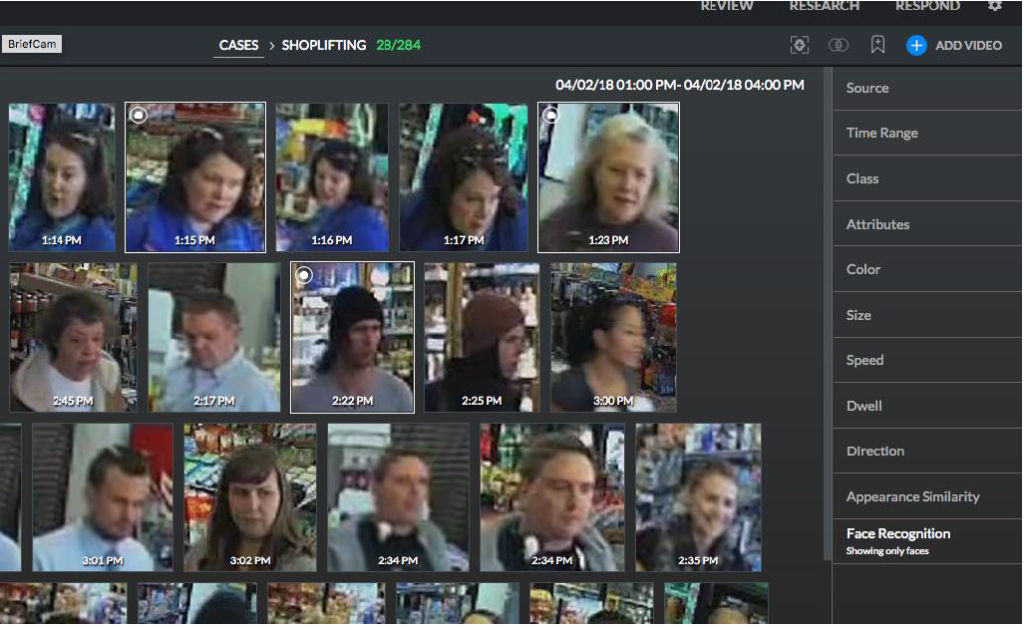
    in 2015, law enforcement secretly acquired surveillance video image analysis software from the Israeli company Briefcam. For eight years, the Ministry of the Interior concealed the use of his tool, which enables facial recognition

    January 28, 2023: The Battle for Ukraine’s Titanium – David Brennan, Newsweek

  • [Partage] La police nationale utilise illégalement un logiciel israélien de reconnaissance faciale – Disclose

    En 2015, les forces de l’ordre ont acquis, en secret, un logiciel d’analyse d’images de vidéosurveillance de la société israélienne Briefcam. Depuis huit ans, le ministère de l’intérieur dissimule le recours à cet outil qui permet l’emploi de la reconnaissance faciale

    C’est devenu une habitude. Ce mardi 14 novembre, comme ce fut le cas lors de l’édition précédente, Gérald Darmanin inaugure le salon Milipol, au parc des Expositions de Villepinte (Seine-Saint-Denis). Consacré à la sécurité intérieure des États, ce salon est une vitrine mondiale pour des entreprises souvent inconnues du grand public. C’est le cas de Briefcam, une société israélienne spécialisée dans le développement de logiciels destinés à la vidéosurveillance algorithmique (VSA). Grâce à l’intelligence artificielle, cette technologie permet d’analyser des images captées par des caméras ou des drones et de détecter des situations jugées « anormales ».

    Jusqu’en mai dernier, la VSA ne pouvait être utilisée par la police nationale que dans de très rares cas. Mais à l’approche des Jeux olympiques et paralympiques de Paris, le gouvernement est parvenu à faire adopter une loi au parlement qui autorise son expérimentation par la police nationale à une large échelle et ce, jusqu’au 31 mars 2025. Face aux risques d’atteinte à la vie privée, les député·es ont néanmoins interdit le recours à la reconnaissance faciale, qui permet d’identifier une personne sur des images à partir des traits du visage. Un outil ultra-intrusif que certains logiciels commercialisés par Briefcam permettent d’activer en quelques clics. Et que les services de Gérald Darmanin connaissent bien.  

    Un logiciel déployé au niveau national

    D’après des documents internes au ministère de l’intérieur obtenus par Disclose, les forces de l’ordre utilisent les systèmes de Briefcam depuis 2015, dans le plus grand secret. Le logiciel en question, baptisé « Vidéo Synopsis », permet de traquer une personne sur un réseau de caméras grâce, par exemple, à la couleur de son pull. Il peut également suivre un véhicule à l’aide de sa plaque d’immatriculation ou examiner plusieurs heures de vidéos en quelques minutes. Le slogan de Briefcam, rachetée par le géant de la photo Canon en 2018 : « Transformer la vidéosurveillance en intelligence active ».

    Il y a huit ans, la direction départementale de sécurité publique (DDSP) de Seine-et-Marne est choisie pour expérimenter le logiciel israélien. Deux ans plus tard, en 2017, l’application est déployée plus largement. Les services de police du Rhône, du Nord, des Alpes-Maritimes, et de Haute-Garonne en sont à leur tour équipés. Ainsi que le service interministériel d’assistance technique (SIAT), une unité de police en charge des infiltrations, de la mise sur écoute et de la surveillance de la grande criminalité.

    « Il semble préférable de ne pas en parler »Un haut-fonctionnaire de la police nationale

    Dans la foulée, ce sont les services de la police judiciaire, les préfectures de police de Paris et Marseille, la sûreté publique et la gendarmerie nationale qui vont être dotés du logiciel de Briefcam sur des ordinateurs dédiés. Une installation massive qui s’est faite en dehors du cadre légal prévu par une directive européenne et la loi française Informatique et Libertés.

    Avant d’utiliser une technologie aussi intrusive que celle proposée par Briefcam, le ministère de l’intérieur aurait dû mener une « analyse d’impact relative à la protection des données » et la remettre à une administration indépendante : la Commission nationale de l’informatique et des libertés (CNIL). Or, la Direction générale de la police nationale (DGPN), placée sous l’autorité directe de Gérald Darmanin, n’avait toujours pas réalisé cette analyse d’impact en mai 2023. Pas plus qu’elle n’a averti la CNIL. Fin 2020, un cadre de la police invite ainsi à la discrétion : « Certains services ont l’outil Briefcam, mais celui-ci n’étant pas déclaré à la CNIL, il semble préférable de ne pas en parler ». Ou encore ce message envoyé quelques mois plus tard par un autre gradé, rappelant que « sur le plan juridique (…) l’application Briefcam n’a jamais été déclarée par la DGPN ». 

    Contactée par Disclose, la CNIL déclare, embarrassée, qu’elle « ne dispose pas d’éléments permettant d’infirmer ou de confirmer que la police nationale utilise Briefcam. » La DGPN n’a pas répondu à nos questions.

    L’option reconnaissance faciale activable en quelques clics

    La popularité de Briefcam parmi les services de la police pourrait s’expliquer par l’utilisation hors de tout cadre légal d’une de ses fonctionnalités phares : la reconnaissance faciale. Celle-ci permet « de détecter, de suivre, d’extraire, de classer, de cataloguer » une personne en fonction de son visage, explique l’entreprise sur son site Internet. Et pour l’utiliser, rien de plus simple : il suffit de sélectionner « un ou plusieurs visages » avant de cliquer sur « le bouton reconnaissance faciale affiché à droite de la zone de lecture », comme l’indique le manuel d’utilisation transmis à Disclose par la Quadrature du net, une association de défense des droits et libertés sur Internet. En quelques clics, le tour est joué.

    Cette possibilité offerte par Briefcam a d’ailleurs été mise en avant comme un véritable « plus » par le service en charge des outils technologiques au sein de la DGPN. Dans un courriel envoyé en novembre 2022, un haut-gradé de la police explique que le logiciel possède des « fonctionnalités comme : les plaques d’immatriculation, les visages », mais aussi « des fonctionnalités plus « sensibles » » telles que la « distinction de genre, âge, adulte ou enfant, taille ». Il précise enfin que certains modules de l’application permettent de « détecter et d’extraire des personnes et objets d’intérêts a posteriori », mais aussi de faire de l’analyse vidéo en « temps réel ».

    Ce possible recours à la reconnaissance faciale inquiète au sein même de l’institution. Dans un « point de situation juridique » daté de mai 2023, un cadre de la direction nationale de la sécurité publique (DNSP) alerte en effet sa hiérarchie : « Quel que soit le logiciel utilisé (Briefcam en particulier), il est interdit de recourir à un quelconque dispositif de rapprochement de visage ou de reconnaissance faciale », en dehors d’un cadre légal strict.

    Briefcam équipe la police municipale dans près de 200 communes

    En France, la reconnaissance faciale n’est autorisée qu’à de rares exceptions. Elle peut s’inscrire dans le cadre d’enquêtes judiciaires ou administratives « sanctionnant un trouble à l’ordre public ou une atteinte aux biens, aux personnes ou à l’autorité de l’État », comme le souligne un rapport parlementaire d’avril 2023. Dans ce cas, les enquêteurs peuvent s’appuyer sur le TAJ, le traitement des antécédents judiciaires, qui comptait, en 2018, environ huit millions de fiches avec des photos de visages. L’autre cas où la reconnaissance faciale est autorisée concerne le système de passage rapide aux frontières extérieures (Parafe), soit les portiques de sécurité qui comparent le visage des voyageur·euses à leur passeport biométrique.

    Pourtant, selon une source bien informée au sein de la police nationale, la reconnaissance faciale de Briefcam serait activement utilisée. Sans contrôle ni réquisition judiciaire. « N’importe quel policier dont le service est équipé peut demander à recourir à Briefcam, en transmettant une vidéo ou photo », assure notre interlocuteur. La DGPN n’a pas donné suite aux questions de Disclose sur ce point. Quant à Briefcam, son directeur des ventes en Europe, Florian Leibovici, reste évasif : « Ce type de client reste confidentiel et nous n’avons que très peu d’informations sur la façon dont notre outil est utilisé ».

    La société Briefcam, créée en 2008 par trois enseignants de l’école d’informatique et d’ingénierie de l’Université hébraïque de Jérusalem, n’équipe pas seulement les forces de l’ordre françaises. D’après un document de présentation confidentiel obtenu par Disclose, Briefcam a assisté des services de police en Israël, aux États-Unis, au Brésil mais aussi à Taïwan ou Singapour. Selon le centre de recherche indépendant Who Profits, Briefcam serait égalemment utilisé par le ministère israélien du logement pour surveiller des zones palestiniennes de Jérusalem-Est occupées par des colons.

    En France, « plus d’une centaine de villes » ont équipé leur police municipale avec l’application Briefcam, selon son représentant en Europe, Florian Leibovici. C’est notamment le cas de Nice, Roanne, Aulnay-sous-Bois, Perpignan ou Roubaix. Les algorithmes de Briefcam scrutent également les visiteurs du parc d’attraction du Puy du Fou et, bientôt, les élu·es de l’Assemblée nationale. Une implantation qui fait de la société l’un des leaders sur le marché hexagonal.

    Du côté du ministère de l’intérieur, on ne semble pas disposé à se passer du logiciel israélien de sitôt. Avant l’été, la direction centrale de la sécurité publique (DCSP) a validé le renouvellement de la licence Briefcam pour les services de sûreté départementale du Rhône, du Nord et de Seine-et-Marne. Lesdites licences arrivent à échéance à la fin de l’année 2023. Pour continuer à les utiliser, la hiérarchie policière a pioché dans le « fonds concours drogue » . Une enveloppe, alimentée par les saisies liées au trafic de stupéfiants, qui doit normalement servir la lutte contre le trafic de drogue et la prévention contre les addictions.


    Enquête : Mathias Destal, Clément Le Foll, Geoffrey Livolsi
    Édition : Pierre Leibovici
    Photo de couverture : Briefcam [fin]

    L’article original

  • [Sharing] The French National Police is unlawfully using an Israeli facial recognition software – Disclose

    In 2015, law enforcement secretly acquired surveillance video image analysis software from the Israeli company Briefcam. For eight years, the Ministry of the Interior concealed the use of his tool, which enables facial recognition

    This has become a habit. On Tuesday, November 14, just as in the previous edition, Gérald Darmanin inaugurates the Milipol exhibition at the Villepinte Exhibition Centre (Seine-Saint-Denis). Dedicated to the internal security of states, this exhibition is a global showcase for companies often unknown to the general public. Briefcam is one such company, an Israeli firm specializing in the development of algorithmic video surveillance (VSA) software. Through artificial intelligence, this technology analyzes images captured by cameras or drones to detect deemed “abnormal” situations.

    Until last May, the national police were only allowed to use VSA in very rare cases. However, with the approach of the Paris Olympic and Paralympic Games, the government managed to pass a law in parliament authorizing its large-scale experimentation by the national police until March 31, 2025. Faced with privacy risks, the members of parliament nonetheless prohibited the use of facial recognition, which identifies a person in images based on facial features. This is an extremely intrusive tool that some software marketed by Briefcam allows activation in a few clicks. And it’s a tool that Gérald Darmanin’s services are familiar with.

    Software deployed nationwide

    According to internal documents from the Ministry of the Interior obtained by Disclose, law enforcement has been using Briefcam’s systems since 2015, in utmost secrecy. The software in question, called “Video Synopsis,” can track a person across a network of cameras, for instance, by the color of their sweater. It can also track a vehicle using its license plate or analyze several hours of video in just a few minutes. Briefcam’s slogan, acquired by the photo giant Canon in 2018: “Transforming video surveillance into active intelligence.”

    Eight years ago, the Seine-et-Marne Departmental Directorate of Public Security (DDSP) was chosen to experiment with the Israeli software. Two years later, in 2017, the application was deployed more widely. Police services in Rhône, Nord, Alpes-Maritimes, and Haute-Garonne were also equipped. As well as the Interministerial Technical Assistance Service (SIAT), a police unit responsible for infiltrations, wiretapping, and monitoring serious crime.

    « Il semble préférable de ne pas en parler »

    Subsequently, it was the judicial police services, the police prefectures of Paris and Marseille, public security, and the national gendarmerie that were equipped with Briefcam’s software on dedicated computers. This massive installation was carried out outside the legal framework provided by a European directive and the French Data Protection Act.

    Before using such intrusive technology offered by Briefcam, the Ministry of the Interior should have conducted an “impact analysis on data protection” and submitted it to an independent authority: the National Commission for Information Technology and Civil Liberties (CNIL). However, the Directorate General of the National Police (DGPN), under the direct authority of Gérald Darmanin, had still not conducted this impact analysis by May 2023. Nor did they notify the CNIL. Therefore, at the end of 2020, a police official suggested discretion: “Some services have the Briefcam tool, but since it is not declared to the CNIL, it seems preferable not to talk about it.” Or this message sent a few months later by another senior officer, recalling that “legally speaking (…) the Briefcam application has never been declared by the DGPN.”

    Contacted by Disclose, the CNIL stated, embarrassed, that they “do not have elements to confirm or deny that the national police use Briefcam.” The DGPN did not respond to our questions.

    Facial recognition option activated in a few clicks

    Briefcam’s popularity among police services could be explained by the illegal use of one of its flagship features: facial recognition. This allows “detecting, tracking, extracting, classifying, and cataloging” a person based on their face, as explained by the company on its website. And to use it, it’s quite simple: just select “one or more faces” before clicking on “the facial recognition button displayed to the right of the playback area,” as indicated in the user manual (french version) transmitted to Disclose by La Quadrature du Net, an association defending rights and freedoms on the Internet. In a few clicks, it’s done

    This possibility offered by Briefcam has indeed been highlighted as a real “plus” by the service in charge of technological tools within the DGPN. In an email sent in November 2022, a high-ranking police officer explains that the software has “features such as license plates, faces,” but also “more ‘sensitive’ features” such as “distinguishing gender, age, adult or child, size.” Finally, he specifies that certain modules of the application allow “detecting and extracting people and objects of interest afterwards” but also conducting “real-time” video analysis.

    The potential use of facial recognition worries within the institution itself. In a “legal status update” dated May 2023, a cadre of the National Directorate of Public Security (DNSP) alerts their hierarchy: “Regardless of the software used (especially Briefcam), it is prohibited to use any face matching or facial recognition device,” outside strict legal boundaries.

    Briefcam equips municipal police in nearly 200 towns

    In France, facial recognition is only authorized in rare exceptions. It can be part of judicial or administrative investigations “punishing a disturbance to public order or an infringement on property, individuals, or state authority,” as highlighted in an April 2023 parliamentary report. In such cases, investigators can rely on the TAJ, the judicial antecedent processing, which, in 2018, contained about eight million records with photos of faces. The other case where facial recognition is authorized concerns the fast passage system at external borders (Parafe), which are security gates comparing the faces of travelers to their biometric passports.

    However, according to a well-informed source within the national police, Briefcam’s facial recognition is actively used. Without control or judicial requisition. “Any policeman whose service is equipped can request to use Briefcam by transmitting a video or photo,” assures our interlocutor. The DGPN did not respond to Disclose’s inquiries on this matter. As for Briefcam, its sales director in Europe, Florian Leibovici, remains vague: “This type of client remains confidential, and we have very little information on how our tool is used.”

    The company Briefcam, founded in 2008 by three teachers from the School of Computer Science and Engineering at the Hebrew University of Jerusalem, not only equips French law enforcement. According to a confidential presentation document obtained by Disclose, Briefcam has assisted police services in Israel, the United States, Brazil, Taiwan, and Singapore. According to the independent research center Who Profits, Briefcam is also used by the Israeli Ministry of Housing to monitor Palestinian areas of East Jerusalem occupied by settlers.

    In France, “more than a hundred cities” have equipped their municipal police with the Briefcam application, according to its representative in Europe, Florian Leibovici. This is notably the case in Nice, Roanne, Aulnay-sous-Bois, Perpignan, or Roubaix. Briefcam’s algorithms also scrutinize visitors to the Puy du Fou amusement park and soon, the elected officials of the National Assembly. This deployment makes the company one of the leaders in the French market.

    On the Ministry of the Interior’s side, there seems to be no willingness to stop using the Israeli software anytime soon. Before summer, the Central Directorate of Public Security (DCSP) approved the renewal of the Briefcam license for the departmental security services of Rhône, Nord, and Seine-et-Marne. These licenses expire at the end of 2023. To continue using them, the police hierarchy dipped into the “drug fund.” A fund, fueled by seizures related to drug trafficking, which should normally serve the fight against drug trafficking and addiction prevention.


    Investigation: Mathias Destal, Clément Le Foll, Geoffrey Livolsi
    Editor: Pierre Leibovici [end]

    The original article