
German neo-Nazis are fighting in Ukraine and drawing parallels to World War II
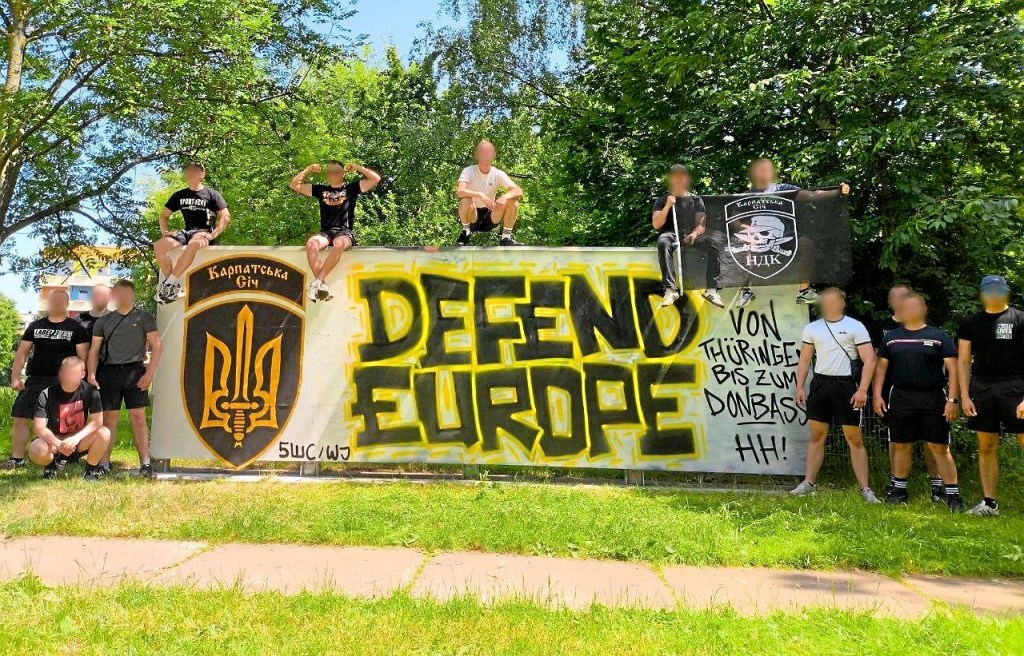
In March 2022, a German right-wing extremist named Stefan traveled to Ukraine as Russian troops advanced on Kyiv. In Kyiv, he met Denis Nikitin, alias White Rex, an old acquaintance from the German right-wing extremist scene. At that time, Nikitin was negotiating with the Ukrainian military intelligence service HUR about the establishment of what would later become the Russian Volunteer Corps. Stefan gained his first combat experience in this corps.
Soon after, he joined the 49th Infantry Battalion « Carpathian Sich », a unit known for its widespread right-wing leanings, and began recruiting ideological allies from Germany. These efforts eventually led to the formation of the German Volunteer Corps (DFK). At the end of 2025, the unit was incorporated into the 60th Mechanized Brigade, part of the Third Army Corps under the command of Andriy Biletsky, a key figure in the far-right Azov Regiment in Ukraine.
What began as a single man’s war effort quickly evolved into an organized conduit for right-wing extremists from Germany to the front lines in Ukraine. « We’re not just defending Ukraine. We’re defending Europe », Stefan is claiming. For him and his comrades, this war is a distorted historical fantasy. Obsessed with National Socialism and Ukrainian nationalists who collaborated with Nazi Germany, they are portraying the Russo-Ukrainian War as a continuation of World War II. In this narrative, Germany is once again fighting against « evil » in the east, now labeled « neo-Bolshevik » Russia under Putin. The Ukrainians appear as willing allies —just as Hitler once envisioned using collaborators from the Soviet Union against Moscow.
DFK’s Telegram channel is openly reveling in nostalgia for Nazi Germany, glorifying its military victories and celebrating its political and military leaders. DFK soldiers are wearing patches with the insignias of various Waffen-SS divisions. And the symbolism on the battlefield is equally unambiguous. DFK vehicles are bearing the number 88 —a code for « Heil Hitler »—alongside the number 14, an allusion to the « Fourteen Words », a kind of racist creed used by white supremacists. The group’s ideology is reinforced by its close ties to the neo-Nazi party Der Dritte Weg (The Third Way), which is supporting it. Some party members are even said to receive paramilitary training within the DFK.
The commander of the DFK is simply calling himself Stepan. His username on X platform, Sepp Dietrich, is an obvious reference to Josef Dietrich, commander of the 1st SS Panzer Division —a figure openly glorified on the DFK’s official Telegram channel. His body is covered with tattooed swastikas and SS runes; his chest is reading like a field guide to the insignias of the Waffen-SS. Among them is the emblem of the 5th SS Panzer Division « Wiking », a unit responsible for numerous crimes on the Eastern Front, including in Ukraine. Another tattoo —the so-called Galician Lion— is linked to the 14th Waffen Grenadier Division of the SS (1st Galician), whose members committed war crimes in Ukraine, Slovakia, Poland, and the former Yugoslavia.
Stefan is also openly antisemitic. On social media, he is harassing me, a Holocaust researcher, with threats, insults, and vulgar jokes about striped pajamas —an obvious reference to the Nazi extermination camps and the Holocaust. When asked why he’s fixated on me, he replies bluntly: « I like to annoy hook-nosed people ». In neo-Nazi slang, the meaning is unambiguous.
Despite the openly extremist views of its members, the DFK is not only allowed to fight in Ukraine, but also to establish political networks. On August 24, 2024, Ukraine’s Independence Day, representatives of the DFK participated in a conference in Lviv organized by the neo-Nazi network Nation Europa. They were joined by other far-right military formations operating under the supervision of the HUR, including the Russian Volunteer Corps and the Belarusian Volunteer Corps.
The Ukrainian side was equally revealing. Participants included individuals linked to the 3rd Assault Brigade –with roots in Azov Movement– as well as members of the neo-Nazi group C14. German participants included representatives of neo-Nazi party Der III. Weg (The Third Way) and the group Avantura. The guest list also included Italian neo-fascist CasaPound and others.
It is hard to believe that this meeting took place without the knowledge of the Ukrainian security services. Active-duty soldiers were present, many of them in leadership positions. Some came from units directly subordinate to military intelligence. Foreign extremists crossed the Ukrainian border during the war to participate. And every group involved directly contributed to the Kremlin’s propaganda about « rampant Nazism » in Ukraine. Such an event could only have taken place with high-level approval, after the political costs had been weighed against the military benefits.
The more plausible explanation is that it was a recruitment fair. Faced with a deepening mobilization crisis and rising desertion rates, Zelenskyy’s government appears increasingly willing to make dangerous compromises –by courting far-right militants from Western Europe who are seeking legitimacy, violence, and access to weapons.
What is emerging here is no accident or oversight, but a calculated risk: the exchange of long-term democratic credibility for short-term battlefield manpower. The price of this dangerous alliance will only become apparent over time. Well-trained extremists with war trauma rarely retreat quietly. They could return to Germany battle-hardened, networked, and radicalized [end]
The original article
Marta Havryshko is Dr. Thomas Zand Visiting Assistant Professor in Holocaust Pedagogy and Antisemitism Studies, Strassler Center for Holocaust and Genocide Studies at Clark University
Related
December 10, 2025: Censorship in Western Academia and the War in Ukraine – New Global Politics
Why are liberal institutions censoring discussion of forced mobilization in Ukraine? – Volodymyr Ishchenko, Marta Havryshko, Tarik Cyril Amar, Milica Popović and Almut Rochowanski
September 6, 2025: The Killer Godfather – Susann Witt-Stahl, junge Welt
Ukraine: Andriy Parubiy has written a world-shaking chapter in fascist criminal history. His crimes, however, have not been dealt with to this day
August 21, 2025: « Ukraine über alles! » – Susann Witt-Stahl, junge Welt
Azov paramilitaries are aiming to debunk Kremlin « myths ». In doing so, they are solidifying their Nazi tradition and reducing German normalization narratives to absurdity
August 7, 2025: How Nazi Collaborators Are Celebrated in Wartime Ukraine – Marta Havryshko, New Global Politics
April 20, 2025: Ukraine: Zwischen SS-Mythos und Gedenkkultur – wie der Westen zur Nazi-Apologie schweigt – Marta Havryshko, Berliner Zeitung
Kiew ehrt den Sieg über Hitler – doch Gedenken mischt sich mit Heldenverehrung. Was steckt dahinter? Eine Kolumne
Nazism in Ukraine
its roots before WW2, its collaboration with Nazi Germany, its legacy in modern Ukraine, how NATO has continually supported Nazism in Ukraine, chronicle
The footprint of the Ukrainian Nazism in the West
interactions between Ukrainian Nazi organizations and Western supremacist militants, chronicle

 Nicolas Cinquini
Leave a comment